What's the link between emotional intelligence and psychological safety?
From the Easy in theory, difficult in practice Blog
by Kiron Bondale

My musings on project management, project portfolio management and change management.
I'm a firm believer that a pragmatic approach to organizational change that addresses process & technology, but primarily, people will maximize chances for success.
This blog contains articles which I've previously written and published as well as new content.
Recent Posts
Leading Through Crisis Means Leading Through Context
"It's the end. But the moment has been prepared for." - retirement lessons from the Doctor
Just because they are non-critical, doesn't mean they are not risky!
Just because they are non-critical, doesn't mean they are not risky!
How will YOU avoid these AI-related cognitive biases?
Categories
Agile,
Artificial Intelligence,
Career Development,
Change Management,
Communications Management,
Decision Making,
Governance,
Hiring,
Kanban,
Lessons Learned,
Personal Development,
PMO,
Portfolio Management,
Project Management,
Resource Management,
Risk Management,
Risk Management,
Schedule Management,
Scheduling,
Tools
Date
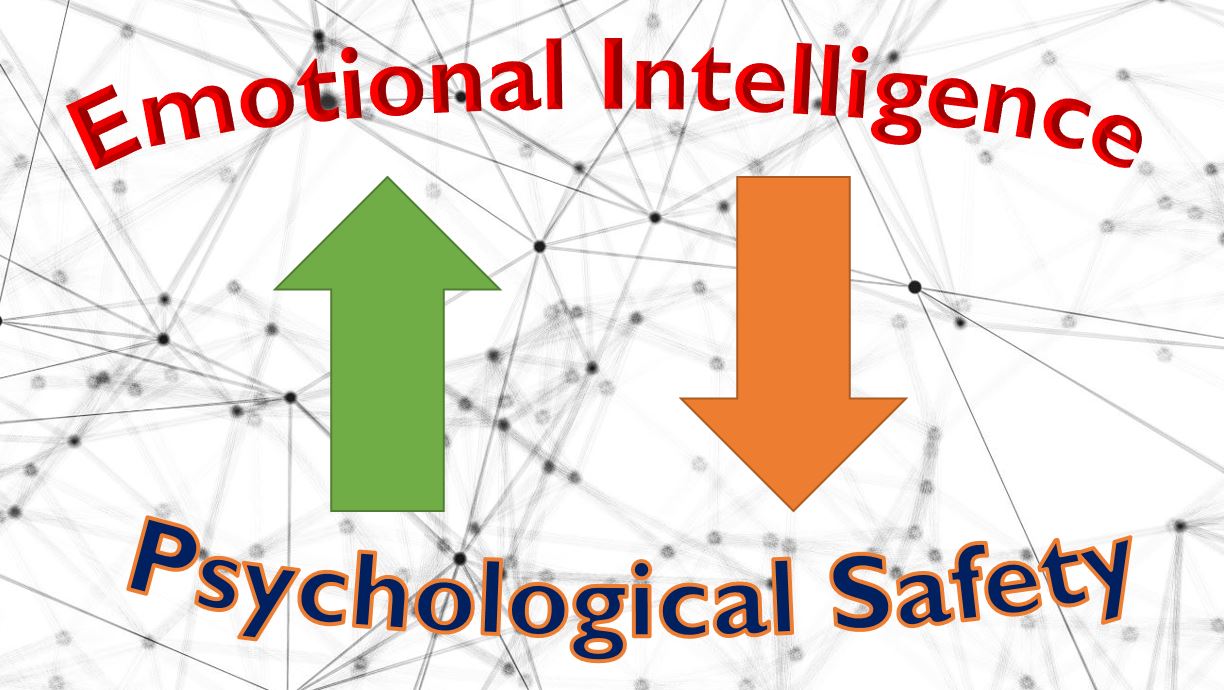 Following a presentation I gave this week on how project managers can cultivate psychological safety within their teams, an attendee asked me to what the relationship is between psychological safety and emotional intelligence (EI). After answering her I felt it was worth writing about it.
EI is normally considered to be a personal trait although it is possible to claim that one group of people has a higher degree of EI than another. Psychological safety is usually defined in the context of a team as it wouldn't make sense to assess the level of psychological safety of an individual unless they are suffering from multiple split personalities! It would be difficult to assess psychological safety for an overall organization as companies are normally composed of multiple overlapping teams. However, it is possible to assess if the executive team is committed to building a team culture of high psychological safety within the divisions which they lead.
One model for EI uses the following four attributes: self-management, self-awareness, social awareness & relationship management.
How do these traits help a team to become psychologically safe?
Team members who are effective at self-managing and are self-aware will be better equipped to handle actions, comments or behaviors from their team members which they take exception to. They know what their own strengths are but they also understand their weaknesses which means that they are more likely to say when they don't know something, are making an assumption or need assistance from someone else on the team. They have self-confidence which means they are comfortable with experimenting and not feeling that a failed experiment reflects poorly on their abilities.
Social awareness and relationship management relate to how much empathy we demonstrate towards others and to our ability to work well in a team as both a contributor and a leader. Having higher levels of these characteristics means that individuals will be better at picking up on the discomfort of their peers and can help those who are silent to find a voice. It also means that they will be more effective at resolving conflicts which could mean interceding on behalf of a team member if they are being persecuted.
So it seems like a reasonable assumption that on those teams where the members exhibit higher levels of emotional intelligence they are likely to become psychologically safe quicker than others.
But is there an inverse relationship as well?
It is difficult to effectively improve one's emotional intelligence without receiving coaching and support from those whose feedback we trust. In psychologically safe teams, team members feel safer providing feedback with radical candor to their peers. As such, I'd assert that psychological safety can act as an accelerator for increasing the overall emotional intelligence of the members of a team.
A rising tide lifts all boats!
Posted on: August 30, 2020 07:00 AM |
Permalink
Comments (13)
Please login or join to subscribe to this item

Rami Kaibni
 Community Champion
Senior Projects Manager | Field & Marten Associates
New Westminster, British Columbia, Canada
Great insights and points Kiron. Couldn’t agree more with you.

Michael Hilbert
Director of Project Management| TuWay Communications
Bethlehem, Pa, United States
Kiron.. Well said and explained. One must know himself to be a better leader and team member to others. Each attribute plays off the other (EI to PS and PS to EI) Thanks for sharing.
Thanks for the kind feedback, Michael!
Thank you for the insight, Kiron.
You touched a point on the fact that psychological safety can accelerate Emotional Intelligence; an observation I have been observing with colleagues with high Emotional Quotient.

Ashleigh Kennett-Smith
ICT Project Manager| Australian Red Cross Lifeblood
Adelaide, South Australia, Australia
Great article Kiron. I had not consciously made this link previously.
Being able to acknowledge weaknesses publicly (even if only one other person) is a building block to greater EI. It is also a prerequisite to optimising learning and growing generally. But, you need need psychological safety to be able to do this.
So treating people with respect generally leads to the best outcomes for everyone?
Absolutely Ashleigh - regardless of what we might think about them, treating people with fairness and respect are a good way to create positive change within a team.
Thanks for sharing, very interesting.

Kwiyuh Michael Wepngong
Community Champion
Financial Management Specialist | US Peace Corps
Yaounde, Centre, Cameroon
Wow, merci beaucoup Kiron....
Quite an insightful write-up
Very interesting, thanks for sharing !
Deeply insightful and accurately expressed Kiron. A failure at self-management is an indication of failure at people and and team management. Frankly, from every practical approach, a high emotional intelligence should result in a sense of psychological safety within the team that distinguishes itself as possessing such high level of EI. Such feeling of safety in turn further boosts EI within the team. When this team symbiosis is sustained over time, EI and psychological safety may become a team's culture; and how pleasantly transformational and performance boosting that would make the work environment become!
Please Login/Register to leave a comment.
|
"The secret of life is honesty and fair dealing. If you can fake that, you've got it made."
- Groucho Marx
|





