Are Organization Charts Still Useful?
From the Voices on Project Management Blog
by Cameron McGaughy,
Lynda Bourne, Kevin Korterud, Conrado Morlan, Peter Tarhanidis, Mario Trentim, Jen Skrabak, David Wakeman, Wanda Curlee, Christian Bisson, Ramiro Rodrigues, Soma Bhattacharya, Emily Luijbregts, Sree Rao, Yasmina Khelifi, Marat Oyvetsky, Lenka Pincot, Jorge Martin Valdes Garciatorres, cyndee miller

Voices on Project Management offers insights, tips, advice and personal stories from project managers in different regions and industries. The goal is to get you thinking, and spark a discussion. So, if you read something that you agree with--or even disagree with--leave a comment.
View Posts By:
Cameron McGaughy
Lynda Bourne
Kevin Korterud
Conrado Morlan
Peter Tarhanidis
Mario Trentim
Jen Skrabak
David Wakeman
Wanda Curlee
Christian Bisson
Ramiro Rodrigues
Soma Bhattacharya
Emily Luijbregts
Sree Rao
Yasmina Khelifi
Marat Oyvetsky
Lenka Pincot
Jorge Martin Valdes Garciatorres
cyndee miller
Past Contributors:
Rex Holmlin
Vivek Prakash
Dan Goldfischer
Linda Agyapong
Jim De Piante
Siti Hajar Abdul Hamid
Bernadine Douglas
Michael Hatfield
Deanna Landers
Kelley Hunsberger
Taralyn Frasqueri-Molina
Alfonso Bucero Torres
Marian Haus
Shobhna Raghupathy
Peter Taylor
Joanna Newman
Saira Karim
Jess Tayel
Lung-Hung Chou
Rebecca Braglio
Roberto Toledo
Geoff Mattie
Recent Posts
Project 2030: Skills We Need to Cultivate Now
The Technical Program Manager: How to Stay Relevant in 2025
5 Things Your Operational Plan Should Do
5 New Project Guardrails for Adaptive Leaders
The Leader's Voice: Respect It, Protect It, and Use It Properly!
Categories
2020,
Adult Development,
Agile,
Agile,
Agile,
agile,
Agile management,
Agile management,
Agile;Community;Talent management,
Artificial Intelligence,
Backlog,
Basics,
Benefits Realization,
Best Practices,
BIM,
business acumen,
Business Analysis,
Business Analysis,
Business Case,
Business Intelligence,
Business Transformation,
Calculating Project Value,
Canvas,
Career Development,
Career Development,
Career Help,
Career Help,
Career Help,
Career Help,
Careers,
Careers,
Careers,
Careers,
Categories: Career Help,
Change Management,
Cloud Computing,
Collaboration,
Collaboration,
Collaboration,
Collaboration,
Collaboration,
Communication,
Communication,
Communication,
Communication,
Communications Management,
Complexity,
Conflict,
Conflict Management,
Consulting,
Continuous Learning,
Continuous Learning,
Continuous Learning,
Continuous Learning,
Continuous Learning,
Cost Management,
COVID-19,
Crises,
Crisis Management,
critical success factors,
Cultural Awareness,
Culture,
Decision Making,
Design Thinking,
Digital Project Management,
Digital Transformation,
digital transformation,
Digitalisation,
Disruption,
Diversity,
Diversity,
Documentation,
Earned Value Management,
Education,
EEWH,
Enterprise Risk Management,
Escalation management,
Estimating,
Ethics,
execution,
Expectations Management,
Facilitation,
feasibility studies,
Future,
Future of Project Management,
Generational PM,
Governance,
Government,
green building,
Growth,
Horizontal Development,
Human Aspects of PM,
Human Aspects of PM,
Human Aspects of PM,
Human Aspects of PM,
Human Aspects of PM,
Human Resources,
Inclusion,
Information Technology,
Innovation,
Intelligent Building,
International,
International Development,
Internet of Things (IOT),
Internet of Things (IoT),
IOT,
Knowledge,
Leadership,
Leadership,
Leadership,
Leadership,
Leadership,
lean construction,
LEED,
Lessons Learned,
Lessons learned;Retrospective,
Managing for Stakeholders,
managing stakeholders as clients,
Mentoring,
Mentoring,
Mentoring,
Mentoring,
Mentoring,
Mentorship,
Mentorship,
Methodology,
Metrics,
Micromanagement,
Microsoft Project PPM,
Motivation,
Negotiation,
Neuroscience,
neuroscience,
New Practitioners,
Nontraditional Project Management,
OKR,
Online Learning,
opportunity,
Organizational Culture,
Organizational Project Management,
Pandemic,
People management,
Planing,
planning,
PM & the Economy,
PM History,
PM Think About It,
PMBOK Guide,
PMI,
PMI EMEA 2018,
PMI EMEA Congress 2017,
PMI EMEA Congress 2019,
PMI Global Conference 2017,
PMI Global Conference 2018,
PMI Global Conference 2019,
PMI Global Congress 2010 - North America,
PMI Global Congress 2011 - EMEA,
PMI Global Congress 2011 - North America,
PMI Global Congress 2012 - EMEA,
PMI Global Congress 2012 - North America,
PMI Global Congress 2013 - EMEA,
PMI Global Congress 2013 - North America,
PMI Global Congress 2014 - EMEA,
PMI Global Congress 2014 - North America,
PMI GLobal Congress EMEA 2018,
PMI PMO Symposium 2012,
PMI PMO Symposium 2013,
PMI PMO Symposium 2015,
PMI PMO Symposium 2016,
PMI PMO Symposium 2017,
PMI PMO Symposium 2018,
PMI Pulse of the Profession,
PMO,
PMO,
pmo,
PMO Project Management Office,
portfolio,
Portfolio Management,
Portfolio Management,
portfolio management,
presentations,
Priorities,
Probability,
Problem Structuring Methods,
Process,
Procurement Management,
profess,
Program Management,
project,
Project Delivery,
Project Dependencies,
Project Failure,
project failure,
Project Leadership,
Project Management,
project management,
project management office,
Project Planning,
project planning,
Project Requirements,
Project Success,
Ransomware,
Reflections on the PM Life,
Remote,
Remote Work,
Requirements Management,
Research Conference 2010,
Researching the Value of Project Management,
Resiliency,
Risk Management,
Risk Management,
Risk management,
risk management,
ROI,
Roundtable,
Salary Survey,
Schedule Management,
Scheduling,
Scope Management,
Scrum,
search,
SelfLeadership,
SelfLeadership,
SelfLeadership,
SelfLeadership,
SelfLeadership,
Servant Leadership,
Sharing Knowledge,
Sharing Knowledge,
Sharing Knowledge,
Sharing Knowledge,
Sharing Knowledge,
Social Responsibility,
Sponsorship,
Stakeholder Management,
Stakeholder Management,
stakeholder management,
Strategy,
Strategy,
swot,
Talent Management,
Talent Management,
Talent Management,
Talent Management,
Talent Management,
Talent Management Leadership SelfLeadership Collaboration Communication,
Taskforce,
Teams,
Teams in Agile,
Teams in Agile,
teamwork,
Tech,
Technical Debt,
Technology,
TED Talks,
The Project Economy,
Timeline,
Tools,
tools,
Transformation,
transformation,
Transition,
Trust,
Value,
Vertical Development,
Volunteering,
Volunteering #Leadership #SelfLeadership,
Volunteering Sharing Knowledge Leadership SelfLeadership Collaboration Trust,
VUCA,
Women in PM,
Women in Project Management
Date
By: Lynda Bourne.
Has agile killed the organization chart? The concept of business management evolved with the development of factories during the early days of the Industrial Revolution. Initially, factories followed the same system as pre-industrialized enterprises where the “Lord of the Manor”/owner made all of the significant decisions and told others what to do. But this straightforward command-and-control process was limited by the capacity of the owner to stay on top of the flow of information and decisions needed.
As organizations grew larger and more complex, the delegation of authority became necessary—but initially appears to have been very ad hoc and dependent on personalities. But as the concept of an organization evolved in the 19th century, management structures became more formalized—and one of the early tools used to demonstrate the management hierarchy, and the division of labor, was an organization chart. The example below is from 1917:
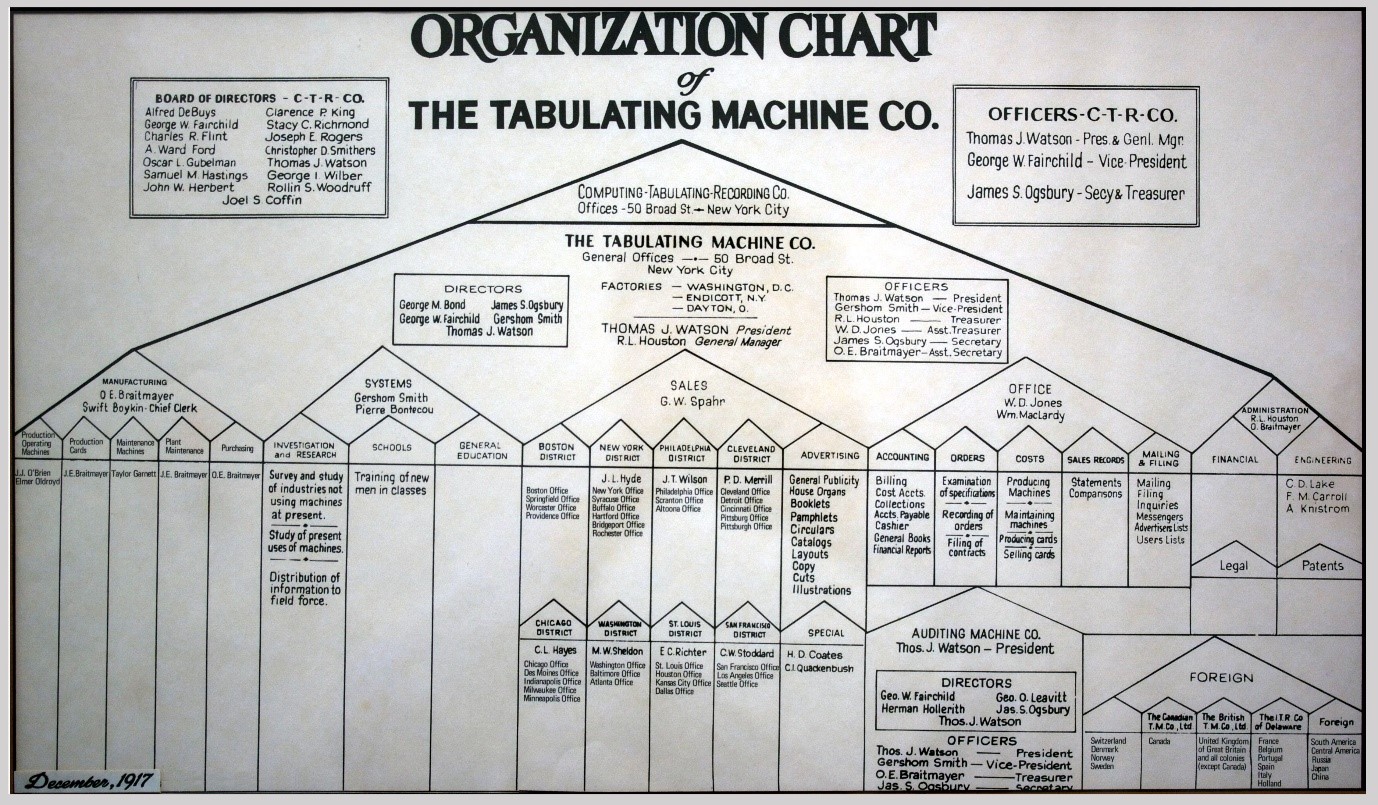
This view of an organization give rise to concepts such as departmentalization, chain of command, span of control, centralization, work specialization and formalization. The business appears well organized (at least on paper), but is not very adaptive.
Traditional project management grew out of business management, and uses the organization breakdown structure (OBS) linked to the work breakdown structure (WBS) to define the person responsible for each element of the work. The OBS fulfils the same function as an organization chart in general business, defining the management hierarchy and reporting lines within the project or program.
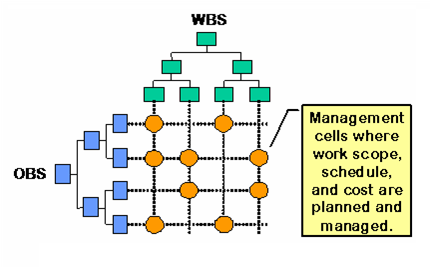
But is this type of thinking useful in today’s flexible working environment? In one respect, knowing who is going to be responsible for delivering each element of the project and ensuring their work integrates with the other parts of the project is important, as is the need to balance the delegated levels of authority and responsibility with the capability of the assigned person.
The OBS is also useful for informing the people doing work who they need to keep informed of progress, issues and the completion of the task. These concepts are central to the way earned value management is designed with the management cells above becoming control accounts.
But does the effective management of human resources need a hierarchy, or can distributed responsibility work as effectively and more dynamically? There are many success stories built around self-organizing teams, cross-functional teams, and agile ways of working. And in business, matrix structures are probably more common than the hierarchic structure depicted by an organization chart.
The organization chart has been around for a very long time, but does the type of structure and management theories built around the concept of a management hierarchy really help at the project and program level when confronted with “alien” concepts such as self-organizing teams and agile? The two questions posed for discussion are:
- Do you think the OBS is useful, and is something similar used in your project or organization?
- What options are available—or need inventing—to replace the OBS in an agile, self-organizing workplace?
Posted
by
Lynda Bourne
on: July 27, 2021 11:34 PM |
Permalink
Comments (7)
Please login or join to subscribe to this item

Kwiyuh Michael Wepngong
 Community Champion
Financial Management Specialist | US Peace Corps
Yaounde, Centre, Cameroon
Thanks for this, great reflection

Luis Branco
CEO| Business Insight, Consultores de Gestão, Ldª
Carcavelos, Lisboa, Portugal
Dear Lynda
The theme that brought to our reflection and debate is very interesting.
Thank you for sharing, framing and asking questions.
One of the most interesting books I've read on the topic was "Reinventing Organizations: A Guide to Creating Organizations Inspired by the Next Stage of Human Consciousness" by Frederic Laloux
We found the answers to your questions.

Lynda Bourne
Director, Professional Development| Mosaic Project Services Pty Ltd
South Melbourne, Vic, Australia
Thanks Luis - I will add to my reading list :-)
Luis Branco
CEO| Business Insight, Consultores de Gestão, Ldª
Carcavelos, Lisboa, Portugal
Dear Lynda
I also had the opportunity to watch some videos about another approach to changing the structure of organizations: Holacracy - A Radical New Approach to Management - Brian Robertson
https://youtu.be/tJxfJGo-vkI
Thanks Luis for your comments And sharing useful material to think about this interesting topic. Reading how millenials are moving the concept of structured Organization, i feel / Think my Organization is having exactly the same question on how having a better collaboration within dpts.
Please Login/Register to leave a comment.
|
"I'm glad I did it, partly because it was worth it, but mostly because I shall never have to do it again."
- Mark Twain
|






