How Are You Finding Information?
From the Voices on Project Management Blog
by Cameron McGaughy,
Lynda Bourne, Kevin Korterud, Conrado Morlan, Peter Tarhanidis, Mario Trentim, Jen Skrabak, David Wakeman, Wanda Curlee, Christian Bisson, Ramiro Rodrigues, Soma Bhattacharya, Emily Luijbregts, Sree Rao, Yasmina Khelifi, Marat Oyvetsky, Lenka Pincot, Jorge Martin Valdes Garciatorres, cyndee miller

Voices on Project Management offers insights, tips, advice and personal stories from project managers in different regions and industries. The goal is to get you thinking, and spark a discussion. So, if you read something that you agree with--or even disagree with--leave a comment.
View Posts By:
Cameron McGaughy
Lynda Bourne
Kevin Korterud
Conrado Morlan
Peter Tarhanidis
Mario Trentim
Jen Skrabak
David Wakeman
Wanda Curlee
Christian Bisson
Ramiro Rodrigues
Soma Bhattacharya
Emily Luijbregts
Sree Rao
Yasmina Khelifi
Marat Oyvetsky
Lenka Pincot
Jorge Martin Valdes Garciatorres
cyndee miller
Past Contributors:
Rex Holmlin
Vivek Prakash
Dan Goldfischer
Linda Agyapong
Jim De Piante
Siti Hajar Abdul Hamid
Bernadine Douglas
Michael Hatfield
Deanna Landers
Kelley Hunsberger
Taralyn Frasqueri-Molina
Alfonso Bucero Torres
Marian Haus
Shobhna Raghupathy
Peter Taylor
Joanna Newman
Saira Karim
Jess Tayel
Lung-Hung Chou
Rebecca Braglio
Roberto Toledo
Geoff Mattie
Recent Posts
Project 2030: Skills We Need to Cultivate Now
The Technical Program Manager: How to Stay Relevant in 2025
5 Things Your Operational Plan Should Do
5 New Project Guardrails for Adaptive Leaders
The Leader's Voice: Respect It, Protect It, and Use It Properly!
Categories
2020,
Adult Development,
Agile,
Agile,
Agile,
agile,
Agile management,
Agile management,
Agile;Community;Talent management,
Artificial Intelligence,
Backlog,
Basics,
Benefits Realization,
Best Practices,
BIM,
business acumen,
Business Analysis,
Business Analysis,
Business Case,
Business Intelligence,
Business Transformation,
Calculating Project Value,
Canvas,
Career Development,
Career Development,
Career Help,
Career Help,
Career Help,
Career Help,
Careers,
Careers,
Careers,
Careers,
Categories: Career Help,
Change Management,
Cloud Computing,
Collaboration,
Collaboration,
Collaboration,
Collaboration,
Collaboration,
Communication,
Communication,
Communication,
Communication,
Communications Management,
Complexity,
Conflict,
Conflict Management,
Consulting,
Continuous Learning,
Continuous Learning,
Continuous Learning,
Continuous Learning,
Continuous Learning,
Cost Management,
COVID-19,
Crises,
Crisis Management,
critical success factors,
Cultural Awareness,
Culture,
Decision Making,
Design Thinking,
Digital Project Management,
Digital Transformation,
digital transformation,
Digitalisation,
Disruption,
Diversity,
Diversity,
Documentation,
Earned Value Management,
Education,
EEWH,
Enterprise Risk Management,
Escalation management,
Estimating,
Ethics,
execution,
Expectations Management,
Facilitation,
feasibility studies,
Future,
Future of Project Management,
Generational PM,
Governance,
Government,
green building,
Growth,
Horizontal Development,
Human Aspects of PM,
Human Aspects of PM,
Human Aspects of PM,
Human Aspects of PM,
Human Aspects of PM,
Human Resources,
Inclusion,
Information Technology,
Innovation,
Intelligent Building,
International,
International Development,
Internet of Things (IOT),
Internet of Things (IoT),
IOT,
Knowledge,
Leadership,
Leadership,
Leadership,
Leadership,
Leadership,
lean construction,
LEED,
Lessons Learned,
Lessons learned;Retrospective,
Managing for Stakeholders,
managing stakeholders as clients,
Mentoring,
Mentoring,
Mentoring,
Mentoring,
Mentoring,
Mentorship,
Mentorship,
Methodology,
Metrics,
Micromanagement,
Microsoft Project PPM,
Motivation,
Negotiation,
Neuroscience,
neuroscience,
New Practitioners,
Nontraditional Project Management,
OKR,
Online Learning,
opportunity,
Organizational Culture,
Organizational Project Management,
Pandemic,
People management,
Planing,
planning,
PM & the Economy,
PM History,
PM Think About It,
PMBOK Guide,
PMI,
PMI EMEA 2018,
PMI EMEA Congress 2017,
PMI EMEA Congress 2019,
PMI Global Conference 2017,
PMI Global Conference 2018,
PMI Global Conference 2019,
PMI Global Congress 2010 - North America,
PMI Global Congress 2011 - EMEA,
PMI Global Congress 2011 - North America,
PMI Global Congress 2012 - EMEA,
PMI Global Congress 2012 - North America,
PMI Global Congress 2013 - EMEA,
PMI Global Congress 2013 - North America,
PMI Global Congress 2014 - EMEA,
PMI Global Congress 2014 - North America,
PMI GLobal Congress EMEA 2018,
PMI PMO Symposium 2012,
PMI PMO Symposium 2013,
PMI PMO Symposium 2015,
PMI PMO Symposium 2016,
PMI PMO Symposium 2017,
PMI PMO Symposium 2018,
PMI Pulse of the Profession,
PMO,
PMO,
pmo,
PMO Project Management Office,
portfolio,
Portfolio Management,
Portfolio Management,
portfolio management,
presentations,
Priorities,
Probability,
Problem Structuring Methods,
Process,
Procurement Management,
profess,
Program Management,
project,
Project Delivery,
Project Dependencies,
Project Failure,
project failure,
Project Leadership,
Project Management,
project management,
project management office,
Project Planning,
project planning,
Project Requirements,
Project Success,
Ransomware,
Reflections on the PM Life,
Remote,
Remote Work,
Requirements Management,
Research Conference 2010,
Researching the Value of Project Management,
Resiliency,
Risk Management,
Risk Management,
Risk management,
risk management,
ROI,
Roundtable,
Salary Survey,
Schedule Management,
Scheduling,
Scope Management,
Scrum,
search,
SelfLeadership,
SelfLeadership,
SelfLeadership,
SelfLeadership,
SelfLeadership,
Servant Leadership,
Sharing Knowledge,
Sharing Knowledge,
Sharing Knowledge,
Sharing Knowledge,
Sharing Knowledge,
Social Responsibility,
Sponsorship,
Stakeholder Management,
Stakeholder Management,
stakeholder management,
Strategy,
Strategy,
swot,
Talent Management,
Talent Management,
Talent Management,
Talent Management,
Talent Management,
Talent Management Leadership SelfLeadership Collaboration Communication,
Taskforce,
Teams,
Teams in Agile,
Teams in Agile,
teamwork,
Tech,
Technical Debt,
Technology,
TED Talks,
The Project Economy,
Timeline,
Tools,
tools,
Transformation,
transformation,
Transition,
Trust,
Value,
Vertical Development,
Volunteering,
Volunteering #Leadership #SelfLeadership,
Volunteering Sharing Knowledge Leadership SelfLeadership Collaboration Trust,
VUCA,
Women in PM,
Women in Project Management
Date

By: Lynda Bourne
We now live in an age where Google search is ubiquitous, and the “find” function in Word and PDF documents is almost instantaneous. The challenge for most people is sorting through the long lists of information returned from a search to locate the most useful items. This was not always the case. As Dennis Duncan—a British writer, translator and lecturer—set out in his book Index, A History of the: A Bookish Adventure, the need for indexing first emerged in the 13th century and has been evolving ever since.
There are basically two indexing systems. The simplest is a listing of the important words that occur in a reference book, identifying the pages or sections in which the word is used. The more complex system is built around topics and identifies the section of a book in which the topic is discussed, often indexing multiple publications. Both systems were developed around the year 1230, and marks the change from a time when books were a valued artifact to be read and enjoyed, to one where books became an information repository to be used as a resource. The invention of the printing press would not occur for another 200 years (1440), so in 1230 books were an incredibly valuable resource in limited supply.
The word “index” was invented in Paris by a Dominican Abbot named Hugh of Saint-Cher. The Dominicans are a preaching or mendicant religious order, founded in 1216. Their calling was to have Friars live among the people in big cities and preach sermons to stop the flock from going astray.
To help his Friars write their sermons, Saint-Cher instructed a group at the Dominican Friary of Saint-Jacques to create a word index, or a concordance, of the Bible. Every single word in the Bible was put in alphabetical order with a locator indicating where that word appears. The friars listed about 10,000 individual words and 129,000 locations. As a consequence of this work (that still exists), the preaching Friars writing new sermons were able to find the information they needed reliably and consistently.
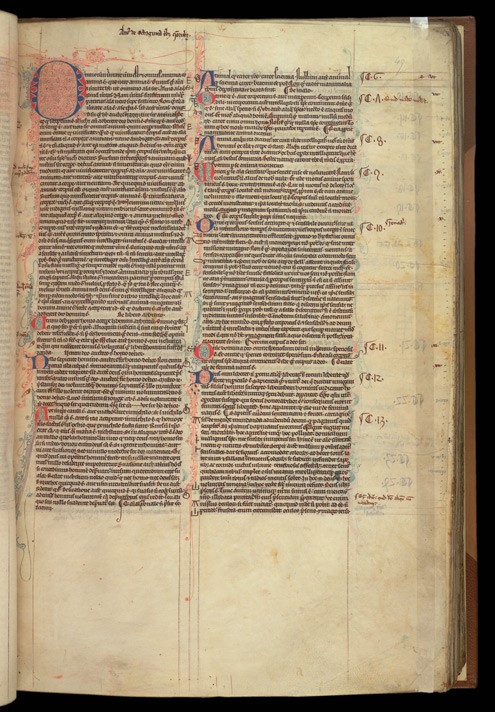 A parallel driver for indexing was the creation of universities, with Oxford being one of the earliest. Robert Grosseteste, a medieval English scholastic philosopher, taught at Oxford until his appointment as Bishop of Lincoln in 1235. Grosseteste read widely, and to help locate materials for his lectures, invented an indexing system based on symbols made up of curved and straight lines, circles, E-shapes, etc., which were added as annotations in each of his books. Different symbols represented different subjects, and in a separate general index he kept a record of where they were located. The result was a kind of parchment Google—once he's read and annotated a book, he knew where information on a subject was for future reference. This type of index is still called a general index.
In the 13th century, very few people could read, and books were scarce, making the oral delivery of information vital either as a lecture or a sermon. But delivering a lecture (or sermon), required information to be sourced, organized, synthesised and written down in preparation for the delivery. This means the presenter needed to use books—not just read books, but to be able to go back and use the contents of books as an information resource.
Engaging with a book transitioned from being a linear process where the reader had all the time in the world to journey from end to end, to one where books became seen as storehouses of morsels of information. The invention of indexes allowed people to use and research their books more efficiently, enabling them to preach or lecture at short notice.
800 years later, these concepts are still evolving. Unfortunately, the traditional concept of indexing is rapidly disappearing. The fundamental requirement for an index is a page number, and e-books don’t have set pages; the page a word appears on changes depending on the font size and screen size selected by the reader. This is a pity; creating a good index is both an art and a craft, requiring interpretation and judgement to look at each passage and decide what words a person would use to look for that specific text.
On the other hand, Robert Grosseteste’s concept of the general (or subject) index has moved from the world of academia to mainstream. Google indexes millions of pages of new information every day. Both Google and the various feeds to your PDA index then select what you see based on the topics you are interested in, filtered by the application of a liberal dose of artificial intelligence (AI).
The challenge for everyone in the modern era is being able to filter and validate the thousands of returns from a typical Google search and to make sure their feeds are not too limited. The various systems will order the information you see in a way its AI systems calculate will give you the best experience. But best from the system’s perspective is that you like the result and will therefore use it again. This is not the same as offering the most accurate selection of information, particularly if there are contradictory viewpoints.
How reliable do you find the search engines and indexes you use to find information?
Posted
by
Lynda Bourne
on: February 09, 2022 06:52 PM |
Permalink
Comments (6)
Please login or join to subscribe to this item

Luis Branco
CEO| Business Insight, Consultores de Gestão, Ldª
Carcavelos, Lisboa, Portugal
Dear Lynda
The topic that you brought to our reflection and debate was very interesting.
Thanks for sharing and for the little story about indexing systems
I can easily search for information on google (words, authors, concepts sometimes isolated and sometimes associated)
I like the search system of the pdf's and the texts in word

Lynda Bourne
Director, Professional Development| Mosaic Project Services Pty Ltd
South Melbourne, Vic, Australia
The things we take for granted today were impossible only a few years ago, Google started in 1998, PDF only became an open standard in 2008.
Luis Branco
CEO| Business Insight, Consultores de Gestão, Ldª
Carcavelos, Lisboa, Portugal
Dear Lynda
It's a great truth what you wrote
Humanity sometimes advances... at other times only apparently it happens... and at other times it goes backwards.
From an early age I gained reading habits and learned to appreciate books.
I usually resorted to indexes, but whenever I had the opportunity to read something relevant in a book, I wrote it down (putting the source)
I have several notebooks (organized by themes) where I can consult this information
Interestingly, as I consult similar information on google, (if there is compliance) I delete some of my physical files from the notebooks

Stephen Robin
Project Analyst Trainee| Ministry of Works and Transport
Arima, Ari, Trinidad and Tobago
Thanks for sharing. Extremely informative.

Khaled Ktecha
PM I| Darwish Engineering Emirates L.L.C
Dubai, Dubai, United Arab Emirates
Thanks for sharing the interesting article about finding information.

Corey Tatum
Bumlife2Bomblife Management| PeepDaSlan9
Las Vegas, Nv, United States
Great read, very informative
Please Login/Register to leave a comment.




