
 Posted on: December 05, 2022 09:08 PM
|
Posted on: December 05, 2022 09:08 PM
| 


Guessing is not a strategy: How to build decision velocity with AI and real-time data
June 10, 2026 | Live Webinar

Workplace Gym Memberships or Leadership Bootcamps?
Project Managment in the Education Industry
Project Management a Critical Aspect of Successful Business Operations
Active listening, autonomy, Business Operations, change, Empathy, feedback, Great Regression, health, Healthcare, help, improvement, Innovation, Leadership, mental health awareness, motivation, performance, Project Management in Education, remote work, self-awareness, self-care, self-leadership, self-love, stress, Suicide prevention, team, Teams, trust


| Workplace Gym Memberships or Leadership Bootcamps? Healthy Workplace It is going to take much more than free gym memberships to keep your workplace healthy. Work evolved into a wonderful set of goals we achieved rather than a place we go to for 10 plus hours a day with the advent of remote working. The trend was catching steam and exploded during The Covid Pandemic 2020. Now, we are backsliding. Work is feeling the great regression or devolution of the workplace. It may be more accurate to describe this as the devolution of leadership. Many leaders have reverted back to ineffective, outdated leadership practices. Micromanagement is becoming common with controlling, punitive, and manipulative leadership behaviors being observed. behaviors. Continuous employee monitoring is leading to a Panopticon Effect where employees feel like leadership is waiting for them to mess up. This damages motivation and morale further escalating the issue. Workplace Bullying Workplace bullying is also on the rise. I am not sure how it gets this far, but it does. When adults turn into common playground thugs when our jobs are on the line, the physical effects are devastating. Workplace bullying has been increasingly recognized in occupational health literature as a significant public health concern with both psychological and physiological consequences. Recent research demonstrates that chronic exposure to bullying behaviors in the workplace is associated with severe long-term health outcomes, particularly cardiovascular disorders and trauma-related psychological conditions. Physical Consequences One major physical consequence linked to workplace bullying is cardiovascular dysfunction, including hypertension and stress-related heart disease. Prolonged exposure to hostile workplace environments activates the body’s stress-response systems, particularly the hypothalamic–pituitary–adrenal (HPA) axis, resulting in elevated cortisol levels, chronic inflammation, and sustained increases in blood pressure. Walker (2025) explained that repeated exposure to bullying and psychological intimidation contributes to cardiometabolic strain and increased risk for cardiovascular complications. The review further identified workplace bullying as an occupational health hazard associated with absenteeism, burnout, and long-term physiological deterioration. PTSD A second serious consequence of workplace bullying is the development of post-traumatic stress disorder (PTSD) symptoms and complex psychological trauma. Contemporary research increasingly characterizes workplace bullying not as a minor interpersonal conflict, but as a form of chronic relational trauma capable of disrupting an individual’s psychological safety and cognitive stability. Symptoms frequently include hypervigilance, avoidance behaviors, emotional exhaustion, intrusive thoughts, self-doubt, and impaired interpersonal trust. Minibas-Poussard (2025) conceptualized workplace bullying as existential and relational trauma, emphasizing that repeated exposure to toxic workplace interactions can shatter an individual’s assumptions about safety, identity, and meaning. The study connected prolonged bullying exposure to trauma-related outcomes like PTSD and severe burnout syndromes. Mental Health Problems Earlier longitudinal research also supports these findings. Nielsen et al. (2014) found significant associations between workplace bullying and subsequent mental health problems, as well as somatic symptoms over time, reinforcing evidence that bullying exposure contributes to lasting psychological and physical harm. I have always been an advocate of self-leadership for knowledge workers. Autonomy breeds innovation, motivation, and engagement. True autonomy Is achieved through self-leadership. As the SME, you are your own leadership. You seek continuous improvement over time while achieving your best work outcomes. Gym memberships will not keep your workplace healthy, however, long intensive boot camps for leadership may. References Minibas-Poussard, J. (2025). From suffering to growth: A conceptual review of workplace bullying through a logotherapeutic lens with organizational implications. Social Sciences, 14(11), 669. https://doi.org/10.3390/socsci14110669 Nielsen, M. B., & Einarsen, S. (2014). Workplace bullying and subsequent health problems. Tidsskrift for Den norske legeforening, 134(12/13), 1233–1238. https://doi.org/10.4045/tidsskr.13.0880 Walker, J. (2025). Trauma, power, and psychological safety: Understanding the mental health impact of workplace bullying. Healthcare, 13(23), 3084. https://doi.org/10.3390/healthcare13233084 |
| Work Should Not Hurt To project managers, micromanagement is a dirty word. For all PM frameworks, micromanagement is more than a nuisance; it is a fundamental breakdown of the professional framework. Project management is built upon the pillar of trust, where teams are selected for their expertise and leaders serve as facilitators who remove obstacles to enable strategic execution. We trust that our leaders are crafting a vision, and in return, they trust that we are executing that vision with precision. However, as the workplace has transitioned into a post-pandemic era, this model is facing a systemic challenge. When the social exchange between leader and team shifts from trust to control, the results are no longer just organizational—they can be clinical. “When the social exchange between leader and team shifts from trust to control, the results are no longer just organizational—they can be clinical.” 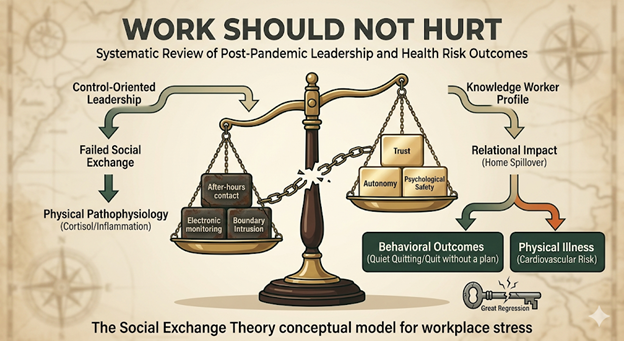 Note: Visual depiction of the Social Exchange Theory represented by a scale comparing cost-benefit to knowledge workers in their current roles. The Erosion of Boundaries During the shift to remote work, productivity did not merely remain stable; it often intensified. Yet, this surge came with a hidden cost. The Microsoft Work Trend Index has documented the emergence of an "infinite workday," characterized by a 16% increase in late-evening meetings and constant weekend connectivity. Nearly half of remote workers reported that the walls between their professional and personal lives had effectively been breached, and they had difficulty maintaining boundaries between work and personal life (The Conference Board, 2023). Employees were often expected to maintain the same level of availability while also absorbing commuting time and in-person requirements. Monitoring tools have expanded. Oversight has intensified. More importantly, the boundary between professional oversight and personal time has become less defined, and leadership is crossing into spaces that were once respected as non-work domains. After-hours communication, continuous availability expectations, and increased involvement in how work is performed represent a shift toward control-oriented leadership. The Rise of Command-and-Control The role of the leader is to enable performance by removing barriers, not by directing every action (Project Management Institute, 2021). Knowledge workers, as described by Peter Drucker, perform best when they are trusted to apply their expertise with autonomy (Drucker, 1999). Leadership behavior has shifted in ways that demand our attention. Reports indicate rising workplace incivility, increased micromanagement, and a decline in institutional trust (Society for Human Resource Management, 2025). Leadership is crossing into personal boundaries. This "Great Regression" represents a retreat to 20th-century "Command-and-Control" models, characterized by:
This tension is best understood through the lens of Social Exchange Theory. This theory posits that social behavior is an exchange process where individuals weigh the potential benefits and risks of relationships (Cropanzano & Mitchell, 2005). In a healthy workplace, an employee exchanges skill and dedication for fair compensation, respect, and autonomy. When a leader provides control instead of trust and intrusion instead of support, the exchange becomes extractive. When the professional relationship costs more in physical and mental health than it provides in benefit, a rational actor must eventually sever the tie to preserve their own resources. The Clinical Cost of Micromanagement The evidence of this imbalance is no longer just anecdotal; it is clinical. Chronic workplace stress and excessive hours are documented risk factors for major health events. The World Health Organization (WHO) and the International Labor Organization (ILO) have linked overwork to hundreds of thousands of deaths annually from stroke and heart disease (WHO, 2021). Furthermore, clinical research suggests that sustained micromanagement and high-strain environments can double a worker’s inflammatory response, significantly increasing the risk of cardiovascular morbidity. The Path Forward For project managers and organizational leaders, the lesson is clear. High-performing teams are not sustained through surveillance, but through psychological safety and autonomy (Project Management Institute, 2021). When leadership behaviors interfere with the rhythm of work and the health of the worker, they damage the very human capital they intend to manage. The research into these integrated systems of workplace change is still in its early phases and will continue to uncover the depth of this impact. However, the current data suggests a simple truth: work should not make you ill. When social exchange no longer holds, and the environment becomes a threat to your well-being, walking away may be the only way to protect yourself and to be good to yourself.
· It disrupts flow. · It signals distrust. · It interferes with execution. · It stifles creativity and innovation. · Destroys trust and autonomy Chronic stress can lead to:
Response to uncertainty: · Increased control. · More monitoring. · More oversight. · Less trust · Boundary intrusion When leadership crosses the line into control, intrusion, and distrust, it doesn’t just affect performance. It affects employee health. |
| Project management, a discipline involving planning, organizing, and executing projects, is becoming essential for student success in today's workforce. Project management is a pivotal skill set in the ever-evolving education and career readiness landscape. It transcends traditional boundaries and asserts its relevance in diverse professional arenas. Examining the benefits of project management skills in education, emphasizing enhanced problem-solving, decision-making, planning, organization, communication, and collaboration has shown promise. Furthermore, educators strategically incorporate project management principles to refine teaching methods, elevating the learning experience. It is essential to pay attention to integrating project management skills in education and their importance in student development and career readiness. A recent study highlights the benefits of project management skills, including enhanced problem-solving, decision-making, and collaborative abilities among students when they participate in project management studies and work through a set of project management cases. Most notable was the improvement in analytical skills, creativity, and communication. It explored the practical application of these skills in education and teaching methods. The findings suggest that incorporating project management principles in education enriches student learning outcomes and equips students with the necessary skills for the modern workforce. Project management is crucial in the evolving education and career readiness landscape, extending far beyond its traditional business and engineering confines. Project management is no longer a craft for the construction industry. It has become essential in HRM and education as well. Its relevance in the educational sphere is gaining prominence, mirroring the demands of a workforce increasingly driven by project-based and team-oriented tasks. The current state of project management within education highlights its significance and value in many disciplines and the need for expanding educational opportunities for learners to explore project management for its value. In response to the industry's evolving demands, the education sector has begun recognizing the value of incorporating project management principles into its programs. This integration aims to bridge the gap between theoretical knowledge and practical application, preparing students not just academically but also for real-world challenges. By embedding project management skills into education, institutions ensure that students are knowledgeable and possess the competencies to apply this knowledge effectively in diverse professional scenarios. Thus improving many of the skills necessary for creating valuable employees. Educational systems worldwide recognize the need to align with the demands of the "Project Economy." This alignment involves integrating project management principles and practices into the curriculum across various levels of education. The objective is to bridge the gap between academic learning and the practical skills required in a project-driven workplace, thus preparing students to thrive in a landscape where project execution is critical to professional success. Servranckx, T., & Vanhoucke, M. (2021). Essential Skills for Data-Driven Project Management: A Classroom Teaching Experiment. Journal of Modern Project Management, 9(1), 122–139. https://doi.org/10.19255/JMPM02609Nosková, M., & Jelínková, E. (2023). Identifying Opportunities to Innovate Project Management Education in the Digital Age. Management: Journal of Contemporary Management Issues, 41–54. https://doi.org/10.30924/mjcmi.28.si.4 |
| Project management is critical to successful business operations, as it helps organizations plan, execute, and control projects effectively. Effective project management can help organizations to achieve their goals and objectives by providing a structured approach to project delivery while minimizing the risk of project failure. In this blog, we will explore some of the fundamental principles of project management and how they can be applied to enhance the success of a project. Project management principles allow organizations to define clear project goals and objectives. Organizations can start by defining the goals and objectives of their current project. This will provide a clear direction for the organizational team and help ensure everyone is working towards the same end goal. The teams can develop a project plan. A project plan should outline the steps and activities required to achieve the organizational goals and objectives. The plan should be detailed and include information on resources, budgets, timelines, and risk management. Roles and responsibilities for all team members can be assigned. Assigning clear roles and responsibilities to each project team member ensures that everyone understands their role and the tasks they need to complete. Teams will manage resources. Effective project management requires careful management of resources, including personnel, technology, and finances. This can be performed at the organizational level and help ensure that an organization operates within budget and that production is on time. Teams will monitor progress and adjust plans as needed. Project management is an ongoing process, and monitoring progress and adjusting plans as needed is essential. Regular progress reports and status updates can help to keep the project and the organization on track and allow for any necessary course corrections. Communicating effectively is valued at any level. Effective communication is critical to the success of a project, a team, and an organization. It is essential to ensure that everyone involved in the project is kept informed and updated. This can help avoid misunderstandings and ensure everyone is working towards the same goal. Project management involves managing risk, and it is essential to identify and assess potential risks and implement measures to minimize their impact. This can help to minimize the risk of project failure. Organizations want success, and failure should be avoided. Risk management can help to mitigate and avoid risks. In conclusion, effective project management can help organizations to achieve their goals and objectives by providing a structured approach to project delivery. By applying the principles of project management, organizations can enhance their overall success and improve the success of their projects, minimize the risk of failure, deliver projects on time, and operate within budget.
|
|
Project management is known as a very stressful job. The success or failure of a project and, inevitably, the happiness of the customer and all stakeholders involved a ride on the shoulders of the project manager. This can be a massive burden to bare. The project manager is accountable for the project's outcome, and many project managers are not comfortable reaching out when they feel that the stress may be too much for them to handle. High-stress levels can harm your health, behavior, attitude, success, and family (Teak, 2015). Of course, not all stress is bad, but if managing a project begins to hurt a project manager's job, health, and life, there is help. Solutions are not the answer.
- Richard M. Nixon |