
Workplace Gym Memberships or Leadership Bootcamps?


| Workplace Gym Memberships or Leadership Bootcamps? Healthy Workplace It is going to take much more than free gym memberships to keep your workplace healthy. Work evolved into a wonderful set of goals we achieved rather than a place we go to for 10 plus hours a day with the advent of remote working. The trend was catching steam and exploded during The Covid Pandemic 2020. Now, we are backsliding. Work is feeling the great regression or devolution of the workplace. It may be more accurate to describe this as the devolution of leadership. Many leaders have reverted back to ineffective, outdated leadership practices. Micromanagement is becoming common with controlling, punitive, and manipulative leadership behaviors being observed. behaviors. Continuous employee monitoring is leading to a Panopticon Effect where employees feel like leadership is waiting for them to mess up. This damages motivation and morale further escalating the issue. Workplace Bullying Workplace bullying is also on the rise. I am not sure how it gets this far, but it does. When adults turn into common playground thugs when our jobs are on the line, the physical effects are devastating. Workplace bullying has been increasingly recognized in occupational health literature as a significant public health concern with both psychological and physiological consequences. Recent research demonstrates that chronic exposure to bullying behaviors in the workplace is associated with severe long-term health outcomes, particularly cardiovascular disorders and trauma-related psychological conditions. Physical Consequences One major physical consequence linked to workplace bullying is cardiovascular dysfunction, including hypertension and stress-related heart disease. Prolonged exposure to hostile workplace environments activates the body’s stress-response systems, particularly the hypothalamic–pituitary–adrenal (HPA) axis, resulting in elevated cortisol levels, chronic inflammation, and sustained increases in blood pressure. Walker (2025) explained that repeated exposure to bullying and psychological intimidation contributes to cardiometabolic strain and increased risk for cardiovascular complications. The review further identified workplace bullying as an occupational health hazard associated with absenteeism, burnout, and long-term physiological deterioration. PTSD A second serious consequence of workplace bullying is the development of post-traumatic stress disorder (PTSD) symptoms and complex psychological trauma. Contemporary research increasingly characterizes workplace bullying not as a minor interpersonal conflict, but as a form of chronic relational trauma capable of disrupting an individual’s psychological safety and cognitive stability. Symptoms frequently include hypervigilance, avoidance behaviors, emotional exhaustion, intrusive thoughts, self-doubt, and impaired interpersonal trust. Minibas-Poussard (2025) conceptualized workplace bullying as existential and relational trauma, emphasizing that repeated exposure to toxic workplace interactions can shatter an individual’s assumptions about safety, identity, and meaning. The study connected prolonged bullying exposure to trauma-related outcomes like PTSD and severe burnout syndromes. Mental Health Problems Earlier longitudinal research also supports these findings. Nielsen et al. (2014) found significant associations between workplace bullying and subsequent mental health problems, as well as somatic symptoms over time, reinforcing evidence that bullying exposure contributes to lasting psychological and physical harm. I have always been an advocate of self-leadership for knowledge workers. Autonomy breeds innovation, motivation, and engagement. True autonomy Is achieved through self-leadership. As the SME, you are your own leadership. You seek continuous improvement over time while achieving your best work outcomes. Gym memberships will not keep your workplace healthy, however, long intensive boot camps for leadership may. References Minibas-Poussard, J. (2025). From suffering to growth: A conceptual review of workplace bullying through a logotherapeutic lens with organizational implications. Social Sciences, 14(11), 669. https://doi.org/10.3390/socsci14110669 Nielsen, M. B., & Einarsen, S. (2014). Workplace bullying and subsequent health problems. Tidsskrift for Den norske legeforening, 134(12/13), 1233–1238. https://doi.org/10.4045/tidsskr.13.0880 Walker, J. (2025). Trauma, power, and psychological safety: Understanding the mental health impact of workplace bullying. Healthcare, 13(23), 3084. https://doi.org/10.3390/healthcare13233084 |
Work Should Not Hurt
| Work Should Not Hurt To project managers, micromanagement is a dirty word. For all PM frameworks, micromanagement is more than a nuisance; it is a fundamental breakdown of the professional framework. Project management is built upon the pillar of trust, where teams are selected for their expertise and leaders serve as facilitators who remove obstacles to enable strategic execution. We trust that our leaders are crafting a vision, and in return, they trust that we are executing that vision with precision. However, as the workplace has transitioned into a post-pandemic era, this model is facing a systemic challenge. When the social exchange between leader and team shifts from trust to control, the results are no longer just organizational—they can be clinical. “When the social exchange between leader and team shifts from trust to control, the results are no longer just organizational—they can be clinical.” 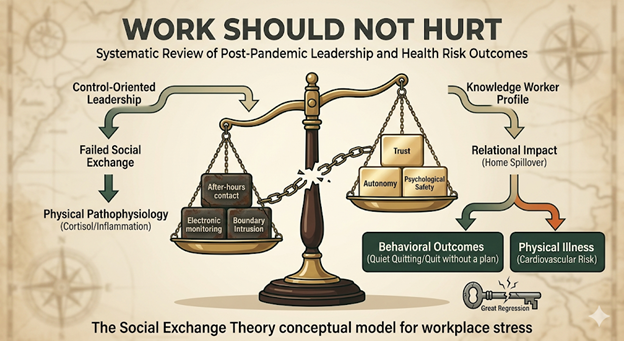 Note: Visual depiction of the Social Exchange Theory represented by a scale comparing cost-benefit to knowledge workers in their current roles. The Erosion of Boundaries During the shift to remote work, productivity did not merely remain stable; it often intensified. Yet, this surge came with a hidden cost. The Microsoft Work Trend Index has documented the emergence of an "infinite workday," characterized by a 16% increase in late-evening meetings and constant weekend connectivity. Nearly half of remote workers reported that the walls between their professional and personal lives had effectively been breached, and they had difficulty maintaining boundaries between work and personal life (The Conference Board, 2023). Employees were often expected to maintain the same level of availability while also absorbing commuting time and in-person requirements. Monitoring tools have expanded. Oversight has intensified. More importantly, the boundary between professional oversight and personal time has become less defined, and leadership is crossing into spaces that were once respected as non-work domains. After-hours communication, continuous availability expectations, and increased involvement in how work is performed represent a shift toward control-oriented leadership. The Rise of Command-and-Control The role of the leader is to enable performance by removing barriers, not by directing every action (Project Management Institute, 2021). Knowledge workers, as described by Peter Drucker, perform best when they are trusted to apply their expertise with autonomy (Drucker, 1999). Leadership behavior has shifted in ways that demand our attention. Reports indicate rising workplace incivility, increased micromanagement, and a decline in institutional trust (Society for Human Resource Management, 2025). Leadership is crossing into personal boundaries. This "Great Regression" represents a retreat to 20th-century "Command-and-Control" models, characterized by:
This tension is best understood through the lens of Social Exchange Theory. This theory posits that social behavior is an exchange process where individuals weigh the potential benefits and risks of relationships (Cropanzano & Mitchell, 2005). In a healthy workplace, an employee exchanges skill and dedication for fair compensation, respect, and autonomy. When a leader provides control instead of trust and intrusion instead of support, the exchange becomes extractive. When the professional relationship costs more in physical and mental health than it provides in benefit, a rational actor must eventually sever the tie to preserve their own resources. The Clinical Cost of Micromanagement The evidence of this imbalance is no longer just anecdotal; it is clinical. Chronic workplace stress and excessive hours are documented risk factors for major health events. The World Health Organization (WHO) and the International Labor Organization (ILO) have linked overwork to hundreds of thousands of deaths annually from stroke and heart disease (WHO, 2021). Furthermore, clinical research suggests that sustained micromanagement and high-strain environments can double a worker’s inflammatory response, significantly increasing the risk of cardiovascular morbidity. The Path Forward For project managers and organizational leaders, the lesson is clear. High-performing teams are not sustained through surveillance, but through psychological safety and autonomy (Project Management Institute, 2021). When leadership behaviors interfere with the rhythm of work and the health of the worker, they damage the very human capital they intend to manage. The research into these integrated systems of workplace change is still in its early phases and will continue to uncover the depth of this impact. However, the current data suggests a simple truth: work should not make you ill. When social exchange no longer holds, and the environment becomes a threat to your well-being, walking away may be the only way to protect yourself and to be good to yourself.
· It disrupts flow. · It signals distrust. · It interferes with execution. · It stifles creativity and innovation. · Destroys trust and autonomy Chronic stress can lead to:
Response to uncertainty: · Increased control. · More monitoring. · More oversight. · Less trust · Boundary intrusion When leadership crosses the line into control, intrusion, and distrust, it doesn’t just affect performance. It affects employee health. |


