
Work Should Not Hurt


| Work Should Not Hurt To project managers, micromanagement is a dirty word. For all PM frameworks, micromanagement is more than a nuisance; it is a fundamental breakdown of the professional framework. Project management is built upon the pillar of trust, where teams are selected for their expertise and leaders serve as facilitators who remove obstacles to enable strategic execution. We trust that our leaders are crafting a vision, and in return, they trust that we are executing that vision with precision. However, as the workplace has transitioned into a post-pandemic era, this model is facing a systemic challenge. When the social exchange between leader and team shifts from trust to control, the results are no longer just organizational—they can be clinical. “When the social exchange between leader and team shifts from trust to control, the results are no longer just organizational—they can be clinical.” 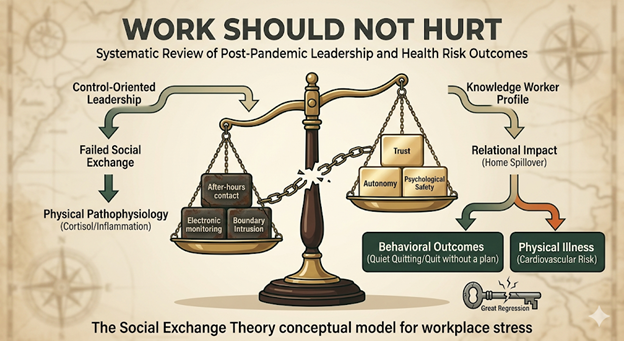 Note: Visual depiction of the Social Exchange Theory represented by a scale comparing cost-benefit to knowledge workers in their current roles. The Erosion of Boundaries During the shift to remote work, productivity did not merely remain stable; it often intensified. Yet, this surge came with a hidden cost. The Microsoft Work Trend Index has documented the emergence of an "infinite workday," characterized by a 16% increase in late-evening meetings and constant weekend connectivity. Nearly half of remote workers reported that the walls between their professional and personal lives had effectively been breached, and they had difficulty maintaining boundaries between work and personal life (The Conference Board, 2023). Employees were often expected to maintain the same level of availability while also absorbing commuting time and in-person requirements. Monitoring tools have expanded. Oversight has intensified. More importantly, the boundary between professional oversight and personal time has become less defined, and leadership is crossing into spaces that were once respected as non-work domains. After-hours communication, continuous availability expectations, and increased involvement in how work is performed represent a shift toward control-oriented leadership. The Rise of Command-and-Control The role of the leader is to enable performance by removing barriers, not by directing every action (Project Management Institute, 2021). Knowledge workers, as described by Peter Drucker, perform best when they are trusted to apply their expertise with autonomy (Drucker, 1999). Leadership behavior has shifted in ways that demand our attention. Reports indicate rising workplace incivility, increased micromanagement, and a decline in institutional trust (Society for Human Resource Management, 2025). Leadership is crossing into personal boundaries. This "Great Regression" represents a retreat to 20th-century "Command-and-Control" models, characterized by:
This tension is best understood through the lens of Social Exchange Theory. This theory posits that social behavior is an exchange process where individuals weigh the potential benefits and risks of relationships (Cropanzano & Mitchell, 2005). In a healthy workplace, an employee exchanges skill and dedication for fair compensation, respect, and autonomy. When a leader provides control instead of trust and intrusion instead of support, the exchange becomes extractive. When the professional relationship costs more in physical and mental health than it provides in benefit, a rational actor must eventually sever the tie to preserve their own resources. The Clinical Cost of Micromanagement The evidence of this imbalance is no longer just anecdotal; it is clinical. Chronic workplace stress and excessive hours are documented risk factors for major health events. The World Health Organization (WHO) and the International Labor Organization (ILO) have linked overwork to hundreds of thousands of deaths annually from stroke and heart disease (WHO, 2021). Furthermore, clinical research suggests that sustained micromanagement and high-strain environments can double a worker’s inflammatory response, significantly increasing the risk of cardiovascular morbidity. The Path Forward For project managers and organizational leaders, the lesson is clear. High-performing teams are not sustained through surveillance, but through psychological safety and autonomy (Project Management Institute, 2021). When leadership behaviors interfere with the rhythm of work and the health of the worker, they damage the very human capital they intend to manage. The research into these integrated systems of workplace change is still in its early phases and will continue to uncover the depth of this impact. However, the current data suggests a simple truth: work should not make you ill. When social exchange no longer holds, and the environment becomes a threat to your well-being, walking away may be the only way to protect yourself and to be good to yourself.
· It disrupts flow. · It signals distrust. · It interferes with execution. · It stifles creativity and innovation. · Destroys trust and autonomy Chronic stress can lead to:
Response to uncertainty: · Increased control. · More monitoring. · More oversight. · Less trust · Boundary intrusion When leadership crosses the line into control, intrusion, and distrust, it doesn’t just affect performance. It affects employee health. |
Who would be best at leading you remotely? : YOU
| Self-leadership Self-leadership is not something to discount in the new remote workspace. Every employee should be encouraged to self-lead. In the remote work environment, it is vital to master self-leadership. If you do not lead, then who will? You are the best at teaching, motivating, and encouraging yourself to complete top-quality work. I love working remotely. I can control the noise level and the temperature. I can play music while I work and choose what to listen to. It saves me time, and it helps conserve my energy making it possible to be more productive. I have often thought about leading those that you cannot see. It isn't easy, so do not do it. Teach remote workers to lead themselves. Show them how to motivate, encourage, and educate themselves. As many of us work from home or other locations, we are not always under the direct supervision of managers, leaders, or mentors. Many workers are hurrying back to the office, and they are very excited to go back to the traditional way of working. However, many workers prefer remote work, and they feel like the arrangement is cheerful and evolving continuously. Recent studies have shown that millennials prefer flexible work relationships, and many will not accept a role that does not allow remote work. The concept of self-management is becoming very important. It is essential to understand its value and to learn techniques to self-manage. While performing my dissertation research on the best leadership style for remote workers to achieve positive work outcomes, I worked with two subject matter experts. One was employed at Bank of America and one from Autommatic. Both SME’s stated that I should not discount self-leadership. For leaders to feel comfortable allowing remote workers to make their own decisions on how they will lead themselves and complete their work, they will need to trust their employees. Trust is necessary for the leader/ follower relationship to be successful. All workers want to be trusted in their work environment, whether at home or in the office. Trust is a basic need for all people. Many remote workers feel that they are not trusted, and many managers think that remote workers cannot be trusted with this much freedom and autonomy. If trust is established, then e-leaders can allow remote workers to self-lead. Self-leadership is the ability to manage oneself without other leaders, e-leaders, managers, or supervisors. Self-leadership includes setting clear personal goals and limits (Hertel et al., 2005). Remote employees must set personal goals and meet them without close supervision (Hertel et al., 2005; Macduffie, 2007; Nurmi, 2011). Leaders can encourage and reward autonomy and self-advocacy, encouraging and leading to self-leadership. E-leaders can help remote workers set goals and limits and allow remote employees to work independently. Autonomy is associated with trust, self-advocacy, and coping skills. The remote worker must possess coping skills, self-advocacy, and the ability to set goals and limits. Autonomy was shown to encourage the ability to self-lead. The correlation may be due to increased trust given by the leader. Therefore, trusting remote employees may promote and increase the capacity to self-lead. Remote workers must work autonomously (Horwitz et al., 2006). “Autonomy from the parent organization led to higher performance” (Hertel et al., 2005, p. 82).“Differing levels of worker autonomy are reflected in the level of trust held by employers” (Clear and Dickson, 2005, p. 227). This may explain why some employees are given more autonomy than other employees. The remote worker must be able to work independently, and e-leaders must encourage autonomy and self-leadership. Researchers found a significant relationship between autonomy, learning, and engagement. Autonomy leads to positive outcomes, including work motivation and job performance (Grant et 95 et al., 2013). Autonomy can lead to the ability to self-advocate and eventually self-lead (Van Kortenhof, 2013). Self-leadership skills are critical for avoiding overloading work situations (Hertel et al., 2005; Nurmi, 2011). Self-leadership skills include setting clear personal goals and limits (Macduffie, 2007). Self-leadership requires that an employee be a self-starter (Hertel et al., 2005), and remote employees must set personal goals and meet them without close supervision (Macduffie, 2007; Nurmi, 2011). Increasing remote workers’ ability to self-lead may alleviate some of the burdens on e-leaders and the remote workers that know to set limits and self-advocate. Employees with good self-leadership skills were better able to cope with strain, possibly due to their ability and willingness to prioritize their workload (Nurmi, 2011). Employees identified the need to develop self-advocacy skills and express their needs to their leaders and other coworkers (Macduffie, 2007; McNaughton et al., 2013; Nurmi, 2011). By prioritizing workloads and self-advocating, self-leadership allows teleworkers to better cope with the strain. Self-leadership increases motivation and discourages procrastination. Relationship-based leadership is most effective when leading remote workers. This includes transformational, empathetic, authentic, and servant leadership. These types of leadership encourage trust. This trust can allow remote workers to thrive and lead themselves when away from the office. Be good to yourself; we are all in this together. Dr. Even |


