Project Management

Project Management 2.0

by
New technologies, concepts, and Web 2.0 tools are popping up everywhere. How can you use them to help your project team collaborate, communicate - or just give your project an extra boost? [Contact Dave]

About this Blog

RSS

Recent Posts

Are You Prepping For The PMP 24/7?

Are You Just Too Darn Busy?

Eliciting Requirements... Creatively!

What To Expect When Your Stakeholders Are Expecting

8 More Templates to Save You Time

Categories

Advice, Certification, Collaboration Tools, Decision Making, Estimating, Interviews, Learning, Management Approaches, New Templates, Personal Productivity, PM Software, PPM Software, Presentation Tools, Reporting Tools, Requirements Management, Research, Risk Management, Scheduling Software, Security, shameless self promotion, Techie Tools, Time Killers, Time Tracking Software, Training, Virtual Team Tools, Web-based Tools, workshops

Date

Gantthead Badges - How To Get Them

linkedin twitter facebook Request to reuse this  

Situation: You could use a pat on the back.

Badges are one of my favorite recent additions to gantthead. At a glance, they help you understand how your peers are contributing to the site. If you look at your profile as your "PM Body of Work", badges offer a fun set of highlights - adding a sort of punctuation to the link-lists of things you've done.

They live on the your profile and and follow you around the site. Every time you make a comment or participate in a discussion, badges tell people a little bit about you.

Since launching badges last week, we've received a lot of questions about how you earn them. So here's a quick list of the launch set of badges and a description of how you can get them. We'll be adding more over time, but these are a great place to start.


Contender

Contender

Create a public profile on gantthead

Showoff

Add 5 areas of PM expertise

Producer

Register a project on gantthead

Loudmouth

Comment on 10 blog postings

Chatterbox

Comment on 40 blog postings

Critic

Write 10 reviews

Pundit

Write 40 reviews

Arbiter

Rate 25 items

Pioneer

Create 5 wiki pages

Watchdog

Edit 10 wiki pages

Promoter

Refer 10 new members

Advocate

Refer 40 new members

Celebrity

Complete a public profile on gantthead

Instigator

Post 10 questions in gantthead discussions

Firestarter

Post 40 questions in gantthead discussions

Know-it-all

Post answers in 10 discussion threads

Smartypants

Post answers in 40 discussion threads

Thinker

Write 10 blog posts

Philosopher

Write 40 blog posts

Networker

Connect with 50 ganttheads

Mover

Connect with 200 ganttheads

Shaker

Connect with 500 ganttheads

SME

Become a Subject Matter Expert

Contributor

Contribute 5 downloads

Brain

Answer 5 PMprep questions correctly

Genius

Answer 20 PMprep questions correctly

Scribe

Get 3 articles published on the site.

Author

Get 15 articles published on the site.

Thought Leader

Get 30 articles published on the site.

Einstein

Answer 100 PMprep questions correctly

Scholar

Successfully complete a gantthead NOD for "PMO Mission, Goals, and Objectives: Business Driven vs. Theory Driven PMOs"

Scholar

Successfully complete a gantthead NOD for "Managing Projects: Think Process not Methodology"

Scholar

Successfully complete a gantthead NOD for "PMO Tools: Establishing an Architecture vs. Implementing a Tool"

Scholar

Successfully complete a gantthead NOD for "Effective Contracting With a Senior Sponsor"

Groupie

Join 5 public GIGs

Socialite

Join 10 public GIGs

Party Animal

Join 30 public GIGs

Posted on: October 05, 2010 08:54 PM | Permalink | Comments (78)

Lazy Project Management

linkedin twitter facebook Request to reuse this  

Situation: You think "there's got to be a better way."

Peter Taylor is the head of a PMO at Siemens Industry Software Limited, a supplier of global product lifecyclemanagement solutions.  He does a lot of speaking and writing on the subject of ‘The Lazy Project Manager .   His elearning modules are available online as are his free podcasts on iTunes  .

So most people would think that being lazy is not something you would want to be known for.  Peter thinks differently.  We recently caught up with to find out why...


Q.  You talk about the Pareto 80/20 rule in the book, but finding that critical 20% is always a trick.  How did you identify the critical parts of PM that are most important?  Do they share common attributes?  Generally speaking, are they the easiest things to do or the hardest?

A:  Answers to each question in series -

  • I tell people to just think back to the previous working day and they will most likely be able to identify two or three things that delivered the most impact or produced the most momentum on their project.
  • We all have ‘to do’ lists and the moment we enter the office we will get distractions through conversations, meeting invitations and so on. But it is important to focus and deal with the most important things first. If you don’t then whilst you may cheerfully clear many other tasks from that ‘to do’ list you will still have the big one left to do and you just won’t feel good about that. Get the big one out of the way and the pressure will be off, progress will have been made, and more than likely you will ride a wave of positive feeling that will see you clear the ‘to do’ list with ease.
  • You asked were these the easiest or the hardest. Well I guess they will be typically nearer the hard end of the spectrum but sometimes procrastination can turn a simple thing in to a hard thing. By just getting on and starting something you realize that it wasn’t so hard at all (sometimes at least).


Q.  You also discuss the way that the leadership potential of Prussian Army officers was judged according to their intelligence and their laziness.  You go into some detail about how laziness and high intelligence in combination makes for good leadership.  Does that mean you believe in born leaders?  Are 3/4 of project managers doomed to be poor or mediocre leaders?

A:  Answers to each question in series -

  • Born leaders? Well yes I guess there are people who somehow naturally take the lead in things without too many concerns or worries and other people tend to follow them happily. That said they are in the small minority. No I think that the majority of project managers, myself included in my early days, combine a lot of activity with a reasonable level of intelligence. But that isn’t the most productive or sustainable way of managing projects in my opinion.
  • 'Progress isn't made by early risers. It's made by lazy men trying to find easier ways to do something.' Is the quote that I use - Robert Heinlein. It is about working smarter and not harder – it is about a decent work/life balance – and it is about giving yourself the chance of keeping control of your project by not being at capacity all of the time.
  • So are all project managers doomed to be less than good project managers? Not at all. We can all learn to be better just as a golfer can learn a new swing to become a greater golfer then project managers can learn what I call The Art of Productive Laziness.


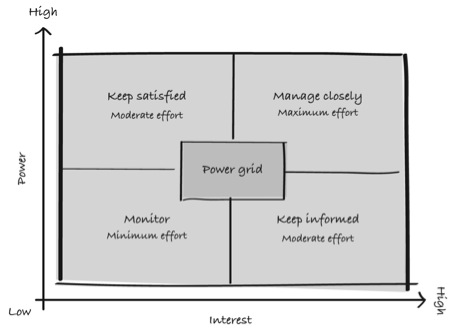
Q.  You use a tool called a power grid to assess a project sponsor.  How does that work?

A:  Well it is all about how to control your greatest asset and potentially your biggest threat. Critical to any projects success is having a good project sponsor, but, like the saying goes ‘you can pick your friends but you can’t pick your relatives’ and the same is true of project sponsors.

So what makes a good project sponsor and how do you deal with the one you have just inherited for your project?

The Project Sponsor is the key stakeholder representative for the project and provides the necessary support for the Project Manager with the primary responsibility of achievement of the project objectives and benefits. An inappropriate choice of Project Sponsor can seriously impact the possibility of success of the project and provide you, the project manager, with an unwanted additional overhead. Now you can’t practically ask a sponsor for their CVand put them through a formal interview process, nice as it would be sometimes to utter the phrase ‘I’m sorry but I just don’t think that this is the job for you right now’. But you should evaluate the sponsor you have and complete, in a subtle way of course, a ‘Strengths and Weaknesses ‘assessment so that you can adapt your project approach and communication methods to maximise their sponsorship support for the project that you now manage.

Tip: At your first meeting with the sponsor don’t ask ‘hard’ project questions but ask ‘softer’ and more open questions: ‘What are your hopes for this project? What are your fears about this project?’ – You will learn a whole lot more.

But let’s not be pessimistic, that isn’t going to happen to you, you won’t get an extreme case of project sponsor and they won’t fail the ‘interview’. So, what is your next move? Well perhaps you should consider the power base that your project sponsor has. Use the power grid to assess your project sponsor, assess their rating of interest in this project from high to low and their actual power in the organisation, also from high to low.


This will give you an indication of the way in which you should work with them. Actually this power grid is for all project stakeholders and if you end up with a project sponsor that is in the ‘low interest’ and ‘low power’ quadrant you really have a problem. It is unlikely that this sponsor is ever going to support your management endeavours.


Q.  What's the single most important take away from the book?

A:  Well people tell me they love the stories at the end of each chapter as they show real situations where I pretty much got it completely wrong but lived to tell the tale and learn a very good lesson.

But if I was to pick one thing that project managers should do it would be to work on your communication. At least 70% of a project managers time is spent in communicating so if you are going to be productively lazy anywhere do it here. That doesn’t mean communicate badly but communicate more effectively and that can often mean less effort overall.

Oh and ‘be lazy’…

Posted on: August 02, 2010 04:48 PM | Permalink | Comments (16)

Why is it SO Hard to Hire the Right People?

linkedin twitter facebook Request to reuse this  

Situation: You feel like there's something wrong with the way you hire.

Two weeks ago, at the PMI research conference, 

Dr. Joana GeraldiSenior Research Fellow at Cranfield School of Management, International Centre for Programme Management gave a presentation entitled Finding the Right Person for the Job: Rethinking Work-Worker Fit in PPM.  The presentation was based on a research paper she co-authored with Harvey Maylor, Sergio Pellegrinelli and Scot Colquhoun. We recently asked her a few questions about how we can put her findings into action.  The answers to the questions below are her personal opinions, but closely tied to the research findings.   Her perspectives, both here and in the research paper are pretty thought-provoking.


Q. During your presentation you discussed the problems with the way that "fit" is judged. (a worker's fit with a work profile, or work fit to a worker's profile) Could you briefly discuss how that fit is currently  determined and the problems with that approach? 


A. Current most common approaches to achieve fit between work and worker are:

  • Work-oriented (define the work and based on that, define what the worker would need to do, one of the main problems with this one is that it assumes that one can define all activities that are to be undertaken be the employee, what we know is not possible in project/programme context, moreover, the bridge between the specific tasks and competences is missing) 
     
  • Worker-oriented (focus on the worker and then define what would be the job that would fit personal competences. This is interesting, and still much used and powerful, for example, the manager would explore what their employees can do well and make sure he/she explores their talents. The problem here is that it can produce descriptions of competence that are too general or abstract. 
     
  • Worker-Work fit (contingency): here we look at the job characteristics and at people's competence. This is a more elaborated concept, and of much use, the problem is that it takes the job and person as static. 


But in general, all the three approaches are set within a rationalist frame.   In relation to project and program management, a number of implicit assumptions may be called into question: 
 

  • Objectivity: it is possible to define and measure work, worker, fit and performance objectively; 
     
  • Independence of work and worker: there are no mutual influences or dependencies between the work and the worker; 
     
  • Causality and Fit: there is a best fit between work and worker and this will lead to higher performance; 
     
  • Focus on static nature of the relationship work-worker: the fit is measured at a point in time.


Q. Hiring managers and PM practitioners seem to be unaware of these issues.   Why do you think that is? 
 
A. It is difficult to say, but my guess is that the current approaches are more accessible, widely known among HR practitioners. There are plenty of people trained to assess people through these well known competence-based models. This makes life easier. We may also be tempted by the rationality and objectivity that these models promise. 


Q. You talked a bit about a more holistic approach to hiring that doesn't create such a strong separation between the work and the worker. Could you describe this approach? Do you have any tips for someone who would like to put this into practice?  

A.  First the theory: Building on Sandberg (2001) and Partington et al (2005) we look at worker and work as inseparable. An individual's competence cannot be reduced to objective lists of activities, but is constituted by the 
subjective meaning that work takes on for workers in their lived experience of it. Our task is to understand what individual workers conceive of as work and, through the elicitation of examples, how they conceive of it. 

More specifically, Partington proposes four conceptual levels: 
  1. Focus on the delivery of project/programme 
     
  2. Looks also at the impact of the project/programme in the organisation 
     
  3. Preoccupation with high level outcomes of the project/programme 
     
  4. Explores the development of organisational capabilities beyond the project/programme 

That is interesting, but how do you put it into practice? As a first step, Sergio Pellegrinelli and colleagues typically run assessments with project and programme managers and identify which of the four conceptual levels above they fit into. This helps the assessors identify high potential people in their firm and also make sure they are nurtured appropriately. 

The next question though is how to identify which projects or programs require candidates to be at the various conceptual.   One way to map a project or program to a level is to judge it's complexity. One model to measure this complexity is MODeST (Maylor et al, 2008).   This model looks at Mission, Organization, Stakeholders, and Team attributes to help judge complexity.

There is still a need to explore the relationship between complexity and conceptual levels, these could be explored by studies, such as: 
  • A significant number of managers, working on the same project/ program, should be interviewed to allow some assessment of convergence, either across the group, or a within conceptual level. The nature of convergence and divergence would yield insights into the subjective nature of the work and its complexity. 
 
  • A number of instances (projects/ programs) should be examined to explore the existence or otherwise of trends in assessing complexity based on conceptual level. In particular, it would be interesting to discover whether on some projects and programs all parties perceived approximately the same degree and type of complexity, while on others it varied according to conceptual level.
     
  • A number of projects/ programs should be tracked over time to explore if and how perceived complexity and conceptual level changes over the life of a project or program. It would be also interesting to understand the dynamics of the worker-work relationship and if and how project and program managers enact their work and transform the complexity of their project. What is the extent of possible agency? Does this relate to the existing or acquired (higher) conceptual level? 

     
Posted on: July 30, 2010 04:31 PM | Permalink | Comments (8)

Project Management - Getting Better or Worse?

Categories: Interviews, Research

linkedin twitter facebook Request to reuse this  

Situation: You occasionally wonder whether we're moving forward as a profession.


PMI's mission, roughly speaking, is to have business leaders view project management as essential for businessresults.  Obviously, the best way to do that is to show increasing success over time.  That's why I found this particular PMI research report interesting.  Are we getting any better? Comparing project management in the years 2000 and 2008 was a report produced by Erling S. Andersen and present two weeks ago at the PMI Research conference.  Mr. Andersen was kind enough to answer a few questions for us recently about the research he conducted.


Q. Your research was conducted using the X Model, could you tell us a bit about how that works? (both at the micro and macro level) 

The intention of the X Model is to give a comprehensive view of the present situation of an enterprise or an organization. It is extremely valuable for a manager to get such a condensed picture of how the organization is performing and that it is presented in a way that makes it possible to discuss why the situation is as depicted. The X Model was originally development in the 1970-ies with firms in mind. Many years later I started to apply it to projects. The strength of the X Model is that the present situation is presented on one page of paper and that it allows for causal analysis. It is easy to discuss why the results are as we see them. The results must depend on the way we conduct our work processes, and the work processes are affected by personal and factual premises. 

I have quite recently written an article which presents the ideas of the X Model in more detail: Erling S. Andersen (2010): Describing and assessing projects: The X model. International Journal of Managing Projects in Business,3 (3), pp. 369-386. 

At Norwegian School of Management BI we have given Masters-level courses in project management since the middle of the 1990-ies. I have taught our students, who are experienced practitioners from industry and government, the X Model. Many have used it in their Master theses to assess projects they have been writing about. The students have used it on a micro level (to assess their real world projects) to get a better understanding of their projects and discuss improvements. After a while I thought might be interesting to collect all the X Models that the students were making. Then much later the idea appeared that it would be interesting to compare the situation of 2000 and 2008 by looking at all the models from these two years. I then did what we could call a study on the macro level to see if it was possible to identify significant changes over time. And as you see from my paper we are getting better. 


Q. You concluded that some areas of project management have shown improvement, saying specifically that team members are more knowledgeable about project work, project objectives are more clearly expressed, project organization is more appropriate, most work processes are improved, team members experience project work as rewarding and are more motivated for future projects, and the results of the project are more balanced. Why do you think this is true? Do you credit PMI? Better Training? Stiffer performance requirements from employers? 

My research does not look into why we have become better. I would think that many factors contribute to progress. Project managers and team members are better educated and have more extensive experiences compared to ten years ago. Of course the professional associations like PMI deserve credits. They have argued strongly for professionalization, use of standards and certifications. 


Q. You also talk about areas for improvement, specifically, in achieving the project mission and goals or keeping to the project schedule and budget. Why do you think this is the case? 

It is of great importance at the start of the project to discuss what we mean by project success. Our research shows that there is too little interaction between the project owner (the sponsor) and the project manager. Often, the purpose of the project is not clearly stated. The project manager tends to focus solely on the project constraints (time, cost, and quality), but the project owner is focused on value creation. Better and close cooperation between the two parties always improves value creation.


Q. Do you know of other recent and important research in this area? Do you know of other studies being conducted now that might be of interest? 


I have been fortunate to have taken part in two very interesting research projects: "Value of Project Management", chaired by professor Janice Thomas, Athabasca University (the results are presented as a special issue of Project Management Journal, 2009, issue 1) and the UK-initiated project "Rethinking Project Management" (the results are presented as a special issue of International Journal of Project Management, 2006, issue 8). Many international researchers took part in both projects and they have affected the way we think about project management. 
 

Posted on: July 28, 2010 01:55 AM | Permalink | Comments (6)

What's Interesting to You?

Categories: Research, Learning

linkedin twitter facebook Request to reuse this  

Situation: You Like to Get Your Head Around the "Big Questions" in Project Management.

Hey PM Thought Leaders >> Take a look at the list below and let me know if one of the topics could really help you tackle the challenges you face every day.

Earlier this week I attended PMI's Research & Education Conference 2010.  The event has asubtitle - "Defining the Future of Project Management".   While I'm not sure that anyone can "Define the future" of anything, I think there were some interesting presentations.  I plan to interview some of the researchers, but I was hoping to get some feedback (either here as a comment or via email, whichever is easier) on what you might find interesting.  During each interview I'll be attempting to identify who the research findings might be interesting to and what practical actions you can take based on their findings.


PMI presented awards for work in the following areas:

The 2010 Project Management Journal® Paper of the Year Award
PMI's 2010 Project Management Journal® Paper of the Year Award was presented to Terence J. Cooke-Davies, Ph.D., Lynn H. Crawford, DBA, MTCP, and Thomas G. Lechler, Ph.D. for their article Project Management Systems: Moving Project Management From an Operational to a Strategic Discipline.  The article was published in the March 2009 issue of Project Management Journal.

          
2010 Student Poster Award
Jefferson Leandro Anselmo, Ph.D., M.Sc., PMP® is the winner of PMI's 2010 Student Poster Award for his submission, Project Management In Project-Based Businesses: An Integrated Proposal for the Management of the Operational, Organizational and Strategic Dimensions.


Topics presented at the conference

  1. Applications of positive psychology to teaching project management and leadership
  2. Supporting interaction in the classroom – Using personal response units
  3. The use of Skype and other communications technologies to deliver international project management education.
  4. Online programme delivery – A case study
  5. A New Route to Professional Development: Overcoming the Immunity to Change
  6. Inter- and Intra- Project Knowledge Transfer – Analysis of Knowledge Transfer Techniques
  7. A Proposed Construction Design Change Management Tool to Aid in Assessing the Impact of Design Changes
  8. Predicting Team Performance based on Past Individual Achievements using Artificial Neural Networks
  9. Change Management in Project- based Organizations - a case study of a construction company
  10. Relevance of Project Marketing Activities to Project Management Practitioners
  11. Interactions-based Risk Network Simulation for Project Risk Prioritization
  12. Identifying Forces Driving PMO Changes
  13. Attitude-Based Strategic Negotiation for Conflict Management in Construction Projects
  14. Aim Fire Aim - Planning Styles in Dynamic Environments
  15. Managing projects practitioner development – a successful university- industry partnership
  16. The PMO Maturity Cube, a Project Management Office Maturity Model
  17. Social and Behavioral Influences on Project Team Process
  18. Managing Complex Public Projects: Timing Norms, Temporal Misfits, and the Role of Project Management
  19. Building a Positive Classroom in Graduate PM Education
  20. Exploring PMOs through Community of Practice Theory
  21. Cultural Differences in Projects
  22. Early Warning Signs in Complex Projects
  23. Project Management Education, Training, Working & Learning: a longitudinal study into the experiences of British Army officers in UK defence related projects
  24. Strategic priorities and PMO functions in project-based firms
  25. A Conceptual Model of the Emotional Valuation of a Project
  26. Classifying Improvisation: Some comments on Managing chaotic Evolution
  27. Project Management in Academia: Friend or Foe? An Exploratory Study of the Social Sciences and Humanities
  28. Project portfolio management (PPM) – strategic and operational agility through projects
  29. Change Management & Project Management
  30. The relation between organizational & professional commitment in the case of project workers: implications for the project management profession
  31. Project Portfolio Management: Comparing Practive with Theory
  32. World Bank projects’ critical success factors and their interactions: an empirical investigation
  33. 25 Years of Stakeholder Theory in Project Management Literature (1984-2009)
  34. Project Value Mindset of Project Managers
  35. Interdependencies among projects in Project Portfolio Management: A content analysis of techniques
  36. Are we getting any better? Comparing project management in the years 2000 and 2008
  37. I Can’t Get No... Satisfaction:Moving on From the Dominant Approaches to Managing Quality in Complex Programs
  38. Human Resources in Project- Based Firms: Moving In, Moving Out, Moving On
  39. Managing Projects in Context: Responding to Strategic Drivers
  40. Role of project maturity and organizational culture on project success
  41. Problem-based learning in advanced project management education
  42. Using Performance Evaluations to Raise Individual Accountability on Project Teams
  43. Project Management Maturity of Croatian Companies: Is There Any?
  44. Why Information Systems Development Projects are always Late
  45. Using Web 2.0 in large cohort project management education: panacea or empty promise
  46. Finding the Right Person for the Job: Rethinking Work-Worker Fit in PPM
  47. Dynamic capability: Understanding the relationship between project portfolio management capability and competitive advantage
  48. The program manager’s leadership competence and program success: A qualitative study
  49. Simulation as a Teaching Tool for Quantitative Risk Analysis
  50. Improving project team performance through team learning
  51. Key drivers to the effectiveness in managing multiple projects: An empirical investigation in an IT organization of a world largest financial institution
  52. Program Benefits Management in Practice: an exploratory investigation
  53. A case for project management education as a catalyst for sustainable development in developing countries
  54. Project Management in Small to Medium-sized Enterprises: tailoring the practices to the size of company
  55. Organizational Control and Project Performance
  56. The Impact of a Project Benefit Methodology on the Project Management Discipline
  57. Structuring Risk into Projects
  58. Influences of Environment and Leadership on Team Performance in Complex Projects
  59. Contribution of Individual Project Participant Competencies to Project Success
  60. Integrating Performance Measures to Exert Effective Leadership in Managing Project Portfolios
  61. The Accuracy of Hybrid Estimating Approaches?—Case Study of an Australian State Road & Traffic Authority
  62. Implementing Organizational Change Using Action Research in Two Asian Cultures
  63. Demographic Determinants of Project Success Behaviors
  64. The Time Dependence of CPI and SPI for Software Projects
  65. The Role of Project Collaboration Quality and Knowledge Integration Capability in Multi-Partner Projects
  66. Project Champions in the Context of Socio-Political Issues of Project Management
  67. Project Portfolios in Dynamic Environments: Sources of Uncertainty and Sensing Mechanisms
  68. Re-Thinking Project Management Maturity: Perspectives Gained From Explorations Of Fit And Value
  69. Knowledge entrainment and project management: Understanding project management as knowledge integration under time pressure
  70. Factors that influence and are influenced by change projects
  71. Balancing value-for-money and operational performance of Public- Private Partnerships projects
  72. Relating sustainable development and project management: A conceptual model
  73. Knowledge Production and the Success of Innovation Projects
  74. Understanding and Managing Conflict in a Project Environment
  75. Dimensions for Project Success Enabled by the Sponsor / PM Relationship
  76. How does modern project work really affect our societies, our organisations, and us a individuals?
  77. Knowledge Management Practices in IT Projects: An Exploratory Assessment of the State of Affairs in the Caribbean
  78. Integration of 3-D Web and Semantic Web Technologies: A New Structure for Communications Plans
  79. The influence of project front end management and project complexity on project success - A contingency approach in project management research
  80. Creating knowledge of end-users requirements
  81. Climate of Innovation in Government Communities of Practice: Focusing on Knowledge Gains and Relationships
  82. An Empirical Identification of Project Management Toolsets and a Comparison among Project Types
  83. The influence of the gap between project manager and executives on project results
  84.  It’s Not My Fault!: Exploring the role of the client in program performance


Anything jump out as just what you were looking for?  Let me know and I'll drill down deeper for you.


pplications of positive psychology to teaching project management and leadership.” J Davis Clark School of Engineering, University of Maryland, USA 2. “ Supporting interaction in the classroom – Using personal response units.” A W Gale School of Mechanical, Aerospace and Civil Engineering, The University of Manchester, UK
3. “The use of Skype and other communications technologies to deliver international project management education.


pplications of positive psychology to teaching project management and leadership.” J Davis Clark School of Engineering, University of Maryland, USA 2. “ Supporting interaction in the classroom – Using personal response units.” A W Gale School of Mechanical, Aerospace and Civil Engineering, The University of Manchester, UK
3. “The use of Skype and other communications technologies to deliver international project management education.
Posted on: July 15, 2010 11:00 PM | Permalink | Comments (11)
ADVERTISEMENTS

"Don't go around saying the world owes you a living. The world owes you nothing. It was here first."

- Mark Twain

ADVERTISEMENT

Sponsors