Lazy Project Management
From the Project Management 2.0 Blog
by Dave Garrett

New technologies, concepts, and Web 2.0 tools are popping up everywhere. How can you use them to help your project team collaborate, communicate - or just give your project an extra boost? [Contact Dave]
Recent Posts
Are You Prepping For The PMP 24/7?
Are You Just Too Darn Busy?
Eliciting Requirements... Creatively!
What To Expect When Your Stakeholders Are Expecting
8 More Templates to Save You Time
Categories
Advice,
Certification,
Collaboration Tools,
Decision Making,
Estimating,
Interviews,
Learning,
Management Approaches,
New Templates,
Personal Productivity,
PM Software,
PPM Software,
Presentation Tools,
Reporting Tools,
Requirements Management,
Research,
Risk Management,
Scheduling Software,
Security,
shameless self promotion,
Techie Tools,
Time Killers,
Time Tracking Software,
Training,
Virtual Team Tools,
Web-based Tools,
workshops
Date
Situation: You think "there's got to be a better way."

Peter Taylor is the head of a PMO at Siemens Industry Software Limited, a supplier of global product lifecyclemanagement solutions. He does a lot of speaking and writing on the subject of ‘The Lazy Project Manager’ . His elearning modules are available online as are his free podcasts on iTunes .
So most people would think that being lazy is not something you would want to be known for. Peter thinks differently. We recently caught up with to find out why...
Q. You talk about the Pareto 80/20 rule in the book, but finding that critical 20% is always a trick. How did you identify the critical parts of PM that are most important? Do they share common attributes? Generally speaking, are they the easiest things to do or the hardest?
A: Answers to each question in series -
-
I tell people to just think back to the previous working day and they will most likely be able to identify two or three things that delivered the most impact or produced the most momentum on their project.
-
We all have ‘to do’ lists and the moment we enter the office we will get distractions through conversations, meeting invitations and so on. But it is important to focus and deal with the most important things first. If you don’t then whilst you may cheerfully clear many other tasks from that ‘to do’ list you will still have the big one left to do and you just won’t feel good about that. Get the big one out of the way and the pressure will be off, progress will have been made, and more than likely you will ride a wave of positive feeling that will see you clear the ‘to do’ list with ease.
-
You asked were these the easiest or the hardest. Well I guess they will be typically nearer the hard end of the spectrum but sometimes procrastination can turn a simple thing in to a hard thing. By just getting on and starting something you realize that it wasn’t so hard at all (sometimes at least).
Q. You also discuss the way that the leadership potential of Prussian Army officers was judged according to their intelligence and their laziness. You go into some detail about how laziness and high intelligence in combination makes for good leadership. Does that mean you believe in born leaders? Are 3/4 of project managers doomed to be poor or mediocre leaders?
A: Answers to each question in series -
-
Born leaders? Well yes I guess there are people who somehow naturally take the lead in things without too many concerns or worries and other people tend to follow them happily. That said they are in the small minority. No I think that the majority of project managers, myself included in my early days, combine a lot of activity with a reasonable level of intelligence. But that isn’t the most productive or sustainable way of managing projects in my opinion.
-
'Progress isn't made by early risers. It's made by lazy men trying to find easier ways to do something.' Is the quote that I use - Robert Heinlein. It is about working smarter and not harder – it is about a decent work/life balance – and it is about giving yourself the chance of keeping control of your project by not being at capacity all of the time.
-
So are all project managers doomed to be less than good project managers? Not at all. We can all learn to be better just as a golfer can learn a new swing to become a greater golfer then project managers can learn what I call The Art of Productive Laziness.
Q. You use a tool called a power grid to assess a project sponsor. How does that work?
A: Well it is all about how to control your greatest asset and potentially your biggest threat. Critical to any projects success is having a good project sponsor, but, like the saying goes ‘you can pick your friends but you can’t pick your relatives’ and the same is true of project sponsors.
So what makes a good project sponsor and how do you deal with the one you have just inherited for your project?
The Project Sponsor is the key stakeholder representative for the project and provides the necessary support for the Project Manager with the primary responsibility of achievement of the project objectives and benefits. An inappropriate choice of Project Sponsor can seriously impact the possibility of success of the project and provide you, the project manager, with an unwanted additional overhead. Now you can’t practically ask a sponsor for their CVand put them through a formal interview process, nice as it would be sometimes to utter the phrase ‘I’m sorry but I just don’t think that this is the job for you right now’. But you should evaluate the sponsor you have and complete, in a subtle way of course, a ‘Strengths and Weaknesses ‘assessment so that you can adapt your project approach and communication methods to maximise their sponsorship support for the project that you now manage.
Tip: At your first meeting with the sponsor don’t ask ‘hard’ project questions but ask ‘softer’ and more open questions: ‘What are your hopes for this project? What are your fears about this project?’ – You will learn a whole lot more.
But let’s not be pessimistic, that isn’t going to happen to you, you won’t get an extreme case of project sponsor and they won’t fail the ‘interview’. So, what is your next move? Well perhaps you should consider the power base that your project sponsor has. Use the power grid to assess your project sponsor, assess their rating of interest in this project from high to low and their actual power in the organisation, also from high to low.
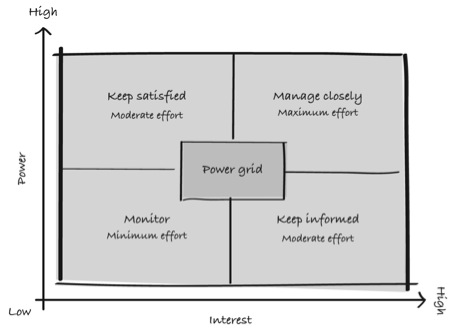
This will give you an indication of the way in which you should work with them. Actually this power grid is for all project stakeholders and if you end up with a project sponsor that is in the ‘low interest’ and ‘low power’ quadrant you really have a problem. It is unlikely that this sponsor is ever going to support your management endeavours.
Q. What's the single most important take away from the book?
A: Well people tell me they love the stories at the end of each chapter as they show real situations where I pretty much got it completely wrong but lived to tell the tale and learn a very good lesson.
But if I was to pick one thing that project managers should do it would be to work on your communication. At least 70% of a project managers time is spent in communicating so if you are going to be productively lazy anywhere do it here. That doesn’t mean communicate badly but communicate more effectively and that can often mean less effort overall.
Oh and ‘be lazy’…
Posted on: August 02, 2010 04:48 PM |
Permalink
Comments (16)
Please login or join to subscribe to this item
I really enjoyed The Lazy Project Manager book, and I'm looking forward to hearing Peter speak at PMI's North America Congress later this year. I'm off to be productively lazy...!
 | komal |
I enjoyed this article and can relate to it. I'm looking forward to reading the book.
Good comments. As someone who once spent a nano-second (well, actually nearly thirty years) as an infantry officer, I despair of the recourse to the concept of natural-born leaders. Misinformed commentators often refer to the military as the exemplar of this characteristic when nothing could be further from the truth. if anyone thinks that the military's on this planet could possibly populate the vast resource demand for leaders from the implausible source of 'natural born leaders', then those people are living in a land of delusion. The high demand alone, the technical requirements secondly, and by no means least the increasing sophistication of the rank and file, all demand something other than accidental leadership.
The same is true in project management. In Australia alone, the AIPM has 10,000 members; representing just a slice of the actual PM requirement in a single country. The day of the accidental project manager is rapidly diminishing, and the trained aspirational project manager is well and truly on the rise. At a recent conference I was asked what the accidental project managers should do to properly train the aspirational project managers. My comment ... "Well first we better be sure that we are qualified to teach them anything other than bad habits..."
My dad used to say if you want something doing quickly ask a lazy man to do it.
I am not sure that I still agree with this unless a lazy man is someone who wants to spend the least amount of time doing something without compromising quality. My experience of truly lazy people is that they just don't want to do it at all.
However, I do agree that there has to be better ways to manage projects. They are getting more bureacratic all the time and the likes of PRINCE 2 is not helping this cause.
We need some sort of project intelligence system where we can input all the data once(!) and then link each data item up to the related data, risks to activities. Issue and risks, budget and timelines and then have simple reports produced to show the various aspects of the project. Even some lovely "what if" scenarios if the risk eventuates at a certain point what effect will it have on the project. Mmmmm project manager heaven!

Peter Taylor
VP Global PMO and Keynote Speaker/Author| Dayforce
Newent, United Kingdom
Project Intelligence is something that I have written about in the past -
‘It's not that I'm so smart, it's just that I stay with problems longer.’ Albert Einstein
There are probably as many definitions of intelligence as there are experts who study it. Simply put, however, intelligence can be described as the ability to learn about, learn from, understand, and interact with one’s environment.
This general ability consists of a number of specific abilities including:
• Adaptability to a new environment or to changes in the current environment
• Capacity for knowledge and the ability to acquire it
• Capacity for reason and abstract thought
• Ability to comprehend relationships
• Ability to evaluate and judge
• Capacity for original and productive thought
Environment in this definition has a wider meaning that includes a person’s immediate surroundings, including the people around him or her. Environment in this case can also be something as small as a family, the workplace, or a perhaps a project team.
A project, as we all know, is a temporary endeavor, having a defined beginning and end (usually constrained by date, but can be by funding or deliverables, undertaken to meet unique goals and objectives, and usually to bring about beneficial change or added value. The temporary nature of projects stands in contrast to business as usual (or operations), which are repetitive, permanent or semi-permanent functional work to produce products or services.
But what if you combine ‘intelligence’ with ‘projects’, what would you achieve? Well a successful project manager certainly needs to address the specific intelligence abilities:
• Adaptability to a new environment or to changes in the current environment - projects are all about delivering change and the ability to oversee such change requires a great degree of adaptability.
• Capacity for knowledge and the ability to acquire it – projects also require a continuous learning process to understand the change that is being delivered, the lessons that are there to be learned. The combined knowledge of the core and extended project team offer the best platform for project success.
• Capacity for reason and abstract thought – logical application through the methods of project management will deliver a degree of likely success, the ability to ‘think outside the box’ and supply beneficial adaptations to process and solutions will deliver the rest.
• Ability to comprehend relationships – projects are all about people and the relationship of people with other people.
• Ability to evaluate and judge - such is the essence of project leadership and decision making.
• Capacity for original and productive thought – problem resolution and the comparative analysis of options is a constant need in good project management.
So in all aspects the project demands the intelligent project manager.
But what else is required to support successful project delivery, not from the individual’s perspective but from the organisation as a whole?
Here we can introduce a new term that refers to these requirements; Project Intelligence.
Project Intelligence (PI) refers to the skills, processes, technologies, applications, metrics and practices used to support successful project delivery from the organisation as a whole.
Common components of Project Intelligence include:
• Project Management skills, maturity and certification (from project contributor through to senior project (or program) roles)
• Project Methodologies and practices
• Project Management Information Systems
• Project (or Progam) Management Office (PMO) activities and focus (supportive, directive, controlling)
• Executive/Management skills, maturity and experience in project delivery
• Project based organizational maturity
• Project Support technologies (Resource Management, Skills Database, Scheduling and Time Management, Invoicing or Cost Management)
• Project Dashboard and Reporting technologies
Project Intelligence aims to support a project based organisations successful project capability.
Whilst we may believe we understand all of these components of PI perhaps we should explore a few of them in some detail.
For example, many organizations have a growing capability in project management skills but in contrast many do not specifically train beyond the project management role. They don’t develop great project sponsors, nor do they train people to undertake objective lessons learned activities.
More and more organizations have in-house project methodologies and then don’t explain to their sales force what it is about, or align the methodology with their product development team.
Executives in general have acquired project knowledge – well let’s be honest here, it tends to be project experience and usually ‘experience’ of a painful type – but few will come close to understanding the mechanics and skills of being a project leader.
And the deployment of project dashboards is, sadly, often a means to either move swiftly away back to safe operational issues if the dashboard looks ‘green’ or raise a lot of unhelpful noise when the dreaded ‘red’ appears; just when the project needs all the positive help it can get.
Project Intelligence is all about having the very best environment to nurture and deliver project success through the needed skills, processes, technologies, applications, metrics and practices. Our project managers deserve the very best support that we can give then and Project Intelligence is what they need.
‘If your project doesn't work, look for the part that you didn't think was important.’ Arthur Bloch

Sylvie Edwards
Professor/Program coordinator| Durham College (DC)
Whitby, Ontario, Canada
I have had the chance to read some more articles and listen to podcasts from "the lazy project manager" and LOVE the simplicity and down to Earth approach.
Keep up the great work... which reminds me I have to go see if there are new podcasts.
| thelazyprojectmanager |
There certainly are new podcasts as I am now committed to two per month
Thank you for your kind words
I recently read Mr. Taylor's book for a project management book club. It was one of the fastest yet informative reads yet for me. Many PM books are very long and very involved. Mr. Taylor's book gets right to the point. I would definitely use this as a primer for any noob PM coming into my organization. I think it'll get things started off on the right foot!
| thelazyprojectmanager |
Thank you all for your very kind comments

Mitch Krayton
President| Krayton Seminars
Denver, Co, United States
I appreciate the article because I am too lazy to have read the book.
| thelazyprojectmanager |
Ah the book is cunning in that you don't have to read it - encouraging the readers to be lazy you can skip to a chapter at the end which is a lazy summary of the book itself - Quick tips to Productive Lazy Heaven
Peter Taylor
VP Global PMO and Keynote Speaker/Author| Dayforce
Newent, United Kingdom
How could I write a book about being lazy and then expect my readers to have to work their way through 30,000 words :)
Peter Taylor
VP Global PMO and Keynote Speaker/Author| Dayforce
Newent, United Kingdom
The Lazy Project Manager has produced another eBook 'The Lazy Blogger'.
Sometimes even The Lazy Project Manager leaves his comfy chair and ventures out in to the big wide world and when he does he will be travelling by land, or air or sea and this gives him a lot of time to think (and write).
This is a self-published eBook (pdf) only and all profits will go to Cancer Research (£3 per book is guaranteed to go to the charity).
The Lazy Blogger contains 30 short stories about travelling and project management (25,000 words) and The Lazy Project Manager thanks you for your kind support in 2010 and for Cancer Research.
If you enjoyed The Lazy Project Manager (or even if you didn’t) perhaps you could consider buying The Lazy Blogger in aid of this great charity.
In some way you have all supported me in 2010 and I thank you for that generosity.
You can buy the book at www.thelazyprojectmanager.com

Wai Mun Koo
PMO Director| Intergraph PP&M
Singapore, Singapore
The 80/20 rule that The Lazy Project Management is based on makes perfect sense. However, this is more on working efficiently than encouraging project managers to be lazy which, the title itself, could be a bit misleading (though it sounds kind of cool).

Lidia Istoc
National Director of Training Department| Romanian Union of Students
Bucharest, Romania
Totally agree Mitch :))
Thanks a lot for sharing!
Please Login/Register to leave a comment.
|
"If you havenÆt got anything nice to say about anybody, come sit next to me."
- Alice Roosevelt Longworth
|







