


How Do You Compare to Your Peers?


|
Situation: You want to know how you are measuring up these days.
Global Knowledge is conducting a salary survey that actually goes way beyond "how much do you make". It asks some pretty detailed questions about job satisfaction, training, certifications, and other things that you might like to know about your peers. As is typical with these things, you can get a copy of the results sent to you after completing the survey. So if you have about 3 minutes, check out the 2011 IT Salary and Skills Survey |

Preconfigured SaaS MS Project PPM
| Situation: You're in a MS shop, looking at PPM SaaS options.
Q. Is the future of PM and PPM software in house or in the cloud? Obviously everything has been moving in the cloud for a while now. Is that where it all ends up? If so, when? Most of PPM will end up in the cloud, and relatively soon. Even large businesses with well-established IT departments while leveraging their existing infrastructure for some on premise applications will opt to tie into the cloud and get the benefit of both. Organizations handling financial, medical, or intelligence information may opt for a “private cloud”. We’ve found the more agile small and mid-sized companies are moving towards SaaS solutions at a faster rate as evidenced by the success of the early PPM SaaS vendors. Where does sit end up? With more vendors looking ahead to more open and cross platform technology standards like HTML 5, companies will be able to “turn on and off” and only pay for the features they need on demand. So whether on the PC, the Web or a Mobile device they will only pay for the capability they need throughout the lifecycle of a project. Project ramp up may require more of the initial feature set but as a project goes live they will just need more of the update and collaboration capability. Users will also have a choice to select best of breed features from multiple vendors all seamless to the end user. As businesses realize the security, accessibility, as well as the ability to rapidly get access to the latest features and capabilities only as they need them, the benefit of cloud solutions and the economics are irresistible.
Q. Fast implementation times are a key selling point for SaaS PM and PPM offerings competing against Project Server. The idea is that they give you "just enough" of what you need, without extensive customization. Generally speaking, what is the functionality or type/level of customization that you can't get with Project Server in the cloud (whether it's with your company or another) and why? I agree that fast implementation has been one of the SaaS vendor’s value proposition’s when positioning against Microsoft. Microsoft Project and Project Server are tremendously successful with over 20 million Project Users and 10,000 larger companies using Project Server. It still is one of Microsoft Top 10 products so the investment in new development is huge. Although Project Server has been available in a hosted environment for years, there has not been a “pre-packaged or ready-to-go” version that did not require at least some initial configuration. When developing SharkPro Projects we decided to leverage the power and popularity of Project and Project Server 2010 as a platform but provide a completely new way to deploy and experience Project Server. Available via SaaS in minutes or installed on premise in a few hours It is pre-provisioned and has a fresh web interface so users are ready to go, just like the early SaaS products. The difference is SharkPro Projects still has all of the new Microsoft Project 2010 and Server capability available as needed. A company can grow into the more advanced features without having to migrate to another tool later. The limitations we have seen so far have to do more with architecture deployment decisions rather than features. For example, a large employment agency was looking at SaaS initially but also wanted the option to bring on premise to leverage existing infrastructure when ready. Typically not an out-of-the-box solution with SaaS only vendors and requires more thought and planning to deploy. For global companies there are more laws and regulations related to where the actual data resides. Some have compliance requirements that require that servers and data are physically located in the host country.
Q. Do you see many IT shops strictly using MS Project Desktop at this point? Are there specific industries or company sizes that are more likely to be using stand-alone software? We still see a tremendous amount of MS Project Desktop. Many still use Project Desktop even when they have selected other SaaS or higher end tools. Desktop is still great for just learning project management or if you are a project manager managing a large capital construction project and there is not a need to share that information on the web. We also see Project terrific for off-line work when you may not always be connected to the cloud and are on a plane or very remote region in the world such as an offshore platform.
Q. At what point do you see an enterprise needing an EPM solution? Is there a particular set of attributes or pain points that you typically see in companies at that stage of maturity? Is there a particular situation in which a Microsoft-based solution is best? Individual project managers are usually successful running their projects using a tool Like Microsoft Project. Companies often realize they have a problem when they start trying to optimize resources across multiple projects or need to understand and optimize the “demand” of all the requests coming in. Companies also need to be able to support multiple workflows and work streams and need to better communicate and collaborate across teams. I have always felt that the tools did not take into account the likely user scenario or “workflow “and how people interact on a project. Most tools do fine as a big repository of all the project data but forget to take into account the likely “use case” scenarios of how the information needs to flow within a team or organization. That’s a good time to use Microsoft Project Server either from scratch or to start with SharkPro Projects.
Q. Without saying "all of them", what company sizes and industries is your software MOST useful in? Why is that? SharkPro Projects is ideal for the upper mid market. Companies, government agencies or departments within each that have between 250-1500 employees. They typically would like a “ready to go” solution they can start with due to budget constraints and in house expertise but would like to make sure they have the flexibility to grow with the tool and be able to still do some configuration to their specific needs. We have seen 3 types of early customers. Those that started with the early SaaS or SharePoint tools but have started to outgrow them, companies that want to upgrade from earlier versions of MS Project but would like a “ready to go” Project Server to get them started and lastly companies that started with a higher end tool that may be too complex for a specific department to tie into. |
 Many organizations ask "Should we go with MS Project Server or a SaaS solution?" The folks at
 Gantthead Badges - How To Get Them
| Situation: You could use a pat on the back. Badges are one of my favorite recent additions to gantthead. At a glance, they help you understand how your peers are contributing to the site. If you look at your profile as your "PM Body of Work", badges offer a fun set of highlights - adding a sort of punctuation to the link-lists of things you've done. They live on the your profile and and follow you around the site. Every time you make a comment or participate in a discussion, badges tell people a little bit about you. Since launching badges last week, we've received a lot of questions about how you earn them. So here's a quick list of the launch set of badges and a description of how you can get them. We'll be adding more over time, but these are a great place to start.
|


Lazy Project Management
| Situation: You think "there's got to be a better way."
Peter Taylor is the head of a PMO at Siemens Industry Software Limited, a supplier of global product lifecyclemanagement solutions. He does a lot of speaking and writing on the subject of ‘The Lazy Project Manager’ . His elearning modules are available online as are his free podcasts on iTunes . So most people would think that being lazy is not something you would want to be known for. Peter thinks differently. We recently caught up with to find out why...
Q. You talk about the Pareto 80/20 rule in the book, but finding that critical 20% is always a trick. How did you identify the critical parts of PM that are most important? Do they share common attributes? Generally speaking, are they the easiest things to do or the hardest? A: Answers to each question in series -
Q. You also discuss the way that the leadership potential of Prussian Army officers was judged according to their intelligence and their laziness. You go into some detail about how laziness and high intelligence in combination makes for good leadership. Does that mean you believe in born leaders? Are 3/4 of project managers doomed to be poor or mediocre leaders? A: Answers to each question in series -
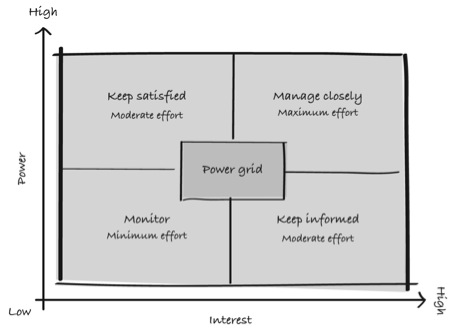
Q. You use a tool called a power grid to assess a project sponsor. How does that work? A: Well it is all about how to control your greatest asset and potentially your biggest threat. Critical to any projects success is having a good project sponsor, but, like the saying goes ‘you can pick your friends but you can’t pick your relatives’ and the same is true of project sponsors. So what makes a good project sponsor and how do you deal with the one you have just inherited for your project? The Project Sponsor is the key stakeholder representative for the project and provides the necessary support for the Project Manager with the primary responsibility of achievement of the project objectives and benefits. An inappropriate choice of Project Sponsor can seriously impact the possibility of success of the project and provide you, the project manager, with an unwanted additional overhead. Now you can’t practically ask a sponsor for their CVand put them through a formal interview process, nice as it would be sometimes to utter the phrase ‘I’m sorry but I just don’t think that this is the job for you right now’. But you should evaluate the sponsor you have and complete, in a subtle way of course, a ‘Strengths and Weaknesses ‘assessment so that you can adapt your project approach and communication methods to maximise their sponsorship support for the project that you now manage. Tip: At your first meeting with the sponsor don’t ask ‘hard’ project questions but ask ‘softer’ and more open questions: ‘What are your hopes for this project? What are your fears about this project?’ – You will learn a whole lot more. But let’s not be pessimistic, that isn’t going to happen to you, you won’t get an extreme case of project sponsor and they won’t fail the ‘interview’. So, what is your next move? Well perhaps you should consider the power base that your project sponsor has. Use the power grid to assess your project sponsor, assess their rating of interest in this project from high to low and their actual power in the organisation, also from high to low.
This will give you an indication of the way in which you should work with them. Actually this power grid is for all project stakeholders and if you end up with a project sponsor that is in the ‘low interest’ and ‘low power’ quadrant you really have a problem. It is unlikely that this sponsor is ever going to support your management endeavours.
Q. What's the single most important take away from the book? A: Well people tell me they love the stories at the end of each chapter as they show real situations where I pretty much got it completely wrong but lived to tell the tale and learn a very good lesson. But if I was to pick one thing that project managers should do it would be to work on your communication. At least 70% of a project managers time is spent in communicating so if you are going to be productively lazy anywhere do it here. That doesn’t mean communicate badly but communicate more effectively and that can often mean less effort overall. Oh and ‘be lazy’… |

Why is it SO Hard to Hire the Right People?
| Situation: You feel like there's something wrong with the way you hire. Two weeks ago, at the PMI research conference,
Dr. Joana Geraldi, Senior Research Fellow at Cranfield School of Management, International Centre for Programme Management gave a presentation entitled Finding the Right Person for the Job: Rethinking Work-Worker Fit in PPM. The presentation was based on a research paper she co-authored with Harvey Maylor, Sergio Pellegrinelli and Scot Colquhoun. We recently asked her a few questions about how we can put her findings into action. The answers to the questions below are her personal opinions, but closely tied to the research findings. Her perspectives, both here and in the research paper are pretty thought-provoking.
Q. During your presentation you discussed the problems with the way that "fit" is judged. (a worker's fit with a work profile, or work fit to a worker's profile) Could you briefly discuss how that fit is currently determined and the problems with that approach?
Q. Hiring managers and PM practitioners seem to be unaware of these issues. Why do you think that is?
A. It is difficult to say, but my guess is that the current approaches are more accessible, widely known among HR practitioners. There are plenty of people trained to assess people through these well known competence-based models. This makes life easier. We may also be tempted by the rationality and objectivity that these models promise.
Q. You talked a bit about a more holistic approach to hiring that doesn't create such a strong separation between the work and the worker. Could you describe this approach? Do you have any tips for someone who would like to put this into practice?
A. First the theory: Building on Sandberg (2001) and Partington et al (2005) we look at worker and work as inseparable. An individual's competence cannot be reduced to objective lists of activities, but is constituted by the subjective meaning that work takes on for workers in their lived experience of it. Our task is to understand what individual workers conceive of as work and, through the elicitation of examples, how they conceive of it. More specifically, Partington proposes four conceptual levels:
That is interesting, but how do you put it into practice? As a first step, Sergio Pellegrinelli and colleagues typically run assessments with project and programme managers and identify which of the four conceptual levels above they fit into. This helps the assessors identify high potential people in their firm and also make sure they are nurtured appropriately. The next question though is how to identify which projects or programs require candidates to be at the various conceptual. One way to map a project or program to a level is to judge it's complexity. One model to measure this complexity is MODeST (Maylor et al, 2008). This model looks at Mission, Organization, Stakeholders, and Team attributes to help judge complexity. There is still a need to explore the relationship between complexity and conceptual levels, these could be explored by studies, such as:
|



