


MS Project 2010 - Will You Upgrade?


| Situation: You are on The Fence about the New Version of MS Project.
I have to admit, when I first began looking at the new version of Project, I expected a number of new features that I am most excited about the flexibility that has been built into the tool. Until now, the typical new PM went through a cycle that looked like this. They had MS Project 2007 and Excel. They tried MS Project, but found the contraints it imposes (task/subtask relationships, effort, etc.) made the process of creating a schedule too complex. More specifically, MS Project was telling them what they were doing wrong by not allowing them to do the wrong thing - really just alluding to a problem without being specific or telling them what to do about it. For example, a summary task would just be composed of the durations of the tasks below them. You couldn't enter in a value for the summary task that disagreed with what you had entered below. Often, PMs would just get turned off and use Excel - which places no contraints on anything because its not a project management tool. The new version of MS Project allows to you to actually make mistakes, tells you what is wrong, then offers ways to fix the schedule. This is a HUGE leap forward. There are a lot of reasons to check out this new version: - Better integration with the rest of Office (as you would expect) - Sharepoint Syncing - etc. Probably the best way to explore the whole thing is to attend the MS Office Product Launch online on 5/12. Once you attend the event, please come back here and let me know what you thought. |

Have You Considered Adoption? (of Project Management Tools)
| Situation: You feel challenged by user adoption of PM tools. User adoption is one of the toughest challenges related to PM and PPM software. Users “live” in email, MS Word, etc. and  will only use other applications if there is some sort of carrot and/or stick involved. The folks at Clarizen feel that they have developed some unique angles on user adoption and introduced me to one of their customers. Jim Herries, Program Manager, Business Products at ESRI, to find out more. will only use other applications if there is some sort of carrot and/or stick involved. The folks at Clarizen feel that they have developed some unique angles on user adoption and introduced me to one of their customers. Jim Herries, Program Manager, Business Products at ESRI, to find out more. Q. Prior to your most recent implementation, what were your experiences with PM software adoption? Prior to Clarizen, we used Microsoft Project but team adoption was not sufficient enough to meet the demands and expectations we set on our company and products. Our team consists of 50 people across eleven cities and thirteen time zones – without constant guidance and monitoring, it was difficult to communicate effectively between teams to meet deadlines and deliver products on time. Microsoft Project limited our team’s potential – even the most effective project manager can spend time and resources on creating a plan and, for various reasons, fall victim to not executing the plan effectively and efficiently. Clarizen’s focus on execution won us over – the features and functionality that the solution provides ensures that our teams followed the plans that they spend time creating. Q. What were some negative lessons learned from those experiences? (“I’ll never do that again” sort of stuff) We frequently saw the project plan fall behind reality, and reality had this annoying habit of winning out over the project plan every time. We saw the project plan become outdated, despite all the planning and best efforts of the contributors. Weekly status meetings could take an inordinate amount of time rehashing decisions already made but not reflected in the plan. Stakeholders could become disillusioned with the entire project management process and begin to see it as an enemy to progress.
1. Choose a solution that does not require extensive training. Employees are already set in their ways and comfortable with past methods of planning and working on a project, even if the methods are not effective. By implementing a solution that is user-intuitive and easy to understand, team members are more willing to exchange their old tricks for better solutions that save time and resources. Online demos, tours and resources for training, that are insightful to the everyday user, are also helpful if a project leader is not available to train an entire team. 2. Choose solutions that integrate with everyday tools. Clarizen’s integration with Microsoft Outlook, for instance, ensures that team members who are hesitant to use the new solution will jump right in because it is a comfortable medium. Our teams and various project constituents receive email updates pertaining to their activities, and with multiple projects going on simultaneously among team members in offices across the country, this feature facilitates clear communication on deliverables and deadlines without overwhelming the team with unnecessary details. 3. Choose Software-as-a-Service (SaaS) solutions because it is constantly available from any web browser, allowing project managers and leads to communicate, update, add tasks, etc., from anywhere in the world. This reliability for on-demand and real time updates becomes critical to day-to-day activities and long term success. Clarizen’s “Roadmap” feature allows PMs to easily monitor the status of the project with a real-time view of where items stand, behind or ahead of schedule. This allows us to be nimble and alter the plan as needed. By inputting and tracking the milestones of each phase of the project in the Roadmap, our team is keenly focused on each step, helping create and follow a meaningful plan. Q. If you were to offer one specific approach or technique to help with PM software adoption, what would it be? (going through it step by step would be great) It is difficult to shift a team’s mindset when first implementing a solution – team members must receive explanations about how the software will make their lives easier by enabling communication and task completion accountability. As our team started using Clarizen, we no longer needed to spend time convincing people of the benefits because they became apparent. Ensuring internal executive sponsorship is fundamental to succeed but just as important is grassroots adoption and end-user buy-in. Prior to making the go-ahead decision, having more end users involved increases adoption and commitment from the extended team. As a program manager, I have told people that if I see their concerns reflected in the plan, I will back them publicly. If they choose to run their part of the overall project without benefit of the project plan, then they are expected to be on time, on budget, no issues, no excuses. The point is that we use the software to surface and address issues. Q. How did the Clarizen software suite facilitate better user adoption? Was it more about the software’s functionality or your approach to implementing it? Clarizen is intuitive to our user needs and this eased the process of getting our team up to speed on the solution. Since February 2009 when our software development team started using Clarizen, our level of team effectiveness has improved drastically. Now PMs structure meetings around Clarizen, which helps them remain focused on primary issues and not get sidetracked by updating status items. This level of focus and efficiency alone has reduced time, money and resources spent on a project, ultimately encouraging company-wide adoption. Particularly, the PMs benefit from the scalability of the interface, allowing them to see issues and delays in schedule in a matter of seconds. This level of accountability has improved meetings exponentially and resulted in more meaningful discussions about the status and progress of a project. Because we are able to focus less on updating the team and more on developing products, we are hitting all our release dates. Subsequently, the team is pleased and clearly working more efficiently because the projects are going much better overall. Even those who were skeptical about using the tool at first are now eager to use it. |
Do Your IT Projects Produce?
Situation: You deal with highly repeatable processes and new components in most project cycles.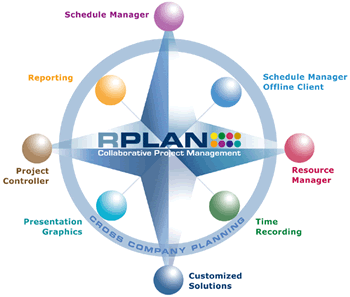 RPlan is a project management tool which is very popular in automotive manufacturing, with clients such as GM, Daimler, VW, AUDI, Porsche, BMW, Renault, Getrag-Ford, Airbus, Rolls-Royce and more. The tool is designed to address a variety of challenges common both project and product management. These days automotive projects involve a lot of IT and IT projects are often faced as product development efforts. So I thought it would be a good idea to speak with Actano's CEO, Thomas Salva to understand what makes their tool set special and why those differentiators are important in the IT space. RPlan is a project management tool which is very popular in automotive manufacturing, with clients such as GM, Daimler, VW, AUDI, Porsche, BMW, Renault, Getrag-Ford, Airbus, Rolls-Royce and more. The tool is designed to address a variety of challenges common both project and product management. These days automotive projects involve a lot of IT and IT projects are often faced as product development efforts. So I thought it would be a good idea to speak with Actano's CEO, Thomas Salva to understand what makes their tool set special and why those differentiators are important in the IT space.Q. How is project management different in a product-focused environment? How do project and product management work together most effectively? In a product-focused environment projects are not and can not be treated as a “unique endeavors,” but must follow standard processes to make the most of scarce resources. A defined development process, that comprehends the characteristics of the product, the organization that will execute the projects, and the program management processes and control points, is essential. RPlan provides standard structures and templates that provide the consistent and efficient basis for project planning, and allow the project manager to focus on the aspects of the product that make it unique to the market. One major difference in product focused environment like automotive vehicle development is the need to coordinate component planning. In a "new" vehicle design there are components to be developed "from scratch", carryover from vehicles in production and components in various stages of development. The last of which is complicated to manage, due to their interdependence with the "new" components, often so-called lead vehicles are delayed or canceled entirely. This causes “Sturm und Drang”, i.e. the need to seek scheduling alternatives to still meet launch dates. RPlan supports this process with “what-if” scenarios and their ramifications. A very high degree of collaboration is required between project and product management to insure that the corporate goals for part commonality, vehicle launch dates and costs are adhered to, while providing a successful product to the market. RPlan provides the global, web based platform to manage the complex schedule interdependencies via SynchroLinks (task/resource interlinking across projects and programs) combined with resource loading, leveling and costs. Q. Most of RPlan’s clients are global. What are the top 3 things to be mindful of when working with large distributed teams? What can be automated? What needs to managed via human interaction? Cultural differences, e.g. in terms of how concrete a schedule actually is. Differing priorities/goals between the global and regional organizations that must be harmonized if global PD is to function effectively and lastly language barriers, e.g. terminology must be uniform so that all partners truly have the same understanding for each English term, when it’s translated back into their native tongue. Reports can be automated, typically there is a set of standard metrics that management requires weekly reports on (e.g. baseline budget $/Euros, effort and timeline vs. actuals). This is capability that RPlan provides out-of-the-box via integrated Crystal Reports. Human interaction is required in resolving scheduling conflicts. Here RPlan provides multiple means of communicating a delay to the stakeholders, including a link directly to the schedules/tasks/resources involved and "what-if" capabilities to provide options to remedy the situation. Q. What are the focus of project presentations in the automotive industry? What do they always include? Are they fairly standardized or very unique to the project that you are working on? Project presentation for complex programs such as automotive development can vary widely, but general focus on either overall project status or the status of key project metrics. Communication of the project schedule is a critical need, as program team members are typically balancing resources across multiple projects. RPlan provides the capability to generate project timelines directly into Microsoft PowerPoint. Standard formats provide consistent communication, with the ability to annotate and draw focus to areas requiring attention. Project managers also need the ability to dive into the detail supporting the overall status. The supporting information must be organized in such a way that the metrics supporting the key control points defined in the product development process are easily identifiable. RPlan provides the ability to manage all the information and to create presentation reports that integrate the key cost, schedule and resource metrics. Q. RPlan has been very effective in the automotive industry, based on its strengths in collaboration, project information management, and bottom-up schedule management. How do you see those strengths being applied in the broader IT market? Many of the same requirements carry-over to IT: complex interdependencies of modules and components in SW development, reuse of components across projects, and the need to adhere to standard processes and structures. Typically SW development is now also spread out globally. Several of our customers in automotive are now also using RPlan for their SW development activities (e.g. BMW) Q. If you had to name one key differentiator for the RPlan toolset, what would it be? What makes it special? What does that mean to the organization and people using it? Collaboration! RPlan's architecture, ease of use and flexibility make it ideal for complex, distributed and dynamic project environments where world-wide collaboration of all of the stakeholders is the key to achieving the project goals. Visibility and transparency of project information insure stakeholders always have access to current information, and are working to the same plan. Project team members are able to focus on accomplishing the tasks and objective they own, with a clear line of sight into tasks and issues that impact them. The RPlan product coupled with ACTANO's 20 years of experience in providing project management best practices will insure the customer’s organization reaps the ROI in the shortest time and the users experience a significant productivity gain and less migraines. |
Project Manager - Should You Really BE THE CHANGE?
Categories:
Decision Making
Categories: Decision Making
Situation: You've been thinking about the big picture. Over the last couple of years, I've listened to PMI's CEO, Greg Balestrero talk A LOT about sustainability at PMI Global Congresses and other venues. In fact, I believe it gets more air time than any other topic he speaks on. While I'm a big proponent of "getting more green" in everything we do, I've been surprised with the way that he connects it to project management and to our responsibilities as project managers. In his mind, it should be central to what we all do - not a "nice to have". Something he said in a recent press release caught my eye, summarizing his view on the topic. Over the last couple of years, I've listened to PMI's CEO, Greg Balestrero talk A LOT about sustainability at PMI Global Congresses and other venues. In fact, I believe it gets more air time than any other topic he speaks on. While I'm a big proponent of "getting more green" in everything we do, I've been surprised with the way that he connects it to project management and to our responsibilities as project managers. In his mind, it should be central to what we all do - not a "nice to have". Something he said in a recent press release caught my eye, summarizing his view on the topic."Integrating economic, social and environmental value into all portfolios, So I followed up and asked him a few questions at the PMI Global Congress in Orlando. Again, I know we should all do what we can as individuals to promote sustainability, However, can and should project management practitioners integrate economic, social, and environmental value into [their projects, programs and portfolios]? After a brief conversation, I believe I understand his perspective a bit better. I'll put it in my own words and see what you think. It's not: - that all projects need to focus on sustainability. - that you need to add cost to your projects to ensure they have a positive impact on sustainabilty. - that sustainability is something that should be considered ahead of the project requirements you already have to deal with. Here's my version of the case for making sustainabilty a key part of your project management approach As an ethical Project Manager, you need to think about longer term financial and environmental results and factor the benefits of sustainability into your ROI analysis and execution plans. If you consider sustainable approaches, materials, etc. for every single project. They may only make sense SOME of the time, but with your help, they will at least be considered. In this way you can ensure that sustainable approaches that make sense are used. Making sustainability part of what you do implies you must make it your business to learn about and introduce sustainable approaches to your work. If you don't, chances are that no one else will. For this reason, Project Manager - you need to be the change. The actions that you could take to make this happen include: - unearth potential sustainable approaches within the context of your project. - understand how specific sustainable approaches relate to the financial success of your project so that you can propose them as appropriate. - find out if a sustainable approach to your project could help your company from a PR perspective. What do you think? Is this something you have time for and feel is important? Should it be a key focus for PMI? Should it be a key personal focus for you? |
You Are SO HOT Right Now!
Situation: You need a little "pick me up". This morning, CNN Money announced the top 50 jobs in America - IT Project Manager was #5! How great is that? Give yourself a pat on the back for choosing a great profession to be a part of. |


