


Are You Speaking Their Language?


Situation: You need to get a better handle on your "work-speak".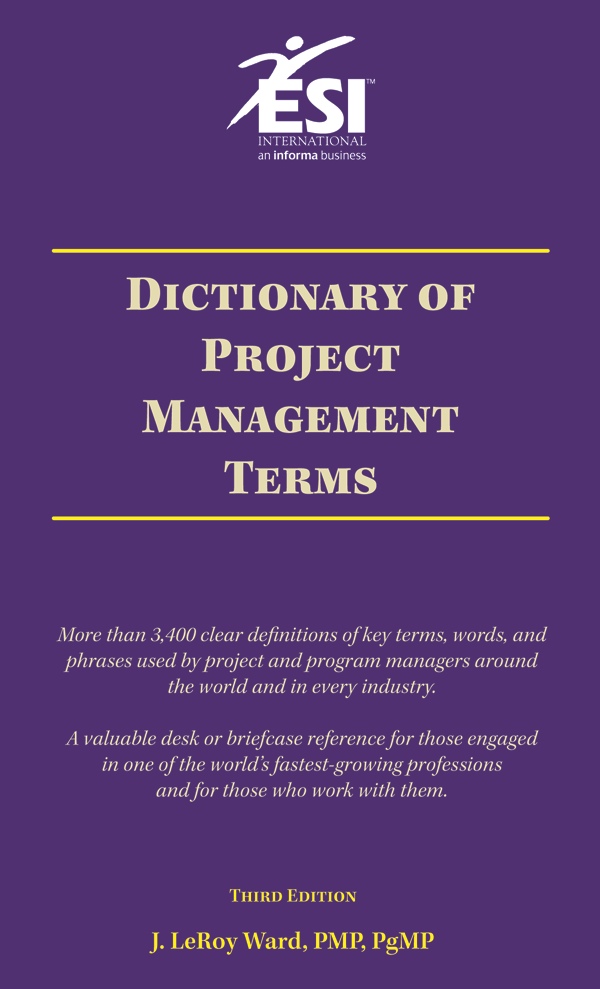 We recently spoke with J. LeRoy Ward, PMP, PgMP, Executive Vice President at ESI International and author of Dictionary of Project Management Terms. He was kind enough to offer his ideas about the importance of a common business language. In Mr. Ward’s view, it is easier to walk the talk when you are all in agreement of what the talk means. We recently spoke with J. LeRoy Ward, PMP, PgMP, Executive Vice President at ESI International and author of Dictionary of Project Management Terms. He was kind enough to offer his ideas about the importance of a common business language. In Mr. Ward’s view, it is easier to walk the talk when you are all in agreement of what the talk means.Q. What is the most effective approach one can take to learning the language in any given field – without looking like an idiot? Is it through books, peers, trade pubs or some other mechanism? The fastest way is generally through trade publications, peers and Google. Don’t be afraid to ask people what they mean when they use terms you don’t understand. Start writing some terms down and refer to your list from time to time. However, you must buy a good dictionary in your field. While no one in their right mind would sit and read a dictionary like a regular book (it would be as boring as listening to your hair grow), it is important to add it to your quick reference library. The other quick way I learned new terms is to create my own Google Library. Every time I encounter a word I don’t know, I Google it, print the page and stuff it in a folder. It’s the quickest, cheapest education around. There are thousands of online dictionaries Google finds for you, but you can always start with Wikipedia. No matter what word I’m looking up, it seems Wikipedia always has it. Q. As a Project Manager, are there particular areas you should focus on learning – like financial terms, customer related terms, etc.? Every project manager needs to know the „hard core“ PM terms such as precedence diagramming, monte carlo techniques, float, etc. Beyond these, however, it really depends. If you’re in the financial services industry (what’s left of it anyway!) and you’re working for an investment bank or hedge fund, you’d better know some of the key terms in that field. If you’re working in the pharmaceuticals industry, you’d better know the difference between a clinical trial and a toxicology screening (you would rather participate in the former than the latter, believe me!). If you happen to find yourself implementing SAP throughout the accounting organization, you had better bone up on such terms as accounts receivable, bad debt, and general ledger. The key here is to be conversant with the main, most often used terms. No one expects you to be an expert, but they do expect you to understand the fundamentals of their business. Q. Can you describe a particular situation you were involved in where not knowing the “language” harmed a Project Manager? I consulted with a major computer manufacturer for years. Everyone I came into contact with complained that they were losing „margin“ on hardware sales and that’s why they were going into the services business. When I asked how they defined and calculated margin to a person they looked at me as if I had 2 heads, until about 18 months later a project manager shouted out „Rev minus cost divided by revenue“ to which I responded „why isn’t it revenue minus cost divided by cost“? He said because we pay our sales staff their commission based on margin, and given that revenue should be higher than cost (that’s what keeps them in business), and given that revenue is the denominator in the equation, that means they get less commission. Now, think of this, every project manager in that company was responsible for ensuring they were delivering the most margin on each project, yet no one knew how to calculate it. Therefore, how effective were they in that critical aspect of their job? Not very. All they were doing was „parroting“ some exec they heard constantly lamenting the fact their margins were eroding. And, by the way, no one ever told me if they were talking about gross or operating margins either. Q. Both industry speak and cultural differences in speech and body language are important. In your opinion, which is more important and why? I would say the latter because regardless of your background, nationality, ethnicity, race, or even if you’re right or left-handed, each industry has its own jargon. IT people speak their IT cant the same in France as they do in the U.S. yet, the cultural differences and body language are vastly different. One day while in Switzerland for a meeting one of the Directors for our client said they would need to stop the meeting to address a serious business matter. Of course, we said no problem. When they were done she came over to me, and her perfect French-accented English she said „I am terribly sorry for the interruption.“ I responded by saying „Sure, what are you going to do?“ She retorted in a somewhat defensive tone „why, I’m not going to do anything, I just told you I was sorry“ So, you see, my innocuous „Hey, what are you going to do?“ idiom was taken as an affront. Even though someone for whom English is not their first language and appears to speak it perfectly does not mean they understand the nuances of the idioms that we tend to speak among ourselves in the U.S., and the same holds true for every language. Don’t assume colloquialisms will translate well. Most often, they do not. Q. In which industries is language MOST important? In which industries might it be easier to get by without it? I believe the more technical and or advanced the industry the greater the degree it has formed its own language, terms and definitions. My mother was a registered nurse and a head supervisor on various medical wards for more than 45 yeas. In high school I would have to go pick her up from the hospital. As is the protocol in that field, when there is a shift change, the people leaving brief the professionals coming onto the floor the status of each patient. Typically, the head nurse, such as my mother, would present the briefing. I would sit there and listen to her provide detailed medical status on each patient to her colleagues. It all sounded Greek to me, but to the others it all made perfect sense. There might be industries for which it is easier to get by without a common language, but the truth is the more proficient you are with language, the higher your chances of success. |
Corralling An Insane Number of Small Efforts
| Situation: You have a small to mid-size business and need to get a handle on all of those small projects. The needs of a small to sort of "mid-size, but still small" companies are different from those of the Fortune 500 crowd.  People wear more hats at smaller companies and sometimes "Project Manager" is just one of those hats. In instances where there is little complexity and structure, but a lot going on - you still need a view of what's on the organization's "list" of efforts. Entry software is one of the companies working to address those needs. People wear more hats at smaller companies and sometimes "Project Manager" is just one of those hats. In instances where there is little complexity and structure, but a lot going on - you still need a view of what's on the organization's "list" of efforts. Entry software is one of the companies working to address those needs. We recently spoke with Barry, Cousins, CEO of Entry Software and author of One Task List, a teamwork fable to get an overview of what makes Entry Software special and his insights on the "One Task List" concept. Here is what he had to say... Q. Tell us about the "One Task List" concept and why its so powerful. One Task List is about managing all of an organization's work in a single place. Most of our clients are small to medium sized organizations made up of employees who have to balance a variety of roles between projects and support work. Having all of the work in a single system makes it easier to prioritize, allocate resources, and ensure that the right work is done by the right people at the right time. Q. What industries are the best fit for Entry Software? Entry's products and services fit best in the IT shops of Health Care, Education, Government, Professional Services, and Software Development organizations. Q. What size projects are the best fit for Entry Software? We specialize in organizing work for people who manage a large number of smaller projects, typically less than 50 Effort-Months. Q. Who do you consider to be competitors? What makes Entry software different from them? Our competitors are the identifiable stand-alone HelpDesk and Project Management vendors targeting the Small and Medium Business marketplace. What makes Entry.com different is our ability to provide an integrated environment for both Project Management and Help desk and that it is available as a hosted managed service. Q. When I looked at the components of the system, "Help Desk" seemed out of place, sitting alongside Portfolio Management, Project Management, and time sheets. Looking at it more deeply it seems that the value is more in the capture of best practices. Could you talk a little about that? Our mix of functionality makes perfect sense to those organizations who have to balance project and support work. When projects fail to deliver on time, it's often because support tickets are taking resources away from project allocations. Many support issues arise from recently implemented projects, and many projects are funded as a result of support incidents. As a result, we built our software to allow new support incidents to be related directly back to projects and quality assurance cycles. We developed the ability to start a new project directly from a support ticket, and that project's requirements can be developed by dragging in other tickets. For the executive leadership, we make it possible to allocate resources and manage a portfolio that incorporates both kinds of work, across the entire enterprise. People in smaller organizations tend to wear many different hats, and our software helps them to succeed in those different roles within one toolset. Q. If you have project management software and a time sheet system in house that you are already happy with, can it be integrated with Entry Software? We have a variety of ways to integrate with other systems, from feeding data into a common reporting platform to feeding support requests from external sources. We look at each need on an individual basis to determine the best fit. Q. How do you deal with requirements tracking and financial management within this toolset? Is there integration with other tools to address these issues? Requirements tracking is one of our hidden gems, because our users can assemble project requirements from other projects, past support incidents, and the body of requirements that are documented on a day to day basis. Regardless of their source, requirements carry the comprehensive historical audit trail of our support tickets so that product managers have access to the richest possible context for each requirement. Our software includes functionality to manage the budget, cost, and benefits associated with any activity. Integrating with other tools for transaction processing and/or reporting is possible through our XML Web Services layer Q. Who should NOT use Entry Software? With our software and service design, we targeted smaller organizations who have to manage a variety of project and support activities. Entry's offerings have 10 years of traction within that customer profile. |
It’s All About Building Bonds Of Trust
| Situation: You want a simple way to tell whether you're a good leader. I just finished watching Colin Powell deliver the keynote speech on Leadership at the PMI Global Congress,  North America. He began by touching on his busy day – having just endorsed Barack Obama on Meet the Press this morning. Speaking for well over an hour , including some pretty decent impressions of Arnold Schwartzenegger, Ronald Reagan and others. His presentation was, of course, filled with impressive war stories and he did a good job of relating much of his military experience to Project Management. Early on, he said that prepping for this presentation made it clear to him that he had been a Project Manager all of his life. North America. He began by touching on his busy day – having just endorsed Barack Obama on Meet the Press this morning. Speaking for well over an hour , including some pretty decent impressions of Arnold Schwartzenegger, Ronald Reagan and others. His presentation was, of course, filled with impressive war stories and he did a good job of relating much of his military experience to Project Management. Early on, he said that prepping for this presentation made it clear to him that he had been a Project Manager all of his life.After many colorful examples and stories he said it all comes down to one thing. “Leadership is all about building bonds of trust – and that’s all I know about Leadership.” He followed that up with, “ you know you’re a good leader when the mission is going bad, men are falling all around you – but your people are still following you.” I thought it was a beautifully simple assessment of what it takes to be a leader. If you look at it one way, he skips over the detail so many of us become preoccupied with - that the leader has great communication skills, paints a clear view of the future, and has all of the other qualities that we have come to expect from a leader. On the other hand, perhaps if you consider General Powell’s trust goal – maybe you cant get there from here without having all the right stuff. What do you think? Is it really that simple? |
A New Online Benchmarking Tool
| Situation: You want better assess project risk. ITProjectMetrics.com is a rather crude looking online tool - but the people who put it together may have really hit on something. The site gathers project information (both demographics and performance data) from people like you, then lets you know how different factors might affect project success. At this point the sample size is too small (86 projects), but we could all help change that if we were so inclined. Everyone wants benchmarks and everyone wants to better understand risk from every angle. These sorts of things help you define success and make sure you don't stumble over common obstacles that should have been avoided. You only enter project data on completed efforts. Here's what the current breakout looks like:
Here are a few examples of the data you'll get back from the site:    |
StrengthFinder 2.0
| Situation: You want to create a stronger personal brand. Being a Project Manager means you are in one of the hottest professions out there today. In the current economy, that's  a really good thing. So you have solid experience. You're either certified or "certifiable". -- but can you name your top 3-5 strengths? Even more importantly, is your every day work playing to those strengths? a really good thing. So you have solid experience. You're either certified or "certifiable". -- but can you name your top 3-5 strengths? Even more importantly, is your every day work playing to those strengths? Sometimes the hardest part of this sort of self-reflection is finding an easy way to get started. Now, there's a quick and easy to do just that with StrengthFinder 2.0. About StrengthFinder 2.0 (from the website) "Hide not your talents. They for use were made. What's a sundial in the shade?" — Benjamin Franklin Do you have the opportunity to do what you do best every day? Chances are, you don't. All too often, our natural talents go untapped. From the cradle to the cubicle, we devote more time to fixing our shortcomings than to developing our strengths. To help people uncover their talents, Gallup introduced the first version of its online assessment, StrengthsFinder, in the 2001 management book Now, Discover Your Strengths. The book spent more than five years on the bestseller lists and ignited a global conversation, while StrengthsFinder helped millions to discover their top five talents. In StrengthsFinder 2.0, Gallup unveils the new and improved version of its popular assessment, language of 34 themes, and much more. While you can read this book in one sitting, you'll use it as a reference for decades. Loaded with hundreds of strategies for applying your strengths, this new book and accompanying website will change the way you look at yourself — and the world around you — forever. A week ago, a friend (Jim Garrettson) recommended this book and described the impact it had on his life. He said,"Imagine being able to name your top five strengths - what a gift that is!" I think he had a point - most people can't do that. So I grabbed the book, took the test and ended up buying several for some of the folks in gantthead. In fact, I think I'm going to buy one for everyone that works with me. It's not perfect, but it only takes about an hour to read the book and another half hour to take the test. At the very least, it causes you to stop and think about your strengths and what you are doing to leverage them. |


