


A New Way to Look at Search


Situation: You need a to increase your search speed. ManagedQ isn't another search engine. It offers an interesting new - visually logical - way to look at search results. This is the sort of thing you have to try to really understand, but I think it has a lot of potential. On the left-hand tool bar, it breaks down the search results into People, Places, and Things. In the main body of the screen, you get screen snaps of the results under each category. So you immediately see where you are going. It's like the difference between having your headlights on or off as you drive down the road at dusk. You react a little more quickly and perhaps get where you are going faster. -- kind of like a more advanced version of Ask.com's pop-up previews. ManagedQ isn't another search engine. It offers an interesting new - visually logical - way to look at search results. This is the sort of thing you have to try to really understand, but I think it has a lot of potential. On the left-hand tool bar, it breaks down the search results into People, Places, and Things. In the main body of the screen, you get screen snaps of the results under each category. So you immediately see where you are going. It's like the difference between having your headlights on or off as you drive down the road at dusk. You react a little more quickly and perhaps get where you are going faster. -- kind of like a more advanced version of Ask.com's pop-up previews.Again, a picture speaks a thousand words - so go ahead and give it a try... |
Posted on: February 23, 2008 09:48 AM
| Permalink |
Comments (2)
Did You Know You Have 5GB of Free MS Storage on the Web?
Situation: You Need a Little More (Hard Drive) Space. As part of its LIVE program, Microsoft offers SkyDrive, FREE storage on the web that you can use as back up space, a place to share large files - or anything that the pack rat in you demands you keep. Obviously lots of vendors do this, but 5GB is lots of space for free and MS will likely be around for quite some time. As part of its LIVE program, Microsoft offers SkyDrive, FREE storage on the web that you can use as back up space, a place to share large files - or anything that the pack rat in you demands you keep. Obviously lots of vendors do this, but 5GB is lots of space for free and MS will likely be around for quite some time.The SkyDrive is linked to (really sort of the back-end for) Spaces, which is Microsofts answer to Facebook. If you are an MS Messenger user, this might interest you as well. The whole LIVE scene is completed by OfficeLive, the SaaS (really lite online) version of MS Office which I've reviewed in past postings. |
Posted on: February 22, 2008 02:08 PM
| Permalink |
Comments (0)
Mash-ups and PM, What's the Deal?
Situation: You Could Use a Little Mash-up Primer. PMs deal with reporting a LOT. Whether you are dealing with reporting on projects within the enterprise, or building an enterprise app that has a strong reporting component, its good to know a bit about how mash-ups might play a role in your overall approach. Recently, we spoke with Chris Warner at JackBe - who gave us some quick answers to questions I think many of us share. PMs deal with reporting a LOT. Whether you are dealing with reporting on projects within the enterprise, or building an enterprise app that has a strong reporting component, its good to know a bit about how mash-ups might play a role in your overall approach. Recently, we spoke with Chris Warner at JackBe - who gave us some quick answers to questions I think many of us share.Q. What’s a good example of a Project Manager using an enterprise mashup? Do you see them being used to actually manage projects or are they more a class of applications that many PMs will be involved in implementing? Everyone seems to have a gut ‘feeling’ for mashups. And many of us have played with the proverbial ‘Chicago apartment locator’. But defining a mashup in the context of the enterprise is another story. So let’s start with an example of a sophisticated enterprise mashup: connecting your SAP ERP data with your Oracle/Siebel CRM data and two sets of online third-party demographic information while maintaining single sign-on through your global LDAP server, then sharing the mashup with your management. And doing it without IT’s involvement. A good definition of an enterprise mashup would be ‘a user-centric micro-integration of Web-accessible data’. While short, this definition contains a number of important points worth considering: • “User-centric” – Mashups are always intended user consumption and are often created by the users themselves, not the by black-box back-end integration systems such as ESB, BPM, BPEL, etc. Without this guiding principle, we are merely sending the users back to IT for more development. • “Micro-integration” – Think of a user taking data from multiple sources and copying it into Excel. As these users typically deal with small amounts of knowledge-oriented information (as opposed to IT-managed applications that typically deal with large amounts of transactional information), these are called “micro-integrations”. • “Web-accessible” –Mashups are best created from standardized data formats such as WSDL, REST and RSS, which we summarize here as ‘web-accessible’. In other words, our data sources shouldn’t require too much manipulation for the user to make sense of it. It is important to note that this describes what an enterprise mashup is but not its usage. That is left to the user, whether that user is an intelligence analyst performing an evaluation of a terrorist hotspot or a securities trader completing an analysis of an interesting investment opportunity. More importantly, the way a user interacts with a mashup makes it distinct from IT-centric integrations. Users dynamically create and interact with mashups. The net effect is that IT doesn’t prescribe the integration, they only need to provide a framework to govern their creation. With all this as background, it is reasonable to expect that enterprise mashups will be both a tool for Project Managers and a part of the new class of ‘Web 2.0’ applications PMs will be involved in implementing. As a tool, enterprise mashups can greatly improve the real-time decision-making capabilities of a PM. And JackBe can attest that mashup adoption in industries like financial services and government has already begun; some PMs are already learning what it means to deal with this new style of ‘Web 2.0 mashup application’ with requirements like ‘loosely-coupled’, ‘user-driven’, and ‘browser-based’. Q. At a portfolio level, executives often use Enterprise Project Portfolio Management Tools to organize and prioritize projects. For example, the Daptiv Product Suite has a Cognos back-end that allows access to project data via a data warehouse. If I’m trying to manage a portfolio of projects, do enterprise mashups replace some of this functionality or is it complementary? Mashups are very complimentary to today’s popular reporting/analysis tools. Enterprise mashup solutions provide users with the ability to mash data from a data warehouse/mart as easily as any other data source. A good example would be mashing your warehoused project data with third-party resource availability/cost data in real-time. But it’s also worth noting that mashups don’t require a warehouse/mart. Mashups can easily be constructed from transactional ERP/CRM/SFA systems and newer interface technologies like SOA and RSS services. Mashups can make these disparate technologies easy to dynamically combine for real-time information solutions. Q. What is the most common executive dashboard application created via a mashup? What is the most unique one you’ve seen (something that would not have been possible with older technology)? Common dashboards constructed from enterprise mashups have been in executive hot-spots like real-time financial benchmarking and regulatory compliance. The most unique enterprise mashup application is certainly Project ‘Overwatch’, the real-time intelligence briefing interface JackBe helped build at the Defense Intelligence Agency (there’s a short case study online). They’ve replaced the low-tech cut-and-paste into Powerpoint approach with a rich browser-based interface that connects live to data sources. Every briefing can be given based upon real-time, live information and that information can also be shared collaboratively among analysts. This is what Web 2.0 is all about. PMs and their clients will all come to expect this kind of dynamic information in the near future. Q. Mashups seem to make data and reports more directly accessible to executives, allowing them to dream up reports and easily pull them together on the fly. How do you think that will change the nature of future large scale application development projects? In general, mashup applications are the antithesis of the ‘big bang’ software projects of the past. These are constructed from data sources that have standardized interfaces (making them easy to assemble) and are deployed as ‘containerized’ micro-applications that are built from browser-based ‘rich internet’ technologies like Ajax, Flex and Silverlight (making them easy to embed in websites/blogs and making them easy to share with others), and they are often created by the users themselves. As we often say at JackBe, enterprise mashups can be constructed in minutes, not months! |
Posted on: February 22, 2008 11:44 AM
| Permalink |
Comments (0)
Kicking Your Surfing Habits
Situation: Your Staff (or YOU) Need To Spend More Time Working and Less on the Web.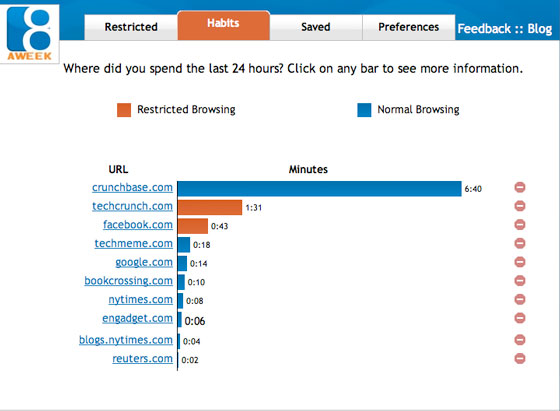 Not that I think there's anything wrong with spending all day every day on the web... but I know it can be a productivity issue in some organizations. Not that I think there's anything wrong with spending all day every day on the web... but I know it can be a productivity issue in some organizations.8aWeek won't alter your behavior or micromanage you in any way, but it IS a quick and easy way to monitor your internet usage. If you have an employee that seems to spend all of their time on facebook, ask them to download this and see what their usage looks like after a week. I'm not saying YOU should monitor it, but perhaps letting them do it themselves will help them understand how much of their work day is devoted to surfing. I picked this site and the attached graphic up from Techcrunch , more details on the app are available in their blog posting. |
Posted on: February 16, 2008 10:55 AM
| Permalink |
Comments (5)
A New Way to Test Software?
| Situation: You Are Involved in QA/Software Testing... Do you have software that needs testing?  OR Want to make some extra cash testing software? I had to bring this one up as it seems to be a new approach to an age-old problem. There's never enough money, time, or skilled people to test software. So you give up and eventually users of the first release become your alpha users. uTest has an interesting new crowdsourcing approach to the problem that I think holds some promise. They are creating a pool of remote testers online and paying them to find bugs. You can be a tester or have others test your software. On the positive side, one would think that you would have a motivated pool of testers out there that will pound out the obvious/typical flaws. That's a hugely positive thing. However, what you won't have is typical users that will take role-specific approaches to interacting with the system. |
Posted on: February 10, 2008 11:10 AM
| Permalink |
Comments (3)


