


Low Overhead Meeting Scheduling


| Situation: You Schedule Lots of Meetings and Want to Make the Process Easier Why would you want another tool to schedule meetings? You already have Outlook, right? Here are a couple of reasons: 1. Not everyone has Outlook (just almost everyone). 2. If your meeting participants are from different organizations or there are a lot of them, scheduling can involve a lot of back and forth - first in email, then in the meeting acceptance process. That last part is probably the best reason to try a tool like ScheduleOnce. It allows you to send all particapants a bunch of time range options. They then respond concurrently with preferred times and you pick the best time option for everyone. So to you its just two volleys of messages. Compare that to the back and forth you end up mired in otherwise. If you only schedule meetings once in a while, then this isn't the tool for you, but if you're constantly setting up meeting times, it's worth a look. |
Do you ONLY do Project Work? (with a Borat accent) NOT!
| Situation: You Are Doing Some Thinking about the Future of PM Software... There are a few clear trends in the market today. The most obvious one is the movement toward very simple, easy to use, SaaS PM apps. The majority of these are great for giving some structure to simple projects, but they don't do a lot for you at the enterprise level. A lot software sales are being generated, based on this simple model. Probably a more important trend is the integration of project work and basic operational tasks - allowing management to judge the value of all work, rather than just looking at projects. In the real world, you have to hire people and pay them a full time salary. Some of that effort and cost goes torward your project and the rest gets used elsewhere. If you can't look at the whole picture, how can you really make the right resource decisions? In this posting, I wanted to bring out a couple of functional changes that software companies are making with this concept in mind. In my conversations with the Microsoft Project folks, Outlook task integration with Project is a huge step for them, directly addressing consistent feedback from users asking for a more integrated view of all work. In this way, users can organize both project and non-project work in the application they live in. It can be accounted for with integrated time tracking and viewed from a PPM perspective via their (acquired UPM) EPM tools. Daptiv is doing some very impressive things with Cognos and Pervasive Software (press release on this coming out tomorrow) that not only allow management folks to easily spin the data up in a thousand different (and very useful) views and reports, but gives implementation folks much easier ways to integrate Daptiv with popular enterprise software packages like SAP, Peoplesoft, etc. Couple that with a push into functional areas of the business outside of IT (Marketing, HR, etc.) and you start gathering the data you need while granting access to it in a simple enough way that its really useful. There's a lot of power in that. Why am I bringing all of this up now? There's something here that makes a lot of sense. Too often we get caugh up in "here is what PM software should do" versus "this is what our organization needs". Take a minute to think about how this sort of "work-centric" versus "project centric" approach to resource management would be better for your company? What parts of it are important to you? - and how should that change your portfolio reporting and software purchasing decisions? |
FASTER Social Networking...
Situation: You Have Too Many Social Networks and Too Little Time... I'm on most of the more popular social networks (gantthead, of course being my favorite) and believe that networking can really be valuable. Having a lot of the interaction happen on line allows you to better control the time you spend on it and focus your efforts in the right places. However, if you're like me (poor you) you now have islands of information, subsets of your "address book" all over the web. I'm on most of the more popular social networks (gantthead, of course being my favorite) and believe that networking can really be valuable. Having a lot of the interaction happen on line allows you to better control the time you spend on it and focus your efforts in the right places. However, if you're like me (poor you) you now have islands of information, subsets of your "address book" all over the web.That's why I find Flock interesting. I'm not saying its for everyone - or even for the average person, but for some of us it's worth a look. Flock automatically logs into and pulls in all of your contact from various social networks and makes them available to you on a sidebar. This means if you find something interesting on the web, it a lot easier to find that friend of yours that shares you passion for your newfound info-treasure and send it on to them. Making link-sharing into an easier exercise, means you'll do it more often, touch more people, -and hopefully build a stronger network. |
Requirements Start With an IDEA
| Situation: You Need a New Way to Deal with Project Requirements. Eric Winquist, CEO of Jama Software: We’re finding it does both. First and foremost, Contour, is about making requirements management easier and helping teams manage complexity found in developing software applications or systems, designing new products or whatever their projects might be. For 70% of enterprise organizations, innovation via new product development is a top strategic initiative; yet, the majority of these projects don’t end successfully. Why is that? When we founded Jama a little over year ago, we looked to answer this question. From our personal experience in managing software development projects and the insights we gained from customers, we consistently saw a gap between the requirements definition phase and the ability to successfully deliver on them.
When we created our tool, we built it on a core philosophy that by unlocking the requirements and getting the entire organization collaborating on the projects through a Web-based environment, project teams will increase their success rates. When companies adopt this open collaborative approach to RM and innovation overall, it fosters new ideas and a cultural shift toward greater accountability to the goals of the projects across the entire organization.
Eric: Yes. The larger the organization, the greater the risk for information silos to exist. And, when information silos exist, that’s when projects break down – errors get made leading to expensive rework and defects (you know, all the issues we’ve heard about ad nauseum for years around the failure of projects). Eliminate the silos, and you eliminate a major point of failure.
The focus is at the Enterprise level because the complexity is magnified. Some of our enterprise customers have hundreds of projects going on concurrently, with thousands of moving parts within them that are interrelated across people, departments and other projects. Companies that are successful have adopted an open innovation model that not only breaks down walls internally for greater internal collaboration; it also brings external audiences such as customers and partners into the process as well. This is where collaborative Web-based tools are making such a difference. In fact, we’ve found this has become one of the primary benefits customers are seeking in their selection of an RM solution.
1: Capture - define requirements and other items. For example, we have customers who use our tool as a centralized repository for capturing research documents, usability studies, videos, raw product ideas, etc., essentially leveraging the tool to manage items at the front-end of the innovation funnel, and thus connecting these items up to the requirements definition and management phase later in the product planning & development process – creating a stronger bridge between R&D and Product/Project Management. In fact, we’re customizing this for a Fortune 100 technology company right now. So, companies are definitely looking at RM from a much more strategic perspective now and wanting to tie it together end-to-end.
In many ways, Jama and other new vendors are at an advantage because we don’t have 10-year old code bases to manage. So we can build our tools on modern, flexible platforms. Also, we take an iterative approach to our development of Contour, so we’re constantly working on new ways in which we can improve our UI, make tasks easier to accomplish and simply make things more intuitive for our users. We push things out in new releases every few weeks and see how people respond. In fact, we did a complete overhaul of our UI in our 2.0 release in December. Our customers provide as much input into our product roadmap as we do. Some features are home runs, others don’t stick. And, when that happens, we go back to the drawing board to figure out a smarter way.
To answer the last part of your question, one of the challenging areas within RM is reporting. At first glance, companies want the ability to build custom reports, so we offer a flexible and powerful Custom Report Designer in response to that need. But, in practice, building custom reports is a complex art form in itself. So, we’ve found that for some customers who don’t have an internal reporting guru on-staff, they have more success when we actually build the reports for them versus just handing them the keys to this feature.
Dave: Thanks Eric for the Q&A session. Appreciate your time and perspective on things.
If you have any specific questions for Eric, you can reach him at [email protected] or for more information about Jama Software, visit www.jamasoftware.com |

Cheaper Than Going to a Trade Show...
Categories:
Time Killers
Categories: Time Killers
Situation: You're all about "the stuff". 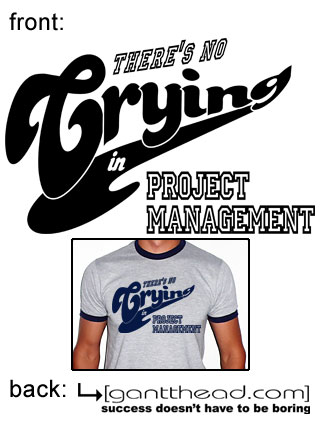  Several times a year, gantthead has a booth at trade shows where we talk about the site and give away t-shirts, luggage tags, umbrellas, CDs, and tons of other stuff that people will do almost anything for. It's amazing watching show attendees, five or six deep shouting out their shirt sizes, reaching past you, crawling under the table and snatching away anything that's not nailed down. Once this sort of mob mentality sets in, there really isn't much you can do about it. Several times a year, gantthead has a booth at trade shows where we talk about the site and give away t-shirts, luggage tags, umbrellas, CDs, and tons of other stuff that people will do almost anything for. It's amazing watching show attendees, five or six deep shouting out their shirt sizes, reaching past you, crawling under the table and snatching away anything that's not nailed down. Once this sort of mob mentality sets in, there really isn't much you can do about it. A couple of hours later, the shirts are gone and you start talking to people who are really interested in what you do. In the end it works out from a branding perspective though. You notice people wearing your shirts around the conference and for not much money, your name is everywhere. Startup Schwag is an online club that sends you a lot of the stuff you would bring home from a trade show, on a monthly basis. So if in the end, the only thing you really get out of going to a show is a t-shirt - this is a much less expensive way to get that done. |


