Time To Move PPM To The Cloud?


| Situation: You think "the cloud" could be a solution for you, but you're still not sure...
Q. When you talk about faster and less costly Project Server Deployments online, what's really driving the speed of implementation and cost savings? What are you giving up in return for those advantages when you compare it to a more traditional implementation? A. Hosted deployments lead to faster implementations by avoiding three main roadblocks commonly encountered in onsite deployments: i) procurement delays in acquiring new hardware (or software), ii) delays to approve software for deployment (often requiring IT to have the training to support it), and iii) security delays in granting consultants the access they need to configure a solution. By avoiding these delays, online environments become operational more quickly, saving money through more effective and efficient project and portfolio management. Online environments also save money by allowing customers to only pay for what they need – starting small and scaling as needed. The main things that customers give up in an online PPM environment are i) data being inside their corporate firewall, ii) integration to their onsite Exchange server, and iii) automatic corporate authentication. Some organizations will not consider online services in the first place, simple because their data would reside outside their firewall. But many organizations are OK with hosted project management information as long as the hosting provider has the correct security certifications (e.g. SAS70, ISO 27001, PCI). Although email alerts from Project Server and SharePoint work from online services, the Exchange integration that allows a user to update Project Server tasks from within Outlook does not work when connecting online PPM to onsite Exchange. Although it is possible to integrate online authentication with a customer’s corporate Active Directory, it does involve some customer IT work and is not automatic like in an onsite deployment.
Q. When do you have issues with security in the cloud? How do you ensure your PPM data in the cloud is secure? A. Security is (and should be) the number one concern of most cloud customers. Many customers have their own checklists, assessments, or surveys that ask all the questions they need answered to ensure the safety of their data. Others use standard checklists like those for ISO 27001 or FISMA (Federal IT standards). It is important to make sure that a cloud service provider has had their security audited by a third party and to be able to see the results. Some customers will even perform their own audits, which may include penetration testing (ethical hacking) and other verification techniques.
Q. What do you give up in terms of customization with a cloud based solution vs one onsite? Can you give some examples? A. If the cloud based solution is restricted to shared servers, then there are typically quite a few restrictions on customizations: One typically cannot add 3rd-party applications or custom webparts, and it may not even be possible to develop custom workflow or certain types of BI reports. If the cloud based solution involves dedicated servers, then the above-mentioned customizations are possible, but there may still be limitations with integrations to onsite resources where the integration requires everything to be in the same domain (e.g. Exchange integration to Project Server).
Q. What are the licensing challenges that you need to be aware of as you integrate your PPM cloud implementation with all of the other MS applications that are present in most organizations? A. If a customer provides their own licenses for a cloud solution (to reduce hosting fees), the customer will need to remember to account for those licenses along with their onsite licenses when they do periodic licensing “true-ups” with Microsoft. |

Do You Need a Project Management Survival Plan?
| Situation: You need a fresh perspective on Project Management in general.
Dave: How did you come up with the idea of applying survival principles to project management? Surviving is about achieving a minimum threshold –presumably in a difficult environment. Are you taking a project view that says, "achieve the stated goal and no more?" (I.e. - stay entirely within scope) Steve: A key to surviving many of life’s situations involves mental toughness. Essentially, knowing how to think through a problem and develop action plans. If you think about your project as a survival mission in which it’s your responsibility to save and lead members of your team to safety, you may change your approach to managing your projects. You may start to understand your team members better: their strengths, weaknesses, and the environment in which they perform best. You may also have a new sense of urgency considering what’s on the line. Many times on survival missions you only have one shot to get it right. You could say the same thing about planning and managing a project. If you don’t get it right up front, you may find yourself and the team in front of the CEO explaining the failure, missing customer expectations, and hurting your career. With the role of the project manager, there’s a lot at stake and no room to take chances. Corporations are counting on project managers more than ever. Dave, the view I am taking is that project managers, especially those involved with developing new and innovative products, must be mentally tough! Project Managers must mentally train themselves to think through alternatives before tackling any of them. As critical situations develop during a project, the project manager needs to physically stop and think to consider all their options. Next, they need to observe their environment and consult with their team members to determine the best plan of action - thinking through how the plan is going to be accomplished. A project manager must also know when to recommend stopping the project. Stopping isn’t something a lot of organizations do well. In a recent study, the Accept Corporation and the Association for International Product Marketing and Management (AIPMM) found that more than 60 percent of executives say they struggle making kill/ go decisions. There is a tendency to continue projects and activities even when most people involved realize it’s not an optimal use of their time. The S.T.O.P. principles were designed to ensure that critical thinking occurs in high pressure situations (sound familiar?). I have taken those same principles and constructed a framework for project management. Giving the project manager guidance and direction on what that minimum threshold should be for being successful if their project is viable – and if it’s not viable, then what it takes to stop it!
Dave: When we thing of managing scope, schedule, and cost we are really balancing those things against on another in many ways. In your version of the triangle, do you see project managers needing to balance value, team performance, and communication? How does that work? Steve: If project management is to survive as a profession, then we as project managers need to realize that our job is more than just managing scope, schedule, and cost – it’s about delivering value. The iron triangle still exists; don’t get me wrong. But to truly be effective as a project manager I believe a new triangle must emerge. A triangle based on managing value, team performance, and communication. I developed equations in the book to help identify and quantify the variables where more focus and management need to be applied on our projects. Let me give an example on how this works in regards to determining and managing project value: You’re raised as a project manager with a visual implanted in your head of a triangle that flexes and constrains as you move through your project. You force your sponsors to make decisions and tradeoffs against the three (scope, schedule, and cost), but based on what? The answer should be value. When creating, developing, and delivering a product to the market, you seek to maximize its value. You want to maximize the customer benefit and experience while maximizing the return on investment. When you adjust your perspective around the triangle like this, you realize it’s more of an equation based on deriving value. I call this the project management value equation. It’s designed to give context to “scope, schedule, and cost,” ensuring that you’re weighing all that you do against the overall value of the project and keeping your sponsor and team focused on the prize. Said another way, it’s an equation meant to quantify and assess the value of a project and identify — if value has been decreased — whether the project should be stopped. The equation is the following: Value = Scope ÷ (Schedule + Cost) By understanding this concept, you bring more depth and meaning to what you really need your sponsors to trade off against. By assigning a value to each of your success criterion, you in essence are quantifying the value of the project. Increases to schedule and cost will decrease the value of the project if more scope is not being delivered to offset it. Ensure that your scale for scope, schedule, and cost are the same. Assigning either a percentage value or using a 1–10 scale can work if each variable is quantified consistently. The idea is that, at the start of the project, as you determine its overall value, it should equal 100 percent. As tradeoffs are made between each of the three variables, the project value will change. Together with your sponsor, determine what the threshold value is for stopping your project.
Dave: Can you give us your top 3 tips for understanding and creating value on projects? Which tools do you apply and why are they important? Steve: You bet, they are the following:
Dave: Can you give us your top 3 tips for managing team performance on projects? Which tools do you apply and why are they important? Steve:
Dave: Can you give us your top 3 tips for ensuring effective communication on projects? Which tools do you apply and why are they important? Steve:
|

Do You Need a Delegation Document?
| Situation: It's unclear which decisions you can take and which ones must be escalated.
At their best, a good delegation document will:
Our version helps you record decision-making authority for the following types of decisions:
We've seen various types of delegation documents and developed our version of a template this past week (a premium template, available to all gantthead members through 1/15/2012). If you think you might find it useful, take a look at the template and tell us what you think.
|

T- shirts Seem to Be All the Rage
| Situation: Ya need something casual to wear that makes a PM statement. I just noticed on facebook that PMI is promoting a new set of T's. Here's the announcement and link -
‘Rome Wasn’t Built in a Day. They Should’ve Hired a PMP” t-shirt: For team members with a PMP® credential.
Of course, I tend to favor our gantthead T's - but I think it's great that you now have more PM fashion options. If you're interested, the PMI shirts can be found here. Our t-shirts are of course, in the gantthead shop. You also get a free one if you sign up for a Premium Plus Membership. Here's a few of them...
|
 Show off your project management pride! Reward your favorite project team members with new T-shirts from PMI!




Do You Need a Team Operating Agreement?
| Situation: Team members keep stumbling over simple, common sense, standard practices.
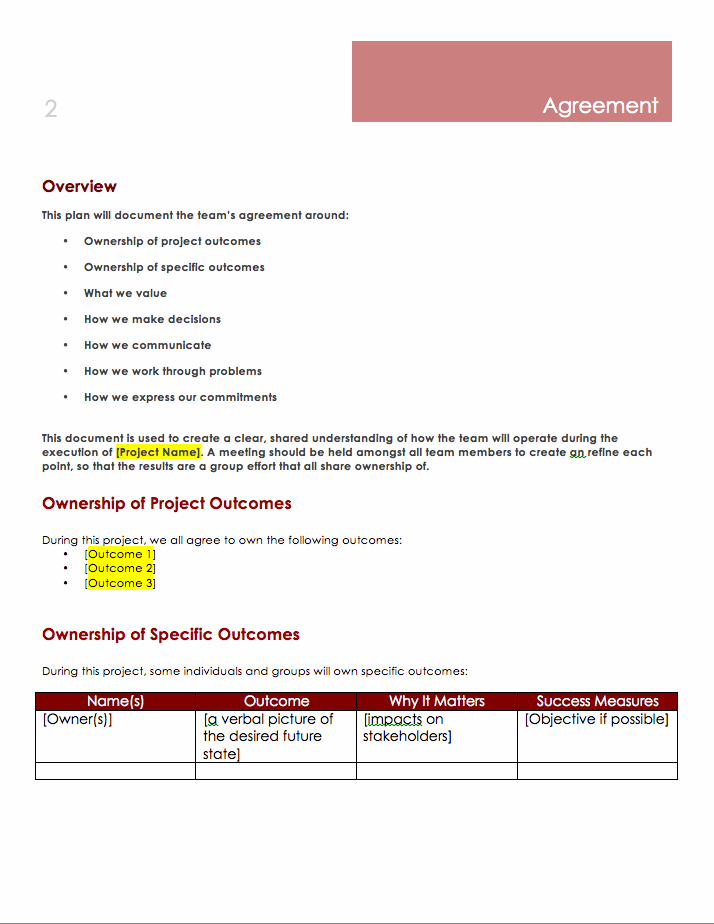
Yesterday we went through the process of updating the TOA template we have here on gantthead (usually available only to premium plus members, but freely available to all registered members through 1/15/2012) and we added a few items that you see listed in bold below.
In my opinion all of these things are important, but as it is with so many other things, the more important part is not the document - but the process of having built it collaboratively. It's that collaborative process that gets you real buy-in to the principles you lay out in the agreement. The signature is just a formality. If you have a moment, come take a look at the new version of our template and let us know what you think. What do you think should be in a Team Operating Agreement? What's a waste of time? How do you make the collaborative process of building the document work? |