Hope-less
Categories:
Philosophy
Categories: Philosophy


|
It is not difficult to understand why we depend on hope so much. As we have seen, it is a natural part of us to be optimistic. This is especially true when there is nothing left behind and hope is the only grip that we can hang on to. Furthermore, for the worst of it, hope is free and it doesn’t cost us a dime to hope. This costless characteristic of hope turns out to be the glue that got us all stuck and addicted to it, and occasionally abusing it blindly. All these manifestations of hope seem to fit extremely well into a single sentence that William Shakespeare wrote – “The miserable have no other medicine, but only hope”. Yet, there is nothing wrong with hope. “Hope is a waking dream”, said Aristotle. Without hope, most of us will collapse easily. In fact, it is the sole motivator that gets us moving most of the time. The problem with most of us is, we tend to take it for granted. While it is so easy to hope, we often jump into it too easily and readily without knowing that we will get drowned and never want to get out. In other words, we are extremely obsessed with and addicted to hope. The side effect is we become too passive, intoxicated and paralyzed. What should we do then? In order to address this, I would like to borrow from the philosophy of Albert Einstein – “Learn from yesterday, live for today, hope for tomorrow”. Fitting this into the context of project management it means that whenever we are stuck with a problem, we should not just sit there and hope for fairy godmother to get us out of the mess without doing anything. What we should do is to find out what went wrong and learn from the mistake. If possible, we should apply the knowledge we have acquired from our past experience to solve the problem. Bear in mind that we should not just sit on the problem. We have to rally everyone we know and utilize every resource we have to work on the problem. Pull all the brains together into a brainstorming session and produce an action plan. Distribute the tasks out and get everyone starts working on the action items assigned. Review the results with the team at end of the day. We may not have solved the problem completely, but at least we have tried to live for today. The last thing we have to do when we have done everything we could to salvage the situation is to have our fingers crossed, tell ourselves that we have already done our best and keep the hope on for tomorrow. Remember, the problem is not with having hope but having too much of it obsessively. Below is a poem that I wrote to sum it up.
|
 Have you ever found yourself stuck in an extremely screwed up project that sucked up the very last bit of energy in you and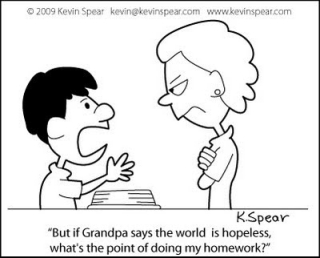
Forward Me Not...
Categories:
Technology
Categories: Technology
| Email has become an integral part of our live. Most of us use email as the default mode of communication in projects too. However, the abuse on email usage has reached a level that we often find ourselves caught in a situation where we need to catch up with torrent of emails flooding our inbox on a daily basis. This is due to the fact that email applications are so easy to use that sending a mail is just a click on a button regardless of how many people you are sending to. For this reason, many people have developed a habit of pressing 'Reply to All' or 'Forward' to have their email copied to many, somehow unrelated, people. People do this for various reasons without understanding the consequences and impacts that these actions could have on others. One good example is confidential email accidentally forwarded to people who shouldn't have seen it. Another good example is people in the CC list busy clearing emails in their inbox just because of two monkeys actively exchanging email conversations on a personal topic through the 'Reply to All' button. Fortunately, there might be an end to all these email nonsense. I recently stumbled across this nifty tool "NoReplyAll" developed out of Microsoft Research (click here to download the tool). It does what its name says exactly. After installing, it creates extra buttons at the end of the ribbon in your Outlook as shown in the diagram below.
Say goodbye to the embarrassing moments due to missing subject line or attachment… |
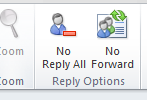 As the names suggest, clicking on these buttons will prevent recipients of your emails from performing those two actions; clicking again toggles the relevant option's state back again. However, this is not a strong and tight control as there are still ways to circumvent the control mechanism. I leave it to you to find out. Hence, do not take this tool as a strong security control to prevent your recipients from forwarding your email to other people. It is just providing a nice and convenient feature for your Outlook to prevent recipients to reply-to-all or forward your email to others. This could potentially help to reduce the problems related to abuse on email usage described above. On top of these, this tool also includes a smart feature that reminds you when you send out an email with a blank subject line. There is also a similar feature that scans the contents of your email for words like "attached" and "attachment" and warns you to include your attachment if any of these words are found.
The SMART Question
Categories:
Education
Categories: Education
| I came across this interesting dialogue few years back.
For example, I once came across a print on a mug that says – ‘Failure is not an option’. Speaking the lingua franca in software development industry, most software developers will interpret the phrase ‘not an option’ as ‘mandatory’ since anything that is not optional to them must be mandatory (you will know what I mean if you have ever tried filling up an online form where all fields with a star ‘*’ are mandatory and the rest are optional). In other words, a simple and positive statement like ‘Failure is not an option’ may turn out the opposite way as ‘Failure is a mandatory’ if it is not interpreted correctly. If you think this is funny, it only gets worse when the whole event of requirement gathering is to be conducted in a multicultural and multilingual environment where the differences in culture and language pose to be a challenge in communication. Still not convinced? Take a look at some of the funniest Chinese-to-English translations at Engrish.com. “The ability to ask the right question is more than half the battle of finding the answer”, once said Thomas J. Watson. How true this statement is. Yet to be able to ask the right question, it takes more than just addressing the 5 Ws mentioned earlier. At the very least, your question should be SMART – Specific, Meaningful, Appropriate, Relevant and Timely. On top of all these, you still need to close the loop. You need to make sure that the person fully understands your question before he or she attempts to answer it. One way to achieve this is to ask the person to explain your question back to you. Listen carefully to what the person says and clarify any dubious points immediately. Keep in mind that all of us come from different backgrounds and something that looks common sense to you may not be very obvious to others. The important point is to keep your question SMART to avoid ambiguity. Occasionally, people may like to ask questions which no one is able to answer and they feel great about it. Some of those who are more egotistic actually feel intellectually superior and excited when no one is able to understand their questions. Honestly, asking a question that is difficult to answer is no big deal. The real challenge is how to raise a question that is simple enough that everyone, from the CEO sitting in the corner room to the pantry lady, is able to understand and hopefully, provide some good answers. Anyway, at the end of the day, what is the point of asking a question that you can’t find an answer? Keep asking SMART questions, and not questions that make you look smart. To ask a hard question is simple. However, to ask a simple question is hard. |
 Sometimes, asking question in a wrong or unclear way may confuse the listener and in some cases, create unnecessary misunderstanding. Asking question is an essential skill required in the requirement gathering task in most projects. It is a soft skill that looks simple on the face of it (who doesn’t know how to ask question?) but extremely difficult to master. One useful guideline that may help to improve effectiveness in the communication is to focus on the 5 Ws (What, Why, Who, When and Where) in your question. First, you need to consider what to ask in your question and how to phrase it and decide whether the question should be open-ended or specific and direct to the point. You need to keep asking yourself why you need to ask the question and whether it is appropriate and adequate. Then you must also make sure you are asking the question to the right person, at the right time and right location. The approach you use and the words you choose in your question are also critical in order not to leave any room for ambiguity. If there are any special terminologies or idiosyncrasies that are expected to be used in the conversation, they have to be clearly defined and communicated up front to everyone to prevent unnecessary confusion.
You Got to Have Style!
Categories:
Business
Categories: Business
|
On the other hand, the kind of talents that you can attract to your team is very much dependent on the leadership style you display - just like bees to honey while flies to dung. This explains why companies like Apple Inc., while remained boring and nearly out of the competition for a decade, still managed to make a great comeback when Steve Jobs returned in 1997 attracting and establishing a legion of creative talents in his core team, which includes Tim Cook, Jonathan Ive, Ron Johnson and Scott Forstall, that are responsible for Apple’s bleeding-edge products like iMac, iPod, iPhone and iPad. Try looking around and I am sure you will find a lot more similar examples that go with the old saying – “birds of a feather flock together”. Now, let’s get back to the topic on leadership styles. Over the past century, researchers have developed a lot of theories and frameworks attempting to understand and classify different styles of leadership. An article from Mind Tool – “Leadership Styles: Using the Right One for the Situation”, provides a good compilation of the 10 most commonly employed leadership styles. The article also suggested that there is no so called ‘the best’ leadership style. A more pragmatic approach will be for the leader to know how to apply the right style, or a mixture of styles, for the right situation. Nevertheless, it is a good starting point for you to explore what are the leadership styles available and which of them fits into your personality and immediate situation. If this is not enough to convince you, I’ve recently stumbled across a rather unique book “As One: Individual Action, Collective Power”, by Mehrdad Baghai and James H. Quigley, based on the “As One” project initiated by Deloitte to study effective collaborations. The project has discovered that there are many modes of collaboration ‘As One’ behavior and that all are effective in certain contexts resulting in the definition of eight archetypes of leaders and followers: Landlord & Tenants, Community Organizer & Volunteers, Conductor & Orchestra, Producer & Creative Team, General & Soldiers, Architect & Builders, Captain & Sports Team, and Senator & Citizens. In other words, it reinforces the notion that there is no one-size-fits-all leadership style. The approach taken in the project started with reviewing hundreds of perspectives on collective action taken from a variety of academic disciplines, including science, economics and psychology, and pulling together 60 detailed case studies to analyze successful collaborative efforts, asking a set of questions for more than 100 factors about those organizations, such as their structure, systems and processes, leadership, and how they communicate. There is a companion “As One” website set up for this project. For those of you who would like to discover a little bit more about your style of leadership, I encourage you to try out their online Archetypes Classifier to find the archetype in you and which is the most suitable mode of collaboration that best fits your situation. Remember this for your next project – ‘while your team is what you are made of, the situation determines who you should be’. So now, what’s your style? |
 Throughout the years of running a PMO, I have come to learn that “your team is what you are made of”. There are various styles of leadership, and different people are attracted to and inclined towards certain leadership styles. In my opinion, there won't be one-size-fits-all or so called 'best style' of leadership. The leadership style that will be most effective really depends on the environment you are in and the things you want to achieve. In other words, it is situational rather than personal as advocated by
Project Management Pictogram
Categories:
Culture
Categories: Culture
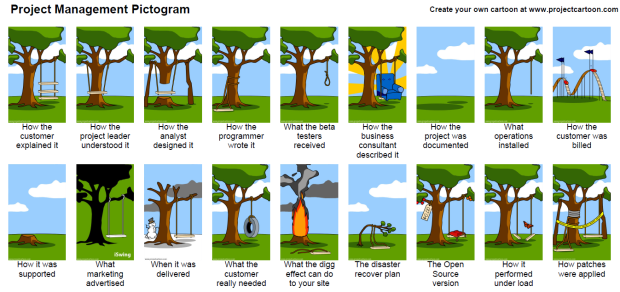
| This is a very popular and humorous illustration of various classic scenarios in project management. I am sure you will find them familiar. For those who have not seen it before, click on this link to download the original high resolution copy. Have a good laugh!
|