


Lessons Learned: Don’t Be Afraid to Share Responsibilities


|
By Yasmina Khelifi, PMI-ACP, PMP There’s no “I” in project team—or volunteer. While volunteering on a 2021 forum for an association, I was assigned to work with a new volunteer. At the outset, I had some reservations. Throughout the experience, however, I gained knowledge that I can now apply to collaborations with my other project teams. I’ve outlined some lessons learned that will help you open yourself up to more collaboration in your volunteer efforts (and become better project leaders in the process): Lesson 1: Get over yourself. When the project manager first proposed to me that I find another volunteer to help manage the forum’s communications, I had to confess I was not particularly enthusiastic, despite the high workload ahead of me. Why? I enjoyed hogging the spotlight, I took more pride in managing alone and I thought it would be extra work to synchronize my efforts with someone else. But after I made the effort to connect with a fellow volunteer, I came to some realizations that showed me how wrong I was. I discovered she was a specialist in communications and marketing, which I am not. Because of her background, she was able to bring fresh perspectives and challenge my views. She also prevented me from being a bottleneck by sharing in the labor and compensating as needed. Finally, she forced me to look more closely at my delegation style in a safe, low-stakes environment, which helped me to grow as a better leader overall. This collaboration revealed a rich tapestry of lessons learned—ones I wouldn’t have experienced had I not opened myself up to the idea of working with another volunteer. Lesson 2: Embrace a different mindset. During your volunteer experience, seize the opportunity to challenge yourself:
Sharing responsibilities does not mean micromanagement. It means learning to trust, learning to give autonomy and learning to oversee. Conversely, giving team members space does not mean pushing them into the unknown without a safety net. Make yourself available and accessible to assist, encourage and explain, as needed. Lesson 3: Think about the future. By working with others, you can contribute to the growth of the next generation of leaders—and that’s rewarding. You will revel in helping them demonstrate their value. I once was in a small language association where the president managed all alone, complaining he had too much to do. When he left, the association died with him. Do you want to be remembered in that way? On a pragmatic side, motivated volunteers with increased responsibilities improve the retention rate, help the association avoid falling into a rut and, more importantly, cement stronger ties, strengthening the feeling of belonging and inclusion. Be a part of shaping that future. Lesson 4: Work toward change in increments. You can’t reshape the organizational culture overnight. But you can take small steps to make a difference:
Sharing responsibilities will bring unexpected benefits for yourself, your co-volunteers and the association. What are some lessons learned you’ve taken from volunteer experiences? Share in the comments below. |

The Not-So-Secret Ingredients to Success? People and Purpose
|
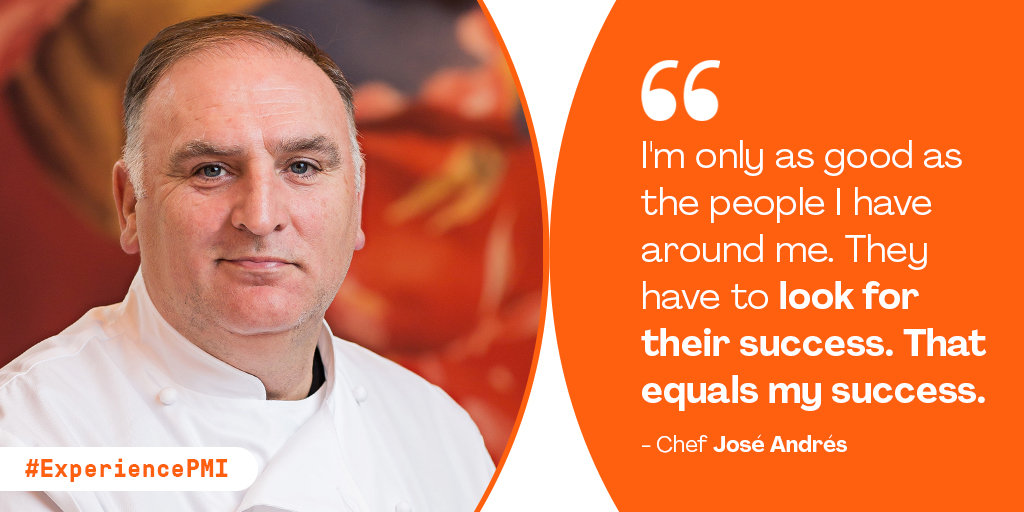
By Cyndee Miller Whipping up tapas and shaking cocktails isn’t your typical day in Project Management Land. So why was I watching master chef José Andrés prepare seafood delicacies as PMI President and CEO Sunil Prashara played mixologist? It was all part of the fun—and the learning—at the first gathering in PMI’s Virtual Experience Series: “My Work. My Life. My World.” Not to sound too much like a fangirl, but I went into the conference really looking forward to the presentation from Andrés. (And no, this wasn’t just about his salt air margaritas). This fellow is one impressive manager of projects. Not only does he helm more than 30 wildly popular restaurants, he’s also creating super-smart solutions to hunger and poverty through his non-profit. Along with the group’s disaster-relief efforts around the world, it also stepped up its response to the COVID-19 crisis, delivering 150,000 fresh meals in dozens of U.S. cities every day. How does he do it all? Well, along with demonstrating how to create some tasty tapas from his home in Spain, Andrés also revealed his personal secret sauce: You’re only as good as the people around you. To have success, you have to provide others with the opportunity to succeed, Andrés said. That means teaching them how to adapt. While projects certainly require planning, there are just too many variables in the world to cover everything, he said. And often, the one you didn’t plan for is the one that happens. “The communities that will be successful today will be the ones that are ready to adapt to any circumstance,” Andrés said. Sometime that means breaking out of the same old patterns: “Don’t be shy of big, bold ideas,” he said. “This keeps you going. This keeps you motivated.” The idea that people and purpose are “critical to business success” as the hype goes is not exactly earth-shattering. But what struck me was how the concept resonated just as much with a superstar Spanish chef as it did with a strategic lead at a U.S. healthcare giant. “People are what make things happen,” said Wale Elegbede, PMP, director of strategy management services at Mayo Clinic. That’s true whether it’s putting together small plates in a Spanish restaurant or transforming a big company. “We’ve seen in our research that the successful organization sets itself apart from others by transforming not just the organization, but the employees,” explained Emil Andersson, a project manager at The Brightline™ Initiative. And those people need purpose. “The biggest mistake we make in any type of gathering is we assume the purpose is obvious,” explained Priya Parker, author and host of podcast Together Apart. “Always start by stating the purpose of a meeting. And then connect people to the purpose—and to each other.” That’s especially true for next-gen team members: Millennials and Gen Zers need to “work for purpose, not just a paycheck,” said Foodeo CEO Marcel Furmie, PMI-ACP. To create a team of true changemakers, though, project leaders must build trust. “Trust provides a sense of safety,” said Dan Mircea Suciu, PMI-ACP, of Babeş Bolyai University in Cluj-Napoca, Romania, during a presentation on the neuroscience of project decision making. “And when team members feel safe, they’re more productive—and more comfortable taking appropriate risks.” Missed out on the action this time around? Tune in to the next Virtual Experience Series event on 25 August with The Daily Show host Trevor Noah. I’ll be there. In the meantime, let me know in the comments below: How do you help the people around you succeed? |
The PMI Future 50 Delivers Action—and Hope
|
By Cyndee Miller Greta Thunberg isn’t messing around. Joining forces with three other young climate change activists, she called on political leaders last week to stop talking and actually do something: “Our current system is not ‘broken’—the system is doing exactly what it’s supposed and designed to be doing. It can no longer be ‘fixed.’ We need a new system.” For many people, taking on such massive issues can be overwhelming. And even the mighty Thunberg admits to Reuters she was “very worried” when she first began. “But when I started doing something, then there came hope from that. Because hope comes from action.” Hope comes from projects. Thunberg is part of a new generation of leaders who see that potential—and are using it to transform and define the future. Unflinching in the face of change. Naturally collaborative. Digitally fluent. Deeply committed to social good. Constantly learning. This is the PMI Future 50. And they’re coming in with their own POV on building a better workplace—and a better world. There’s architecture activist Pascale Sablan, determined to right the social injustices embedded in design. Alagesan Hanippuya, PMP, is forging a fintech future in Southeast Asia. Tiago Chaves Oliveira, PMP, is pushing for more creativity and innovation in Brazil’s government. Gregory Daniels, PMP, is helping Zoom manage a 30-fold traffic surge amid the COVID-19 crisis. And there’s Thunberg, too. They’re all putting their own stamp on the future of work and how projects get done. Deloitte reports nearly half of millennials and Gen Zers prioritize making a positive impact on society, for instance. And 32 percent of Gen Zers say they’re motivated to work harder and stay longer at a company if they have a supportive manager, per The Workforce Institute. It’s common enough advice for leaders, but this new cohort is determined to put it into action. “We need to take care of people. Just asking for results will not work. We also need to try to understand their needs and their perspectives and to encourage each person to ask critical questions,” says Gabriel Costa Caldas, director of operations at GPjr, Brasília, Brazil. This also means a shift in the most in-demand skills. “I would expect big-picture thinking, creativity and empathy to play an even bigger role in successful project management,” says Miishe Addy, CEO of Jetstream Africa, Tema, Ghana. Read more about the youthquake and meet all the Future 50 leaders in a special issue of PM Network® and in a series of videos and digital exclusives. (Pro tip: This is a multimedia affair to be enjoyed. Flipping through the pages of the magazine is a grand experience where you can take in everything and everyone at once, along with loads of pretty pictures. Check out the digital profiles and you’ll find most have Q&As at the end with some content that doesn’t appear in the magazine. And the videos let you see and hear these leaders in action.) How is the next generation of leaders transforming your organizations and industries? And who gives you the most hope for the future? Fill me in in the comments. |
Contingencies Are Not a Soft Option
| By Lynda Bourne
In my last post, The Real Estimating Challenge Isn’t Calculating the Cost, I suggested that calculating a project cost estimate is the easy bit. Having the estimate accepted by either a client or your management—or both—and then delivering your project on budget is far more difficult. In this post, I want to look at the challenge of delivering on budget. Knowing what a project is likely to cost is important from every perspective: personal, professional and organizational. But developing a realistic and achievable cost estimate has two components: first you develop the baseline estimate, then you need to develop a realistic contingency. Most people do step one; very few even think of step two. The baseline estimate should be realistic, and there are many valid approaches to creating one. But what comes next? If you simply stop at the net cost estimate based on expected resource usage and known cost rates, your project will inevitably overrun its budget. There are no allowances for risks, which will inevitably arise during the course of the work. No project is ever risk-free. Risks are uncertainties that matter. From a cost perspective this includes both variability in estimates and performance, and uncertain events that may or may not occur. Managing Variability Variability is inevitable. The work might be completed quicker or slower than planned, people might change and cost more or less per hour, etc. The only certainty is that the actual cost outcome will vary from the estimate. The key question is: by how much? Use past performance as a guide to size this part of the contingency appropriately. Managing Uncertain Events This type of uncertainty is the realm of the risk register and its list of identifiable uncertainties, overlaid by other risk events that were not foreseen. These are the known unknowns and unknown unknowns of risk management. This type of risk can be mitigated or reduced by good practice, but neither of the unknowns can be eliminated entirely. Residual risks always remain. The important question is: How do you compensate for the remaining risks in your business case or cost estimate? One approach is to pad the estimate and hide the costs within the overall price. The problem with this approach was identified by Eliyahu Goldratt in Critical Chain (1997). He stated that when the contingencies are hidden, they tend to get absorbed by the work and are generally larger than needed. This is not a good way of working. For example, in developing software every test may fail, but only some will identify bugs that need fixing. Padding every test with some allowance for failures hides the money, and it is likely to get used anyway to cover all sorts of other events. The better approach is to price each test on the assumption that the test will pass, and then create a contingency for bug fixes. This allows the cost of rectification to be seen, monitored and controlled independent of the costs associated with testing. If the number of bugs is too high, this becomes obvious and allows management to consider ways to improve processes. Managing Contingencies Calculating the amount of money needed to adequately cover the risk exposure of the project is complex. It requires expertise. But once this has been done, the values calculated should be divided into two distinct parts:
These are not slush funds. They are calculated and held for explicit events that may occur and the use of the funds is constrained, controlled and reported on throughout the life of the project. Summary Developing a sensible level of contingency and reserve is a complex process and beyond the scope of this article. The message is simple, though: If you do not include contingencies, you will overrun your project budget! The bigger challenge is to convince management to accept the need for a properly evaluated contingency in every project. Achieving this requires the solutions outlined in my last post, linked to a concerted program of support from both the organization’s PMO and its portfolio management team. The challenge is not insurmountable. Large parts of the U.S. government under the auspices of the Government Accountability Office are mandating this approach, and the U.K. treasury has its Green Book. Your challenge is to inspire similar attitudes within your organization’s senior leadership team. How does your project team develop realistic contingency plans? |

The Power of Diverse Project Teams
|
By Yasmina Khelifi, PMP, PMI-ACP I first experienced the transformational impact of diversity during a six-month internship in Japan in 2000. The experience made me question every action and learned behavior I had previously made without a thought: how to greet people, how to make a request, how to thank others, how to celebrate, how to apologize and, more importantly, how to collaborate. It opened the door to a stunning new world. Since then, I’ve reveled in managing projects in an international environment. Diversity on project teams is an invaluable source of innovation and growth for individuals—as well as for projects. Personal Benefits of Diversity Throughout my career, I’ve been afforded the opportunity to work in diverse and inclusive environments. And I've learned so much as a result. First, these experiences taught me humility: By delivering projects in the Middle East and Africa (MEA), I’ve worked with people who speak multiple languages and learned how to collaborate with people from different cultures, ethnicities and backgrounds. These experiences also helped me question the status quo: For example, in my technical field in France, few of my colleagues are female, while most of my Chinese colleagues are female engineers. My sense of empathy was reinforced: Technical or political constraints can disrupt projects, but despite it all, the teams worked hard to meet their goals. These experiences also ignited my curiosity and encouraged me to broaden my views. I learned to ask open-ended (non-judgmental) questions and to fight against biases. Surprisingly, interacting with people in other cultural environments also pushed me to better understand my own culture and myself. This introspective journey forced me to step back and grow into a more dynamic, informed and empathetic project leader. Project Benefits of Diversity Diversity isn’t just about ethnic or cultural differences—it also means embracing people with varying ages, gender identities, professional backgrounds and levels of experience. For example, when I first began to work as a project manager, I had a team member close to retirement. His role was instrumental in the team: He calmly listened to our issues and acted like a mentor, sharing his experiences to help guide our decisions. Conversely, I wanted to improve a project status, but I did not know how. I talked to a younger colleague, and he offered to review it. I surprisingly discovered he was proficient in designing documents. A few years ago, I worked on a very diverse team, as far as background and experiences are concerned. They were not engineers; some had marketing backgrounds, others were not college graduates, one studied history and managed the supply chain. During our working sessions, we often strongly disagreed and faced various misunderstandings. But I cherish these projects, because we worked collaboratively to reach a compromise, despite our differences. It also fostered a feeling of belonging and true team collaboration. Diverse project teams force you to explore and adopt new ways of working. When I began to work in MEA, I discovered new digital communication tools that allowed me to forge a bond with my team and deliver project information to remote team members. Being inclusive brings fresh perspectives that enhance creativity and spark innovation. It also keeps your project team from falling into a rut of the same old ideas and solutions. Don’t Fall into the Diversity Trap Let’s be clear about the diversity business case. Hiring someone only for the sake of diversity is counterproductive. When I was hired as a SIM Delivery Manager for MEA, a new colleague assumed it was because I speak Arabic. Unbeknownst to them, I cannot speak Arabic. But I do understand project management. Reducing my experiences and knowledge to a cultural fit was demeaning and hurtful. Undoubtedly, knowing a language and a culture helps to build trusting relationships and offers a competitive edge in our global environment. But this cannot make up for a lack of project management skills. Inclusion must have a rational and objective basis:
The desire to boost public image or sway public opinion to appear open-minded and tolerant will not add value. Instead, work to embrace qualified individuals who bring something fresh to your team. How do you foster and celebrate diversity within your project team? |



