4 Essentials for Leading Remote and Hybrid Teams


|
By Emily Luijbregts During my presentation at this year’s PMXPO, I received a lot of questions about the skills needed to adapt to and excel in leading virtual teams. It seems to be something that a lot of project managers are struggling with at the moment, but it’s something that can be easily learned. It all begins with building a strong foundation. First, make sure you understand each team member’s motivations and ambitions. If you do this, you’ll be able to better predict or know when there’s something wrong. If someone on your team is focused on receiving positive feedback, for example, that person may get demotivated or stressed when they don’t receive praise or are criticized. But if you don’t understand the root cause of this issue, you only see the person struggling. You might be aware of Bruce Tuckman’s theory on team development in which teams move through five stages: forming, storming, norming, performing, adjourning. Do you know where your team members are right now? Where they’re struggling? What are their weaknesses? If you can look at this, you will be able to see the best way of managing them successfully. Some teams won’t follow a linear pattern: They may regress during times of stress, the duration of the phases will not be identical and there may be times when it feels like they’re going through several phases in one day. Once you’ve built your foundation, here are four more tips for managing remote or hybrid teams:
You need to define how the team will communicate and establish why it’s important to follow the protocols but also understand any restrictions. Someone might not have access to a webcam or have bandwidth issues due to unstable internet connection, for example. I recommend creating a team charter so everyone buys into the rules being agreed upon.
One of the most important skills right now is being able to build a team even as people are working remotely or in a hybrid environment. How can you do that? Icebreakers allow team members to open up about themselves and share common interests. Or you can try to gamify project activities. If you use agile, for example, ask team members to estimate how many tasks they think they can complete by the end of the sprint.
This is a really difficult skill to master, especially with remote team members as it’s even easier to get distracted. But try to take copious notes, ask follow-up questions and make sure the team has the opportunity to speak. If someone doesn’t have anything to say, try asking a future-looking question like: What are you aiming to complete in the next week? Where do you need support in the next period? In remote settings
What are you communicating? How are you communicating it? Is it the best way? Most importantly, how can these messages be sent with clarity through the remote-work ecosystem? You can monitor how well you’re doing through daily check-ins with your team, stand-ups or individual calls. But be sure to be patient with your team—and yourself—as you navigate virtual communication. What are your lessons learned for leading remote/hybrid teams? |

What Does It Take to Build a Successful Project Team?
Categories:
Teams
Categories: Teams
| By Lynda Bourne
I was recently involved in a discussion about why some projects fail and others succeed, even when they’re completed in similar circumstances. The most common determinant of project outcomes—both positive and negative—boiled down to the way the people delivering the project work together. A cooperative and committed team underpins success. This led me to think about the key requirements for creating a committed and cooperative team. And while the concepts below aren’t new, consistently creating the environment to allow them to flourish can prove challenging. In my opinion, the three most important factors are: 1) An agreed-upon objective: Defining the project objective in a way people understand is the starting point. For one person, a “great website” may mean a technical marvel with all the bells and whistles. But for someone else, it may mean a simple, easy-to-use presence. It’s up to project leaders to get the team aligned—committing to an objective that’s not going to be delivered creates disenchantment. 2) An efficient team organization. Options can range from self-organizing teams to traditional leader-follower models. What really matters is that the team works in a coordinated and organized way, and this requires good, multidirectional communication to work. 3) Trust between team members. This last element is probably the most important—and least understood. You don’t need to like someone to trust them. In fact, you don’t even need to know someone to trust them. In an emergency, for example, it’s common to see a group of strangers form into a self-organized team and work together—often in quite dangerous situations—so things are stabilized. This is often referred to as “swift trust.” More traditional trust builds on reputation and observed experiences. Either type works, but you need trust. Without that, you’re not going to rely on the other people in the group to do the right thing to help you and the rest of the group achieve your shared objective.
In the modern world, people work on projects in all sorts of ways: virtually, in agile scrums, in traditional hierarchical teams and in myriad groupings. The people may come from one organization or many. Regardless of the group structure, one thing remains true: Project success comes down to effective teamwork.
What are your tips on creating an environment that allows project teams to flourish? |

3 Backlog Pitfalls to Avoid
|
By Christian Bisson A key artifact for any successful team is a healthy backlog: a list of what’s needed to bring value to the project—written in a way the team can understand and ordered so the team is always focused on what brings the most value. Yet between all the user stories, enabler stories, technical stories, bugs, defects and so on, it can be quite challenging for a product owner to order all of this properly. Here are a few (ineffective) ways I’ve seen it done: Pitfall 1: Prioritizing what’s understoodProduct owners tend to be less technical, and not everyone can properly explain something technical in a way that conveys its value. The result is that items the product owner understands well are prioritized, leaving the other items on the side, which comes with a great long-term cost. Pitfall 2: Going with instinctI once heard the following about an item: Its value depends on how we feel that day. When people rely on pure gut feeling, the value of an item will vary depending on their emotions at the time. That means the decision of what will bring value to the product is more or less random, often resulting in leading the team to work on items that end up being pure waste. Pitfall 3: Leaning into the noiseSome people even order their backlogs based on who complains the most! This merely encourages a culture in which whoever screams the loudest gets what they want. So what works? There are many ways to take a more mathematical approach to giving value to items. What’s critical is to have an approach that allows the team to properly calculate the value of each item, regardless of what type of item it is. With clear guidelines, all three pitfalls can be avoided—and the decisions can be based on something more reliable. How do you define the value of your backlog items? |

Are You Doing Enough to Encourage Knowledge Sharing?
|
By Yasmina Khelifi, PMP, PMI-ACP, PMI-PBA Sharing knowledge has so many benefits: It’s at the heart of business continuity. It boosts team morale. It creates a culture of continued learning. It connects remote employees to crucial information. It encourages the flow of ideas and can even challenge the status quo. From my point of view, it’s part of being a project professional. As a leader, you can set the right example and get team members in the mindset of knowledge sharing. If it’s presented as a norm, the team follow your lead and carry this behavior to other projects and teams within and outside of the organization. So why isn’t it always practiced? Because it’s difficult. A few years ago, I joined a new technical team, replacing a contractor. During our handover period, we met regularly to discuss the transition, but he didn’t keep much documentation and his explanations weren’t clear to me. I had difficulties grasping the big picture. At the same time, I met the new manager regularly. But he was a true servant leader—trusting his team members—and so he didn’t have the details I needed. And the rest of the team seemed preoccupied by their headphones. (I’ve gained a reputation for asking many questions, so I thought they were afraid of investing too much time in sharing information with me.) Throughout my 20-year career, I experienced some reluctant behaviors. People don’t directly say “no,” but they demur through:
What’s crucial is to get team members to officially agree that they will contribute to sharing/explaining knowledge. But how do you secure that buy-in? I’ve found one-on-one meetings are the best strategy for reluctant colleagues. Being visual and sharing information live—away from the computer screen—also helps people focus. A few years ago, I needed an expert’s help on a new service set to launch. As I knew he balked at sharing knowledge, I organized a face-to-face meeting with him. I arrived one hour before the meeting and wrote the different topics and the questions on a big whiteboard to ensure we stayed on task and maintained clarity. Another thing to keep in mind: Subject matter experts often have scarce availability, so be sure to clarify your intention from the outset of the conversation and highlight the benefits of knowledge sharing. Your goal isn’t to step on anyone’s toes, rather to get information for a given purpose. And you have to create a safe environment to foster that type of collaboration. As a project professional, you’re responsible for devising strategies to get the information and keep it flowing across silos. There’s no silver bullet, but efforts pay off in the long term. How do you foster knowledge sharing within your project team?
|

Wanted: Innovators (And It’s Okay If They Fail Sometimes)
|
By Cyndee Miller No one could have possibly made it through this pandemic unchanged—as a person or as a professional. Existing skills have been put to the test and new ones were developed along the way. Sometimes it was something relatively simple like mastering the mute button. Other times, it was a gamechanger, like learning no-code and developing an app or two. The basic idea? To move forward, we all had to let go of business as usual. That includes letting go of the antiquated notion that somehow you can pursue breakthrough innovation without a massive flameout every now and then. It happens. It’s how you respond that matters. “Failure is the best teacher,” said Wladimir Klitschko, PhD, as he opened PMXPO, the latest in PMI’s Virtual Experience Series. An Olympian gold medalist at age 20, the heavyweight boxing champion has consistently used his losses an opportunity to learn. These days, he’s an author and business leader—and was more than ready to go a few rounds on overcoming challenges to transformation with PMI President and CEO Sunil Prashara. “I love challenges. I eat them for breakfast, lunch and dinner. That’s my food for thought, for life, for energy, for everything,” Klitschko said. He outlined four principles for transformation: focus, ability, coordination and endurance. And through his Klitschko Foundation, he’s driving that message home to young people: “The more they learn, the more secure they’ll feel,” he said. “The more knowledge they have, the better they’ll execute their plan.” Part of that knowledge base will no doubt be linked to emerging tech. But digitalization was created by people to simplify life, Klitschko said, and we shouldn’t forget the human side of technology. That means developing technology that actually delivers value. And one of the emerging ways of doing that is through citizen development, using low-code/no-code platforms to build apps without software expertise—and to do it significantly faster and at a fraction of the cost. It’s like when your boss says: Don’t bring me problems, bring me solutions. Well, citizen development “allows you to bring an actual solution,” said PMI’s Chief Strategy & Growth Officer Dave Garrett. Citizen development isn’t new, but much like agile 10-15 years ago, it’s been held back by concerns about maintaining control and transparency. That’s changing as more organizations adopt low-code/no-code strategies and establish greater governance. Let the citizen development revolution begin. “In the past we had users in spreadsheets working in an isolated fashion,” said Manpower Group’s Eric van Antwerpen. “With maturity, we’ve seen it evolve into more of a treasure box than Pandora’s box.”
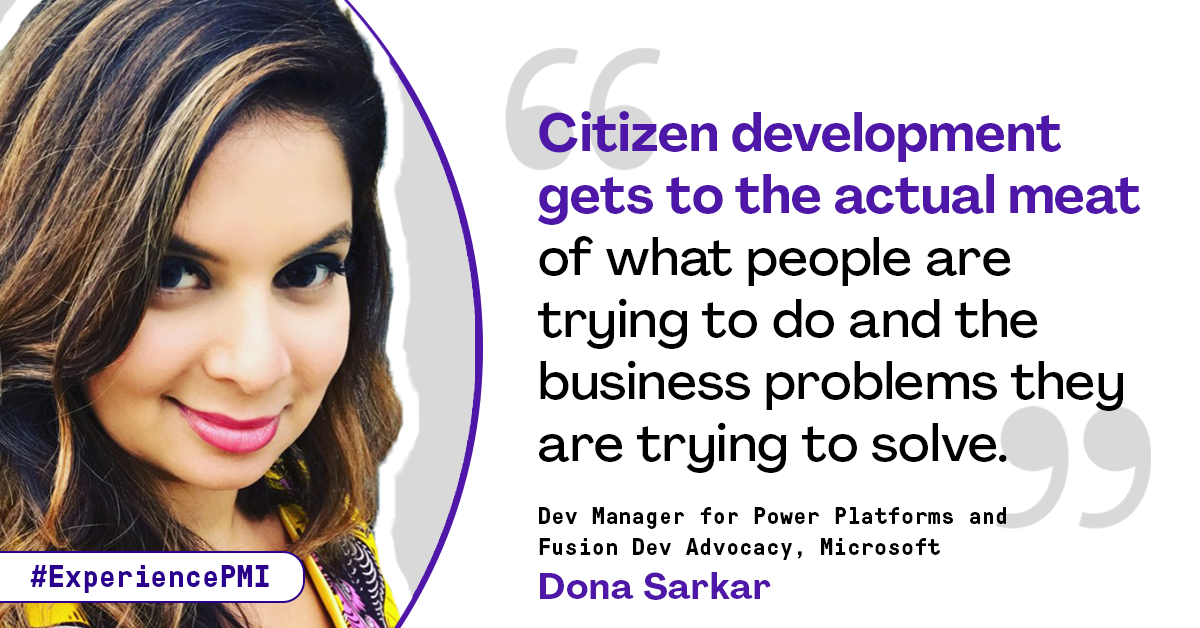
Some of this comes down to the basic rule of supply and demand: “I believe everyone needs to learn to code, but it’s not going to happen,” said Microsoft cloud advocate Dona Sarkar. Citizen development is a way to empower teams to get to the business problem—with guardrails.
It’s a future of work that will require hyper-collaboration. The next generation of citizen development “isn’t just citizen developers work over here and professional, traditional coders work over here,” said Sarkar. There will be fusion developer teams, in which citizen developers work on front-end things while traditional developers work with IT teams. The widespread adoption of low-code/no code is also helping companies uncover hidden potential in their employees, said Qrew Technologies’ Stefan Quartemont. “The future of citizen development is building strong teams and engaging in rapid problem solving.” Citizen development needs to deliver. And as with any innovation, the path to ROI is loaded with roadblocks. So what will it take for project leaders to put up a good fight when faced with inevitable challenges? A little patience and some ingenuity, said Prashara.
“There’s hope for a more united future everywhere, but we’ll need to be incredibly patient and find new ways of working to help us become better at what we do,” he said. If you missed out on the action or want to catch it all over again, PMXPO is available on demand. And don’t miss the next Virtual Experience Series on 2 June. How are you exploring innovation and new ways of working? |