Wanted: Innovators (And It’s Okay If They Fail Sometimes)
From the Voices on Project Management Blog
by Cameron McGaughy,
Lynda Bourne, Kevin Korterud, Conrado Morlan, Peter Tarhanidis, Mario Trentim, Jen Skrabak, Christian Bisson, Yasmina Khelifi, Sree Rao, Soma Bhattacharya, Emily Luijbregts, Lenka Pincot, cyndee miller, David Wakeman, Jorge Martin Valdes Garciatorres, Marat Oyvetsky, Ramiro Rodrigues, Wanda Curlee

Voices on Project Management offers insights, tips, advice and personal stories from project managers in different regions and industries. The goal is to get you thinking, and spark a discussion. So, if you read something that you agree with--or even disagree with--leave a comment.
View Posts By:
Cameron McGaughy
Lynda Bourne
Kevin Korterud
Conrado Morlan
Peter Tarhanidis
Mario Trentim
Jen Skrabak
Christian Bisson
Yasmina Khelifi
Sree Rao
Soma Bhattacharya
Emily Luijbregts
Lenka Pincot
cyndee miller
David Wakeman
Jorge Martin Valdes Garciatorres
Marat Oyvetsky
Ramiro Rodrigues
Wanda Curlee
Past Contributors:
Rex Holmlin
Vivek Prakash
Dan Goldfischer
Linda Agyapong
Jim De Piante
Siti Hajar Abdul Hamid
Bernadine Douglas
Michael Hatfield
Deanna Landers
Kelley Hunsberger
Taralyn Frasqueri-Molina
Alfonso Bucero Torres
Marian Haus
Shobhna Raghupathy
Peter Taylor
Joanna Newman
Saira Karim
Jess Tayel
Lung-Hung Chou
Rebecca Braglio
Roberto Toledo
Geoff Mattie
Recent Posts
Project 2030: Skills We Need to Cultivate Now
The Technical Program Manager: How to Stay Relevant in 2025
5 Things Your Operational Plan Should Do
5 New Project Guardrails for Adaptive Leaders
The Leader's Voice: Respect It, Protect It, and Use It Properly!
Categories
2020,
Adult Development,
Agile,
Agile,
Agile,
agile,
Agile management,
Agile management,
Agile;Community;Talent management,
Artificial Intelligence,
Backlog,
Basics,
Benefits Realization,
Best Practices,
BIM,
business acumen,
Business Analysis,
Business Analysis,
Business Case,
Business Intelligence,
Business Transformation,
Calculating Project Value,
Canvas,
Career Development,
Career Development,
Career Help,
Career Help,
Career Help,
Career Help,
Careers,
Careers,
Careers,
Careers,
Categories: Career Help,
Change Management,
Cloud Computing,
Collaboration,
Collaboration,
Collaboration,
Collaboration,
Collaboration,
Communication,
Communication,
Communication,
Communication,
Communications Management,
Complexity,
Conflict,
Conflict Management,
Consulting,
Continuous Learning,
Continuous Learning,
Continuous Learning,
Continuous Learning,
Continuous Learning,
Cost Management,
COVID-19,
Crises,
Crisis Management,
critical success factors,
Cultural Awareness,
Culture,
Decision Making,
Design Thinking,
Digital Project Management,
Digital Transformation,
digital transformation,
Digitalisation,
Disruption,
Diversity,
Diversity,
Documentation,
Earned Value Management,
Education,
EEWH,
Enterprise Risk Management,
Escalation management,
Estimating,
Ethics,
execution,
Expectations Management,
Facilitation,
feasibility studies,
Future,
Future of Project Management,
Generational PM,
Governance,
Government,
green building,
Growth,
Horizontal Development,
Human Aspects of PM,
Human Aspects of PM,
Human Aspects of PM,
Human Aspects of PM,
Human Aspects of PM,
Human Resources,
Inclusion,
Information Technology,
Innovation,
Intelligent Building,
International,
International Development,
Internet of Things (IOT),
Internet of Things (IoT),
IOT,
Knowledge,
Leadership,
Leadership,
Leadership,
Leadership,
Leadership,
lean construction,
LEED,
Lessons Learned,
Lessons learned;Retrospective,
Managing for Stakeholders,
managing stakeholders as clients,
Mentoring,
Mentoring,
Mentoring,
Mentoring,
Mentoring,
Mentorship,
Mentorship,
Methodology,
Metrics,
Micromanagement,
Microsoft Project PPM,
Motivation,
Negotiation,
Neuroscience,
neuroscience,
New Practitioners,
Nontraditional Project Management,
OKR,
Online Learning,
opportunity,
Organizational Culture,
Organizational Project Management,
Pandemic,
People management,
Planing,
planning,
PM & the Economy,
PM History,
PM Think About It,
PMBOK Guide,
PMI,
PMI EMEA 2018,
PMI EMEA Congress 2017,
PMI EMEA Congress 2019,
PMI Global Conference 2017,
PMI Global Conference 2018,
PMI Global Conference 2019,
PMI Global Congress 2010 - North America,
PMI Global Congress 2011 - EMEA,
PMI Global Congress 2011 - North America,
PMI Global Congress 2012 - EMEA,
PMI Global Congress 2012 - North America,
PMI Global Congress 2013 - EMEA,
PMI Global Congress 2013 - North America,
PMI Global Congress 2014 - EMEA,
PMI Global Congress 2014 - North America,
PMI GLobal Congress EMEA 2018,
PMI PMO Symposium 2012,
PMI PMO Symposium 2013,
PMI PMO Symposium 2015,
PMI PMO Symposium 2016,
PMI PMO Symposium 2017,
PMI PMO Symposium 2018,
PMI Pulse of the Profession,
PMO,
PMO,
pmo,
PMO Project Management Office,
portfolio,
Portfolio Management,
Portfolio Management,
portfolio management,
presentations,
Priorities,
Probability,
Problem Structuring Methods,
Process,
Procurement Management,
profess,
Program Management,
project,
Project Delivery,
Project Dependencies,
Project Failure,
project failure,
Project Leadership,
Project Management,
project management,
project management office,
Project Planning,
project planning,
Project Requirements,
Project Success,
Ransomware,
Reflections on the PM Life,
Remote,
Remote Work,
Requirements Management,
Research Conference 2010,
Researching the Value of Project Management,
Resiliency,
Risk Management,
Risk Management,
Risk management,
risk management,
ROI,
Roundtable,
Salary Survey,
Schedule Management,
Scheduling,
Scope Management,
Scrum,
search,
SelfLeadership,
SelfLeadership,
SelfLeadership,
SelfLeadership,
SelfLeadership,
Servant Leadership,
Sharing Knowledge,
Sharing Knowledge,
Sharing Knowledge,
Sharing Knowledge,
Sharing Knowledge,
Social Responsibility,
Sponsorship,
Stakeholder Management,
Stakeholder Management,
stakeholder management,
Strategy,
Strategy,
swot,
Talent Management,
Talent Management,
Talent Management,
Talent Management,
Talent Management,
Talent Management Leadership SelfLeadership Collaboration Communication,
Taskforce,
Teams,
Teams in Agile,
Teams in Agile,
teamwork,
Tech,
Technical Debt,
Technology,
TED Talks,
The Project Economy,
Timeline,
Tools,
tools,
Transformation,
transformation,
Transition,
Trust,
Value,
Vertical Development,
Volunteering,
Volunteering #Leadership #SelfLeadership,
Volunteering Sharing Knowledge Leadership SelfLeadership Collaboration Trust,
VUCA,
Women in PM,
Women in Project Management
Date

By Cyndee Miller
No one could have possibly made it through this pandemic unchanged—as a person or as a professional. Existing skills have been put to the test and new ones were developed along the way. Sometimes it was something relatively simple like mastering the mute button. Other times, it was a gamechanger, like learning no-code and developing an app or two.
The basic idea? To move forward, we all had to let go of business as usual. That includes letting go of the antiquated notion that somehow you can pursue breakthrough innovation without a massive flameout every now and then. It happens. It’s how you respond that matters.
“Failure is the best teacher,” said Wladimir Klitschko, PhD, as he opened PMXPO, the latest in PMI’s Virtual Experience Series. An Olympian gold medalist at age 20, the heavyweight boxing champion has consistently used his losses an opportunity to learn.
These days, he’s an author and business leader—and was more than ready to go a few rounds on overcoming challenges to transformation with PMI President and CEO Sunil Prashara. “I love challenges. I eat them for breakfast, lunch and dinner. That’s my food for thought, for life, for energy, for everything,” Klitschko said.
He outlined four principles for transformation: focus, ability, coordination and endurance. And through his Klitschko Foundation, he’s driving that message home to young people: “The more they learn, the more secure they’ll feel,” he said. “The more knowledge they have, the better they’ll execute their plan.”
Part of that knowledge base will no doubt be linked to emerging tech. But digitalization was created by people to simplify life, Klitschko said, and we shouldn’t forget the human side of technology.
That means developing technology that actually delivers value. And one of the emerging ways of doing that is through citizen development, using low-code/no-code platforms to build apps without software expertise—and to do it significantly faster and at a fraction of the cost.
It’s like when your boss says: Don’t bring me problems, bring me solutions. Well, citizen development “allows you to bring an actual solution,” said PMI’s Chief Strategy & Growth Officer Dave Garrett.
Citizen development isn’t new, but much like agile 10-15 years ago, it’s been held back by concerns about maintaining control and transparency. That’s changing as more organizations adopt low-code/no-code strategies and establish greater governance.
Let the citizen development revolution begin.
“In the past we had users in spreadsheets working in an isolated fashion,” said Manpower Group’s Eric van Antwerpen. “With maturity, we’ve seen it evolve into more of a treasure box than Pandora’s box.”

Some of this comes down to the basic rule of supply and demand: “I believe everyone needs to learn to code, but it’s not going to happen,” said Microsoft cloud advocate Dona Sarkar. Citizen development is a way to empower teams to get to the business problem—with guardrails.
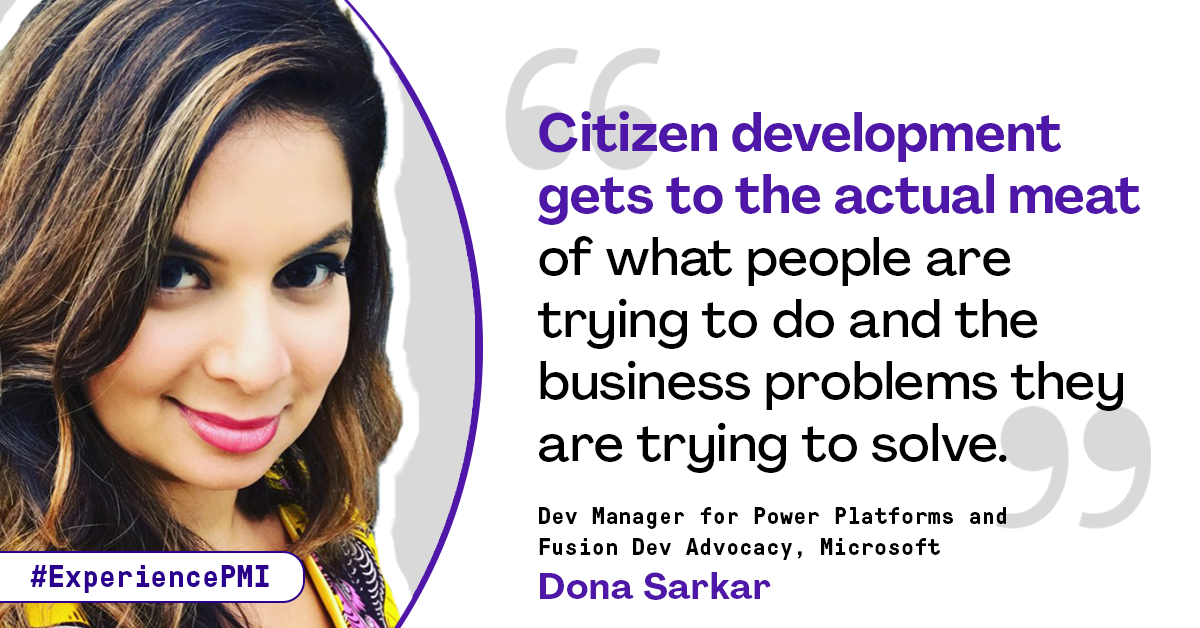
It’s a future of work that will require hyper-collaboration. The next generation of citizen development “isn’t just citizen developers work over here and professional, traditional coders work over here,” said Sarkar. There will be fusion developer teams, in which citizen developers work on front-end things while traditional developers work with IT teams.
The widespread adoption of low-code/no code is also helping companies uncover hidden potential in their employees, said Qrew Technologies’ Stefan Quartemont. “The future of citizen development is building strong teams and engaging in rapid problem solving.”
Yet while there’s a genuine curiosity about citizen development, National University of Ireland Galway’s Noel Carroll said companies want quantitative evidence. “We really need to showcase the evidence behind this. What’s the return on investment?” he said. “There are some pieces of evidence out there, but we need to make it much more transparent for industries that are flirting with the idea of citizen development but haven’t really been convinced yet.”
Citizen development needs to deliver. And as with any innovation, the path to ROI is loaded with roadblocks.
So what will it take for project leaders to put up a good fight when faced with inevitable challenges? A little patience and some ingenuity, said Prashara.

“There’s hope for a more united future everywhere, but we’ll need to be incredibly patient and find new ways of working to help us become better at what we do,” he said.
If you missed out on the action or want to catch it all over again, PMXPO is available on demand. And don’t miss the next Virtual Experience Series on 2 June.
How are you exploring innovation and new ways of working?
Posted
by
cyndee miller
on: March 28, 2021 05:34 PM |
Permalink
Comments (4)
Please login or join to subscribe to this item

Kwiyuh Michael Wepngong
 Community Champion
Financial Management Specialist | US Peace Corps
Yaounde, Centre, Cameroon
The title is so inspiring .... It's ok if they fail sometimes....

Luis Branco
CEO| Business Insight, Consultores de Gestão, Ldª
Carcavelos, Lisboa, Portugal
Dear Cyndee
Very interesting this theme that brought to our reflection and debate (sharing about what happened at PMXPO)
I had the opportunity to attend some online workshops.
There are other themes that I will watch now that the event is on demand.
I take this opportunity to congratulate the entire PMI team that was in the organization of the event this year.

Paphatpisit Klinklan
Regional Sourcing and Operation Manager| Krones (Thailand) Co., Ltd
Samutprakan, Thailand
Thanks Cyndee. Failure is the best teacher.
Please Login/Register to leave a comment.
|
"Judge a man by his questions rather than his answers."
- Voltaire
|




