Viewing Posts by Lynda Bourne


Let’s Make a Deal: Negotiating During COVID-19
Categories:
Negotiation
Categories: Negotiation


| By Lynda Bourne
Eighty percent of the posts I’ve read about dealing with COVID-19 fall into three general categories:
While many of these posts contain good advice, to my mind they are all focused on threat mitigation. While minimizing threats is important, these approaches miss the opportunities inherent in unstable times. You need to do more than minimize threats to come out of the COVID-19 crisis in the best shape possible. There are two factors that will help you get through this: your innovation skills and your negotiation skills. I discussed innovation in my previous post, Innovation and Design Thinking, Part One. In this post, I’d like to focus on negotiation in a time of uncertainty. Of course, to be able to negotiate you do need to stay safe (the first category above). You also need to understand the current situation (the third). But, if you want some control over your future, you also need to be willing to have serious negotiations with the people who matter. This is a very different situation than normal negotiations with employers, clients, subcontractors and suppliers. The traditional framework of negotiation involves having defined outcomes in mind, deciding on your “walk-away point” (best alternative to a negotiated agreement or BATNA) and using a range of negotiating stances and tactics to achieve your desired outcome. In the era of COVID-19, no one knows what the future holds, and everyone is suffering inconvenience and damage to different degrees. But we are all in this together, and playing hardball for short-term, illusory benefits is unlikely to help anyone. For example, in normal times landlords around the globe tend to play hardball with tenants—you pay your rent or you are evicted. However, in Australia the government has now made it illegal for landlords to evict business tenants who are unable to pay their rent for the next six months (with the possibility of an extension). The objective of this measure is to ensure the tenant still has a business when the current lockdowns are over and that the landlord still has a tenant capable of paying rent in the future. There are government incentives and guidelines to encourage both parties to negotiate a workable agreement. Compare this to the normal business-as-usual alternative: The landlord evicts the tenant, the tenant goes bankrupt and the landlord misses out on 100 percent of rental income for two or three years until the market recovers. The imposed solution has everyone sharing the pain. The tenant still has to pay some rent if possible, the landlord will receive less income, the banks support the landlords (after being asked by the government), and the government is paying some of the overall costs if there is an agreement. (Similar measures have also been introduced for private tenants.) This won’t save every business or every commercial landlord. But it will significantly reduce the damage to most businesses and the overall economy. At least, the government hopes this will be the outcome—no one really knows, given the unique situation we are all in. So, how does this concept translate to your own situation during the COVID-19 crisis? Obviously, everyone and every business is in a unique situation, but there are some useful ideas you can apply at both the business and personal level:
People and organizations that come through the current situation ready to succeed in the post-COVID-19 world will be resilient, adaptive and collaborative. Great negotiating skills and innovative thinking will be essential. Still, a little luck will go a long way. As I discussed in my post Probability vs. Luck: Lessons Learned From a Day at the Races, luck will also play a major part in deciding who comes out of this in the best shape. But, to quote Coleman Cox: “I am a great believer in luck. The harder I work, the more of it I seem to have.” How are you preparing for the post-COVID-19 future? |

Probability vs. Luck: Lessons Learned From a Day at the Races
| By Lynda Bourne Last November, my partner and I spent a lovely day in the country attending the Dunkeld Cup at Mt. Abrupt in Victoria, Australia. The location is very picturesque, and we had a thoroughly enjoyable day. To add to the pleasures of wining and dining, my partner developed a “foolproof method” that allowed him to pick five winners and a placegetter (among the top three) out of seven races with a total of eight bets. So, should he give up his day job to exploit this newly discovered skill?
The Dunkeld Racecourse with The Grampians Mountains behind. The horses he chose were not random picks: My partner used a selection method based on a guide that rated horses on their form from 0 to 100. Using a portfolio management approach, he first recognized that the difference between a 97 or 98 rating and a rating of 100 was too small to matter. Every assessment process has a range of error, and a difference of 2 to 3 percent is likely to be well within this range. This approach reduced the panel of potential winners to three or four horses in each race. The second step in the selection process was to look at the variables. The form guide is printed well before race day, and it had recently rained. A soft track would benefit horses carrying a lighter weight. So out of the prospective panel, we placed our bets on the horse with the lowest weight. Voilà! Six winners in seven races—a winning formula that would allow us to retire from managing projects and make our fortunes as professional punters … But not so fast. The probability of repeating a six out of seven winning ratio in the future is very low. How much of our big day boiled down to effective process—and how much was pure dumb luck? That is a risk management question. Step One: Consider the Probability: The first consideration is how likely was it that someone would pick six out of seven winners? There were several thousand people at the race, and it is highly probable, simply based on random chance, that someone would have a “winning streak” and back six winners using their own system. On this basis, there is a several-thousand-to-one chance of a repeat outcome. Someone will have a similar winning streak in 2020, but probably not us. There is a strong tendency for winners to ascribe the results of random chance to their skill. But pragmatic managers look deeper. Step Two: Assess All Available Data (Not Just the Highlights): We placed eight bets: Five came in first, one finished third and the other two were placed sixth and seventh, respectively. All we can say for sure is we were likely to select horses that would finish between seventh and first. But as there can only be one winner and two placegetters, horses finishing fourth, fifth, sixth and seventh mean a lost bet. The median position is 3.5—which also means a lost bet. The mean is 2.6, so we may have been slightly in front, but “place bets” do not pay much. Adding in the range options, no horse can do better than first place, but there are many more places between seventh and last. Factor this in, and the margin of success in our small sample becomes doubtful. So, what are the lessons learned from our day in the country? My take is that good processes help build success—but you should not confuse luck with skill. When Napoleon Bonaparte was criticized for winning battles simply because of luck, he famously retorted: “I’d rather have lucky generals than good ones.” I think we were just lucky. We may well return to the Dunkeld Cup in 2020. It’s a great day out, and more data is needed to round out this research. In the meantime, applying simple probability analysis to my partner’s winning methodology suggests he needs to keep his day job. That’s a safe bet. |

Innovation and Design Thinking, Part Two
| By Lynda Bourne
In my previous post, Innovation and Design Thinking, Part One, I focused on the personal and cultural aspects of innovation. But having an innovative idea is only a small part of the challenge. To create value, the bright ideas need to be transitioned into practical products or solutions that can be applied, sold or used. Well-managed projects are a key element in building the new product or solution, but traditional project management, even agile project management, is rarely sufficient. One well-established technique that bridges the gap between an idea and a practical project: design thinking. Design Thinking The original concept of design thinking was built around problem-solving with a shift in emphasis from traditional analysis toward innovation and synthesis. Design thinking tends to be promoted by its advocates as a complete solution to delivering innovation within an organization. A typical model looks like this:
There are many models, with minor differences, to explain the process. But they all involve the following basic steps:
The problem with these models is a lack of process around creating the solution. My suggestion is using design thinking to link the creation of a culture that encourages the development of innovative ideas (the focus of my last post) with the use of project management to deliver results.
I believe that bringing project management disciplines into the design thinking process—starting from the validation of the design brief (is the proposed solution feasible, viable and desirable?) through to the delivery of the innovation and realization of benefits—is likely to result in a more cost-effective outcome in a reduced timeframe. Innovative thinking should be encouraged within every organization. But you need pragmatic innovation to move the best of these ideas from an abstract concept to a proven concept that delivers value. Melding design thinking and project management seems to be one way of achieving this objective. What do you think? Share your thoughts in the comments below. |


Innovation and Design Thinking, Part One
Categories:
Innovation
Categories: Innovation
| By Lynda Bourne
Everyone is talking about innovation! But to innovate requires two things. The first is an innovative idea, and the second is a process to turn that idea into something valuable. In this post, I will look at what’s needed to create innovative ideas; my next post will look at one of the ways to transform the idea into something useful, even valuable, through design thinking. The challenge of developing an innovative idea is part personal and part cultural. The Personal Part of Innovation Every innovation starts with an idea. So if you want ideas that may turn into useful innovations, you need to allow people time to develop the idea. This may occur in a number of ways:
The Cultural Part of Innovation If an organization wants its people to be innovative, it needs to create a culture that allows innovative thinking. There are many ways this can be encouraged, so getting the mix right is key. Some of the options include:
Recognition and rewards can help, but they are far less useful than most managers think. The driver for innovative thought tends to be introspective, and when a person has a good idea, self-fulfilling. The real challenge is having an open culture that allows new ideas to come to the fore and be considered on their merits. Systems can help—the old “ideas box” needs to be brought into the 21st century if you want an innovative culture. Last, having identified an innovative idea, the organization needs to do something with them! More on this next time. Please share your experiences: How have you sparked innovation within your organization? |

Exploring the Philosophies and Principles of Planning Approaches
Categories:
Project Planning
Categories: Project Planning
| By Lynda Bourne
Any output from a planning process is an embodiment of the planners’ fundamental principles and philosophies. They apply these principles, or approaches, to develop their plans. And different people will develop different plans to achieve the same objectives. As early as the 1950s, James Kelley, one of the developers of the critical path method (CPM), reflected on this theme. He noted that in a class of 20-plus people learning the new CPM approach to scheduling, developing a 16-activity schedule from a set class exercise would result in nine to 10 different schedules. Clearly, different people use different approaches and assumptions. What Shapes Approaches The planner’s approaches may be explicitly stated, or they may be implicit and affected by:
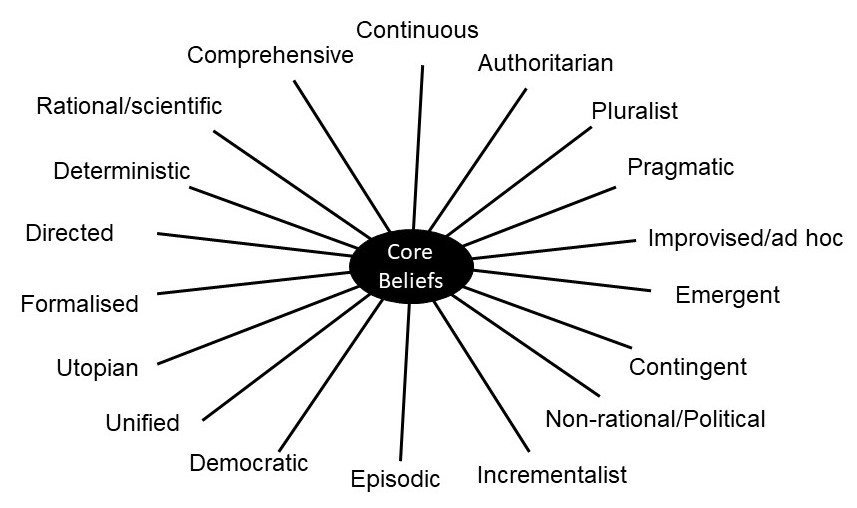
The conundrum facing organizations is deciding the best approach to develop a plan—one that’s accomplished in the most efficient way within a given set of circumstances, in a given cultural environment, that results in the best outcomes. There is no one right answer to this question, or one way of knowing if the chosen options have delivered the desired result. Each project is unique, making tests and comparisons impossible. Some of the approaches that can be used in combination, or isolation, include:
This diagram pairs opposite approaches; it’s up to you to determine where on the continuum is best for you in the current situation. Applying the Approaches The challenge is understanding the choices open to you and then making informed decisions about where on each of the dimensions is best for you in the current circumstances. Making overt choices rather than just doing the normal thing will generally lead to better planning outcomes. For example, an agile project will require a planning approach that leans toward using non-rationality, incrementalism, contingent, emergence, improvisation, utopian, pluralistic, democratic and continuous approaches to the planning activity. A traditional “hard dollar” engineering contract, on the other hand, tends to require the opposite. My recommendation is you think through these options. This offers you an opportunity to improve your planning practice, as one approach will not suit every project and simply doing the same as last time will inevitably lead to a suboptimal outcome. How do you think about your approach to planning? |