

Project Managers and Change


| Every project launched is a change project. It may be a simple project or a complex, cross-functional project – regardless, it is change. If project managers take a change view of every project they lead, they will do a better job engaging the stakeholders in the project and reaching a successful conclusion. That is because when a project manager keeps in mind that the project she is leading is change for someone, she can approach the project from the perspective of the individuals and how they will need to change. Let’s look at a brief example. Carmella is leading an initiative to refine processes within accounts payable. While the goal of the process improvement project is to reduce the time for processing payment through the use of new technology, Carmella is aware of three key factors:
With this information, Carmella meets with the stakeholders impacted by the project. She shares with them the goal of the process improvement project – to reduce time for processing payment through the use of new technology and thereby enabling stakeholders to be more efficient in their roles and reduce their manual workload. She further tells them that training will be provided before full implementation of the technology so that they are comfortable. And, she invites them to see a demo of the technology. Additionally, she schedule another meeting with them to discuss their current processes with a focus on where they think improvements exist. Carmella is engaging these stakeholders in the project. Regardless of Carmella’s perception of the change, she understanding that the stakeholders need to be comfortable with the change if they are to embrace it. If they are not comfortable, they are likely to resist, which will cause the project to fail. Additionally, concerns among the stakeholders regarding the project and its impact on them personally may impact productivity in the group. When project managers recognize and accept that every project they undertake represents a change for someone in the organization, they will better be able to engage stakeholders in the project. This is done by acknowledging the (potential) impact and addressing early on in the communications and throughout the project the concerns and needs of stakeholders. |
Engage Employees in Change: A Mini Case Study
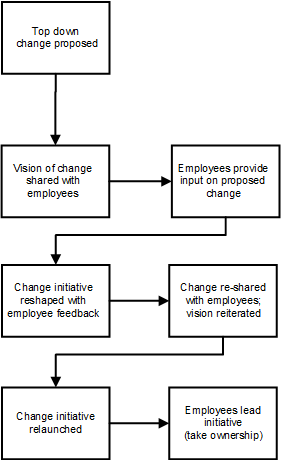
| One of Abudi Consulting Group's client’s wanted to engage their employees in change. This mini case study shares that story. For this brief story, I’ll use the exhibit below.
The client is a retail organization that had changed leadership at the top. The new CEO and other newly-hired top executives had experience engaging employees in change and knew the value in doing so. Once the original vision of the change that was being proposed was shared with employees, Abudi Consulting Group, working in collaboration with the CEO and his team, requested the employees’ feedback. Given the complexity of the change, we allowed for three weeks in having conversations about the change in order to get feedback from employees. We provided employees with a variety of options to provide feedback, including via:
With so many channels to share their ideas, concerns, thoughts and suggestions, we got more feedback than we could have imagined! Employees shared information about the change proposed as well as the vision for the change. Through the employees’ insights and contributions, Abudi Consulting worked with the executive leadership team to reframe the change initiative. We incorporated many of the ideas of the employees as well as addressed the concerns that they had. The end result was a change initiative that was, effectively, shaped by the employees. This is just one client story Gina shares in her book. Want to learn more? Purchase Gina’s book, Implementing Positive Organizational Change: A Strategic Project Management Approach, J Ross Publishing, 2017. |
Conversations around Change: Change the mindset in the organization to a learning-focused mindset
| Having regular conversations around change enables for creating a learning mindset – a mindset where employees appreciate, desire and engage in change. When we change, we are learning – we are growing, adapting, getting better. We want to create this mindset so that employees are more comfortable with change, within continuously improving and moving forward. Regular conversations around change enable for increasing adaptability to change and an increased acceptance of change when it does occur. When working with clients to discuss how to launch conversations around change our goal is to enable employees to look at change from a positive perspective, an opportunity to do something new, different and exciting. It is, obviously, much more difficult to embrace change when the organization is in panic mode; rather – if we think of change as continuous evolving and improving – it becomes easier to accomplish. Telling stories around change appeals to the emotional side of change – which is what helps employees to connect with and embrace change. The rational side – charts, statistics, graphs, financials, etc. – is important; we need that to stay competitive and ensure profitability – but that is not what helps employees to embrace change. As humans, we connect with the emotional side of change. When we begin the conversations around change early on, we…
As part of regular monthly meetings with his entire team, one of Abudi Consulting Group’s client’s manager, Alexander, always poses a question that will explore the need to change. Just prior to his last meeting, Alexander asked the team how the department might better collaborate with another group that had just expanded their head count by 50 new hires. Alexander reminded his team that as the other group grew in headcount, it would impact the informal way his team had worked with them in the past. By asking this question, Alexander was pushing his team to look at their current in-place formal and informal processes and to refine them to continue to work effectively with their peers. Consider how you might engage your employees in conversations around change. What questions might you pose? Here are a few to get you started…
These are just a few ideas to improve your next organizational change initiative. Want to learn more? Check out my book, Implementing Positive Organizational Change: A Strategic Project Management Approach, J Ross Publishing, 2017. |
Enable Employees to Adopt Change - Have a Plan!
| In the ideal world, 100% of our employees will adopt a change immediately. That rarely happens, of course. And, of course, we rarely get 100% of employees even after a while. To get as close as possible to 100% adoption of change, you must have a plan! Consider first, how much change you are asking your employees to embrace. The amount of change will certainly impact how much time you should dedicate to enabling for adoption of the change. For example, a highly complex initiative that crosses multiple functions and impacts significantly how the work is done will require far more time in engaging employees prior to actually launching the initiative. On the other hand, a smaller initiative, that involves one department and simply “tweaks” how work is done can likely be socialized at the same time the initiative is launched. Consider also, the impact on the change based on factors, such as,
Develop your Plan Develop a high level plan on how you will engage employees in change, which will eventually lead them to adopt the change. Your plan should include information on:
These are some key documents/information to include in the overall change plan. By thinking about the change, and planning for it, prior to actually launching the change initiative, you are more likely to engage employees in change early on which means you are more likely to increase the number of employees who adopt the change. Want to learn more? Check out Gina’s most recent book, Implementing Positive Organizational Change: A Strategic Project Management Approach, based on her years of experience working with a variety of large, global organizations on transformational change initiatives. |
Announcing my newest book: Implementing Positive Organizational Change
| Wanted to announce my newest book - Implementing Positive Organizational Change: A Strategic Project Management Approach - was published by J Ross Publishing in February 2017. In today’s increasingly competitive global marketplace, organizations that do not regularly undertake change initiatives will find it difficult—if not impossible—to continue to be successful in the long term. Most organizations only launch change initiatives when forced to address some pain, such as decreased revenues or profits, where the sole focus is on the benefits to the organization. Often, the people side of change management is overlooked, causing 60-70% of these efforts to fail. Implementing Positive Organizational Change explains how to develop a continuous improvement culture of change that will be perceived by employees as a positive opportunity to create something new, exciting and valuable, instead of something negative to confront and resist. This comprehensive guide describes how to communicate with and engage stakeholders and employees to gain buy-in and support, and outlines a strategic project management approach that helps ensure successful implementation and desired results. Learn more here: http://www.jrosspub.com/implementing-positive-organizational-change.html. |


