


Don't blame corporate culture for not cultivating psychological safety within your teams!


|
We would all like to work for companies where leadership teams truly embrace people-centric values and principles but that is rarely the case, especially in organizations which have been in existence for decades. It is common to find companies where the walls of their corporate offices are decorated with empowering, motivational posters of treating staff like their most valuable asset but this is usually a case of putting lipstick on a pig. While organization cultural transformation cannot occur without the sponsorship and commitment of the management team, waiting for them to evolve is a cop out when it comes to creating safety within your team. As leaders, our responsibility is to create a safe haven for team members to work to their best abilities. While there might be stormy weather surrounding the team, we need to keep our team members within the calmer eye of the storm. How do we do this? It starts with building psychological safety between the individual team members. Even if they all represent different functional areas, roles and seniority levels, everyone wants to feel safe while at work. Gain commitment from them as part of developing team working agreements and then reinforce the desired behavior by being a role model for how you want them to behave with one another. If they are not well informed about the subject of psychological safety, take the time to educate them about its importance. Recognize team members who act in ways to increase safety and coach those who diminish it. But safety won't stick if it exists only between your team members. Their work will likely require them to interact with those outside of the team, and often it is in those interactions where safety gets eroded. Until you start to see a corresponding level of safety being promoted by others, you will need to act as a buffer to protect your team members. This will likely mean your having challenging conversations with senior colleagues who ridicule or threaten your team members, educating these stakeholders about the importance of safety, and escalating if necessary. It might also mean being more thoughtful about the planning of interactions between your team members and others, especially if the scope of the interaction is expected to be stressful, controversial or risky. If you shy away from this, not only might you have to settle for mediocre performance, you may also risk losing the best talent you have. If you are successful at building safety, your team members will begin to reap its rewards and, in turn, will begin to demand it as table stakes for any team they join. They will become champions in their own right for safety and will help to build it within other teams. And that is how positive cultural changes happen. |
 While speaking on the topic of psychological safety yesterday I was asked whether it is possible to create safety within a team if the prevailing culture of the department or overall organization is toxic.
Batches? We don't need no stinking batches! (Or do we?)
|
So what are some of the factors which might force us to batch work items? Whether it is equipment, materials or people's time, constraints are a common reason for batching work. Let's say we wanted to build a fence for a customer. While it might be better for the home owner for us to complete the full work for one section of fence at a time so that if the work spans multiple days the homeowner would progressively be receiving value, we might be forced to dig all the post holes first because we only have the use of an auger on the first day. Maybe we are writing a software application which needs to have both English and French messages and we have no one on our team who can do the translation. If we only have access to a translation service for a week, we might need to batch the translation of all the screen messages and until that is done we can't ship the product. Sometimes there might be a mandatory dependency that prevents completion of subsequent work activities till a preceding one is completed for the entire batch. When building a house, you would normally wait for the entire concrete foundation to be ready before we'd start building on top of it. When frosting a cake, it doesn't matter if half of the cake is baked - we'd wait till it is fully baked. Economies of scale or a minimum requirement on how many work items can be efficiently produced might be another reason to batch work. If I want to bake cupcakes, although the cycle time to bake and frost one cupcake is likely to be less than that of completing a dozen identical ones, the costs of wasted energy and ingredients from doing them one at a time would start to add up. Unless I have a customer who is willing to pay me that much more to justify producing single cupcakes, I'm likely to make them in batches. This applies even if I'm trying a recipe for the very first time. While the volume of ingredient wastage would be reduced by baking a single cupcake, the benefits of baking a batch are still greater. Or maybe I need to print some color business cards for newly hired staff from a printing agency. While there would be a per card cost, the overhead costs of setup, proofing and shipping might justify waiting till there are a few new hires rather that printing each set individually. While some of these factors might present opportunities for continuous improvement to our delivery process, others are unlikely to be reduced or eliminated. We may wish to avoid batch work, but we do need to be pragmatic and accept that context counts. |
 Emphasizing flow through the reduction or elimination of batching of work items is desirable but this is not always efficient or practical.
Think top-down and bottom-up for agile transformations
|
A common approach for major organizational changes is to start at the top with executive leadership, creating a coalition of commitment and support towards a shared vision for the future. This is critical with agile transformations for a number of reasons:
But there will also be the need to have engagement at the delivery team level. If individual team members are comfortable with how things are working and have no sense of urgency about the need for change, then their support will be superficial. Their buy-in is needed to:
While these outcomes are needed, a key benefit of taking this top-down & bottom-up approach is that it will create a "sandwich effect" squeezing those middle managers who are unwilling to change how they work. Without that outcome, it is unlikely that an agile transformation will succeed. |
 A question which I'm asked regularly during my classes is what the best place is to start an agile transformation within a company? Given a choice, I'd prefer to use the cop-out (but correct) answer "It depends", but otherwise I usually respond that you'd want to do both a top-down and bottom-up approach simultaneously.
Why project work doesn't get completed early...
|
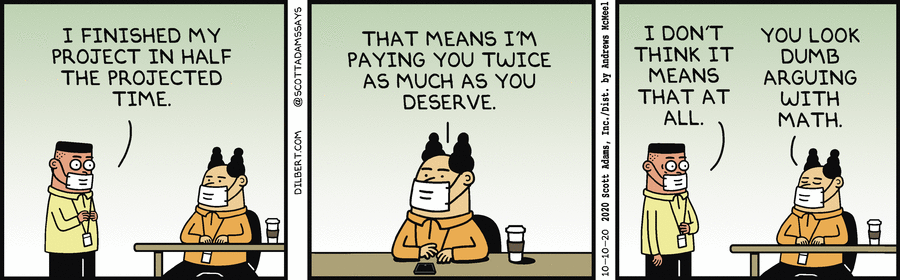
This is intended to counter the potential confluence of Parkinson's Law (work expands so as to fill the time available for its completion), Student Syndrome (let's wait till the very last possible moment to start an undesired activity) and Murphy's Law (anything that can go wrong will go wrong). While this behavior might be true in some circumstances, it is based on a rather Theory X view of the world. Student Syndrome hurts no one other than the student procrastinating on starting their homework assignments or preparing for an exam. With projects, the impact of delays from one team member ripple downstream to others so with the exception of that small minority of Homer Simpson-like workers most of us want to do a good day's work. So if the fault doesn't lie with the individual contributors, where else could we look for answers? Today's Dilbert cartoon provides us with better root causes for this behavior - the system which people work in or the managers they work for. How could the system affect work completion? Poorly thought out performance measures are one way:
Managers can also inadvertently cause staff to complete work on time, but rarely early by:
If we recognize that project activity durations are more likely to follow a lognormal distribution than the nice symmetrical normal distribution which we hope for, then we should praise team members for completing work early (within quality, safety, health and other constraints) rather than introducing impediments which discourage them from doing so. |
 I usually advise my students to encourage their team members to not provide padded work estimates, but rather to make schedule contingencies visible and tie these contingencies to milestones rather than to individual activities.
But what will our staff do if we don't focus on their utilization?
|
Two reasons for this recommendation are:
While managers might accept the above in principle, they might raise some concerns. If we don't maximize the utilization of our team members, how will they be adding value when they aren't contributing directly to the value stream or streams they are part of? After all, we are paying them for a full day's work so shouldn't we expect a full day's work out of them? While some managers might worry that their team members' slack time will be misused for slacking off, there are multiple productive ways to use this freed up capacity including:
Without some free capacity, your team members might be inspired to quote Scotty from Star Trek: "I've giv'n her all she's got captain, an' I canna give her no more." |
 Lean thinking encourages us to focus on maximizing value delivered to stakeholders rather than maximizing the utilization of the people, equipment or material resources contributing to value streams.

