Project Management

Helping Project Managers to Help Themselves

by
I'm all about Building Thriving Leaders™ This blog is based on over 35 years of project management and leadership successes and failures. Get practical, concise nuggets on both hard and soft skills to help you deliver projects successfully with minimal friction.

About this Blog

RSS

Recent Posts

Knowledge and Wisdom: What's the Difference?

I Just Wanna Be a PM!

The Straight A’s of Intentional Leadership

Ten Ways to Grow your Followers into Leaders

Ten Points to be a Better Up and Out Influencer

Categories

Agile, Career Development, Communications Management, Decision Making, Disability Inclusion, Empowerment, Followership, Leadership, New Job, project execution, Project Management, project sponsorship, Social Media, Time Management, Upward Management, Work Life Balance, Working from Home, Writing

Date

What 16 Years Working from Home Taught Me

linkedin twitter facebook Request to reuse this  

In 2004, my wife Patty and I decided to team homeschool our autistic son because we knew he would need more help as he entered middle school. I had spent 20 years in corporate America, working for both Accenture and Microsoft, but in the Fall of 2004, I became his part-time math and science teacher, spending the remainder of my time doing business consulting and writing books.

Up to that time I always had either a client or office to go to. With the change to homeschool teacher/author/consultant, I now had no place to go each day. My office was either our playroom where we homeschooled, our home office, or local coffee shops. It was definitely an adjustment and I learned a lot about how to be effective without going to a workplace. Now I can’t imagine it any other way.

In 2020, millions of people were quickly forced into working from home. When I started working from home sixteen years earlier, I had the benefit of preparing for my new life—a stark difference from those who suddenly found themselves in work-from-home mode with little warning or preparation. Some aspects of 2020 versus 2004 were easier and others harder, for example, the collaboration tools available in 2020 were simply non-existent in 2004. But the bottom line is the changes were massive and required significant adjustments.

In my 16 years of not having an office I experienced a lot of bumps and bruises to get into an effective work/life rhythm. Key to my learnings was the need to enforce greater self-discipline about:

  • what I do,
  • how I manage my time,
  • what and when I eat,
  • how much I sleep,
  • when and how I exercise,
  • how I “turn off work,”
  • and how I interact with others.

It’s those bumps and bruises that I want to help others avoid in shifting to a sustainable work-from-home lifestyle, which I have boiled down into five lessons:

  1. Master the online experience – For Pete’s sake, if Zoom, Microsoft Teams, or other online meeting tools are an integral part of your business, take the time to truly understand them and ensure the hardware you’re using creates the most positive experience for others attending your meetings. Not knowing how to do things like share your screen, give others control to share their screen, or use an electronic whiteboard is akin to meeting a business associate face to face at a coffee shop with blaring music and no chairs or tables. When you fumble with the tools you send a clear message to your recipient that he or she isn’t important enough for you to create an outstanding online experience. Just as important, struggling with online meeting tools conveys that you are slow to adapt to changes.
  2. Plan to “Done” not “Do” – Each Monday morning I go through my to-do list and decide what I plan to have done by the end of the week. I then plan time in my calendar throughout the week to work on each to-do, then I schedule a Friday 5 p.m. meeting summarizing what I have committed to getting done that week. Key to this is expressing your to-do list in terms of a deliverable, or “done,” not in terms of an activity, or “do.” If you think only in terms of activity, you’re more likely to measure success in terms of how long you spend doing something versus what you actually got done.
  3. Put everything in your calendar – In my article "I Can’t Keep Up!" Six Principles for Using Your Calendar to Get More Done, I talk about how to use your calendar not just as a work thing but as a life thing. This is particularly important when you work from home because work start/stop events like commuting to and from work are no longer there. With those barriers gone, it’s much easier to be less respectful of your own time. I’ve had to learn that working from home doesn’t mean I can work anytime; it means I had to be much more disciplined about when I would and wouldn’t work.
  4. Set clear expectations with loved ones – Working from home doesn’t necessarily mean you’re always accessible. Having very clear expectations about when you will and won’t be working is crucial to your overall effectiveness. Patty and I send meeting notices to each other for social gatherings or other meetings where one of us won’t be available to the other. This works very well for us to keep us aligned and ensure we don’t overcommit ourselves.
  5. Make physical and mental health a priority – While there are great conveniences in working from home, it also means you have to be more diligent about tending to your physical and mental health. I never stay in pajamas during the day, I schedule exercise time in my calendar, I eat meals away from my workstation, stick to a regular sleep schedule, and *try to* be disciplined about between-meal snacking. I also weigh myself regularly. This really helps if you want to maintain or lower your weight and if you tend to wear stretchy clothes that don’t remind you if you’ve added an inch to your waistline.

For many, working from home may be a long-term if not permanent reality. Consider these five lessons to help you design a sustainable and satisfying work-from-home lifestyle.

Posted on: January 04, 2021 02:35 PM | Permalink | Comments (20)

“You Did WHAT?!?” Using Decision Guard Rails to Align Decision-Making Expectations

linkedin twitter facebook Request to reuse this  

Bill was a newly appointed project manager over a mission-critical systems development initiative. Ann, Bill’s boss, trusted Bill to lead the initiative and gave him the latitude he needed to execute without getting in his way. While the two worked well together, they did struggle in one area: decision-making. They had several instances where Ann was surprised by key decisions Bill made but didn’t inform Ann. Bill also didn’t benefit from Ann’s experience on several issues and made uninformed decisions that hurt the project. Ann asked Bill to include her more on decisions, but Bill took that as him needing to come to her on decisions he could have made on his own. Bill grew frustrated with his perception of Ann micromanaging him, whereas Ann just wanted to ensure she was in the loop on key decisions. The project ultimately got done, but not without a lot of friction between the two.

Friction that could have been avoided.

Key to a leader who empowers followers is the ability for the follower to make decisions without always having to ask the leader for permission. When done well, the follower is able to execute more nimbly and with greater ownership. When done not so well (as the case above), both the leader and follower are likely to be frustrated by missteps, poor communication, and potentially damaging decisions that were made without enough information. I’ve learned through doing this wrong so many times that there are four degrees of decision-making where the leader and follower agree as to the amount of guidance and input provided in decision-making. The degrees, or what I like to refer as guard rails, are as follows:

  • Get Approval – The follower presents the decision with supporting rationale to the leader. The follower asks the leader to decide. Leader is the decider; follower is the informer. Example: A follower must ask permission to hire an employee.
  • Seek Advice – The follower presents the decision with supporting rationale to the leader. The follower asks the leader for advice. Follower is the decider; leader is the advisor. Example: A follower must seek advice before promoting an employee.
  • Inform only – The follower presents only the resulting decision (minus supporting rationale) to the leader. The follower informs the leader. Follower is the decider; leader is the receiver. Example: A follower should inform the leader when taking a day off work.
  • Don’t inform – The follower makes and executes the decision without escalating to the leader. Follower is the decider; leader is not informed. Example: A follower acts without informing the leader when taking time off during a workday for a personal appointment.


By creating four distinct decision-making categories, it acknowledges not just the extremes (get approval and don’t inform), but also acknowledges there are some decisions where a leader should provide input into a follower’s decision (seek advice) as well as those decisions where the leader should be kept in loop on the decision (inform only). By slotting types of decisions into these four categories, both the leader and follower are better aligned on the decisions being made and the degree of involvement the leader should have in the decision.

In defining decisions under each guard rail, it’s important to keep a couple of things top of mind:

  • Don’t try to define every possible decision the follower can make. Focus on those decisions that are material in nature and help to set a theme for the types of decisions the follower addresses in his/her normal course of work
  • Great empowering leaders don’t apply a one-size-fits-all decision-making approach to followers. Factors such as follower experience level and degree of subject matter expertise influence the guard rail category for different types of decisions. As example, a follower newly promoted to a leadership role may have some decisions that fall into the seek advice category where a more experienced follower would have those same decisions in the inform only category.


To successfully implement guard rails, leaders need to do the following:

  • Categorize typical decisions into guard rails for his/her job – To set an example for followers, the leader should go through his/her decisions and slot them into the guard rail categories. By doing so it not only establishes an example that followers can use, but also highlights potential decision-making conflicts a leader might have with his/her boss.
  • Empower the follower to define the guard-rail decisions – A great step to establish trust with a follower is to ask the follower to define the types of decisions that fall in each of the four guard rail categories. The leader then works with the follower on adjustments until agreement is achieved.
  • Adjust guard rails with capability changes - Revisit the guard rail decisions in each category periodically to make adjustments as the follower’s experience level and subject matter expertise level changes.


Take the time up front to get clarity on decision-making expectations using guard rails. It will help reduce friction between the leader and follower and promote a more healthy empowering relationship.

Posted on: November 30, 2020 10:36 AM | Permalink | Comments (5)

Is Your Leadership Style Like Making Sausage?

linkedin twitter facebook Request to reuse this  

I’m a huge fan of sausages. Whether it be Italian, bratwurst, chorizo, kielbasa, or andouille, I love the seasoning and the snap of the casing when you bite into it. Now I know that the stuff that goes into sausage is of the most undesirable parts of the animal including organs, guts, head, and other parts that I prefer not to think about. I have never had the opportunity to see sausage being made, and as a matter of principle; I don’t want to because I know I’d be grossed out and it would ruin my appetite each time I enjoyed a banger. I choose to remain blissfully ignorant about the sausage making process.

As this relates to leadership, I’ve seen many leaders who are able to get things done but the process in which they do it is ugly. The end result may be positive, but how they got there was filled with unnecessary stress, drama, rework, and wasted energy along the way. In fact, I’ve even seen some leaders who thrive on the chaos; working around the clock, napping in a sleeping bag in their office, surviving on coffee, Cheetos, and Coke. With a successful delivery, the leader rewards and gets rewarded for their delivery heroics and the personal sacrifices made. Now sometimes there truly is a need for participants in a well-planned and run project to burn the midnight oil. It’s not those situations I’m talking about; it’s when the leader fails to deliberately plan and execute the work, resulting in wasted energy, lost productivity, and frazzled nerves. Let me be extremely clear on this: It’s not enough to consistently deliver results but leave a trail of dead bodies in your wake; you need to deliver results through deliberate planning and execution. Now it could be that planning needs to happen concurrent with some execution; I’ve certainly done that when having to work to tight mandated dates from my leadership. When someone says to me, “Well, we got it done,” I ask, “Would your team follow you into battle again?” The answer to that question is a direct reflection on the leader’s ability to deliberately plan and execute the work. I’d love for someone to challenge me on this.

Are you a leader who gets things done but creates unnecessary friction with your team, manager, or stakeholders? Give these four tips a look to help you be a leader who executes without the drama and stress:

  • Deliberately plan work in what/who/when format – When outlining the work to be performed, be precise about what needs to be done, who needs to do it (no assignments to “team”), and when it needs to be done (no “asap” or “tbd”). If there is a tangible work product associated with the what, ensure clarity as to what the work product needs to include.
  • Empower wherever you can – I wrote a book and an article on what I call Intentional Empowerment, which outlines four clear steps on what a leader needs to do to create empowered followers. Empowering your team not only enables more to be done; it also creates a happier and more productive workforce.
  • Establish a clear communication cadence – Develop a communication plan for team members, your manager, and stakeholders to keep them apprised of progress and minimize work disruptions due to confusion or misalignment of work. Be clear about what is communicated, its frequency, and the mode (email, meeting, etc.) the communication occurs.
  • Be available and responsive to requests for help – Things happen which can impact planned work, delivery dates, or participation of key team members or stakeholders. Whether they be issues (something bad is happening now and needs to be addressed), or risks (something might happen that you want to avoid coming true), your job is to be there to help the team when they can’t resolve something on their own.

A leader who gets things done without regard for the chaos he or she creates along the way won’t be a leader for long. Be a leader who deliberately plans and executes and you’ll establish a reputation as someone people will want to follow.

Posted on: September 11, 2020 08:44 PM | Permalink | Comments (2)

Sometimes it’s Best not to Offer Your Feedback

linkedin twitter facebook Request to reuse this  

Despite my very best intentions, there are some people I have encountered throughout my life who simply are not interested in and do not want my feedback.   I would spend a lot of time writing behaviors down, focusing on how I thought others perceived their behavior, and desired changes to behavior.  I would focus on facts and keep things as unemotional as possible during the feedback session.  Even with doing all the right things, my feedback sessions would go bust.

In looking at what went wrong in my failed feedback sessions, I was able to bring it down to several key factors, as follows:

  • My relationship with the recipient wasn’t trusting to a point where I could provide feedback safely.
  • My perspective on the situation was wrong and I provided feedback inappropriately.
  • I hadn’t learned how to give good, constructive, empathetic feedback.  

When I was a young manager, I had a very experienced administrative assistant who worked with me. The person was very competent in the job and did everything I needed very well.  One thing that bothered me, though, was the person's workstation.  There were stacks of paper all around the workstation.  I, in my own naiveté, couldn’t understand how the person could get things done with all that clutter so I offered  some feedback to clean up the workstation to be more effective.  Bad move on my part.  The person got pretty ticked with me and asked me whether the workstation was affecting an ability to do a job. The person was dead right and it took me a long time to re-build our relationship.   My feedback was not steeped in fact, it was based on my perception of what I thought was right.  Painful lesson.

Before you offer up your feedback, think about some of the following things first and then decide: 

You already have a strained relationship with the recipient – As desperately as you may be to provide feedback to a recipient, you may not have a trusting relationship built with the recipient to provide effective feedback.   If you don’t have that trusting relationship, clam up on the feedback.  If you’re not sure, ask a colleague who knows both you and the recipient and get his or her opinion.  

You’re unsure of the facts – You may feel compelled to offer feedback, but if facts are sketchy do your homework first.   You may find the feedback is legitimate, but you may also find the feedback isn’t warranted because the facts don’t support the need for feedback.  Get clear on the facts before you formulate your feedback. 

You’re not in an authoritative position to offer the feedback – A number of years back I offered some feedback to a colleague on his attitude in team meetings.  He in no uncertain terms told me to stick it where the sun doesn’t shine and that because I was just a peer he wasn’t willing to listen to the feedback.  My error in the situation was that I offered feedback to a colleague who didn’t see it as my place to offer the feedback because I wasn’t in an authoritative position and didn’t have a good enough relationship to offer peer feedback. 

You’ve received feedback that you don’t give good feedback – You may feel compelled to offer feedback, but if you’ve received feedback that you aren’t effective at offering constructive feedback, resist the urge.  Work on your own ability to give feedback with a colleague or friend first in “practice sessions” using some of the techniques I’ve highlighted in this book. 

Sometimes the best feedback you can provide is no feedback at all.  If your feedback will only be putting fuel on the fire because of strained relationships, unclear facts, or your own ability to deliver effective feedback, hold your tongue and let someone else do it.  You’ll save yourself and your recipient a lot of stress and will keep from further deteriorating a relationship.

Posted on: September 06, 2020 10:43 AM | Permalink | Comments (7)

Intentional Empowerment in Four Easy Steps

linkedin twitter facebook Request to reuse this  

Empowerment.

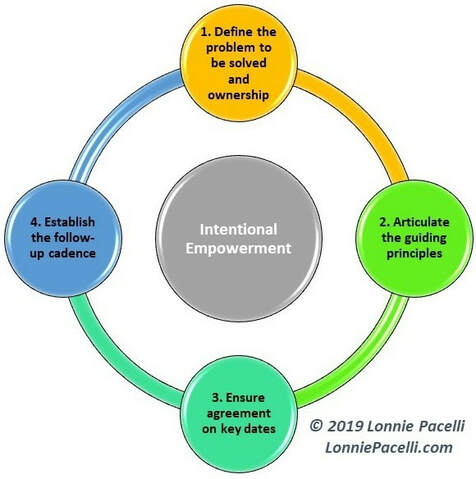
One of the most over-used, warmed-over leadership terms uttered daily. Leaders high and low espouse their expertise in empowering teams to deliver. Some are very good at it, fostering high-performance teams who deliver great results. Others, though, only think they are good at it but frustrate teams with micromanagement, apathy, vagueness, and randomization. Most anyone who has been around the block has seen both good and bad empowerment examples. As for me, I’ve not only seen it, I’ve committed both the good and bad. It took me years to understand that empowerment isn’t just about delegating tasks to be performed. True empowerment is about entrusting individuals with problems to be solved and supporting them in the process. A high-performance empowered team owns problems or missions and is supported by a leader who provides clarity, gives guidance, and resolves only those issues the team can’t resolve on their own. To put some meat on this, I like to think of empowerment as systematic, with four critical steps needed to ensure its success. I call this intentional empowerment.

Intentional Empowerment

Step 1 – Define the problem to be solved and ownership

The first step in intentional empowerment is the clear articulation of a problem statement. The size of the problem doesn’t matter, it can be something that will take hours, days, or months to solve. What matters is a clear understanding of the problem statement, as well as ownership of the problem statement and the resulting solution.

Here is a good example:

  • We need to reduce our invoice processing costs by 15% to align with mandated cuts across the organization. I would like you to take point on creation and execution of a plan to achieve the 15% cost-reduction goal.

And a bad one:

  • Go develop process flows on our invoicing process so we can look for cost reductions.

While process flows may be a necessary step, you as the leader have delegated an errand to someone else and retained control of the problem. The person will run the errand, give you process flows, then await your next instruction.

Step 2 – Articulate the guiding principles

Articulating guiding principles is about policy, legal, regulatory, or other guidelines which the solution needs to adhere to. Note this is not about telling the problem owner how to do something, it’s about ensuring the problem owner knows the boundaries that he or she needs to abide by in solving the problem.

Some good examples of guiding principles:

  • All invoices must be paid within ten days to ensure we get a 2% trade discount.
  • Any personnel hire/fire recommendations must be first discussed with HR and kept strictly confidential
  • Ensure the solution has the buy-in of the purchasing director.

And a couple of bad examples:

  • Here is how you should go about solving the problem.
  • Go talk to the purchasing director, interview her on what she thinks should be done, and tell me what she says.

Guiding principles aren’t about controlling how something gets done, they are about the problem owner knowing what latitude he or she has in solution definition. 

Step 3 – Ensure agreement on key dates
Knowing when something needs to be done and any key interim milestone dates enables the problem owner to figure out tasks and resourcing needs to hit the dates. It’s crucial here to get crisp on a specific date, not an “ASAP,” “immediately,” or “yesterday” date. It’s important for the leader to have his or her key dates thought out to ensure alignment with the problem owner. A good example:

  • We need the plan done by April 15 in time for our annual review with the VP with subsequent implementation complete by fiscal year start of July 1.

And bad ones:

  • I need it yesterday.
  • I need it ASAP.

It may be that a problem needs to be resolved urgently; if that’s the case then stress the urgency to the problem owner but put a date on it. Don’t leave the when up to interpretation.

Step 4 – Establish the follow-up cadence
Key to intentional empowerment is an agreed-upon and timely follow-up cadence that both the leader and problem owner understand and agree is appropriate. When done well, the leader and problem owner stay aligned on execution and can fulfill project “asks” on a timely basis. It also minimizes surprises and frantic rework when expectations aren’t met. Just as importantly, though, is the leader staying in his or her lane by serving as a resource for the problem owner. An impatient or meddling leader can start micro-managing or dictating how something should be done. The problem owner turns into errand runner, with the leader hijacking problem ownership. Empowerment gone bad.

The cadence frequency should be appropriate to the problem and its due date, whether it be monthly, weekly, daily, hourly, or some other increment. As a leader it’s important to work on the frequency right-sizing with the problem owner; too infrequent can communicate disinterest, too frequent can communicate distrust. Here is an example for a project with a due date of one month:

  • Schedule 15 minutes each Friday for both of us to go through status, issues, risks, and any help-wanted requests.

For the same project here are a couple of bad examples:

  • Check in with me every day to tell me what you’ve done and what you’re going to do.
  • I’m very busy, just let me know when it’s done.

There’s no one-size-fits-all follow-up cadence, what’s important is that the cadence exists, and both the leader and problem owner agree it’s appropriate. Again, too-infrequent follow-up communicates disinterest, while too-frequent follow-up communicates distrust.

I want to leave you with one last thought. Empowerment is a privilege, not a right. Those who are empowered have to earn and keep the trust of their manager, peers, and employees. Ensure when you are empowering someone to solve a problem that you are doing so because you trust him/her, and that if the trust is breached the willingness to empower diminishes. With that being said, take the time to understand intentional empowerment and use it to create high-performance teams that deliver value to your organization.

Posted on: August 16, 2020 10:25 AM | Permalink | Comments (2)
ADVERTISEMENTS
ADVERTISEMENT

Sponsors