I Wasn’t Expecting This! Five Tips for Mastering Expectation Alignment


| Some time back I was the executive sponsor responsible for developing a facility strategy for a new line of business. I empowered one of my project managers to develop the strategy which we would jointly present to our management. We both had visions of what we expected in the strategy but I didn’t ensure our points of view meshed.. My project manager was very competent in her job; however mind-reading was not one of her skills. The day before we were due to present the strategy, I did a walk-through with her. It wasn’t anything like I envisioned, and I knew the strategy in its current state wouldn’t be well received by our management. We went through a fire drill to get the strategy to a state where I thought it would be better received. We survived the review with our management, but it didn’t go nearly as well as it could have gone, and we went through a lot of pain (including a sleepless night) to rework the strategy. I don’t fault the project manager one bit for the misstep. It was totally on me that the strategy wasn’t what I was thinking because I didn’t ensure our expectations were aligned at the outset. I also didn’t put checkpoints in place along the way to ensure we stayed aligned. It cost us not only in additional work but in relationship trust. I blew it. Need help to better define and stay aligned on expectations? Consider the following five tips:
As leaders, it is your job to take the lead on clearly aligning expectations for delivery. In this “measure-twice-cut-once” approach, well defined expectation alignment means less execution friction. Your team needs it. |
'I’m not on Board!' Embracing Your Team’s Think-Do Cycle
| My wife Patty and I purchased a townhome back in 2009. It is in a beautiful area, walking distance to the types of things we like to do. Built in the 1970s, it was badly in need of major renovation. I saw the potential and after one visit was ready to put in an offer. Patty needed to go back a couple more times to look at the townhome, the property grounds, and the neighborhood. She needed more time to think through and absorb what we were considering before moving forward. We made an offer four days after seeing the townhome, when we were both comfortable with the purchase. Then we proceeded with gutting and remodeling, then moved in June 2011. We never regretted the decision. Our home purchase example was the first time I consciously thought about how quickly I made decisions and moved forward with implementation relative to Patty’s more deliberate approach. At first, I was frustrated with our speed differences, wondering why she couldn’t move as fast as me. As we’ve continued to grow, I’ve learned to respect and appreciate her more thoughtful and deliberate pace as she raises issues that I might not consider. We now recognize each other’s processing speed, or what I call “think-do cycle,” and how our different styles yield a decision-making speed we’re both content with. The think-do cycle applies to work teams as well. You may have some on your team who are ready to launch on a proposed solution when others need time to process. When differing think-do cycles aren’t acknowledged and embraced, work teams could get frustrated with moving either too fast or too slow. When differences are embraced, decisions and resulting action are made with better team buy-in. As the leader, your job is to balance team-buy-in with the timeliness that a decision must be made. It’s not easy to do; but it’s something that leaders continually need to balance to minimize execution friction. Need better awareness of the think-do cycle and how to implement in your team? Give these five tips a look:
Be mindful about the think-do cycles of you and your team. You’ll better secure team buy-in on key decisions and reduce execution friction. |
'I Can’t Keep Up!' Six Principles for Using Your Calendar to Get More Done
Categories:
Time Management
Categories: Time Management
| Through my years I’ve seen many leaders at all levels struggle with getting things done either by having to work late in the evenings and on weekends or by completely missing due dates. As I’ve talked with these leaders, they just consider it part of the job, unable or unwilling to do anything about it. I found myself early in my career doing the exact same thing; setting unrealistic expectations and killing myself to try to meet them, only to have a limited success rate of delivering on time. I hated that hamster wheel. 1. Make your to-do list a “done” list – It’s commonplace to keep a to-do list. My approach is to apply four changes to the prototypical to-do list:
A common thread through these principles is discipline. You can put the best-intentioned techniques in place but if you don’t follow them, you’re dooming yourself to emails at midnight. Seriously consider the principles, put your spin on them, and put them into action. |
In Search of the Good Enough Leader
| On a recent project my company was working with a frozen seafood manufacturer to help them bring a specialty frozen seafood product to market. A huge component of getting this project done was the packaging; it had to be eye-popping and appealing while protecting the frozen seafood pieces inside. After a number of design sessions with the packaging manufacturer, we received the finished packaging. What was initially exuberance during the design session turned into disappointment when we saw the finished product. Some of the graphics were a bit blurry, a re-sealable zipper wasn't included, and a clear window to view the contents inside was missing. Our emotions went from disappointment to anger as the manufacturer told us it would be a number of weeks before a new delivery of the packaging could be done. If we took this route, a key delivery to a very important customer of ours wouldn't be met. What a pickle. As we thought through our dilemma, we started thinking about what was "good-enough." While some of the problems with the packaging were irritating, they were largely cosmetic and didn't impact the quality or taste of the product. We ultimately decided that we could still use the packaging by making one change which we were able to implement in-house. Through this process, we found that we had to mentally adjust our expectations from "perfection" to "good-enough" in order to meet our commitments to our customers and get the product out in time. Not the optimal choice, but certainly a workable one. As leaders, we are constantly faced with deciding which tasks to do and how to apply resources to those tasks. There are rare occasions where stars align and we are able to get everything done exactly the way we want it with the resources given to us. Most of the time, though, we have to decide not only what to do but what not to do. This is where the good-enough leader comes in. Good-enough leaders are able to get more done with the resources given to them because they know that there comes a point where the incremental effort (or what I like to refer to as "polishing the apple") just isn't worth the expense required to achieve the effort. Good-enough leaders are able to define clearly what good-enough means for any task being worked on and are able to get the team to self-check on achieving good-enough. Simply put, good-enough leaders get more done because they know not only when to start, but when to stop.
Being good enough isn't all that difficult and can be applied to virtually any job. Look to be a good-enough leader by thinking about some of these tips:
Be a good-enough leader. You'll get more done because your team will make better choices on where to spend time and will consciously avoid polishing the apple. Think good-enough; it works. |
New job, now what? Create a practical 100-day plan to start your new gig on the right foot
|
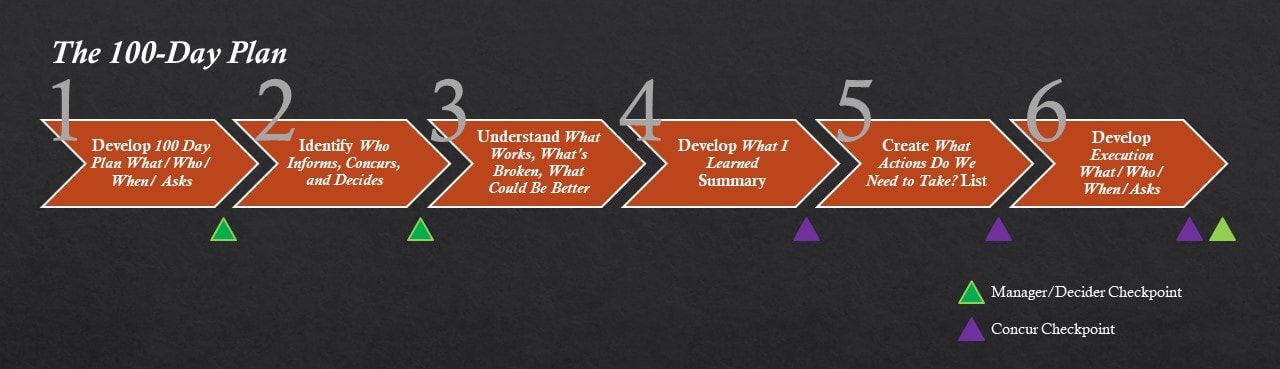
So after you've celebrated that new job or promotion, the reality of what you've gotten into sets in. Now what? Where do I start? Who do I talk to? What are the most important things I need to address? Who can I impact if I do something wrong? Who can impact me if they do something wrong? The question list goes on, adding to the stress of taking the new job. Random execution not only translates to focusing on the wrong things, but also dramatically impacts your credibility with your manager, team, and stakeholders. The answer is not to arrogantly come into the job with all the answers, but to come in with a plan to understand the environment, draw conclusions on the most important things to focus on, and develop an execution plan to act on those conclusions. The answer is a 100-day plan. First things first, your plan may not take exactly 100 days to complete. Depending on your situation it may take fewer days, or, if you are stepping into a major crisis, you may have to expedite the plan or do it concurrently with addressing the crisis. Generally speaking, your plan should not take more than 100 days to complete. The rationale is simple; you want to be viewed as someone who takes deliberate, thoughtful action, not someone who takes forever to figure out what needs to be done. If you can get it done faster and do quality work then by all means do so; just be deliberate in your action.
Note: click on each graphic to see a larger, easier to read picture
The 100-day plan's purpose is designed to help you do the following:
Step 1: Develop 100 Day What/ Who/ When/ Asks Plan
Step 1 is articulate your 100-day plan tasks, who will be performing those tasks, and when you anticipate the tasks being complete. Being "aggressively realistic" is important here; meaning you move the work forward as quickly as you reasonably can while ensuring a quality end product. Once you've determined the what, who, and when of your tasks, articulate any specific requests to your management to help you get the plan executed. Does your plan require travel which requires expense approval? Do you need your manager to provide an introductory email to some stakeholders informing them of your new position and that you'll be contacting them? Think through what those "asks" are then do a plan review with your manager for concurrence and approval. Step 2: Identify Who Informs, Concurs, and Decides
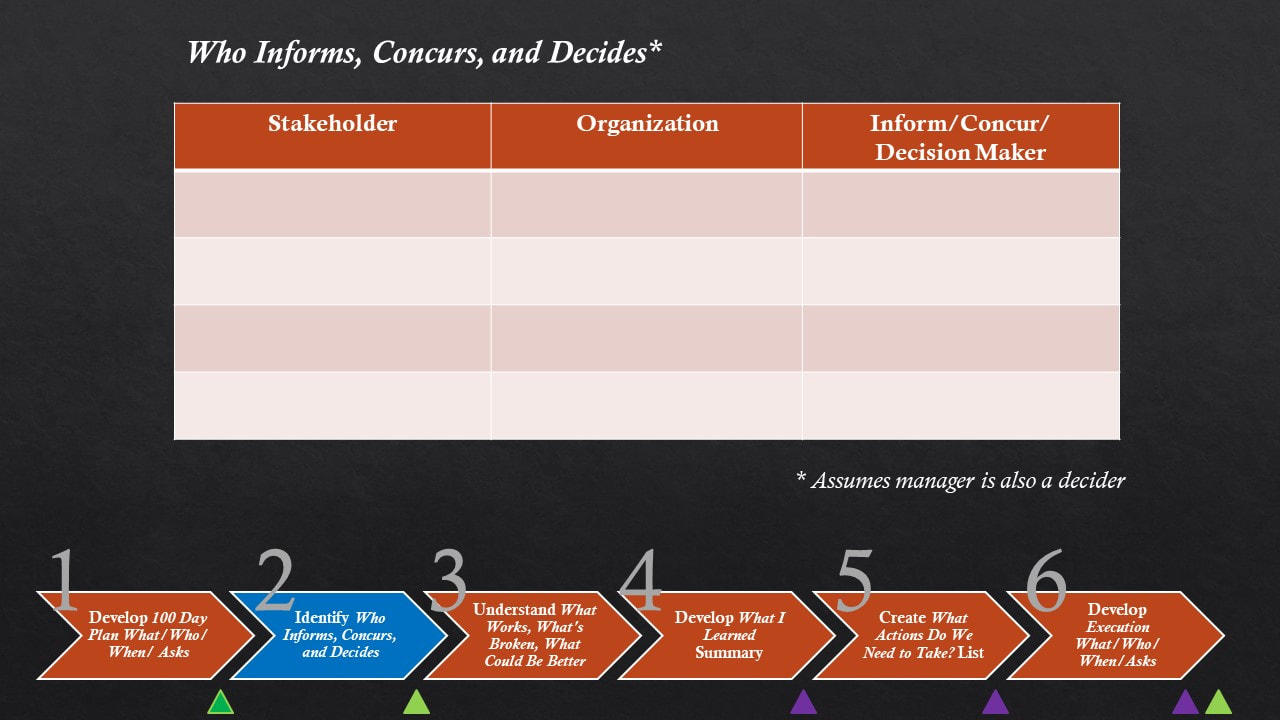
Step 2 is the development of an internal and external list of stakeholders who you want to interview as part of your current-state understanding. Internal stakeholders are those who are within your direct organization including direct reports, extended team members, and other people who impact or are impacted by the work your organization does. External stakeholders are those outside your organization who may or may not be impacted by your work but can provide good information on the current state. External stakeholders also can include experts outside of your company who provide information on industry trends, best practices, or other data points which could help give information about your future direction. For each stakeholder you should identify whether the stakeholder informs you (provides advice but is not directly impacted by your execution plan), concurs with you (doesn't formally approve your execution plan but you want/need their buy-in), or is a decision maker (formally approves your execution plan). I also think it's important to do a checkpoint with your manager as she/he may have additional stakeholders who are functionally or politically important to include, along with their appropriate inform/concur/decide status. Step 3: Understand What Works, Is Broken, and Could Be Better
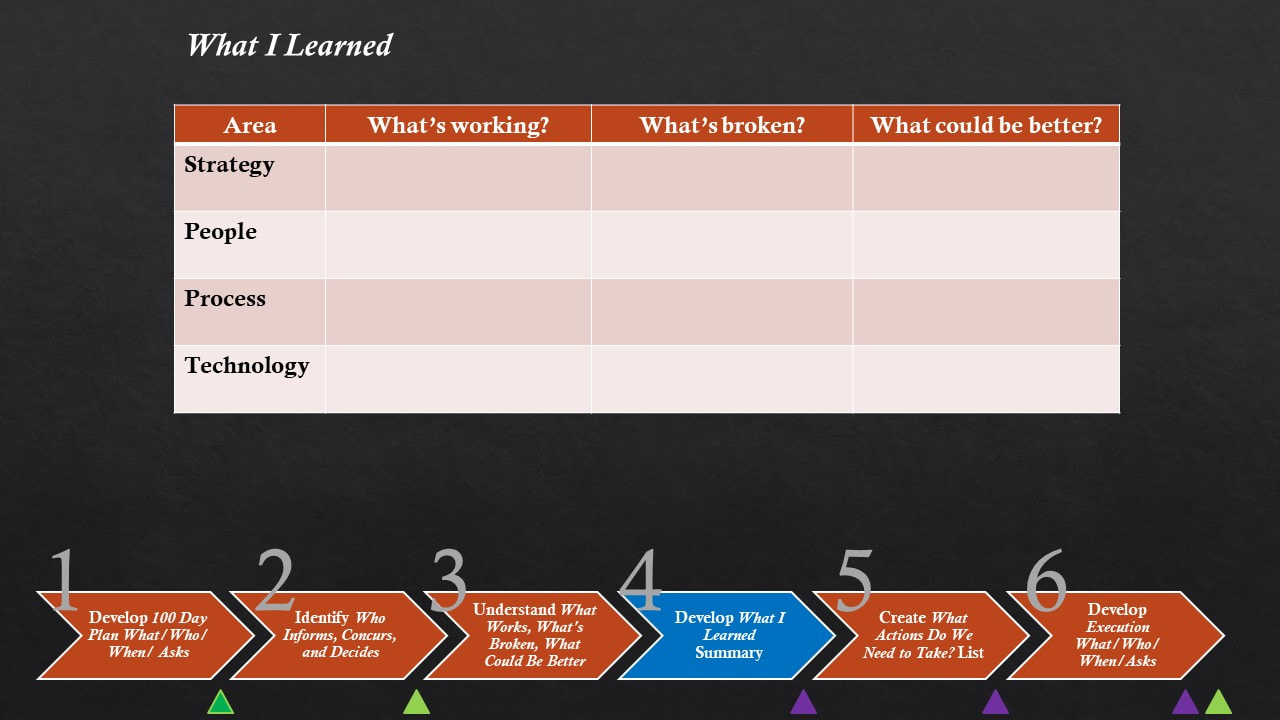
Step 3 is about interviewing your stakeholders to understand what is currently working, what's broken, and what might be working but could work better. This step is vital to not only understanding the current state but to establish a reputation with team members and stakeholders as someone who listens prior to taking action. I've found it helpful to focus on four areas in your works/broken/better discussion: organization strategy, people, processes, and technology. Depending on your situation these areas may be different. The last question I like to ask is, "If you were sitting in my chair, what are the top three things you would you do?" This is particularly effective not only in understanding items stakeholders think are important, but the priority they place on those things they identify. You may customize what you talk about depending on your stakeholder, but it's better to have a structure to work from then alter as needed, rather than totally winging it. Remember to interview your manager to understand his/her top priorities and perspectives. Step 4: Develop What I Learned Summary
Step 4 is about taking what you've learned through your discussions and documenting trends and important facts that will influence execution plan actions. This is not an audit trail of everything you heard in every discussion; if you do that then you're likely to come out of the exercise with an unwieldy an non-actionable list. Conciseness and clarity are important here as this sets the stage for what you will focus on in your execution plan. You'll also want to do a checkpoint with your concur stakeholders to confirm you are focused on the right working/broken/better items and underscore that you've listened to what others have told you. Again, this is a crucial credibility builder with those you will be working with. Step 5: Create What Actions Do We Need to Take? List
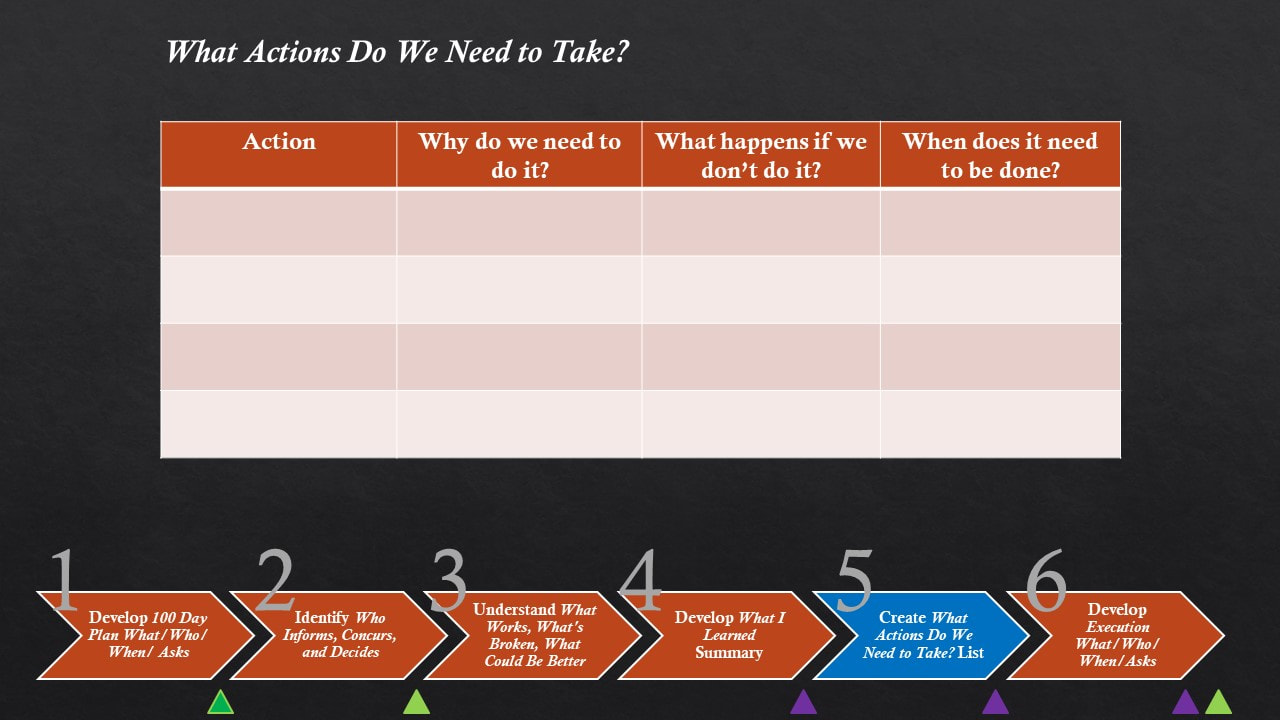
Step 5 begins the translation of what you've learned into what needs to be done to fix what's broken, improve upon what can be done better, and not disturb things that are working well. Each action includes three descriptive pieces of information: why it needs to be done, what the consequence if it isn't done, and when it needs to be done. Through articulating these factors you begin to develop a prioritized list of actions that comprise your execution plan. Do a checkpoint with your concur stakeholders prior to completing your execution plan. Step 6: Develop Execution What/ Who/ When/ Asks Plan
Step 6 is about taking the actions in step 5 and creating a what/who/when plan which facilitates you working on the most important actions and getting them done first. It's totally reasonable to divide your actions up into phases, with your first phase of actions having a more detailed plan and subsequent phases being done once the first phase is complete. I can't stress enough the importance of focusing on the most important items from step 5 first and not getting distracted with trying to plan out all of your actions. In this step you'll do a concur checkpoint to ensure their buy-in prior to doing a decision maker checkpoint. You want to make best efforts to secure concur stakeholder buy-in and avoid having dissenting stakeholders discredit your conclusions and plan. As mentioned throughout, your situation may require compression or expansion of the above steps. What doesn't change is the understand/conclude/act cycle that you'll need to go through to understand what you're getting into and determine what you need to address, while building trust and credibility with your stakeholders and management. Next time you take on a new job, use this model as a framework to help you execute a practical 100-day plan to get you off to a good start. |