


Are You a Wisdom Pontificator?


|
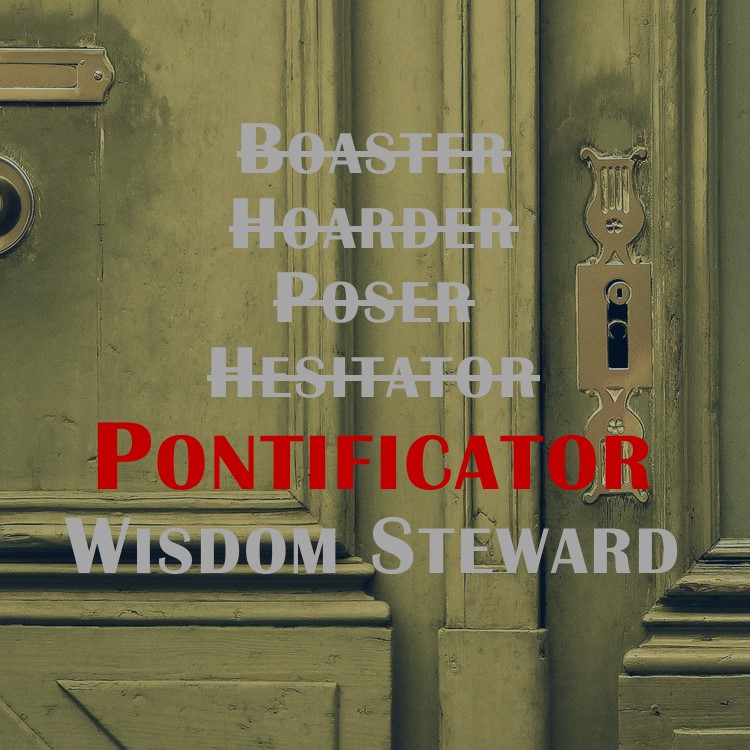
“Oh brother, Moe is on the meeting invite,” Sue said to herself as she prepped for the meeting. Moe has been at the company for 40 years and considers himself the fountain of knowledge for how things should be done. Even though a lot in the industry has changed over the years, Moe loves to tell stories about “the good old days” and how so much of what the company is trying to do can’t work. “Those idiot suits on the 40th floor . . .” is one of Moe’s go-to quotes, explaining his view that leadership doesn’t have a clue as to how to run the company. Moe can easily take up ten minutes in a one-hour meeting justifying why a new idea won’t work, based on an irrelevant old war story which typically ends with, “If they just listened to me . . . .” Some team members try to be polite, and others try to shut down Moe’s bluster. Moe’s credibility, once well-regarded in the company, is now in the toilet. Despite his attempts to demonstrate relevancy, he’s simply viewed as a pontificator. While this illustration may seem a bit extreme, I suspect that most anyone reading this article has some version of a Moe whom they know either personally or professionally. It’s the person who makes things all about him, who knows it all, who isn’t interested in learning the wisdom others have to share, and who uses what he knows and has done in the past as a tool to stay relevant. To understand a wisdom pontificator, we need to first understand a wisdom steward. A wisdom steward is balanced in how they seek and share wisdom. They humbly and genuinely seek wisdom to help make sensible decisions. At the same time, a wisdom steward transparently and candidly shares wisdom with others to help them make sensible decisions. The seeker and sharer roles are equally respected and practiced by the wisdom steward with the goal of embracing success for both themselves and others. The wisdom pontificator generally isn’t concerned about genuinely seeking or candidly sharing. In fact, the pontificator is all about the pontificator. In his mind he knows it all. His motivation for sharing is about demonstrating his relevance, even if what he wants to share isn’t applicable to the situation. The pontificator tends to tell the same tired old stories over and over again that highlight his successes and, even worse, hint that those around him are idiots. People quickly tire of the pontificator and his time-wasting, self-serving bluster. Are you a wisdom pontificator? Ask yourself these questions:
Wisdom pontificators generally aren’t interested in what others have to say; they are more concerned with demonstrating their relevance and making themselves look good. If this is you, then it’s time for you to shut your mouth, listen to what others have to say, and be more candid in your sharing. Wisdom stewardship is about mutual success with others, not about proving relevance. |
Asking for Help: The Leader/Follower Partnership
| It was one of the worst meetings in Greg’s project management career. Asking for help, when done effectively, not only ensures successful delivery but demonstrates a follower’s maturity and wisdom to use any and all levers available to secure delivery. There’s definitely a methodology to asking for help that both the leader and follower need to follow if their partnership is to flourish.
Asking for help means both the leader and follower have responsibilities for the partnership to work well. Take heed of the following points to ensure both are doing their part. For the follower:
For the leader:
Effectively asking for help not only paves the way to getting things done more expediently but also positively impacts the leader-follower relationship. Followers, learn how to effectively ask for help. Leaders, respect the partnership and follow through. |
Are You a Wisdom Hesitator?
|
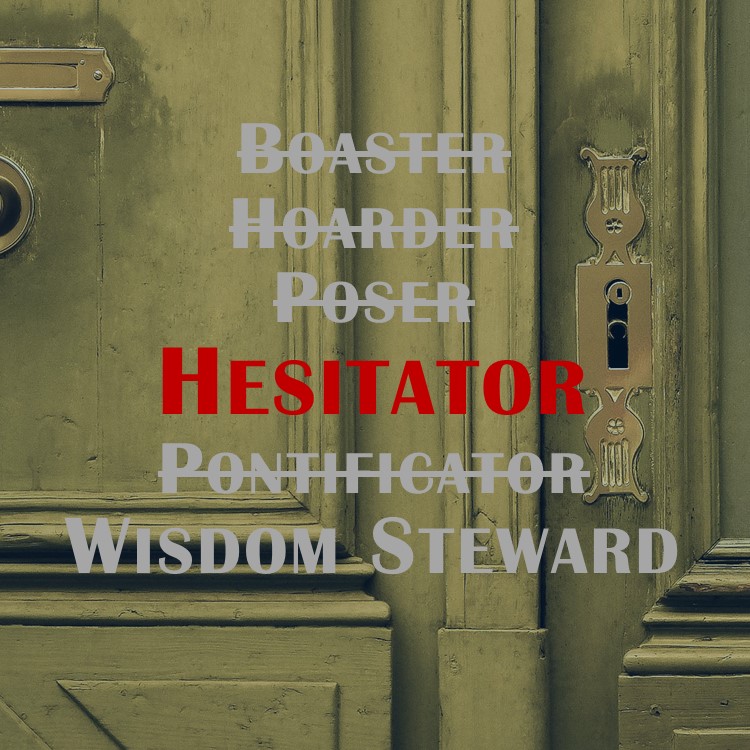
“I should have spoken up,” Gil said as he took another bite of his burger. He and his wife, Pat, loved going out to their favorite burger joint on Wednesday nights for their two-for-one hamburger specials. Gil told Pat how he had sat through a three-hour meeting where his work team wrestled through a nasty problem. Gil had come up with an idea an hour into the meeting but never spoke up. Someone else came up with the same idea two hours later, which was supported not only by Gil’s boss but the other team members. “This isn’t the first time,” Pat said. She and Gil had been married for ten years and she knew him inside and out. She not only knew his strengths, but also his weaknesses. “I know, I just don’t like to monopolize a meeting,” Gil said. “I think you’ve got a long way to go before that happens,” Pat said as she popped a French fry in her mouth. “What do you mean?” “Gil, you’re one of the smartest men I know. When you do speak up, you typically say something very profound and thoughtful. The issue isn’t speaking up too much, it’s speaking up too little.” Gil sat there for a moment, thinking about what Pat just said. Pat wiped her mouth with her napkin and continued. “I went to a class today about something called a wisdom steward. In the class the instructor talked about six different personas; one of them was a wisdom hesitator. As soon as the instructor described the hesitator persona, I thought of you.” “A wisdom hesitator?” “That’s right. Now how about we split a tiramisu?” “Um, sure thing,” Gil said. The server came to the table. “What’s a wisdom hesitator?” Gil thought to himself as Pat ordered their dessert. To understand a wisdom hesitator, we need to first understand a wisdom steward. A wisdom steward is balanced in how they seek and share wisdom. They humbly and genuinely seek wisdom to help make sensible decisions. At the same time, a wisdom steward transparently and candidly shares wisdom with others to help them make sensible decisions. The seeker and sharer roles are equally respected and practiced by the wisdom steward with the goal of embracing success for both themselves and others. Now, on to the wisdom hesitator. The wisdom hesitator may be concerned with success, but he is afraid to express himself out of fear of what others may think about him and his ideas. In team meetings, the hesitator is usually the one who remains quiet and needs to be specifically asked for his input. My experience with hesitators, though, is that they can be incredibly perceptive and contribute valuable perspective to a discussion. I’ve been involved in many meetings where the hesitator, after being prompted, provided a point of view that wasn’t previously expressed and changed the trajectory of a conversation. Typically, it takes a leader who is sensitive to hesitators and draws them into the discussion. Unfortunately, many great ideas never see light of day because the hesitator isn’t willing to express his point of view. When a hesitator doesn’t share his wisdom and something bad happens as a result, everyone loses. Are you a wisdom hesitator? Ask yourself these questions:
Wisdom hesitators can genuinely seek wisdom but need to feel it’s a safe environment before sharing. If this is you, take small steps to more deliberately share wisdom. It will likely be uncomfortable at first, but your ideas deserve to be heard and can make a difference. |
Are You a Wisdom Poser?
|
“If you do this, you’ll definitely increase revenue,” Mark said. Mark was a brash young consultant out to make a name for himself on his first consulting gig since graduating with an MBA. The client, Paula, was an experienced sales manager. She patiently listened to Mark’s presentation filled with consultant-speak and tired cliches. It was the “definitely increase revenue” claim that got her to chime in. “Increasing revenue is always a great thing. Tell me, Mark, where have you done this before?” Paula asked. “Well, our firm has done this with a lot of clients.” “That may be true, but you’re pitching me on work that you specifically would be doing for us. I’m curious as to where you’ve specifically succeeded with a project like this and your experience with increasing revenue. Where have you done this before?” Mark stammered for an answer. “I would have a team working with me that has the experience to deliver.” “Mark, I’ve been around the block a lot and can tell when someone isn’t being up-front with me. You’ve never done a project like this before, have you?” “Well, yeah; when working on my MBA we did a case study on this. I’m confident I can do the work and deliver results for you, Paula.” Paula smiled politely. “Very good, Mark; let me think about it, OK?” “Certainly. Can I call you next week?” Mark asked. “I’ll be out, but I’ll give you a ring if we decide to pursue further. Thanks, Mark.” Paula got up from her chair, shook hands with Mark and led him out of the office. “Sheesh, what a poser,” Paula thought as she walked back to her desk, knowing she would not be calling Mark back. To understand a wisdom poser, we need to first understand a wisdom steward. A wisdom steward is balanced in how they seek and share wisdom. They humbly and genuinely seek wisdom to help make sensible decisions. At the same time, a wisdom steward transparently and candidly shares wisdom with others to help them make sensible decisions. The seeker and sharer roles are equally respected and practiced by the wisdom steward with the goal of embracing success for both themselves and others. Now, on to the wisdom poser. The wisdom poser isn’t concerned about embracing success. The poser is concerned more with impressing others. A poser guardedly seeks wisdom without exposing how much they don’t know about a topic. The poser tries to understand enough to dazzle others with their command of the subject matter. Think of this analogy; I can read about a perfect golf swing all day, but I have to put what I’ve learned into practice and hit the links. The poser would profess to be a great golfer because they read about it, not because they have the scorecards to prove it. The poser shares what they think is wisdom, but it’s baseless because there’s no experience to back it up. So, a wisdom poser guardedly seeks without exposing how much they don’t know, and aggressively shares information, trying to pass it off as wisdom. Are you a wisdom poser? Ask yourself these questions:
Wisdom posers guardedly seek wisdom without exposing themselves and aggressively share information passed as wisdom. If this is you, now is the time to make the move from wisdom poser to wisdom steward. |

Are You a Wisdom Hoarder?
|
Fred was livid with his performance appraisal. He had consistently been a strong project manager in his organization for several years, having received top-of-tier raises and bonuses from Gary, his previous manager. Earlier in the year he was reorganized into a new organization led by Janet, a seasoned and well-respected leader in the company. While Fred’s raise and bonus were respectable, he was not rated in the top tier of the organization. The two sat down to discuss his performance appraisal. “Janet, this is the first time since working for this company I haven’t gotten an outstanding rating. I delivered everything on time, on budget, and within scope. Gary always gave me an outstanding rating and I did everything this year I’ve done in the past. What gives?” “I’m glad we’re talking about this, Fred. Do you remember the discussion we had when you first joined my organization?” “I do,” Fred said. “We talked about needing to be excellent in our delivery.” “Yes, and what else did we talk about?” Fred stopped for a minute, trying to remember what Janet was referring to. Janet took his pause as not having an answer. “Let me help you,” Janet said. “You are one of the most senior project managers in the organization and you have a lot to teach those coming up behind you. I asked you to mentor Gail. She’s an up-and-comer with a lot of potential. She told me you only met once and that the only advice you gave her was to work hard. Do I understand that right?” “Well, we just couldn’t find convenient times to meet,” Fred stammered. “Come on, Fred, in six months you couldn’t find time to meet with her? Growing her skills is something I care deeply about, and I wanted you to invest in her. You didn’t do it. Why?” “Look Janet, you pay me to deliver projects. That’s what I do.” “Fred, at your level your job is more than delivering projects on your own; it’s also about sharing the wisdom you’ve accumulated over the years to help others deliver on time, on budget, and within scope. Are you concerned that sharing wisdom with other project managers might mean another project manager delivers results and gets rated higher than you?” Fred sat quietly, stunned by Janet’s insightful question. “Fred, let me help you with this. I value outstanding delivery across the organization and place a very high value on those who transparently and candidly share their wisdom with others to help everyone be successful. There is no room for wisdom hoarders in my organization. Do you understand?” “Um, yes,” Fred said. The two continued discussing the rest of Fred’s performance appraisal. “Good talk, Fred. Please think about wisdom hoarding and how to work on that, OK?” “OK.” Fred left her office and walked back to his cubicle. “Am I really a wisdom hoarder?” He thought to himself. To understand a wisdom hoarder, we need to look at the definition of a wisdom steward. A wisdom steward is balanced in how she seeks and shares wisdom. She humbly and genuinely seeks wisdom to help her make a sensible decision. At the same time, a wisdom steward transparently and candidly shares wisdom with others to help them make sensible decisions. The seeker and sharer roles are equally respected and practiced by the wisdom steward with the goal of embracing success for both herself and others. Let’s look at the motivations of a wisdom hoarder. The hoarder, like the steward, genuinely and humbly seeks wisdom. The big difference comes with sharing wisdom. While the steward transparently and candidly shares wisdom, the hoarder is guarded in the wisdom he shares. The hoarder uses his wisdom as a competitive advantage over team members he views as threats. The hoarder typically shares wisdom he considers limited in value, keeping the crown jewels for himself. The hoarder doesn’t seek and share to improve himself and others, but he seeks and shares to improve only himself in order to gain a leg up on perceived competition. Who are the hoarder’s competitors? Certainly there are business competitors in a marketplace where trade, patent, and intellectual property secrets need to be contained. By all means, wisdom needs to be guarded with those entities. The competitors I’m referring to are those on a team who should be working together to help each other be more successful. When a hoarder views team members as competitors, the hoarder’s motivations become divisive. Are you a wisdom hoarder? Ask yourself these questions:
Wisdom hoarders genuinely seek wisdom and guardedly share to protect their competitive advantage. If this is you, do some serious introspection to help you transform from wisdom hoarder to wisdom steward. |



