




Guessing is not a strategy: How to build decision velocity with AI and real-time data
June 10, 2026 | Live Webinar

Navigating from a BA to Senior BA Role
How the Big 4 Impact our Personal and Professional Lives
The Impact of AI on the BA Role
Effective Communication is Essential for Project Success
Organizational Culture within The Walt Disney Company
Artificial Intelligence, business analysis, communication, Leadership, mentorship, organization, project management


|
A Toastmasters mentor can bring immense value to the table, particularly with enhancing your public speaking skills. These skills are indispensable in career development, whether for a project manager, business analyst, or the like. As a worldwide club, what a mentor does and what I believe Toastmasters provides, is a fertile ground for speakers and ideas to germinate. The mentor is not there to coax and cajole you to learn. You already bring to the table life skills, and the want and desire to learn, and to improve on your speaking skills. A mentor helps to hone in on those specific skills, to feed your appetite, to help those ideas flourish. In other words, the Toastmasters mentor helps you stay on your path to enhance your public speaking goals, making sure you don't veer too far to the right, or too far to the left. The mentor helps to keep you on that middle road, making suggestions and recommendations on how and where to improve your speaking skills. For those just starting out, the mentor helps to define and nurture your speaking structure, to give form, substance and meaning to your words. Always with the emphasis on the consistent flow of ideas from one subject to the next, unhampered. For the intermediate speaker, the mentor helps you to draw out a stronger speech structure, with a more centralized meaning to your words, making the storyline sound less contrived. Maybe even adding a bit of dramatic license to help better convey your meaning to the audience. And of course, how you can use the stage to your added advantage. For the advanced speaker, the mentor helps you to create a more refined and fluid speech. The emphasis is on subtle nuances of the language that help to pepper your speeches with verve, making them even more tantalizing to the audience. Here you want to be more cogent and coherent, more lucid, more flexible in how you express yourself with words. At each stage you learn to better equip yourself in understanding your audience at a deeper level, which might influence the way you deliver your speech. All these factors come together to encapsulate the gradual stages of how language can be learned, practiced and used to get your point across in an artistic and entertaining way, without losing sight of your message. The mentor is not there to be disparaging, demeaning or deriding. On the contrary, it takes self-control and character to be a mentor, to listen, to provide constructive criticism, and to make the learning environment mutually beneficial to both the mentor and the mentee; making it a win-win for both parties. In a sense, a mentor can be that personal or career growth coach for a short period of time. This is the optimal form of personal success, working in an environment to help cultivate that potential, allowing it to bloom into something bigger and brighter. And, as that seed of knowledge grows and blossoms, you learn how to pollinate it to others. This is in fact the best value we can learn from a Toastmasters mentor. |
|
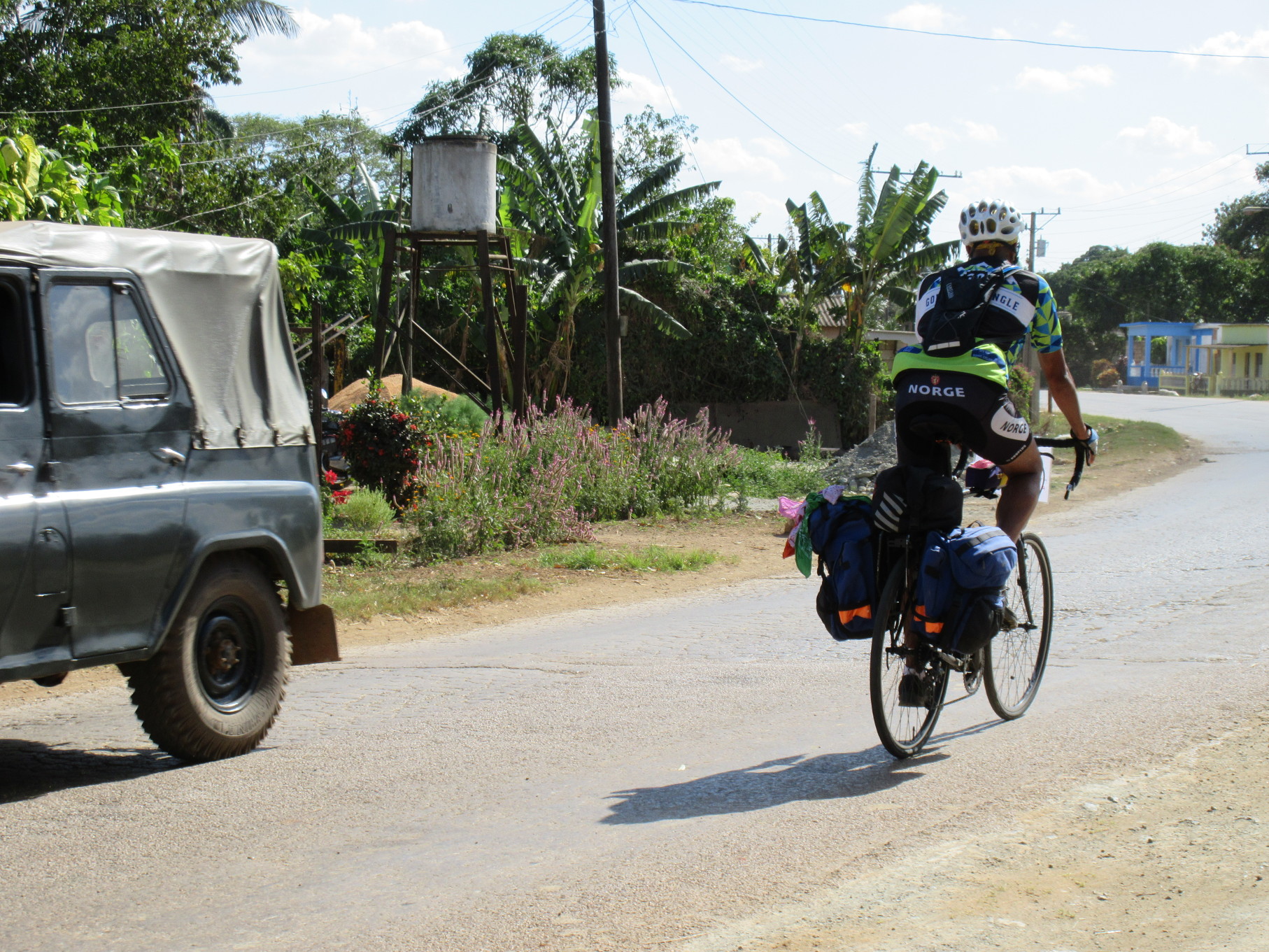
Even on a vacation, you still think in terms of project management: initiating the trip, planning a road map, planning for assumptions and risks, planning resources and expenses (you need to budget), executing your plan, always monitoring and controlling circumstances, and eventually rounding up everything to a close, and heading back home. Sometimes you just feel being Agile would be so much better. In March 2018, it didn't take long to decide to cycle Cuba over nine days, from the south eastern coastal city of Santiago de Cuba, to Havana in the north. If I had any reservations, they were swiftly squashed by Sylvie, my cycling partner, whose intoxicating enthusiasm for the bike ride was ten-fold more than mine. We were riveted with anticipation, as we carefully planned our daily routes, our expenses, and whether to rent or bring our bikes: every minute detail was diligently reviewed and carefully recorded into our daily planning guide. In added preparation we purchased our plane tickets six weeks prior to the event: we were intrepid keeners, ensconced in thoughts of Cuba cycling nirvana! On this trip, we wanted to see the real Cuba, we wanted to see the real people, the real country. What better way to do so than by bicycle! Thus, we were destined to cover Cuba on four pedals and two cranks! We ventured through many cities and towns, both large and small. Our daily routes allowed for unparalleled views of the countryside, which lie in stark contrast from Cuba's teeming resorts. The undulating hills were a good start to our journey. For the most part, the roads were smooth and surrounded by lush vegetation. Though, we did have our fair share of pot-holed or roughly paved roads with few shoulders. Only a few times were the local roads a continuous blanket of semi-asphalt, sand, dirt and debris. I don't think we saw roads with wide shoulders 'till we arrived within close proximity of Havana. Along the ride, it was fascinating to see horses, cows and oxen used to till farms. Horse buggies, bicycles, bicycle taxis, stage coaches, mopeds, and trekking are main modes of transportation in Cuba, particularly in the southern part of the country, which is a bit less developed than the north. The further you are from a city the fewer cars you see. Most automobiles are either classic American 1950s cars or 1970 Russian Ladas, with some modern vehicles here and there. In some cases, the way of life in Cuba conjures up images of early 20th century Canadian pioneer farmers and homesteaders, which is certainly unique to us in today’s world. For instance, it was interesting to see oxen pulling carts of hay on country roads. It makes one rethink the necessity for time-efficient travel. The casas (a type of AirBnB) which we stayed in were impeccable, and either very modern and chique, or old colonial homes with antique furniture, very large rooms and ultra-high ceilings. Some casas had courtyards adorned with flowers. One of our casas was something similar to a typical Spanish style villa. Of all the towns we visited, Caibarien was probably one of the most impoverished. One could easily surmise this from the many dilapidated homes in that town. From scenes like this it may appear at first glance that Cubans are economically destitute. But, their brilliant wealth instead, is tied up in strong cohesive social connections among friends and family, an affinity in helping strangers, and a richness in uniform kindness. And, not to mention free education and free health care available to all its citizens. Characteristics and institutions like these could make even the most doubtful visitor curious to know more. If anyone has a dream to re-live the nostalgic period of the 1950s just for one moment, Cuba is the place to be: it seems to have been stuck in a time warp since 1959 (the year their revolution ended). There is a fascination with all things old school, I mean really old school, at least with cars, some music, architecture, furniture and the like. The former colonial buildings seem to echo history from the deep recesses of time, certainly well worth seeing. When dining at two restaurants, one in Havana and one in the town of Bayamo, we were entertained by musicians singing popular songs from the 1950s and 60s. In the spirit of the culture from that time-period, there is a more tempered paced lifestyle throughout Cuba, which is infectious and enduring. As we moved from town to town, we marvelled at the peace and tranquility around us, taking in the splendid sceneries minute by minute! On our ninth day, triumphant in our glory, we eagerly arrived in Havana. We rested for a day, then got a ride to the airport in a classic red 1950s car, which had been refurbished into a taxi. It was a memorable send off to our last day in Cuba! During our bicycle ride we were intent on immersing ourselves in Cuba's surroundings with agility: taking occasional breaks along our route, sampling local cuisine, and mixing and mingling with locals. Managing and adapting to that swift current of daily change in a new environment was iterative in many ways. We truly relished the ride. Within nine days of distance cycling, we traversed the country on 4 pedals and 2 cranks! In doing so, it afforded us a cyclical movement through time, history and culture. What an irreplaceable and magnificent adventure! In a sense, taking a vacation like this can be a small precursor to planning for how to survive in the project economy. |
|
"If you can't convince them, confuse them." - Harry S. Truman |