


Reinventing Project Management with Citizen Development: Will Project Managers Lose Their Job?


|
So, you are a project manager, and you´ve been hearing a lot about citizen development. You are probably asking yourself, “What´s in it for me?” Maybe you think that this is IT-only and focused on professional developers. Be cautious though, some people had similar thoughts about Agile twenty years ago. Well, let´s face it: the project management profession is changing. And if you want to boost your employability and maintain yourself as a relevant contributor to your company, keep reading this article before it is too late!
80% of Project Management Tasks Will be Eliminated Back in 2019, Gartner said, “Eighty Percent of Today´s Project Management Tasks will be Eliminated by 2030 as Artificial Intelligence Takes Over”. I remember an extensive discussion at that time, and most project managers were incredulous. They argued that project management is a human activity that a machine cannot perform. Other human activities are also being disrupted and automated. Take human resources and people management in the era of big data and machine learning, for example. The rise of “digital leadership,” highly effective virtual teams, and online collaboration are undeniable truths.
If 80% of PM tasks will be eliminated, will project managers lose their jobs?
The answer is yes and no. You will lose your “old job,” but you can reinvent your profession and disrupt yourself, opening a new landscape of opportunities: citizen development and the future of project management. Before I give you the long answer, it is essential to emphasize that humanity is transforming fast. Peter Diamandis, the author of the best-seller book “Abundance,” says that we live in a time of more opportunity and abundance than ever before. According to Diamandis:
Abundance means more projects. Consequently, project managers are in high demand. The Project Economy, according to PMI.org, is one in which people have the skills and capabilities they need to turn ideas into reality. “The future of work is fluid, dynamics and goal-oriented; project leaders will be in high demand.” (Cindy Anderson)
We, project managers, will not lose our jobs. Project managers are in high demand and will be in even higher demand because we need people capable of navigating complexities, managing uncertainties, and delivering value to stakeholders through successful completion of projects, delivery of products and services.
What Shall I do, as a Project Manager, to Stay Relevant? Project Management Offices, project managers, and other stakeholders are increasingly reliant on technology to execute their work. Citizen development is critical to democratize digital transformation, impacting business models and the way we work. Project managers, business analysts, and project team members are change-makers. To stay relevant, increasing our employability, we need to acquire new skills and competencies, revisiting our experience, and connecting the dots to find better ways to deliver value.
You don´t have to look for another profession. You have to reinvent your job by adopting a citizen development mindset, embedding technology into your project management processes and activities.
A Final Word and Actionable Steps Back in 2001, Clayton Christensen wrote the book “The Innovator´s Dilemma: When Great Technologies Cause Great Firms to Fail”. Technologies are now disrupting professions and career because they change the way we work. Citizen development is a wake-up call to all professions. Project managers, change-makers, shall lead breakthroughs not only with innovative products and services but mainly with methodologies and frameworks. The first step is to adopt a growth mindset (Dweck, 2015). The second step is to become aware of the transformations impacting your profession and organizations. Stay tunned on the Citizen Developers community at ProjectManagement.com and revisit The Project Economy website at PMI.org. Finaly, the third step is to start your citizen developer journey.
Join the conversation below and let me know your thoughts. Next week, I will provide real-life examples about the “PMO of the Future” and how project managers are applying citizen development to improve project management processes and results. |
Citizen Development is a Game-Changer. But it’s Not Always the Right Option.
IntroductionMany of us, whether in work or otherwise, have at some point had the thought, “it would be handy if there was an app for this.” We may even have fantasized about how this hypothetical app would work. It would be tailored to our exact requirements and have no extraneous nonsense we didn’t want or need. If only we knew how to code. I don’t know how to code. And I will never know how to code. Don’t get me wrong, coding is a wonderful skill to obtain and I’d happily have Tank upload the relevant programs to my brain if I lived in the Matrix. But I don’t (I think…), so building applications is something outside the realms of possibility for someone like me. Or at least it was. The Citizen Development RevolutionCitizen development is snatching power from the coding elite and placing it in the hands of creative problem solvers. No more claiming that your magnificent idea got lost in translation and the developer botched it. You’re the developer. That painfully convoluted, multi-system reporting process in your department? Build a quick web app to streamline it. Those paper-based onsite inspection forms that require manual, error-prone data entry? Build yourself a purpose-built inspection app and finally make use of the tablet your mum got you for Christmas. That time you worked in a Dutch timber company and needed to optimize your business processes by developing stock and order management software? (We’ve all been there) https://wem.io/stock-and-order-management-software-with-no-code-2/. In short, citizen development is a game-changer, but… It’s not always the right option. The Brown Sauce ConundrumIn our excitement at the endless possibilities engendered by the citizen development revolution, my team and I wanted to use it for everything. But just because brown sauce tastes great, doesn’t mean you should put it in your tea. Our first target was to create a customized learning management system (LMS) to host eLearning content that we were creating. We were all excited by the challenge of creating a bespoke LMS. However, it turned out that so were a lot of others, and they had created excellent, reasonably priced LMS platforms that met all our needs. Anyone who has read PMI’s Citizen Development book may recall the first question in the Environment Check section of the Suitability Assessment: Is there an app on the market that satisfies your requirements for this solution? If the answer is yes, the book poses further questions regarding whether you require the flexibility to make changes to this app in the future, and whether purchasing a market app would be cheaper than building your own. After asking ourselves these questions, it was clear that in this instance we were better served by using what was already on the market. But We Already Have OneSometime later, we were building an online community for a client, and needed a platform on which to host it. We knew exactly how we wanted it to function and were sure that with the aid of citizen development we could quickly make it a reality. And we nearly did. But it soon came to our attention that there was already a community platform in use in another area of the organization. Was it exactly what we had envisaged? No, it wasn’t. But it was close enough, it was paid for, and we could leverage it for little extra cost. The second question in the Environment Check asks: Is there a tool within your organization that satisfies your requirements for this solution? There was. So we used it. The Future of App DevelopmentSince then we have built numerous apps using citizen development (a sales tracker, an events management app, a customer portal, a reporting tool), and we’re continuously seeing more ways in which the technology can be applied. There are of course those that still feel citizen development is all hype and no substance: I recently received feedback from a software developer who told me that citizen development was nothing but a “buzzword” that he’d never heard before and was sure he’d never hear again (we might need to add an eighth entry to this list: https://www.pcworld.com/article/155984/worst_tech_predictions.html). For my money, however, if Amazon (Honeycode), Google (AppSheet) and Microsoft (PowerApps) are pouring mega-millions in to it, and Forbes and Gartner are backing it, it’s safe to say that it’s more than just a fad. It’s the future of app development. And while it may not always be the right option, when it is, get ready to save a lot of money and a lot of time. |
How a Construction Project Manager Tackled Citizen Development Part 1
| After working in construction for almost 7 years I thought both my and my organisation's future was set in stone. Waking up every day, going to work, using the same old / inefficient processes for planning projects and keeping track of various data that would often get misplaced or altered over time through miscommunication; though I never thought anything of it, that was the "norm". That was until I heard about CD (Citizen Development) and started to look into it more and what it could do for me. I quickly became interested in the benefits of CD and "low-code / no-code" (LCNC) platforms and what they could do for me, whenever I did or saw something I begun to think.
The more I researched, the more opportunities unfolded, the more I began to think and solve and start to see the many benefits of CD. Taking the Citizen Developer Course When I heard that there was a specialised "Citizen Developer” course I immediately started to investigate and it didn't take much convincing to get enrolled. I began the course expecting to learn about the opportunities that CD would enlighten, the best LCNC platforms to use and the process of putting my knowledge into practice and I was a little worried that it might be quite difficult given the fact I have never touched coding or built an App before; however, the experience was much more than that. On the foundation course you learn EVERYTHING from ideation to creation and deployment, the whole process! You get to learn the basics and how to unlock the full potential of CD along with how to comply with IT by bringing structure and security. With Citizen Development there is no need for technical knowledge, so long as you have the will to create a solution, CD will enable you to do it and the CD course will show you how and hold your hand through the process. The best parts of the course had to be the many downloadable templates and the real-world examples for you to examine, having the ability to look at a small selection of real-world examples of CD being put into practice was game changing and allowed me to really see the effect it had within a business. Thinking About Implementing CD After the course I began thinking about where and how I should start to implement this within my own career, the use of LCNC platforms will help out a vast majority of businesses, especially the ones with a backlog of work that would usually require an IT specialist. That isn't all CD can do though, just think of the career opportunities that get created, so many businesses have underlying issues that just don't get solved or get pushed to the back of the queue because they don't have the necessary resources to deal with them. For example, think of your own work environment, what do you think could be made more efficient through the implementation of a simple app? As someone with CD experience I would now feel more confident in tackling those issues and developing a solution in a cost and time effective manner. All in all, since starting my path on becoming a Citizen Developer I have had my eyes opened to a new world and I am excited to see where this can take me, first of all I need to get to grips with a LCNC platform, there are so many to choose from, each with their own advantages. Then I need to put both my CD and LCNC knowledge to the test within my own working environment to see just how effective it is in my own line of work; after that I hope to evolve some more and take my expertise to larger projects with more diverse needs. The Next Steps on My Citizen Developer Journey So that is my starting experience with becoming a Citizen Developer, my near future goal is to get to grips with a LCNC platform and put into practice my newfound skills into building something. I am thinking I should build something simple such as a tracker that provides detail of all the hours worked by employees and various contractors on each project. Or maybe I should build something expandable such as a job portfolio that presents details of all past projects that we do so that I have something to show future clients that inquire about past jobs; this will allow me to build something simple to start with and expand / improve over time as I become more skilled. My plan for this is to use a couple of hours each evening and some additional hours on weekends learning the fundamentals of app building within my chosen platform which I hope should be enough time (including ideation and planning) to get my first basic app built to bring a solution to something within my company. I’ll look forward to sharing what happens on my next blog! Over to you, have you been building apps with LCNC? What LCNC platform would you recommend or like to learn? I’d love to hear from you what’s working for you.
|
Project Management Past and Present: Setting the Stage for Citizen Developer
|
As the project management profession developed and matured, more and more organizations understood that project management is indispensable to business results. Project management is a life skill, enabling people and organizations to turn ideas into results. This article will guide you on a journey to describe why and how project management changed overtime, discussing future applications and implications of hybrid approaches, citizen development, PMOs, and agile organizations.
Early Days of Project ManagementCan you imagine a time in which there was no job title "project manager"? There was a time in which project management did not exist as a discipline or profession. Back in the 1960s, practitioners started to collaborate in compiling best practices because of large engineering projects. Since then, "for at least six decades, project management (PM) has been an established discipline with well-subscribed bodies of practitioners and commonly accepted methodologies and standards such as PMBOK® and PRINCE2® (Padalkar and Gopinath, 2016)."
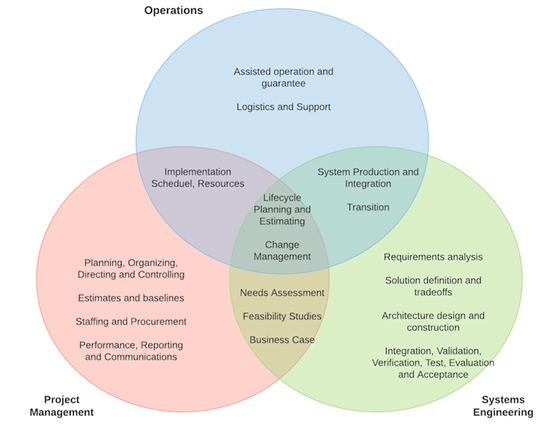
Figure 1 – Operations, systems engineering, and project management processes.
Traditional project management approaches included many process tools and techniques because they were initially designed to manage large engineering projects interfacing with operations and systems engineering (Figure 1). On top of that, engineering and development strategies from the past adopted waterfall approaches and sequential phases. In 2001, the Agile Manifesto started a revolution in software development and project management. At that time, agile projects were associated with small or medium IT projects, while traditional approaches were associated with large engineering projects. Even though both approaches could have been tailored, adapted, blended, and connected, this was not a reality until the next decade.
Current and Emergent Practices in Project ManagementBetween 2010 and 2020, we expanded our understanding of project management. PM's field is diffuse and multi-disciplinary and offers a considerable body of literature in related areas like agile project management, strategy execution, business analysis, and more. There are various methods and frameworks, and we realized that we could build our hybrid methods. But how?
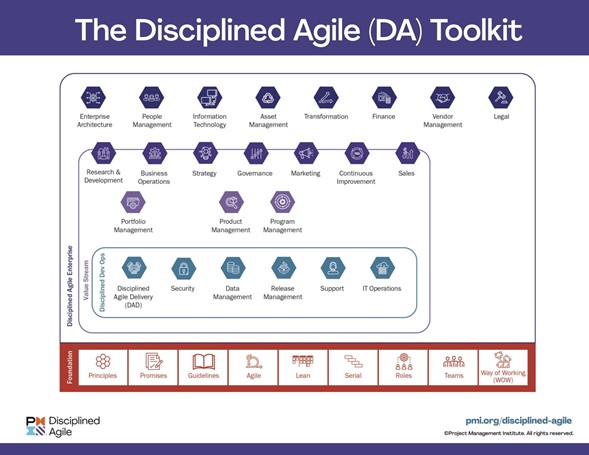
Figure 2 – Disciplined agile toolkit (PMI) Disciplined Agile (Figure 2) is a toolkit to help people and organizations to fully and truly become agile by combining different execution approaches, including serial and agile, to the other business processes in an integrated fashion. Describing DA in detail is beyond this article's scope, but that leads us to "What's next?"
The Future of Project Management – Citizen Development?We started the project management revolution, making project management indispensable for business results sixty years ago. At that time, project management was bureaucratic and prescriptive, as it should have been to manage large engineering projects in hierarchical and structured organizations based on Taylorism. The Agile Manifesto and agile approaches sparked another revolution toward flexible and adaptable project management. As a result, we have multiple "ways to Rome." There are so much content and guidance that it is difficult to know how and where to start. In a volatile, uncertain, complex, and ambiguous world, attention and cognitive bandwidth are the most important assets to every person and, consequently, to every company. To that extent, the future of project management, the future of management, and the future of work must rely on technology to empower people to achieve more. Digital transformation means organizations can embed their processes into customized and integrated tools, making technology central to every business model. It is not about efficiency only; it is about new behaviors (employee experience, customer experience, stakeholders experience). Automation and digitization are just the beginning. We need people capable of continuously strategizing and implementing digital transformation, which implies that project management and citizen development go hand-in-hand with business areas and business processes. My conclusion is that the Citizen Development Revolution is the next big thing in project management. We, PMs, BAs, are change-makers. And the PMI Citizen Development framework combines those disciplines, as I will explain in my article next week.
Please leave your comments and thoughts below. |
CITIZEN DEVELOPMENT: A SURE PATHWAY TO DIGITAL TRANSFORMATION
| Citizen Development (CD) describes the ability for a user, the citizen developer, to create applications without coding expertise, significantly faster, and at a fraction of the cost. Citizen Development platforms have matured to the point that they minimize the need for manual coding when building serious, enterprise-grade applications. Forrester estimates that by 2024 there will be a deficit of 500,000 software developers in the U.S. alone. No doubt, there is a vacuum, a problem to be solved. PMI, however, came to the rescue and has developed and launched the world's first vendor-agnostic governance framework for Citizen Development (PMI Citizen Developer TM). This is to expand the Project Managers toolkit and guide developers and organizations to take full advantage of the benefits of CD while maintaining IT governance and security compliance to enhance project success.
Forrester estimates that by 2024 there will be a deficit of 500,000 software developers in the U.S. alone. Forrester also forecasts that the low-code market will top $21 billion spend by 2022. The Power of Solution Is at the Core of the Business Now With Low-Code/No-Code (LCNC), a project manager or any citizen developer can transform ideas into action solutions, services can be delivered cheaper and faster. These LCNC platforms are growing daily, and so are the needs to develop cheaper apps, products, and services in less time. Any organization that gives Citizen Developers the opportunities to bring ideas to life using LCNC platforms is surely on its way to digitally transform itself. Ideas abound, the tools are now in the hands of the people (employees), and business processes are more flexible. The power to offer solutions is in the hands of those at the core of business processes to deliver results faster.
The pandemic has shown that businesses must respond rapidly to situations. Digital transformation has taken the front seat for most processes. Businesses can’t afford weeks and months to come up with solutions. Time-to-market is more reduced now. Businesses are under pressure to optimize processes and deliver quick products/services in less time. Digital Transformation through Citizen Development LCNC supports digital transformation, creates more opportunities, grows the business with new ideas, and increases productivity. When you give the people all the tools and the flexibility to bring ideas to life, the organizational growth and digital transformation will be massive. The speed at which apps, products, and services are delivered using LCNC platforms shown that it is easier to automate business processes and quickly achieve digital innovation. This is because Citizen Developers do not have to spend time on apps development rules and other time-consuming aspects of apps development. Citizen Developers are bringing major changes to how organizations work:
This is because CD enables businesses to keep up with the rapidly changing technology landscape using LCNC platforms to digitally transform the organization. Here is what other companies have done with citizen development using LCNC platforms. These are clear validations of the citizen development revolution. Citizen development is delivering digital transformation. How has your organization been digitally transformed using LCNC? Please share. |




