


Paving the Way for Project Success Using Citizen Development


| In any organization, successful project completion relies on overcoming certain constraints. Limited budget, scope limitations, and time pressure are just some of the main challenges that can impact the feasibility of the project. The greater the scope or speed of a project is, the more likely it is to overlook some details. It is especially true when using manual processes and outdated tools. PMI's reports indicate that poor project performance can waste up to 11.4 percent of the investment, increasing the likelihood of project failure.
The Project Management Triangle
The triangle's three sides are interconnected, so changing one element will affect the others. For instance, expanding the project scope may cost more money and time, while shortening the project's timeline may save expenses but increase its scope. The triple constraint is a critical part of a successful project, but it is not the only factor. Many other factors contribute to a successful project, and the Triple Constraint is just one piece of the puzzle. That is why some project management experts have added three more constraints to the model to better reflect the most critical areas of a project—quality, risk, and benefit.
IT Skills Gap Yet a shortage of highly trained software specialists and an overworked IT department can create significant challenges for business. We have also seen the impact of the pandemic ripple through the job market. The ongoing skills shortage among developers continues to pressure businesses to cater to these sudden changes. Research by Forrester stated that by 2024, the U.S. alone will have a deficit of over 500,000 software developers. Globally, the number is significantly higher. On top of that, according to Gartner, IT executives see the talent shortage as the most significant adoption barrier to 64% of emerging technologies.
Enter Citizen Development. Research by Gartner stated that by 2024, citizen developers will build 80% of all technological products. With the citizen development approach, project managers now have a larger resource pool as non-technical employees turn into citizen developers to help build the enterprise software solution without any programming skills. It will also help to reduce the dependency on highly-skilled IT professionals. Citizen developers will help not only to build solutions but to ensure the delivery and adoption of the applications as well. It is because citizen development empowers a more flexible and results-focused way of working rather than being bogged down by requirements documentation. This allows things to move faster and at a lower cost, so project managers can focus on delivering results rather than being held up by the IT backlog. Furthermore, project managers are in a great position to leverage Citizen Development to help their organizations succeed. They have a deep understanding of the three project constraints and can use this knowledge to time citizen development initiatives ideally. Additionally, their experience and expertise can be instrumental in helping the organization navigate the citizen development journey to success.
The Game-Changer However, some changes are inevitable as the projects change and evolve constantly. The key is to identify and understand every project's constraints and how they interact with one another. This allows them to course-correct when necessary to keep the project on track. As a head start, project managers can download this simple tool — Project Management - Citizen Development Evaluation Tool to evaluate if your project is a good fit to get started with Citizen Development. This will also give you insights on what are the key considerations that a project manager should be looking for to bring in Citizen Development within their organization in a successful way. Ready to jump into the world of citizen development? I look forward to sharing my next article with you, in which I will cover how to implement and deliver a successful citizen development project.
|


Well begun is half done: Take these steps to kick-start Citizen Development project
| Digital acceleration is a buzzword today because of the new technological trends such as cloud computing, mobile phones and social media. There is an increased focus on delivering customer experiences and business agility through the use of digital tools and platforms. Users are encouraged to become citizen developers who can deliver products faster than traditional programming models. This can be done by using no-code technology and platforms that enable business users to build custom apps without requiring any coding knowledge. But how can organizations create a conducive environment for citizen development? This article explores the key steps organizations can take to become citizen development-friendly. Step 1 - Demarcating the key roles to cover the entire gamut of citizen developmentCitizen development requires coverage on a strategic level and tactical and operational levels. Fusion teams should be created in order to support enterprise innovations. The roles and responsibilities of citizen developers and technical people need to be demarcated. i). Strategic RolesThese are citizen development champions having the experience and skill set of CxOs. This role requires someone who understands how citizens interact with technology. They need to know the requirements of citizen development and understand the challenges involved in developing software solutions. Appointing such people may require effort and time, but the benefits are great. ii). Tactical RolesIndeed, no-code platforms don't require any coding skills. However, a certain section of your business users' and programmers' teams should have the technical and tactical understanding of no-code platforms, and know-how is still required. This can help you nurture individuals who can oversee applications built by citizen developers. To successfully carry out integrations with third-party solutions, your technical staff should understand the nitty-gritty of no-code applications. These individuals can also provide relevant guidance to programmers and citizen developers. iii). Operational RolesTo some extent, operational roles and responsibilities are primarily held by citizen developers and also by no-code masters. Depending on your organization's functioning (centralized or decentralized), you may put citizen developers in one or more departments or business units. When defining the scope of work for citizen developers, you will need to decide whether you will adopt the no-code approach to build departmental workflow apps or customer-facing apps. The primary role of citizen developers (business users) is not to build applications, and therefore, it's essential to designate the minimum and the maximum number of citizen development hours. Step 2 - Selecting business users who are the best fit for citizen developmentCitizen development is an important part of modern software development because many manual tasks that used to be performed manually have now been automated. Examples include data entry into databases and the creation of spreadsheets. Therefore, people who excel as citizen developers are often sought after by businesses looking to automate some of their mundane back-office operations. Citizen development doesn't require any technical knowledge but requires some basic business skills. For example, if you are a citizen developer and want to create an application, you first need to know how to use visual tools (like drag & drop) and then learn what type of data your app collects. You also need to understand how to handle errors and validate user input. In addition, there may be other prerequisites depending on the platform you choose. An ideal candidate must be an independent contributor without being a lone wolf. Citizen developers do not act independently but participate with others within the group to develop solutions while juggling different roles. Time management skills are therefore essential when working with citizen development groups. Step 3 - Choosing the right no-code platform for citizen developersYou can follow these steps to choose the best possible no-code platform for your innovation goals. i). Determine your focus goalsYou can't go overboard with no-code application development, and it is essential to have some focus goals. In this regard, choosing the right project is paramount. For example-
Some of your focus goals can be:
ii). Create a list of functionalities you want in your no-code applicationDifferent no-code platforms support different sets of functionalities. Of course, you should select the one which covers the maximum ground. Here is a general list of functionalities that no-code platforms support, and you can map this list with your requirements.
iii). Create a list of integrations you want your application to supportSome applications exist within an ecosystem of other apps, systems, and devices and therefore require integration capabilities. For example, the application may require access to user contacts and the company's financial data. You can refer to the below list of integrations. Based on your selection, you can zero in on a no-code platform.
iv). Address critical questionsWhen choosing from a list of prominent vendors, it all comes down to their value proposition. These questions will bring you more clarity in the context of no-code platforms.
Step 4 - Imparting training to citizen developersNo-code platforms are designed to simplify application development. Non-IT professionals can develop software applications without needing a background in programming. These platforms allow businesses to create custom apps quickly. However, there is still a significant learning curve for citizen developers who want to use these no-code tools. Frequent education and training need to be imparted as new features continue to enhance these platforms. To seamlessly collaborate with IT, you need a no-code platform and a common language to communicate. Yes, citizen developers don't need to learn to code, but they need to understand the nitty-gritty of software development life cycle and agile methodologies, prototyping, wireframing, and design thinking. Citizen developers should also be briefed on relevant data lists and connected systems. It's ideal for them to take multiple before gaining access to a no-code platform. You can ensure cross-functional learning opportunities for citizen developers in workshops, hackathons, and community events. ConclusionCitizen Development requires an agile approach where new technologies and skillsets are adopted quickly and iteratively. Your governance should be flexible enough to adapt as requirements change. The above-mentioned steps will help you streamline the humongous task of rolling out citizen development. |
Have your Say! Citizen Development from the Trenches
Categories:
Citizen Development
Categories: Citizen Development
| Have you adopted or are you planning to adopt Citizen Development within your organisation? Would you like to receive free independent (academic) feedback on how you are positioned through the Citizen Development Index tool. At PMI, we are collaborating with Dr Noel Carroll & Ms Mary Maher at the Citizen Development Lab at the National University of Ireland, Galway and we aim to investigate how organisations have adopted citizen development and current efforts to assess its impact on digital transformation initiatives. We would like to get your views as the practitioners of Citizen Development (…from the trenches) on your plans or experience with Citizen Development initiatives. By completing this simple survey, you can evaluate how Citizen Development is being utilised within your organisation and whether you are meeting its full potential at various maturity levels. Alternatively, if your organisation is considering the adoption of Citizen Development, this survey will provide you with an organisational readiness assessment for the adoption of Citizen Development. You will also be provided with some advice on how best to move forward with preparing for the adoption of Citizen Development or with the advance to the next stage of maturity. All information will be treated confidentially and your identity will not be revealed through the data gathered. You will have an option to add your details (name and email) if you wish for us to have a follow-up call to discuss your results further. We look forward to learning from you and hope you will find the Citizen Development Index tool useful. |
Citizen Development Can Pave the Way For Agility in 2022. Here’s how!
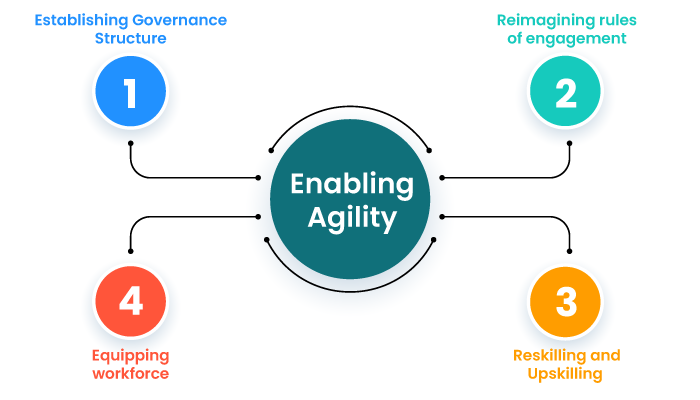
| On one hand, businesses are going full throttle on digitizing their operations, but on the other hand, IT talent shortages hamper the timely implementation of complex software. However, no-code development platforms are proving to be effective. No-code platforms reduce development complexity to the point where business users can create solutions without knowing programming, APIs, or how to deploy web or mobile apps. No-code solutions, which are frequently packaged as a SaaS (software as a service) or PaaS (platform as a service), simplify many complex aspects of development so that business users and IT teams can become more agile and focus on generating functionality. According to Gartner, the market for no-code/low-code application platforms would grow by more than 30% from 2020 levels by 2022. By embracing these no-code solutions, project managers may serve the diverse and often siloed interests of both IT and business as IT project leaders and business process stakeholders. But what are the advantages of no-code development, and how can you put them into practice in your project teams? The answer could be in citizen development — creating a group of non-technical team members to take up some of the tasks that IT teams can’t focus on due to lack of bandwidth. According to Gartner, citizen developers will build 80% of all technological products by 2024, up from just 25% in 2014. This rapid spread is attributed to the COVID-19 pandemic: New business models and processes arose as organizations hurried to implement cloud services and digital initiatives to deal with a distant workforce. These occurrences coincided with the rapid adoption of agile frameworks in recent years, which place a premium on speed and shorter development cycles. Along with developer scarcity, all of this has allowed citizen developers to fix various issues. Citizen development from an agility standpointIn today’s organizations, there is a lot of unmet demand that central IT solution teams can’t address. When citizen developers are given no-code tools, they can build solutions ten times faster than if they had to rely on programming alone. They tackle problems as they arise, creating applications that are unlikely to be quickly built by IT, given the number of projects they are already handling. Developers and architects may focus on more complicated solutions that offer real value to the business. It translates to higher overall productivity (98 percent less time spent producing operational dashboards, for example) and better business results. Embracing no-code means adopting a philosophy that prioritizes user empowerment. However, it would help if you had a new software development life cycle that is flexible and built on agile principles to empower consumers. You also require a framework to assist citizen developers in rapidly developing applications and getting real-time feedback from stakeholders. Enabling agility with citizen developmentUnderstanding citizen development is one thing, but understanding how to scale it is another. To successfully adopt and scale citizen development, your organization needs to:
Without the aforementioned considerations, citizen development applications may cause more harm than good, causing extra work or confusion instead of solving a problem. Your citizen development practitioners need tools to design and build their applications within the context of the business and the entire organization. Citizen development governance structureAlthough business users can easily use no-code platforms to build custom, priority-specific applications in an agile fashion, their roles and responsibilities need to be earmarked to prevent the challenge of shadow IT. This can be achieved by establishing a well-thought-out governance structure. Your IT governance model can take a top-down approach, with a single authority overseeing your entire citizen development programme, including various projects and initiatives. Your CTO can lead this office, which can be placed within your IT department. There are other governance models as well, and organizations can choose based on the assessment of their maturity level. The office can establish no-code development best practices and roll them out across the firm, ensuring that all teams (technical and non-technical) are on the same page. Other tasks may include the following:
Identifying the “right fit” candidate for citizen developmentSomeone with hands-on experience dealing with paper-based processes and understanding the associated pain points is a great candidate for citizen development. No prior coding knowledge is required to use no-code platforms, but the desired candidate must have a solid grip on business logic. It’s important to note that citizen development is not a one-man show and is carried out through a governance paradigm. Therefore, an ideal candidate should also have a collaborative approach. Citizen developers are much more than self-sufficient contributors. They are primarily business users; therefore, no-code development is not their primary responsibility, and they must balance numerous tasks. As a result, another quality of a productive citizen developer is time management. ConclusionWith the rise of citizen developers, the extent of democratization of software development is also rising, which is significantly facilitating agile application development. Although realities like shadow IT may appear frightening, having a defined set of governance principles, roles, and obligations can help make citizen development successful. As more companies adopt a hybrid workforce model, it’s critical to direct non-technical staff toward citizen development rather than burden remote-based IT personnel with day-to-day troubleshooting. No-code platforms are democratizing and speeding up innovation by allowing business analysts, product designers, and marketers to act as citizen engineers. |
Three Important Lessons I Learned about Citizen Development from PMXPO 2022
Categories:
Citizen Development
Categories: Citizen Development
| I’ve been managing projects as either a volunteer or professional since I was 16 years old. Much of what I know about project management I learned through trial-and-error, hard knocks, and late-night emails or Slack messages. Today, I’m Chief Marketing Officer at Pipefy. We offer a business process automation platform for citizen developers, and we’re working closely with our friends at PMI within their Citizen Developer program. As an example of our perspective on the important role of citizen developers, Pipefy recently published a white paper titled “Low-code Automation: Good for Business, Great for IT” which clarifies how to overcome challenges in building successful partnerships between IT and citizen developers. In March, I enjoyed PMI’s 15th annual PMXPO along with more than 60,000 attendees! Pipefy was very proud to be an exhibitor at PMXPO and also a sponsor. The same month, I also earned my certification as a PMI Citizen Developer Practitioner (CDP). What did PMXPO and CDP certification teach me about world-class project management? I can only say that my career would’ve taken a much more direct path, had I attended PMXPO when I was getting started in 2000. Of course, PMXPO was not available at that time, but here are three important lessons that I learned from PMXPO 2022 which I will carry forward with me. Lesson #1: The PMI community draws its power from members traveling the same journey I wish I could have browsed through the thousands of PMXPO attendees to look for other friends and colleagues with whom I’d lost touch. PMI has clearly established a community in which we can continue to learn from one another through PMXPO, other events and the great content published on the PMI website. Lesson #2: Businesses have embraced citizen development Samantha shared these important statistics about how quickly things are changing for citizen developers:
Pipefy sees the same truth that Samantha described. Citizen developers can drive digital transformation with low-code approaches for People Operations, Revenue Operations, Finance Operations and IT Operations. But they must drive that change by collaborating closely with IT. They must integrate low-code apps with legacy “high-code” systems like SAP, NetSuite, Workday, or ServiceNow. The Citizen Developer Practitioner certification course goes into more detail on the partnership between Business and IT, and the hyper-agile software development lifecycle. The SDLC scores citizen development projects according to risk and technical complexity. Some low-code projects representing low risk and technical complexity fall into the Fast Track category, requiring little to no involvement from IT. Assisted projects require some IT involvement, and projects with highest risk and technical complexity should be delivered by IT. Source: PMI Citizen Developer “Suitability Assessment Download Risk/Technical grid” Lesson #3: People Operations + Project Operations makes hybrid models work Laszlo discussed the new challenge of making human connections without being able to sense the subtle visual cues that are easier to notice in person, in three dimensions. He talked about ideas such as “nudging” employees to make it easier for them to do the right thing, instead of trying to force them to comply with a heavy-handed approach. Laszlo discussed the five important elements of culture (purpose, trust, clarity, learning and inclusion). At Pipefy, one of our most important user groups is People Operations leaders like Mr. Bock. Our Pipefy platform automates the nudging he described, helping HR leaders and their teams automate people operations workflows like recruiting, employee onboarding, or HR request management, by breaking those workflows into their individual actions and then assigning them to the right person, at the right time, with the right context. By automating some mundane (but necessary) tasks, People Ops teams are free to do the empathic, culture-building work that Mr. Bock described. I could go on and on about other great PMXPO sessions, but this was meant to be a brief blog post! Pipefy sustains citizen developers, so they can help their teams focus on transformation Here are four easy ways to get started with Pipefy:
|



