PMBOK Now - Agile Later?
From the Project Management 2.0 Blog
by Dave Garrett

New technologies, concepts, and Web 2.0 tools are popping up everywhere. How can you use them to help your project team collaborate, communicate - or just give your project an extra boost? [Contact Dave]
Recent Posts
Are You Prepping For The PMP 24/7?
Are You Just Too Darn Busy?
Eliciting Requirements... Creatively!
What To Expect When Your Stakeholders Are Expecting
8 More Templates to Save You Time
Categories
Advice,
Certification,
Collaboration Tools,
Decision Making,
Estimating,
Interviews,
Learning,
Management Approaches,
New Templates,
Personal Productivity,
PM Software,
PPM Software,
Presentation Tools,
Reporting Tools,
Requirements Management,
Research,
Risk Management,
Scheduling Software,
Security,
shameless self promotion,
Techie Tools,
Time Killers,
Time Tracking Software,
Training,
Virtual Team Tools,
Web-based Tools,
workshops
Date
Situation: You are curious about what's happening in Agile these days. 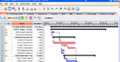
Agile approaches can be confusing to the uninitiated, but they are absolutely gaining in popularity. Agile tools are also becoming more commonplace and
Projity is one that seems to help bridge the PMBOK and Agile worlds a bit. Recently we talked with Jeff McKenna, co-creator of Scrum and VP at
Serena Software. He gave us some insights on what is happening now int he world of Agile.
Q. We've been hearing a lot about SCRUM and Lean lately on Gantthead. Are you still seeing increased usage of Agile processes in the IT space? In other disciplines?We are seeing a rather continuous uptake of agile processes in all areas of software development. IT has been a bit slow to take up Agile but that rate is increasing.
Q. Which flavor of Agile is most popular right now and why? Are the flavors industry-specific?I think of Agile flavors applying more to the levels of the organization than specific industries. When first adopting Agile, folks have historically leaned toward Extreme Programming (XP). Executing agile well requires good engineering practices and XP has a strong focus on engineering practices. As those practices improve then we see Scrum being used more. Since Scrum is focused on work management and team dynamics. Even later in adoption we see Lean being used to guide the business in a more agile manner. I should also say that this view is a bit generalized. This is my recommendation for adoption and what I see working. Using Scrum without strong supporting engineering practices is possible and is difficult.
It is my view that industries adopt new technology at rates more local to the industry rather than the 'whole'. We are seeing that with Agile. Some industries are very far along, others are just getting started.
Q. In general, where do you think the Agile movement is headed over the next 5 years?More and more acceptance and integration into mainstream. Perhaps in 5 years, we will just accept that this is how good software is developed. I am hopeful. Agile is how I have seen good software being developed for over 45 years. Now we have a way to talk about it.
Q. What is driving the change you've just described?When executed well, Agile works: Teams are more satisfied, planning is easier, time to market is faster, business knows what is going on, design emerges. I could go on.
Q. The latest version of the PMBOK is said to address the merging of Agile methods and the PMBOK approach. What are your thoughts on that?This is another sign of widespread adoption. It is always difficult for new methods to be accepted. The PMI folks have fought Agile for a long time and are either noticing that it works or desire to use an 'embrace and extinguish' strategy. I prefer to believe the former. Agile as implemented often has some weaknesses. PMBOK has some things to say that are useful regarding those weaknesses. On the other hand, Agile really is different in important ways and if the important aspects of Agile are lost, then the gains are lost as well.
Q. When approaching projects from an Agile perspective, what are the most important skills for a PM to have?The most difficult aspect of the PM job is to learn to consider work in what we term vertical slices. What is the least that can be done that still provides business value? Doing this well is a skill that needs to be learned. Once learned and when working with agile development teams there are wonderful opportunities to reduce time to market, delight customers and have satisfied development teams.
Q. How does Projity, as part of the Serena offering, address the issues above more effectively?Projity is used to manage more classically developed projects in a more agile way by reducing the ceremony associated with the work.
Q. What are the “must have” software tool attributes when dealing with Agile projects today?The key question is: Does the tool support your environment? Number of teams, number of projects, your terminology, and your worker distribution. As an agilista, I am always looking for the least complicated and intrusive tool to use to accomplish my work.
Posted on: March 24, 2009 10:05 PM |
Permalink
Comments (6)
Please login or join to subscribe to this item

Ian Whittingham
Managing Director| Calixo Consulting
Golden Cross, East Sussex, United Kingdom
I''ve heard people make similar comments about how PMI is now embracing Agile methods but I''m hard pressed to see exactly what PMBOK has to say on the topic. Unless PMI have buried it somewhere in the appendices, the recently published Fourth Edition of the PMBOK Guide makes no explicit reference to either Agile or Extreme Programming methodologies. PMBOK does, however, continue to emphasize the importance of iteration in project management processes--which is certainly an integral part of an Agilist approach to managing projects--but this merely continues to support the concept of "progressive elaboration" or "of developing in steps and continuing in increments" that previous versions of PMBOK promoted.
Ian Whittingham
Managing Director| Calixo Consulting
Golden Cross, East Sussex, United Kingdom
I''ve heard people make similar comments about how PMI is now embracing Agile methods but I''m hard pressed to see exactly what PMBOK has to say on the topic. Unless PMI have buried it somewhere in the appendices, the recently published Fourth Edition of the PMBOK Guide makes no explicit reference to either Agile or Extreme Programming methodologies. PMBOK does, however, continue to emphasize the importance of iteration in project management processes--which is certainly an integral part of an Agilist approach to managing projects--but this merely continues to support the concept of "progressive elaboration" or "of developing in steps and continuing in increments" that previous versions of PMBOK promoted.

Sorin Mitrea
Project Manager| tdbfg
Toronto, Ontario, Canada
PMI does indicate in some of the events they organize (like the World Congress they had in Colorado last year) that the Agile approach is not a “heretic” approach to managing activities. And, if one looks at the Agile methodology elements one realizes that they are a subset of the PMI methodology with focus on the ‘progressive elaboration’, as you noted.
Aside the fact that they changed some terms (the PM is “Scrum Master”, the requirement is a ”story”, an iteration is a “run” etc. ), it is basically a project approach with predetermined parameters: limited duration for iterations (if I recall correctly 4 weeks) usage of only collocated teams and so on.
So I really do not see a contradiction between Agile and PMI. Problems arise when this methodology is forced upon projects blindly. There are drawbacks to the approach and hopefully the literature will start guiding where the Agile fits and why and where it does not and why.

Dave Prior
Trainer/Consultant| LeadingAgile
New York, Ny, United States
About two weeks ago at the Scrum Gathering in Orlando, Greg Balestrero, the CEO of PMI gave a talk to the attendees about PMI and its'' relationship to Agile. The main take-away came at at the end of the talk when Balestrero and Ken Schwaber jointly addressed the audience and expressed that neither of them had saw any reason why the two approaches could not be used together to solve projects and they urged the attendees who were interested in doing so to get on with it.
There were a number of sessions during the Gathering where PMPs and non-PMPs discussed the issues around trying to use Scrum in a waterfall environment or vice-versa. One thing I noticed was that there seemed to be a tendency to gravitate towards issues around semantics and role definition. I think this is probably a normal thing to do, but we need to keep in mind that whatever process we use, PMBOK, Prince 2, one of the flavors of Agile or any blend of different methodologies, it has to be based on getting the work done in the best, most efficient possible way, or as Jeff mentioned above, we need to be " always looking for the least complicated and intrusive tool to use to accomplish my work."

John Reiling
Seeking new opportunities | AcroVision Business Systems, Inc.
Mendham, Nj, United States

Allison Finer
Project Manager| Sparks Industrial Services LLC
Espanola, Nm, United States
"In my environment, the use of project management technology is an after thought."
This was the first sentence. It is not entirely the truth. Processes in place are undergoing a revolution at this time, one that hopefully will allow the chief machinist to prioritize a rather incongruous set of jobs for the most efficient use of equipment.
I appreciate the continuum suggested here of XP, Scrum then Agile. Further on in this series, Jeff McKenna states that "Projity is used to manage more classically developed projects in a more agile way by reducing the ceremony associated with the work." Now I am interested in Projity.
It has been my 'role' to listen and make suggestions, to clarify the position of one or another participant when the discussion becomes heated. That being said, it is inappropriate at this time for me to 'educate' those with whom I work on project management. This is so out-of-place as to reduce a meeting to 'ceremony.'
Nonetheless, I can easily see by their vocabulary that members our workforce have worked in project management environments, even without having been aware this was so. The vocabulary has become vernacular. My implementing concepts, even a software, will have to come as intuitively, as using a mill or a lathe.
Please Login/Register to leave a comment.
|
"Love yourself first and everything else falls into line. You really have to love yourself to get anything done in this world."
- Lucille Ball
|




