Are Project Managers too soft?
From the An Influential Project Manager Blog
by Colin Gautrey

Today, more than ever, a project manager needs to be an influencer.
The purpose of this blog is to stimulate your journey towards greater influence. With influence, you can overcome the roadblocks thrown in your way, overcome opposition, align stakeholders and, enjoy your role even more.
However, since I know you are busy, the posts here will be short (about a minute), thought provoking and also drive you towards action.
Feel free to connect with me, ask me questions, and share what's good here.
Recent Posts
Kindness
Becoming Streetwise
Shooting in the Dark
Three Reasons Why You Can't Handle the Politics
Passed Over for Promotion?
Categories
impact,
influence,
power,
Stakeholder Management,
stakeholder management
Date
Incredible it may be, but the data is beginning to emerge that this could indeed be the case. The usual caveat about generalisations aside, this is what my recent research is starting to reveal. And, you don’t have to be a project manager to learn from these results.
Based on a group of 195 project managers I have discovered, somewhat to my surprise, that they are more likely to be high in Tact and Diplomacy and low in Determination, than the general (professional) working population. To be honest, I had expected the opposite.
These people all completed my Influence Profile that measures preferred behaviours when working with others. This is not looking at their actual behaviour, but rather the way they would most like to behave (which is reality is the default behaviour they use most of the time).
Within this psychometric, four dimensions of behaviour are analysed and then ranked (Sociability and Networking, Determination, Emotional Control and Tact and Diplomacy). The result is a short report that describes how the individual is likely to be viewed by their colleagues.
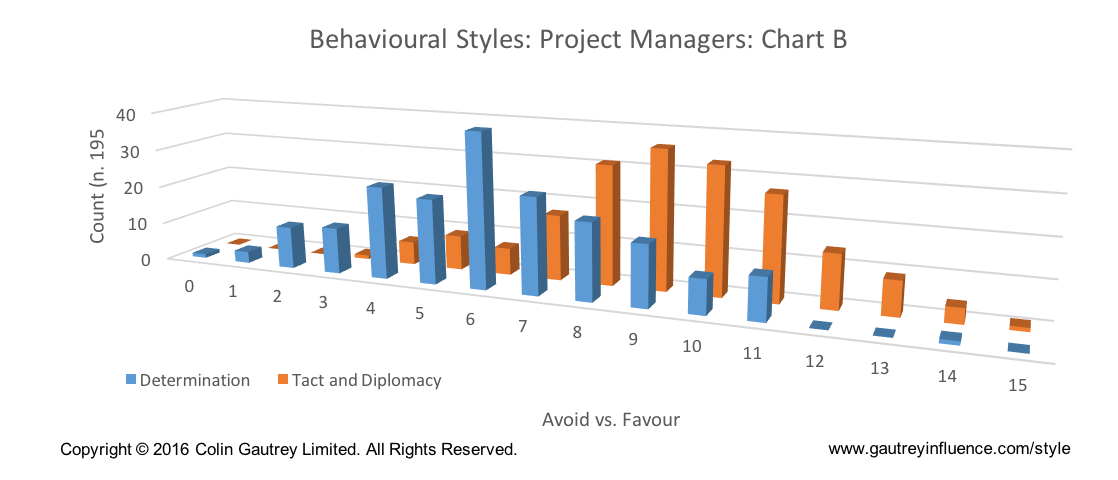
In certain situations, the above is absolutely perfect. In others, it will leave the project manager flailing and struggling to get things done.
What is important here is not how project managers prefer to behave, but how they need to behave to deliver their objectives. If the difference between preference and need is too great, it is likely that the project manager will suffer stress and strain because of the stretch from their comfort zone. Consequently, they’ll probably revert to type.
With awareness and practice, adapting these behaviours becomes easy, and fun.
To turn this towards a practical outcome, it is important to:
- Understand how you prefer to behave, your default.
- Consider, in your situation, working with your stakeholders, how you need to behave.
- Finally, look at simple ways that you can begin to adjust your behaviour to become more effective at working with and influencing your stakeholders.
The bottom line is that the correct style is the one that maximises the potential to get the outcome you want.
If you'd like to take the profile, invite me to connect and let me know you'd like to complete it and I'll give you the link.
Posted on: April 04, 2017 11:59 PM |
Permalink
Comments (19)
Please login or join to subscribe to this item
Very insightful. There is always that balance between trying not to alienate people at the same time you are trying to get more out of them. It isn't an easy task. Any advice for motivating people and instilling a common vision for performance and success?

Colin Gautrey
Author, Executive Coach and Trainer| The Gautrey Group
United Kingdom
Hi Keith, thank you, and yes, lots of ideas - why don't we connect and talk?
Great article Colin, few questions. Are you looking at the definition of determination as: firmness of purpose; resoluteness. Meaning that if a PM does not hold the line, maintain their firmness in the face of adversity, they become too soft and therefore let others walk on them? If given all that is true, and one has read the tips on acknowledging the behavior, what are some specific ways a person can modify their behavior? The article did a fantastic job of pointing out a failing of some PM's, do you or anyone else have thoughts on how to be more resolute?

Aaron Porter
 Community Champion
IT Director| Blade HQ
Payson, UT, United States
I've heard stories about project managers with actual power and authority. My reality, and I'm sure many others can say the same, is that we are usually accountable but have no authority. We're sent to courses on EQ and servant leadership, which are valuable, but they teach us to be soft.
Early in my career, one of the many "truisms" that was often repeated was that, "Everyone wants a strong project manager, until they get one." Company culture reinforces the emphasis on soft skills.
None of these things are bad, by themselves. Soft skills and emotional intelligence are beneficial, but they are tools. They are part of a skillset that project managers should have. We also need balancing skills, like assertiveness. We need to know when to be diplomatic, and when to break a few eggs, and be able to do both effectively.
Colin Gautrey
Author, Executive Coach and Trainer| The Gautrey Group
United Kingdom
@liana - yes, it is really about firmness of purpose. One of the problems I see a lot of is that innate preferences of behaviur override the behaviour that is actually needed in a given situation. So, if one prefers to be tactful and diplomatic, to suddenly be much firmer takes quite a bit of doing. Yet, it is necessary. In fact, preferring determined behaviours correlates to seniority in the research I have done. Many suggest, "well I'm really determined but I just don't show it so much" That is good (in the right circumstances) but actually, demonstrating determination is actually very important due to the signals it sends. In fact, it sets people up to "expect" you to be influential! You can read more on my blog about Demonstrating Determination if you like. Can't see how to put a link in here so just google demonstrating determination and I think my blog comes up second. Hope that helps.

Naomi Caietti
Senior Project Manager | ePMO | Higher Education | Healthcare & IT| Linkedin.com/In/NaomiCaietti
Colin:
Interesting results from your sample. I related to determination as mental toughness; IMPO this takes time to learn; you have to have your ___ in the seat to gain the experience. One off, operational, 3 month projects will not test this. Short radical implementation, 9 month 2 year and 3 -5 year projects will gear up your determination IMPO. Personal development must be top of mind even if you company won't pay for it. Why?
The first thing that come to mind is that project management is an art and science; as a PM you must be able to blend the core (soft) skills with the hard (process) skill sets along with the tenets of leadership. You don't mention the details of your sample (PMP, PgMP, etc, years in service, scale of projects etc).
PMs start with a foundation but must on a daily basis practice leadership skill-sets and gain wide variety of skill-sets over time. In order to move from "good to great"it takes time and accelerated learning is the way to achieve the results faster.
It's clear that a key set of behaviors, competencies and skill-sets are required to lead projects and as you move up the career ladder projects and the personal interactions with sponsors, stakeholders and team members will only increase.
Looking to hearing more about your study; I'll be taking about the Self Aware PM at PMXPO 2017 4/27, make sure to join in.

Ruth Pearce
Attorney, Author, and Coach | Guardian Ad Litem in North Carolina| A Lever Long Enough (ALLE LLC)
Durham, Nc, United States
This is a very interesting article, but I would love to know more!
Are there any common characteristics in the population that you refer to - for example particular fields or industries in which they work?
When I think of some of the fields I have worked in, tact and diplomacy have been sadly lacking along with, in some cases, a sense of humanity!
It feels as though there is a lot more depth to the data that you are using. Is there any chance of finding out more?
Really helpful, thank you.

Nasrullah Mohammed
Portfolio Manager| Advanced Electronics Company
Riyadh, Riyadh, Saudi Arabia

Vincent Guerard
Coach - Trainer - Speaker - Advisor| Freelance
Mont-Royal, Quebec, Canada
Thanks for sharing Colin
How large was the sample, was it regional or worldwide? Many questions come to mind on how representative the sample was.
The result are somewhat surprising. Project manager know that conflict is not productive and it would make sense to be tactical and diplomatic.
Colin Gautrey
Author, Executive Coach and Trainer| The Gautrey Group
United Kingdom
Hello Vincent (and others), yes it is interesting. The demographics on the data are not that detailed. It resulted from my webinar here last year on Engaging Stakeholders with Style (you can find this from my profile). Of the 1400 who attended, and subsequent 2600 views of the webinar, some 200 people took the profile. So, I'd expect the demographics to be similar to the broad profile of PMI members. Hope that helps. If anyone would like to know more, just get in touch.

Lane Compton
Project Manager| American Academy of Orthopaedic Surgeons
Rolling Meadows, Il, United States
Hi Colin, thank you for sharing your research and insights. I'd be fascinated by a series of follow up surveys with the same population that tracks how these styles change over time. My hypothesis is that the majority would drift increasingly towards tact & diplomacy over time based on the feedback cues they receive from using tact & diplomacy (usually positive) vs. determination (more likely to be negative). What do you think?

Rami Kaibni
Community Champion
Senior Projects Manager | Field & Marten Associates
New Westminster, British Columbia, Canada
Hi Colin,
Great article and interesting findings - Thanks a lot for sharing.
Do you mind elaborating more on the chart you've attached. I do understand that the vertical axis is the Count which is 195 max but what does the horizontal axis exactly represent and specifically the numbers from 1 - 15 ? There is something I am missing here and would appreciate your time to elaborate.
I did check your website as well - Nice Video.
Rami Kaibni
Community Champion
Senior Projects Manager | Field & Marten Associates
New Westminster, British Columbia, Canada
Hi Colin,
Great article and interesting findings - Thanks a lot for sharing.
Do you mind elaborating more on the chart you've attached. I do understand that the vertical axis is the Count which is 195 max but what does the horizontal axis exactly represent and specifically the numbers from 1 - 15 ? There is something I am missing here and would appreciate your time to elaborate.
I did check your website as well - Nice Video.
Colin Gautrey
Author, Executive Coach and Trainer| The Gautrey Group
United Kingdom
Hi Lane, having trained several thousands with this tool, what I notice is that with age and experience, people tend to move towards a balance between each dimension in preference, with raised standard devision in actual behaviour as they become "well rounded" as an individual performer. However, those that rise to the top, tend to favour the determination behaviours. The skill comes in developing the flexibility to use the style that suits the individual situation and desired outcome. Generally the preferred style evolves gradually unless a catastrophic event occurs. Hope that makes sense - perhaps I should write another blog on this one!
Colin Gautrey
Author, Executive Coach and Trainer| The Gautrey Group
United Kingdom
Hi Rami, the tool uses a scale of 0 - 15 to record the strength of preference on each dimension. So, 0 would be an extreme "avoid" while 15 an extreme "favour". The profile uses ipsative technique to tease out the preferences between the dimensions. Hope that helps Rami?
Rami Kaibni
Community Champion
Senior Projects Manager | Field & Marten Associates
New Westminster, British Columbia, Canada
Hi Colin,Thanks for the elaboration, it did for sure help.
Lane Compton
Project Manager| American Academy of Orthopaedic Surgeons
Rolling Meadows, Il, United States
Hi Colin, thanks for the follow up. That makes sense for the insight on the top performers. I would love to see that additional blog post if you write it some day.
Please Login/Register to leave a comment.
|
"Try not to have a good time...this is supposed to be educational."
- Charles Schultz
|




