


Situation: You need a few more features in your PM software.
 We recently spoke with Cynthia West, VP at ProjectInsight about one of the most common migration patterns we're seeing at the moment - a move from super-simple "to-do list" software to more capable packages. If you're a Basecamp user, there's a pretty big chance you'll eventually find your needs outgrowing the software bit by bit. If you are in that situation now, read on and see if your experience matches up with what's typical in the industry.
Q. Basecamp is a terrific, inexpensive starting point for many. However, at some point most organizations grow out of it. Can you talk a bit about the triggers that prompt users to start looking at more capable products?
Yes. We think of the market for portfolio and project management solutions as having three basic tiers: the low end tools, mid-market solutions and high end systems. Basecamp is a great low end tool that offers collaboration and task management in a web-based application. High end systems are those designed for very mature project teams. They are more involved in terms of implementation timeline, more expensive and, in general, designed for more ‘top-down’ organizational cultures. Microsoft Project Server is a good example of such a system. Mid-market project solutions are more robust than the low end, but not as overwhelming as the high end systems. Project Insight is one example of project software that is robust enough for experienced project managers, yet easy for team members to adopt.
We talk to a lot of people that have started to manage tasks and collaborate in Basecamp. They like the alerts and the ability to see the tasks they are to work on. However, as you say, many project teams outgrow this tool. The initial trigger points that prompt teams to look at mid-market portfolio and project management solutions include the need for:
-Intelligent scheduling
-Gantt charts
What do I mean by intelligent scheduling? This is the need for something more than a simple task manager. As teams hire more professional project managers, they find they need the ability to link tasks together using dependencies. While some low end tools have the notion, not even all mid-market solutions have the MSP-like dependencies and constraints that more experienced project managers are familiar with.
In many cases, the more experienced project manager has utilized MS Project desktop and wants task dependencies, constraints and splits. At the same time, the organizations we help talk about having project managers of mixed experience levels, so they also want the newer project managers to be able to create projects from templates.
Gantt charts, of course, provide a visual view of one’s project and task flow. As projects get more complex, there’s nothing like being able to see the tasks on the critical path. Basecamp and other low end tools do not concern themselves with something as esoteric as a critical path or a baseline.
Q. There are always the problems you see and opportunities that you don't. Can you talk a bit about capabilities that most of these organizations could use that they are not looking for right away? What sort of quantifiable impact could these functions have?
Sure. When teams finally get their hands on a product that performs intelligent scheduling and they have set up some project templates, they often feel that sense of relief. So, what’s next? At this point, they can benefit from resource allocation views and portfolio reports. If you are only looking at a bunch of tasks that are unrelated, it makes it impossible to shift schedules easily. It also makes it challenging to truly understand what people are working on and when.
Demand management, capacity planning, resource allocation…no matter what you call it, as project teams become more successful, they need a way to see what everyone is working on and when. Because growing organizations are successful, they often have the business challenge of not knowing if and when they can deliver a project on time. Proper resource views in mid-market resource management solutions are needed when organizations hit these levels of success.
As for the quantifiable measurements of the benefits of resource balancing and proper allocation, that is probably the ‘holy grail’ most PPM vendors are looking for. If it were easy to find an ROI measurement that every organization could utilize, then our lives would be much, much simpler. As far as I know, no vendor can offer up a simple ROI calculator that is applicable to most organizations.
That said, I can offer you some anecdotes from customers that lead us toward impacts. For example, one organization had a team of high powered software developers that he was losing. They were leaving for ‘greener pastures’ because the organization was constantly working late on their client deliverables. They would have a 600 pound gorilla customer call in and then everyone would work a fire drill. All of this due to not being able to see the planned work and allocate it properly.
Once they implemented Project Insight, they began to plan every team members’ work two weeks ahead. Once that was mastered, they began looking out a quarter and forecasting. The customer found that his attrition rate of his specialized resources was lower. Why? Because people could plan their lives. They went from working 80 hours per week to 40-50 hours per week. The employees were happier and remained with the company.
Last, but certainly not least, executives want a simple way to oversee all the projects in their portfolio. Low end tools do not always concern themselves with the needs of project managers or executives. Basecamp and others are more focused on team member needs, sacrificing other levels of the team.
Now this functional set is probably easier to quantify. We often hear of project managers spending a certain number of hours aggregating information for executive reports, and then someone else spend another set of hours formatting these reports. That is more easily quantified and can often, in itself, bring in the ROI for a mid-market solution.
Q. Are there staffing considerations when making this sort of (upgrade from Basecamp) move? Should you not take it on unless you have a specific set of skills and competencies in house?
Yes, that’s probably true. If an organization does not have anyone that understands task dependencies, or is willing to learn about the power of intelligent scheduling, then it is probably not wise to upgrade as of yet. It seems that Basecamp appeals to organizations that are small and work with a lot of sub-contractors or freelancers, for example, tiny ad agencies that extend their workforce with subs. In these cases, it is probably overkill for them to worry about anything in the mid-market.
Q. At the other end of the spectrum from Basecamp, there are very high-end complex tools to manage project portfolios. These are often six figure investments. At what point do you need to start looking at these?
There are many organizations that are ready for a high end system. They have certain characteristics to be sure. For example, I attended a PMI chapter even with a Microsoft Project Server consultant as the guest speaker. He was firm and clear when he said, “Don’t even try to implement this unless your organization has a CMM ranking of 3.5 or better.” I would say that is probably good advice for any organization. Do not embark upon a high end system until you are mature enough to benefit from that system.
In May, at the Gartner conference, it was said that a solution like Clarity takes at least six months to configure, so you need to be at the stage where your team can dedicate the resources to analyze the business processes and spend that time configuring the system.
A couple of good examples of companies that use high end systems are Proctor & Gamble and Boeing. P&G has literally 1000s of products and tens of thousands of opportunities for improving these products, or launching new products. They have an entire department that analyzes the risk of each potential program and project. These opportunities are mapped onto a bubble chart and the like. The team has the resources to review the project/idea intake process, and analyze, and quantify well in advance. Many of our customers do not have the luxury of an entire risk management department.
Thank goodness Boeing and other airline manufacturers have mature processes, as our lives depend on it. The type of business requires stringent adherence to standards and processes in order to develop and manufacture their products.
Q. Project Insight has an established migration path from Basecamp. Can you talk a bit about the data that is migrated over, how it's used, and where the gaps are?
Yes, as we upgrade lots of teams from Basecamp, we’ve developed a data migration for these customers so they can have their historical information available to them. We map the following fields:
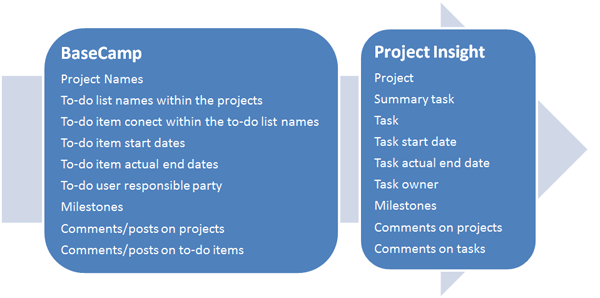
The gaps are the features that Basecamp does not offer like dependencies. So, if the project is in progress, and migrated into Project Insight, then the project manager needs to relate those tasks or just adjust each task manually. We did not migrate files, but one may simply use multiple file upload to pull the files into Project Insight. Everything else is good to go.


