


Winston Churchill once said “Plans are of little importance, but planning is essential.” What Churchill meant was that the value is in thinking something through, in planning it, before you do it. So this leads to some interesting questions: How much planning should we do? How can we get the most value out of our planning efforts? I wish I could tell you that there is solid research evidence to answer this question but sadly I haven’t been able to find any (if you know of any, I’d love to hear about it). Luckily though, we do have a lot of experience and observational evidence to fall back on.
From an accounting point of view we know that value is calculated as benefit minus cost. The implication is that all we need to do then is calculate the benefits of planning, and the costs of doing so, apply a bit of math and there you go. How hard could that be? As we know it’s very difficult to calculate the benefits because some are qualitative, requiring a bit of creativity to turn them into a monetary figure. The bigger challenge is that planning is just one activity of many that go into achieving a benefit making it difficult to tease out the planning portion of the benefit earned. Calculating the true costs of planning isn’t much easier when you start to consider the downstream implications of the work required to gather the inputs that go into the planning process. This is a particular problem in creative domains such as software development, more in this in future blogs. The implication is that in practice there isn’t an easy way to determine the actual value of planning, which explains the dearth of research evidence around this issue.
Because there are no hard and fast rules to determine the value of planning, practitioners rely on belief systems to guide their thinking. Figure 1 overviews two common belief systems, the traditional (sometimes inappropriately called “predictive”) belief system and the agile belief system. We’ve labelled the latter as undisciplined because we will distinguish this from a Disciplined Agile (DA) strategy later. The traditional belief system tells us that the more effort that you put into planning the more value that you will gain from doing so. This belief system tells you to think things through in detail before you do them. This increases value by avoiding mistakes in the future, thereby reducing costs. At the other extreme the (undisciplined) agile belief system tells us that there is very little value in planning, that you are better advised in focusing on being able to react to feedback. This enables you to deliver sooner and thereby earn the actual benefits sooner and longer, thereby increasing value. The obvious downside of course is that mistakes will be made, sometimes serious ones, thereby increasing both costs and risks.
Figure 1. What our belief systems tell us about the value of planning.
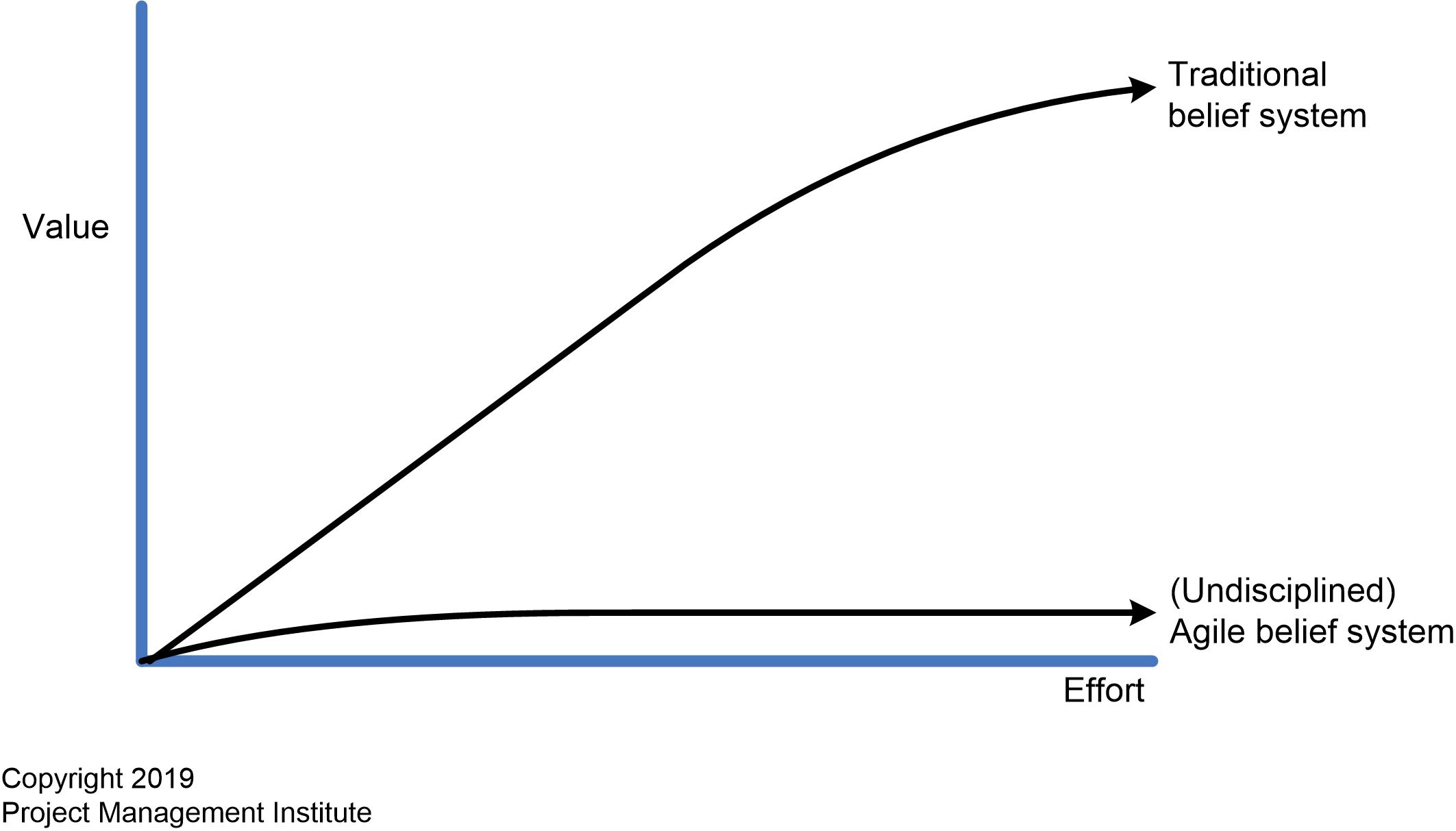
The methodologist in me tells me that extremes are generally a bad thing, that for most situations the answer lies somewhere in between. The easy answer would be to simply draw a dashed line in between the two curves in Figure 1, or get really fancy and introduce some sort of range between the two lines, but the easy answer is wrong. What we really need to do is look at what actually happens in practice, something that we did in the Agile Modeling (AM) community in the early 2000s.
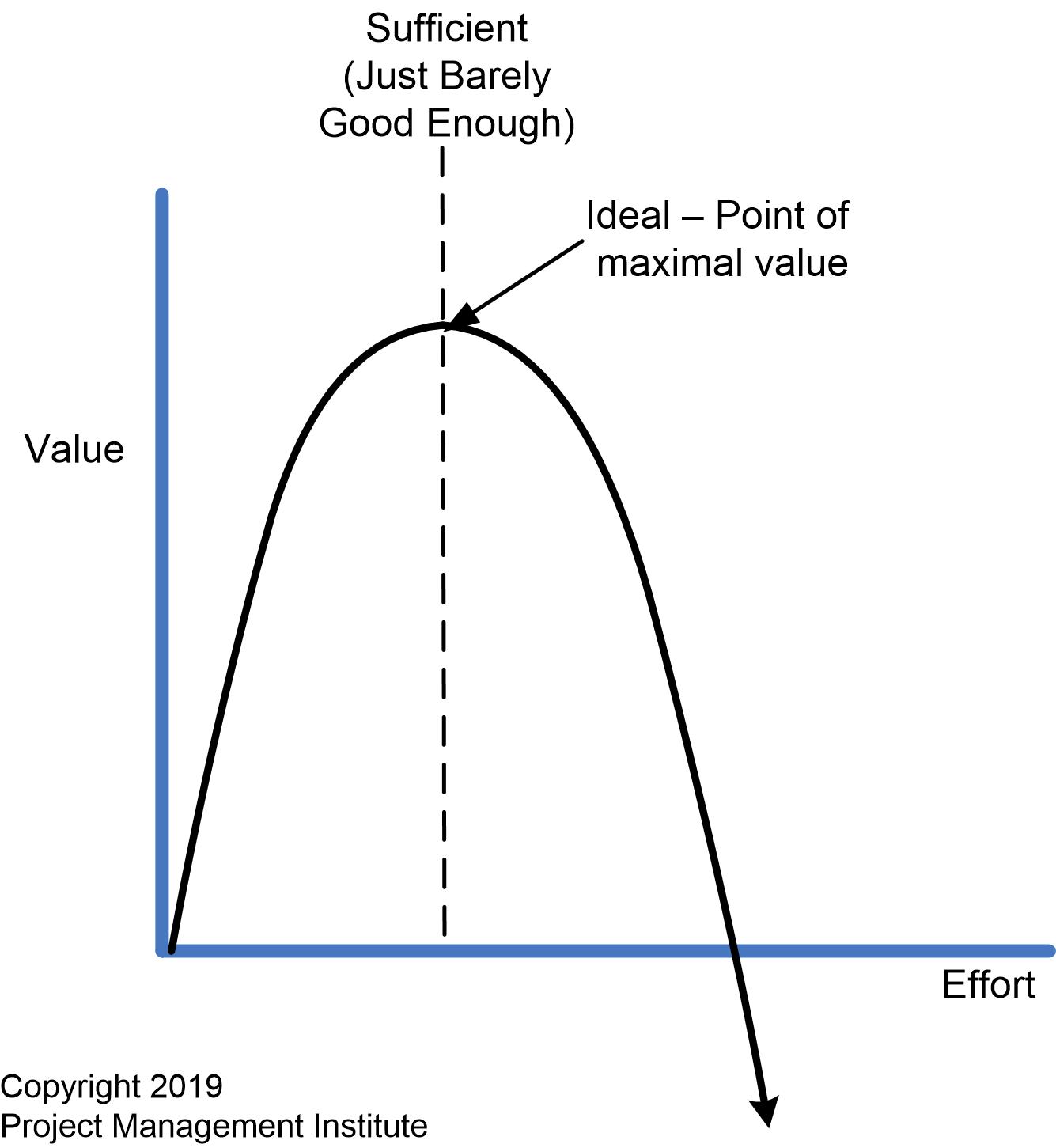
In AM we needed to determine the value of modeling so as to provide coherent advice around when to model and to what extent to model. To make a long story short, we observed that the value of modeling followed the law of diminishing returns as you can see in Figure 2. A little bit of modeling offered a lot of value. So did a bit more, then a bit more, then a bit more. But very quickly we reach a point of diminishing returns, the total costs of modeling soon exceeds the total benefits of modeling – once a model is sufficient for the situation that you’re thinking through with it, you reach a point where any more modeling removes overall value. This point is what we called the just barely good enough (JBGE) point, although others prefer “sufficient” as a term. So why am I talking about the value of modeling? Because modeling and planning are slightly different flavors of the same thing: Thinking something through before you jumping into doing it.
Figure 2. The value of planning/modeling.
JBGE? What?
Many people, particularly those who follow a traditional “predictive” lifecycle approach, tend to be taken aback when they’re told the most effective plans are those that are just barely good enough. The problem is that they often interpret JBGE as insufficient, yet by definition that is clearly not the case. If your planning efforts haven’t been sufficient then you can still benefit from more planning, or to be accurate you can benefit from good planning at the right time. But, if your planning efforts have been sufficient, or more than sufficient, then more planning is only going to remove value. From a lean point of view over-planning is a waste.
To summarize, the DA belief system is that the value of planning and modeling follows the law of diminishing returns. There is significant anecdotal evidence that bears this out but as I indicated earlier the research evidence is sparse. I’ve actively prodded researchers along when I could for the past 15 years to get this evidence, but these efforts have always floundered when they discovered that this research is very difficult long-term work.
In the next blog in this 3-part series we explore how to determine when your planning efforts are sufficient. Following that we work through how to be efficient at planning.




 Community Champion




