Data Technical Debt: 2022 Data Quality Survey Results


| As a manager, the quality of the data available to you has a direct impact on your ability to make effective decisions. I ran an informal survey exploring the state of data quality within organizations from April 11 to May 22, 2022. The survey received 66 responses in total. This blog posting shares the key findings of that survey. Figure 1 explores the perceived importance of data within organizations. This year 95% of respondents indicated that data was considered to be an important asset within their organizations, which is consistent with previous studies that I have run in the past. However, only 54% indicated that they were measuring data quality, which tells me that in many organizations “data is an asset” is merely rhetoric. Figure 1. How important is data to your organization?
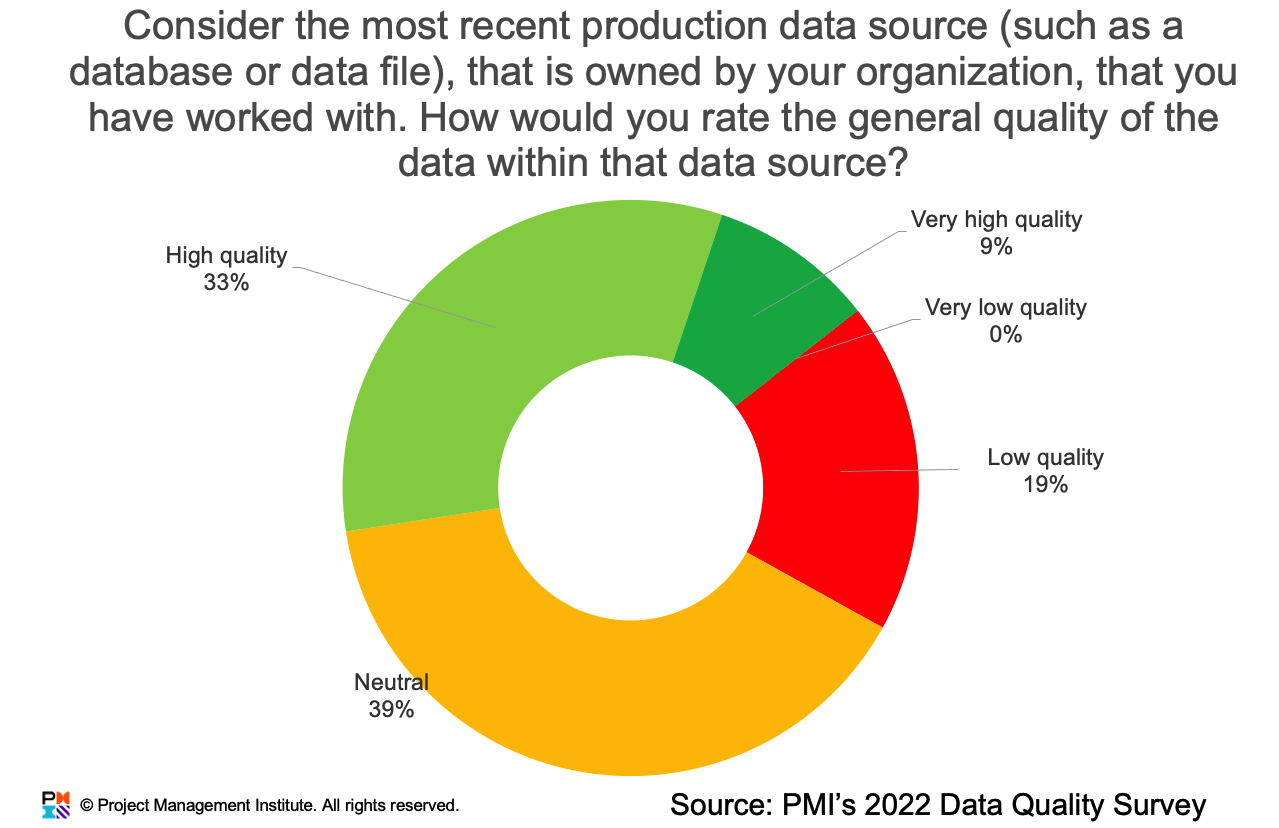
Data Technical DebtThe survey explored issues surrounding data technical debt (DTD), which is a measure of level of data quality (DQ) problems within a data source. Figure 2 summarizes the results of a question that explored the quality of the most recently accessed data source by the respondent. Only 42% of respondents indicated that the data quality was high or very high, and 19% indicated that the data quality was low. Clearly room for improvement. Figure 2. Quality of production data.
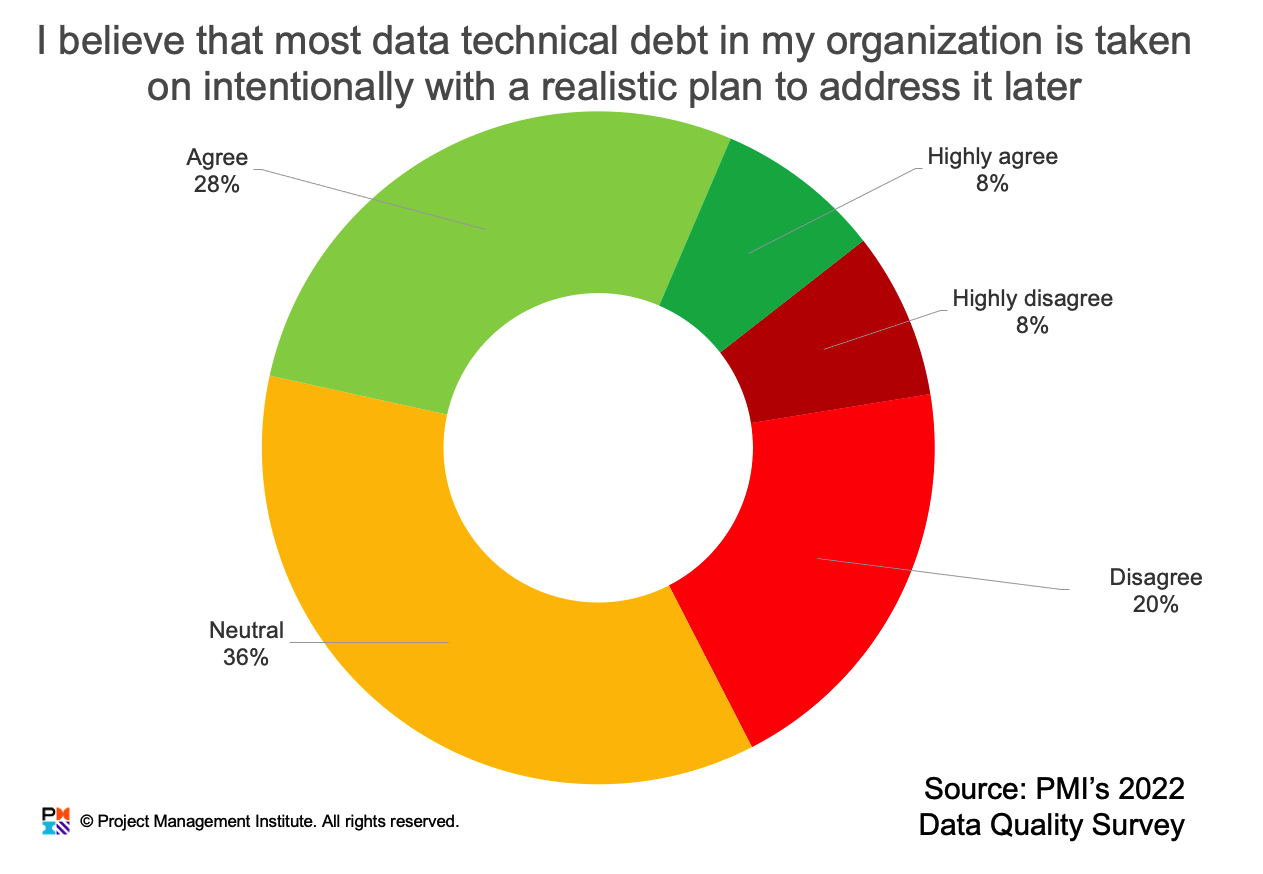
Figure 3 explores whether DTD is taken on intentionally, which is a management decision, with only 36% of respondents providing positive answers. Once again, this is an indication that there is significant room for improvement in many organizations. Figure 3. Is data technical debt taken on intentionally?
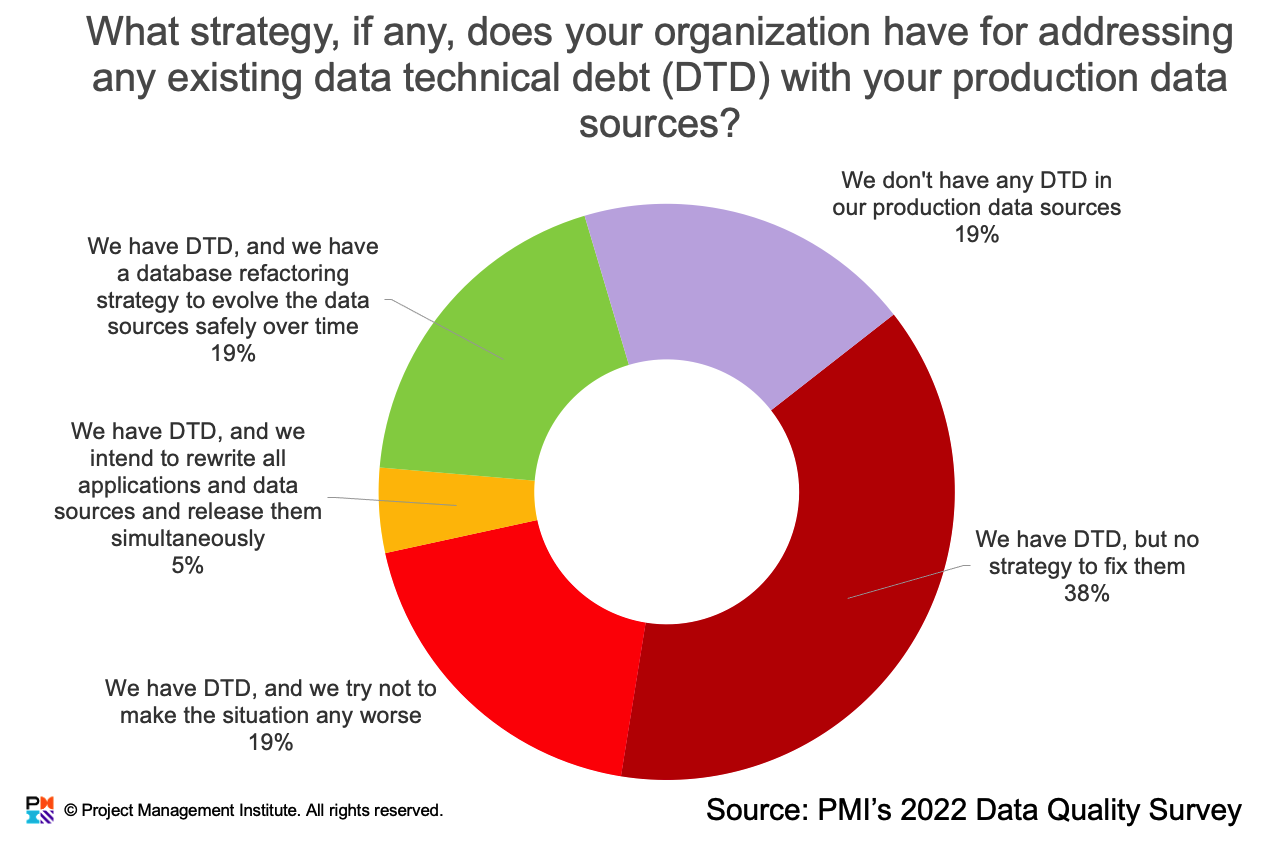
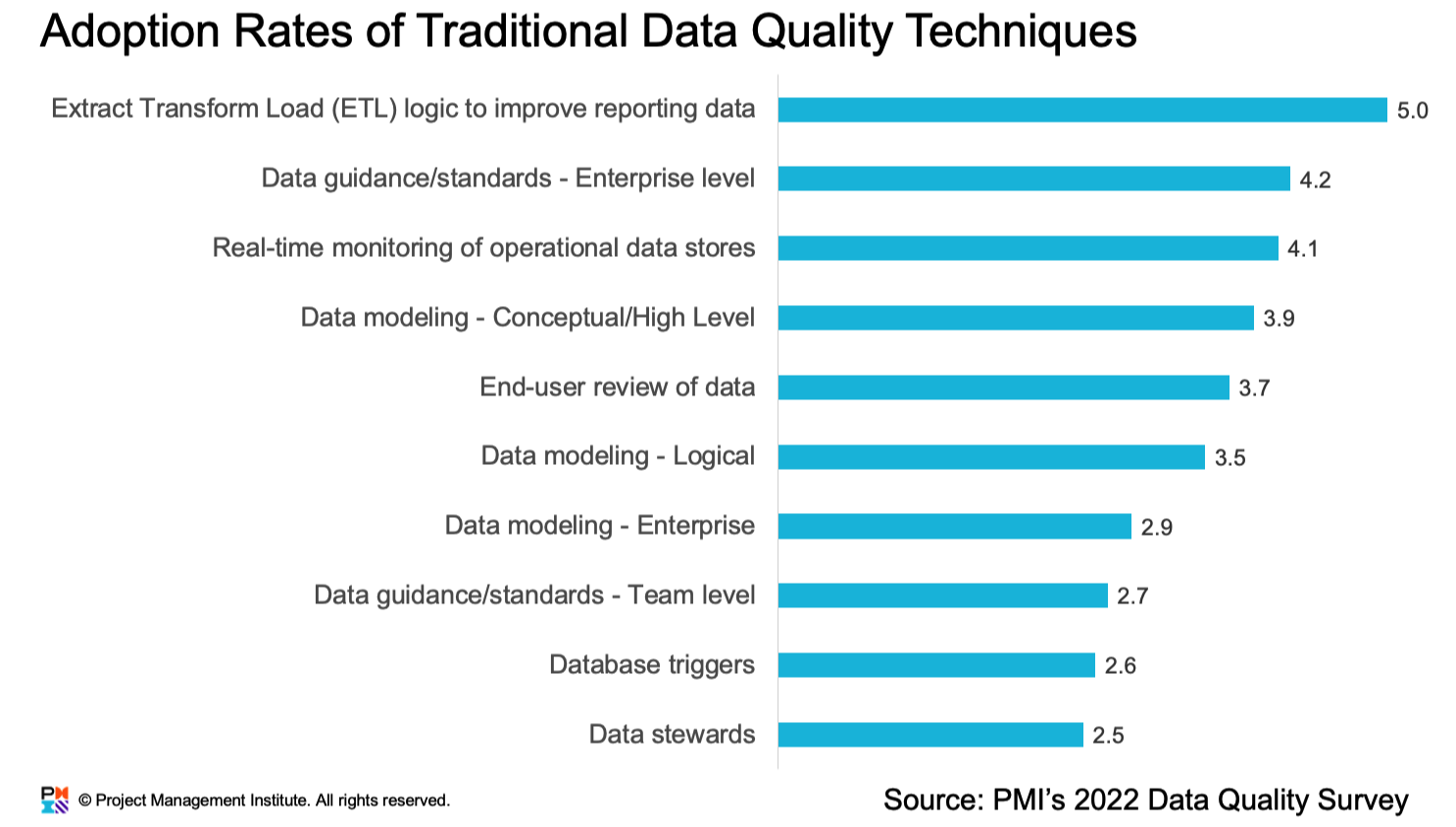
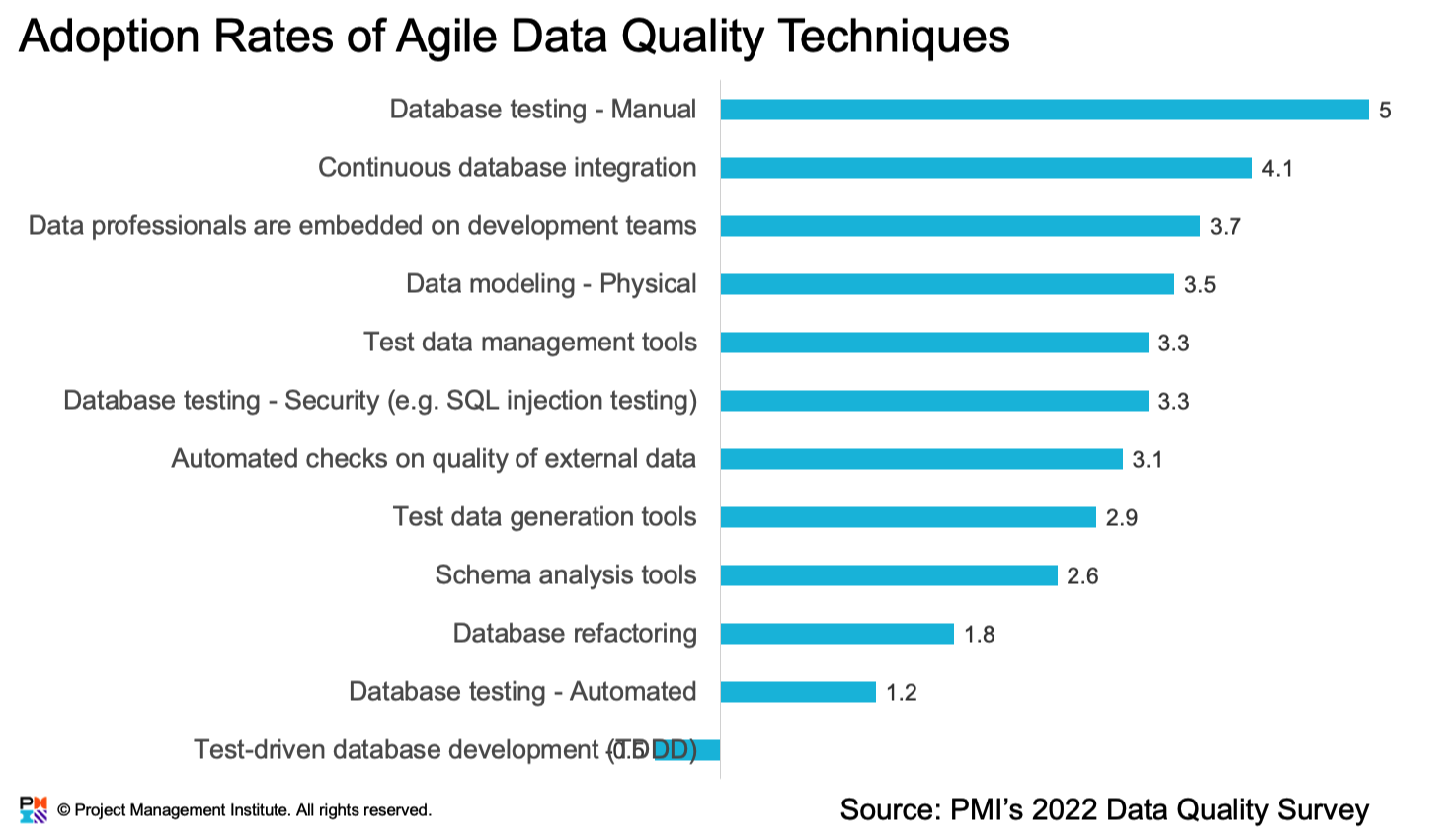
Addressing Data Technical DebtI also explored whether organizations were addressing DTD effectively. Figure 4 summarizes the result of the question that explored whether organizations had a DTD strategy in place. Figure 5 summarizes the results of a question about the adoption rate of traditional data quality strategies and Figure 6 the adoption rate of agile data quality strategies. In general agile quality strategies are more effective in practice than traditional strategies. Figure 4. Do you have a strategy to address data technical debt?
Figure 5. Adoption rate of traditional data quality techniques.
Figure 6. Adoption rates of agile data quality techniques.
|

DoD and DoR: A Disciplined Viewpoint
|
As with many issues within the agile community, there is a bit of confusion around the pragmatic application of the Definition of Ready (DoR) and Definition of Done (DoD). In this blog I answer frequently asked questions (FAQs) around these two techniques. These questions are:
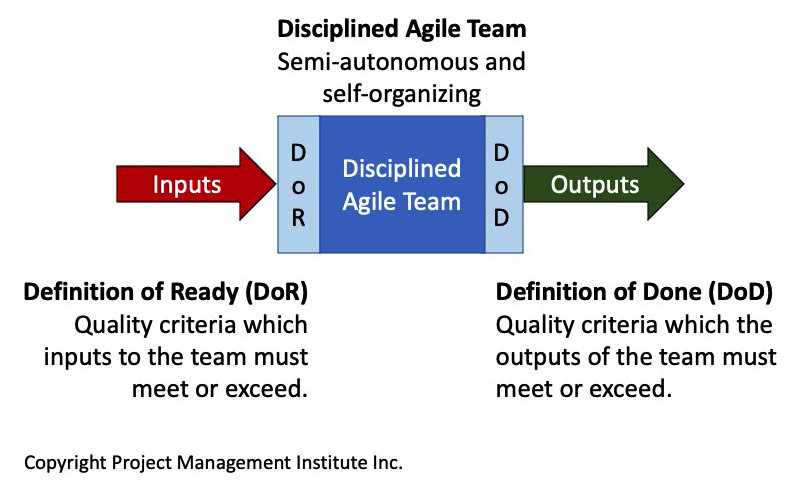
What are the Definition of Ready (DoR) and Definition of Done (DoD)?Figure 1 summarizes three key concepts that I will use throughout this blog:
Figure 1. Defining DoR and DoD.
Why do we want a Definition of Ready (DoR)?As you can see in Figure 1, your team's DoR helps to protect you from poor quality inputs. When your inputs are insufficient they put your work at risk, forcing you to either rework the inputs to get them up to the level that you need or to cut the quality of your own work. By reducing rework, or in some cases hand-backs from the customer to the supplier, you help to optimize the flow between the teams. For example, when you're making a salad, you very likely have a mental DoR for the quality of the ingredients. You want fresh lettuce, fresh toppings, a nice dressing, and so on. But what if the lettuce isn't sufficiently fresh? Perhaps you cut off some of the spoiled leaves, forcing you to do extra work to get it to the point where it's usable. Or perhaps the lettuce isn't quite as crisp as you would prefer, reducing the overall quality of what you produce and reducing your enjoyment of it.
Why do we want a Definition of Done (DoD)?As you can see in Figure 1, your team's DoD helps to protect your customers from shoddy work. It is effectively an agreement between you and your downstream customers that puts a lower limit on the quality of your outputs. Your DoD helps to ensure the quality of your outputs, which in turn improves the predictability of your team in that your outputs are consistent and it helps to optimize the flow between teams due to reduction in hand-backs. Once again, consider making a salad. If you produce a salad that is below your usual level of quality you will likely disappoint whomever you made it for. If the salad is for you perhaps you can live with that. If the salad is for your children perhaps you will have to endure their complaints, or even risk that they won't eat it at all. If the salad is for a customer in a restaurant, you risk them sending it back forcing you to redo your work or they may choose to never frequent your restaurant again. Can we define a standard DoR/DoD?Sort of. The challenge that we face is that our teams consume and produce a multitude of things, from tangible products to intangible concepts. And teams are unique, using those things in different ways. For example, salads are the only item in my cooking repertoire. I can make a wide variety of entrees, including spaghetti, grilled stakes, soup, and many more. I can even make a range of deserts and drinks (I was a bartender at one point during university). Clearly the DoD for a salad, for a T-bone steak, for an apple pie, and for a margarita will vary. There will also be similarities too, such make something delicious, make it look interesting, and don't poison people. The implication is that any DoD or DoR standard will need to focus either on commonalities between the things that you produce or consume or be a checklist of potential issues to consider when formulating your DoR/DoD.
Must a team have a DoR or a DoD? Both?In DA we believe that teams should choose their own way of working (WoW), including whether or not they want to adopt DoR and DoD as techniques. Because it's your choice, in the strictest sense of the question, the answer is no. DA isn't prescriptive that way, but as you learned above it's a very good idea to have a DoR and a DoD.
How do DoR and DoD relate to one another?The outputs of one team are the inputs to other teams. These "teams" may be external to your organization. For example, the lettuce that I used to make a salad came from a grocery store, which in turn came from a vegetable distributor, which came from a farm. The salad itself may be input into someone's overall meal. Figure 3 summarizes the relationship between DoD and DoR, where the upstream team is the supplier to the downstream team, their customer. There are three situations to consider:
Figure 2. Examining the relationship between DoD and DoR.
What must a DoD minimally cover?Sometimes your team produces outputs that are used by different teams in different ways, and each of those teams has their own DoR. The implication is that minimally your DoD is the union of your customer's DoRs for what you produce for them. What I mean by this is that your DoD must cover all of the criteria for all DoRs for downstream teams. Consider the example in Figure 3. The output of the upstream team is being used by three different downstream teams. The DoR for Downstream Team #1 has two criteria, A and B. Similarly, Team #2 has criteria B and E and Team #3 A C and D. The implication is that the DoD for the Upstream Team must minimally address the combination of the three downstream teams, in this case A, B, C, D, and E. Figure 3. Your DoD is the union of the DoRs of your customers.
Sometimes the minimum is only a start when it comes to quality. The minimum will hopefully satisfy your customers, but it might not delight them. The challenge is that if another supplier comes along with a better offering, perhaps in this case A' that extends A to provide higher quality, then you risk losing your existing customers to that new supplier because they've gone above and beyond your offer. Another strategy, described below, is to have multiple DoDs, one for each product version.
Do we need to negotiate our DoR and DoD?It depends. My gut reaction is to say yes, because that would be the smart thing to do. But you're not always in a situation where negotiation is possible. Consider the following scenarios.
What if we can't come to an agreement?It depends. This is an issue when:
What happens when our DoR or DoD breaks?Learn from the breakage. Your DoR/DoD breaks when it is no longer sufficient. Perhaps the upstream supplier changes what they produce without first negotiating with you. Perhaps the downstream customer evolves their criteria for what they require. Regardless, you should treat this situation as a learning opportunity which very often leads to improvement.
What happens when a team produces more than one thing, or more than one version of a thing?If they are different offerings, then you need a DoD for each one. For example, we should have a DoD for the salad that we produce. If we also produced chicken stir fry, then there would be a DoD for that too. There may be overlap in the DoDs, for example we may have criteria around not poisoning people with our cooking, but there would also be differences between them because salads and chicken stir fries are very different things. Similarly, if you have more than one version of something than you need a DoD for each version. Earlier we talked about how a DoD for a given output needed to encompass all the DoRs of downstream customers. Another option would be to refactor your output into different versions, one for each customers, so as to meet their exact needs. This increases your overhead, even if you have a clever configuration strategy you still need to manage the configurations, but has the advantage of being able to offer customized offerings to customers.
Figure 4. Versioning your DoD to meet specific customer needs.
Are DoR and DoD quality gates?Yes. To be more accurate, they are a form or type of quality gate, the implementation if which is determined by the needs of the situation that you face. Context counts.
Aren't quality gates non-agile?This question deserves a multi-part answer:
Once again, consider the DoD for the salad:
Context counts. The implementation of your DoD, and similarly your DoR, varies by the situation that you face.
How should we document the DoR/DoD?I always recommend an agile approach to documentation:
How should we implement the DoR/DoD check/inspection process?The way that you implement the quality gate check/inspection for DoR/DoD depends on your situation. You have several options available to you:
And of course I could have walked through a similar example for applying a DoR on the ingredients going into the salad.
Does DoR/DoD apply outside of software?Yes. DoR and DoD are fundamental concepts that apply to a wide range of products, both tangible and intangible, and services. Also, have I not belabored the salad example enough?
Aren't there similar concepts in the software world?Yes. In fact, this blog was originally motivated by a conversation that I had with Al Shalloway where I observed the relationship between supplier DoD and customer DoR was similar to that of superclasses and subclasses via the Liskov Substitution Principle (LSP). According to LSP a subclass should be more specialized than a superclass, similarly the customer DoR should be equal to or a subset of the supplier DoD. There is also the concept of design by contract where you define the interfaces of software components, the contracts so that others know how to interact with those components. The implication is that you don't need to know the implementation details of the component, you just need to know what it does and how to interface to it.
How does DoR/DoD relate to team working agreements?Your DoR/DoD definitions are an important part of your external working agreement. Remember that there are two aspects of your team working agreement - the internal working agreement between team members that defines the ground rules for how you will work together, and the external working agreement that defines how your team will collaborate with others. As per the previous question, this is effectively design by contract for teams.
Why is this so complicated?Your implementation of DoR/DoD only needs to be as complex as your situation warrants, as you saw in the examples above. The overall concept may seem complicated right now because I'm purposefully exploring all of the issues surrounding these two techniques. But as I discussed above, the way that you implement DoR and DoD is completely up to you. My advice is to keep this as simple as you possibly can.
Why is there a raging debate about DoR and DoD?There are several reasons why people are still debating these concepts after all these years:
What does Disciplined Agile (DA) advise?As always, look to the DA mindset for guidance:
Did I miss any questions? If so, I'd love to hear them. |