


By Cyndee Miller
Full disclosure: I’m a big fan of Trevor Noah. But even I was a bit surprised at his eloquence in speaking about managing projects—and what it takes to deliver them.
Project skills are life skills that can be applied both professionally and personally, the comedian and author said in the second installment of PMI’s Virtual Experience Series, “Together We Rise.”
And those skills are coming in handy in these strange times.
Noah said he felt “inspired” by the opportunity to rethink how he does everything.
“It’s not often you get an opportunity to completely revamp what you do,” he said. “We cannot ignore the situation we’re in. It would be a disservice to not emerge from this without thinking about better ways of working—of living.”
That means abandoning your comfort zone. His approach? “I wake up every day saying this could be the day I get fired,” Noah said. “It makes me appreciate the fact that I’m not. It also makes me ask what else would I be doing?”
There are no rules, Noah said. And that opens up new opportunities for people to reinvent ways of working, to rewrite the rules and to reemerge better than before.
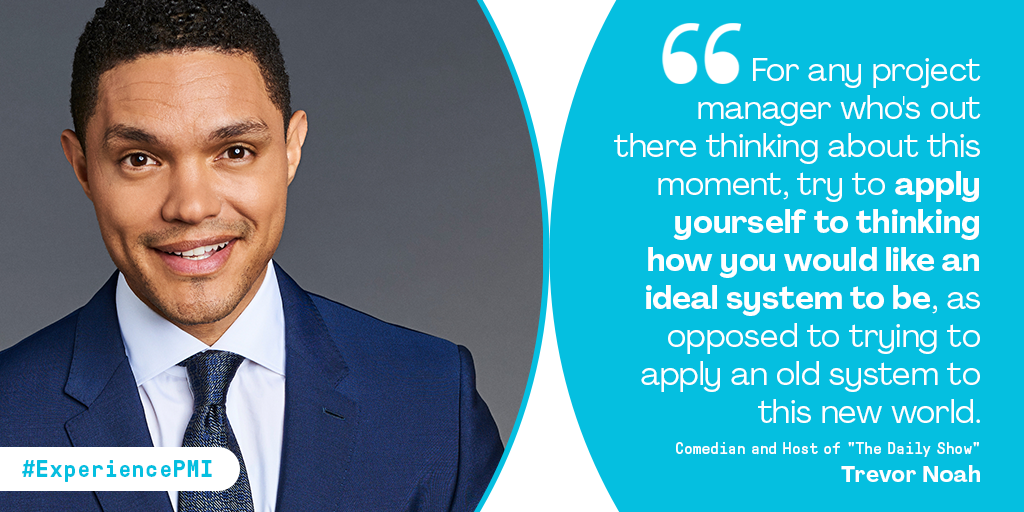
“For any project manager who’s out there thinking about the moment, try to apply yourself to thinking about how you would like an ideal system to be, as opposed to trying to apply an old system to this new world,” he said.
And yes, that includes one of the greatest questions of our Zoom-filled times: Do you really need that meeting? Or can you handle it over a text?
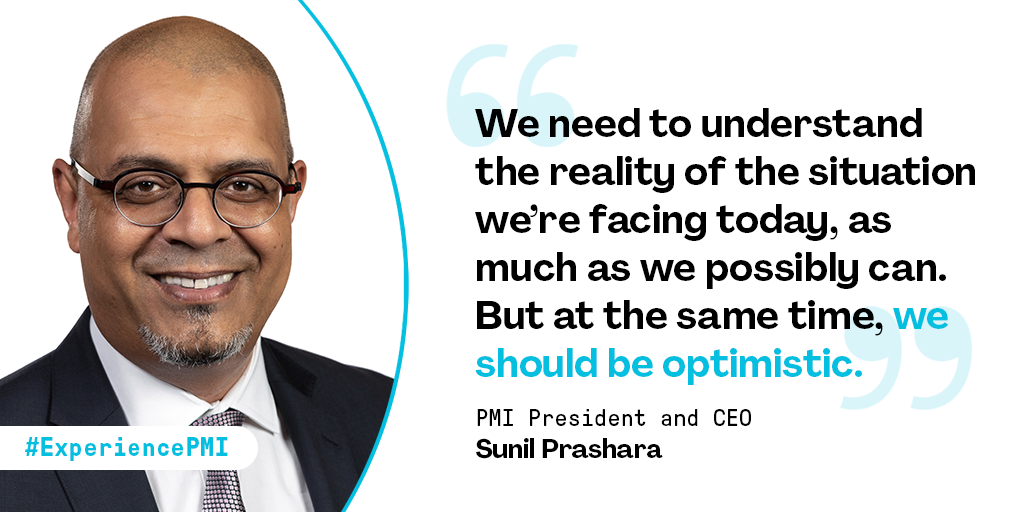
“We are in a situation where we can challenge conventional thinking,” PMI President and CEO Sunil Prashara said in talking with Noah. “Be realistic and optimistic at the same time. That allows you to innovate.”
Note: This optimism isn’t the kind of unchecked, unicorn-and-kittens, pie-in-the-sky optimism. Meaningful innovation only happens when it’s based in reality. And right now that reality is intrinsically linked to COVID, which is serving as a catalyst for iteration and the exploration of new systems. The little virus is the ultimate gamechanger. “There’s nothing like a crisis to ignite innovation,” said Shobhna Raghupathy, PMP.
That means ditching those old prescriptive ways of thinking and activating a new set of power skills. Adaptability, communication and collaboration are the must-haves in the age of disruption, said Erick Means of CDW.
And forget failing fast. You’re still failing, said PMI’s Scott Ambler. Project leaders should instead aim to fail less often, learn faster and succeed earlier.
Much of innovation is tied to tech, of course, and project leaders mustn’t ignore the sometimes-sticky ethical issues that will inevitably bubble up.
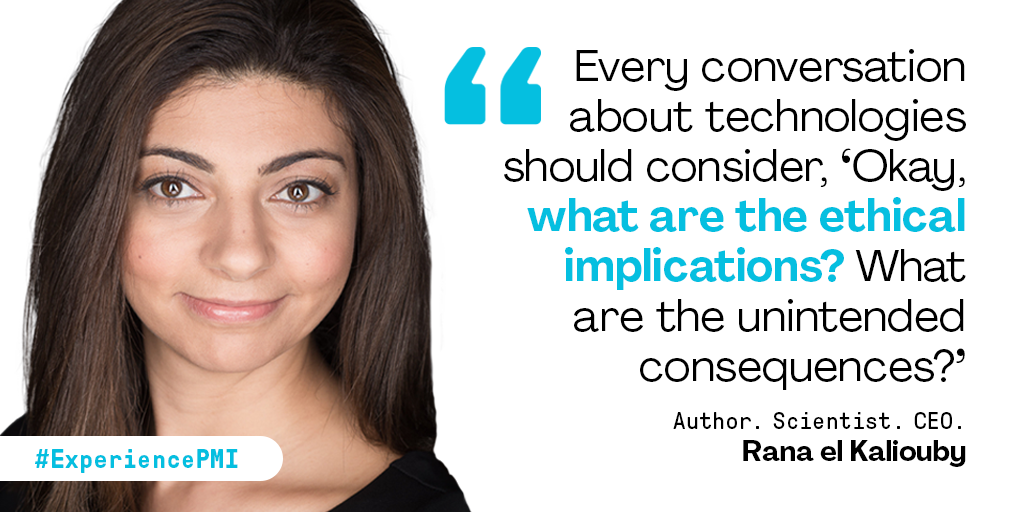
“Every conversation about technologies should consider, ‘Okay, what are the ethical implications? What are the unintended consequences?,’” said Rana el Kaliouby, author and CEO of healthcare Affectiva, an MIT Media Lab spin-off focused on “bringing emotional intelligence to the digital world.”
The effects aren’t always what they would appear on the surface.
“My biggest concern is not that robots are going to take over—it’s that we’re accidentally building in bias in unintended ways,” said el Kaliouby. The best way to combat that? Build diverse teams of people with different POVs and perspectives.
Mark your calendars for the next Experience PMI event on 9 September, when Reddit’s Alexis Ohanian and Lakshyashala Edutech’s Tanya Elizabeth Ken will lead the conversation on entrepreneurship and resilience. I’ll see you there—virtually, of course.
I’ll close out the same way PMI started each session throughout the day, with a simple question: What’s the one word you’d use to describe the work you’re doing today? Tell me in the comments below.


 Community Champion




