From "Triple Constraint" to "Success Star"?
From the Project Management 2.0 Blog
by Dave Garrett

New technologies, concepts, and Web 2.0 tools are popping up everywhere. How can you use them to help your project team collaborate, communicate - or just give your project an extra boost? [Contact Dave]
Recent Posts
Are You Prepping For The PMP 24/7?
Are You Just Too Darn Busy?
Eliciting Requirements... Creatively!
What To Expect When Your Stakeholders Are Expecting
8 More Templates to Save You Time
Categories
Advice,
Certification,
Collaboration Tools,
Decision Making,
Estimating,
Interviews,
Learning,
Management Approaches,
New Templates,
Personal Productivity,
PM Software,
PPM Software,
Presentation Tools,
Reporting Tools,
Requirements Management,
Research,
Risk Management,
Scheduling Software,
Security,
shameless self promotion,
Techie Tools,
Time Killers,
Time Tracking Software,
Training,
Virtual Team Tools,
Web-based Tools,
workshops
Date
Situation: You want to be help define something new...
I had a terrific response to my Triple Constraint posting week before last. So I thought I would take it one step further this week based on your comments. If possible, I'd like to see if it makes sense to collectively create something new. If it's a bad idea, that's fine - just let me know what you think.
Fully realizing that the PMBOK Guide does not put the Triple Constraint out there as the measure for success on a project, I was trying to address the reality (and Aaron Shenhar's) position - that it's very often used that way. To me it's a problem when PMs get so FOCUSED on the Triple Constraint, that they make mistakes in the delivery of their project in the name of "technical success". I got a long string of comments back that expressed a range of opinions and it made me think that it might be productive to take a look at a couple of potential "success stars" - a quintuple constraint if you will, that we could actually use to define the success of a project.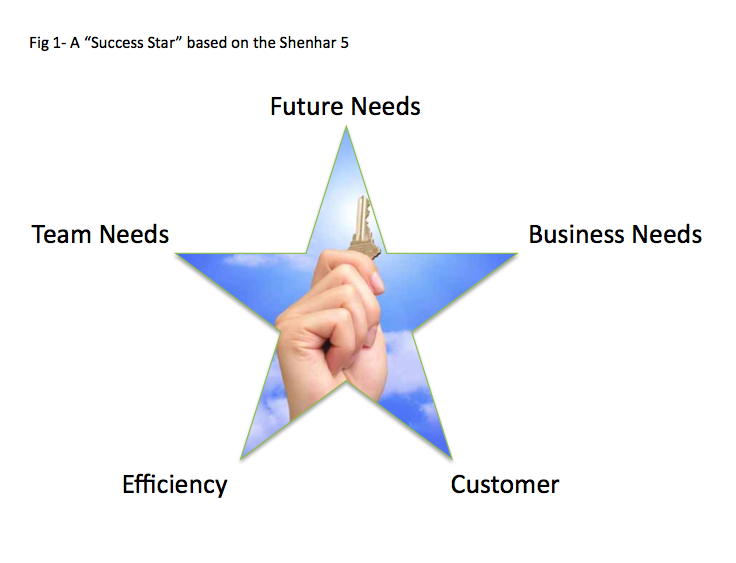
If you look at Figure 1, I've used Shenhar's five success criteria as the points on the star, meaning these are the five things that must be balanced in order to have a successful project. Remember the triple constraint elements are all captured in the "efficiency" point here. So the "technical" success of the project is just one element among five you need to be aware of.
- The "Customer" is the end customer.
- Business Needs are the ROI, etc. that is easily measurable.
- Team needs are the needs of the people on the project.
- Future Needs are impacts that the project will have on the business as a whole, far into the future.
Does this help create a "Focus on the right things" or just an impossible situation? In this scenario, are "team needs" inappropriately put on an equal footing with business needs? I know that "future needs" are hard to quantify and measure, but Aaron's argument is that many critically important projects create a platform for extreme business change. Maybe that impact won't be felt for years, but if we deliver the project with flexibility, etc. in mind, perhaps we can have a huge impact on long-term ROI.
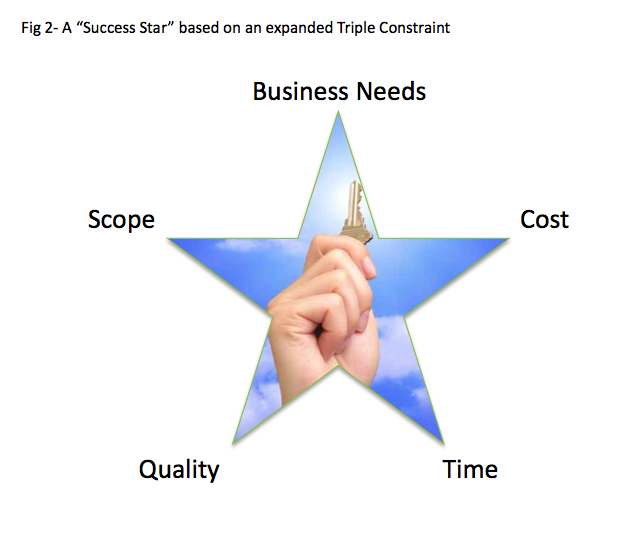 In some you comments, I felt like the was the feeling that the triple constraint was good, but it was missing a "business value" or "business needs" point. I believe some said that "quality" could be too defect focused and didn't necessarily capture all of the business impacts, the ROI, the strategic impact at a given point in time, future needs, etc. So I threw together the version in Figure 2, simply moving quality out to a point and adding business needs as another. I'm not saying this is a solution and one argument against it is obvious - since the new elements can be generally quantified in terms of cost, they are not valid as separate "constraints".
 They don't have the same direct "push/pull" going on that the triple constraint has. You could also argue that future needs (whatever requirements they generate) should be part of scope, but then so could requirements related to quality.
At any rate, my point was not to say, "here are two solutions - pick one", but rather to generate some interesting conversation. If you accept that the triple constraint is overused as success criteria - what would be better?
Posted on: June 09, 2008 12:40 PM |
Permalink
Comments (19)
Please login or join to subscribe to this item

Shawn Belling
Chief Technology Officer and Adjunct Faculty| Geno.Me/University of Wisconsin
Fitchburg, Wi, United States
The key here is to seperate project objective/deliverables success from project management success.
Project objective/deliverable success is acheived if the project ultimately delivers its scope and meets objectives. The project can be late and over budget and still do this (within reason). This project, however, would not be a success from a project management perspective. Project management success would be more focused on the triple constraints as well as other measures such as team performance, morale, good use of the methodology, etc.
I would state that a project can acheive project objective/deliverables success without acheiving project management success, but that a project cannot be called a project management success without acheiving project objective/deliverables success.

Sonya Calef
Senior Project Manager| Hennepin County
Minneapolis, Mn, United States
I think my perspectives on this might be almost heretical by comparison with the Project Management established cannon. I'm not convinced thre is a concrete, universally applicable yard stick for every project. I would prefer a universally applicable discussion framework instead.
I think the success measures depend on the values of the business sponsoring the project. In an ideal world there would be cut & dried criteria and measurements that fit all projects all the time. In my 10 years working on IT projects, I have yet to encounter an absolute situation once. I've been on teams that spent valuable time wrestling the project into submission to concrete criteria that actually didn't fit and whose data were useless.
To borrow an idea, let's begin with the end in mind.
At this point, I see the PM facilitating a conversation with key leadership to determine what success looks like for short, near, and long term durations after the project ends. I can see presenting 3 different scenarios to the management team based on some different models to help them envision impact faster.
Great - What's the model based on?
Perhaps the star doesn't have equivalent points at all. Maybe it's not a star. Maybe it looks more like the "Ka-Pow" starburst from the old Batman shows. I think it is possible to craft a fairly static list of what the criteria of the points *could* be, as guidelines to prevent chaos.
Will the PM need to do this on every project? That could be time consuming and tedious. Is there existing info from the organization to use as a springboard, such as mission statements, strategic goals, etc.?
Could you walk in with suggestions and a recommendation to start the discussion? Something to think about for sure.
I do believe it is a dialogue we need to open up with management/key stakeholders to develop this 360 degree sensibility that will govern the project's decisions along the way.

John Reiling
Seeking new opportunities | AcroVision Business Systems, Inc.
Mendham, Nj, United States
I think that reality has it that others - probably upper management - have selected the project, and someone - a PM - has been brought on board to execute on the project. So, from that standpoint, I agree with Shawn, that there should be separate success criteria. However, I think it is a shame if a project manager does not "take the high road", understand the top level perspective, and "adopt" the project as his/her own. Such ownership would represent buy-in by the project manager of the project's objectives, not just delivery of the project. Ownership of this sort is very motivating and really is the only thing I can think of that would really keep the project on track and effectively allow the PM to communicate to the stakeholders and sponsor.
I don''''''''t see the Triple Constraint as a means to identify success - I see it as a way to illustrate your work space. And there is the key problem: the triple constraint is a flat, two-dimensional model trying to represent a volume.
When was the last time you poured milk - or beer, for that matter - into a circle, a square, or a triangle? These shapes probably didn''t hold your liquid too well, did they?
You poured your volume of milk into a cylinder (or in the case of beer, a fluted convex dodecahedroid - see http://www.realbeer.com/library/beerbreak/archives/beerbreak20010322.php ).
The point is, we need *three* dimensions to talk properly about space. Maybe even more...but I cannot work beyond three to easily.
This whole topic will be covered with a new model called the Constramid(R) in our upcoming book, The Fiddler on the Project.
But back to the question - how do we measure project success? Come to think of it, our Constramid may actually help answer this question. In our model, the triple constraint triangle evolves into a pyramid with three walls repersenting cost, scope, and time, and the FLOOR representing that driver of project change - risk. The PM perches atop this structure, and quality is woven throughout the surfraces of each pyramid wall. The inside of the pyramid is the workspace of the project.
To me, success means staying atop the pyramid. The moving and shape-changing risk floor will inevitably pull out one wall, push out another, at any given time. And there you are, precariously perched at the peak, with these surfaces moving around under you. A successful PM - and a successful project - either has anticipated this change or can intelligently work around it. It's about balance. It's about still getting the work - the deliverables - of the project done, despite the mushy footing underneath you.
All this said, I still think that the triple constraint triangle or even our Constramid model are meant more to depict the workspace and not serve as a success model. The star model you''ve discussed here may do the trick - as long as it identifies satisfaction of all of the key stakeholders.

Michael Wood
Project Manager / Business Analyst / Business Process Improvement Guru| Independent Contractor
Gig Harbor, Wa, United States
Love the concept. There are so many things that contribute to project and even enterprise success.
The key for me is to focus on the value contributions and value trade-offs to stakeholders along with a high certainty of success and low negative social and environmental impacts. Perhaps an overlapping model (ven diagram) might show the interplay between the criteria better; but the star works great too.

Dave McMillin
Sr. Project Manager| TEKsystems
Washington, Il, United States
I like the first Star mentioned. This takes into account the future needs for the business as well as the team needs. If you burn out team members on this project you may not have them for the next one. If you do not challenge them and offer tasks that will help them grow into the next position then many won't be around for the next projects.
I also like the end customer on the first star. Sponsors may be happy that you completed the scope within time and money but the end customer will let you know if the thing is usable.

Frank Winters
Photographer and Conservationist
Sandwich, Ma, United States
Dave,
Models for measuring success will never measure up but they are useful aids to thought. The Star is as good as any I''''ll wager.
The simple measure of success that I like best is effectiveness. Did the project accomplish its goals? In other words did it deliver the goods -- as expected?
Some examples -- The Manhattan Project was successful because it developed a useful A-Bomb early enough in the war to make a difference. In this case schedule, while variable, was still of critical importance. In the end the project delivered the goods.
The Big Dig in Boston was over budget by a very great deal and very late if you use early or even mid project plans as a measure but that''''s not why some people think it failed. The tunnels leak and one failed and killed a user. Quality was and is poor. If it had excellent quality it probably would have been declared successful because it really did what it set out to do -- solve the traffic problems in down-town Boston cutting at least one half hour off the time to get from the suburbs to the airport. while improving the architecture, and the livability of the city. So in this case while goods where delivered they arrived like so much rotten fruit. Goods delivered but they have so far disappointed -- because they are just not up to what was expected.
The Space Shuttle is not a measurable project according to some critics because no one knows exactly why it was developed. Further, it took years for NASA to realize that it is a very unsafe mode of transportation. Many of the standard measures of success can''''t be applied to the shuttle because it is largely a tool of propaganda. But then again if it is measured that way -- as a way to enhance US international prestige -- it might be considered a success. But the poor safety record (1 failure in a few hundred launches -- compare that to any other mode of transportation that is not experimental) probably has nullified the effectiveness of the shuttle as a prestige enhancer. So.. one can easily argue that the shuttle has not delivered even as a publicity stunt.
So I'll go out on a limb and say that if a project team is hired to solve a problem and gets it solved it is successful even if the cost and time constrains are blown. Even if the ''quality'' is sub par (but it must be above abysmal and not kill people!). If the problem is perceived to have really been solved it is a success no matter what. So delivering the goods is important -- but as projects progress the nature of the problem invariably changes. It is up to the team to manage the perception of the changing problem as well as the expectations of those who shall be obeyed.
Of course there are politics so if the problem is very important and if the over runs are high the team can be cast in a bad light. So (thinking out loud) I'll go out on another limb and say that for projects with important goals, delivering the goods as expected is what counts above all other measures. (Note that expectations and perception can be and must be managed by the senior project managers and or her superiors)
The other, less important projects probably should never have been funded anyway!
Cheers,
Frank
Frank Winters
Photographer and Conservationist
Sandwich, Ma, United States
Sorry -- just a edit -- in the penultimate paragraph I wrote "Of course there are politics so if the problem is very important..." I meant "so if the problem is not very important."
You still may question my logic but at least this is closer to coherent! (I hope..)
Frank

Aaron Porter
 Community Champion
IT Director| Blade HQ
Payson, UT, United States
I am all for clarity, and I think the star approach can add more clarity, but so can the triple constraint if used in a more collaborative manner. It is my position that the triple constraint is not overused; it is misused by some PMs, not understood by many stakeholders, and in some cases ignored due to varying circumstances. As with any new thing, the star approach could face the apprehension of "one more thing that gets a lot of hype and goes nowhere," creating the potential for it, too, to be misused and not understood or ignored. I am not saying it is a bad idea, I am just not convinced that it addresses the root of the problem.
I am not going to claim omniscience or special knowledge of the root of the problem, but I think I can speak to part of the problem. It has been my experience that some project managers have lost their focus as facilitators and assumed the role of taskmasters. It may be that this mindset has been forced upon them for whatever reason, but it exists, and it leads to other problems on a project.
As a taskmaster, my approach would be reactive. "Business (or IT), if you change this task or requirement, you must make sacrifices in these areas..." I am not saying that this is not true, just that the taskmaster PM comes across as dictating to others, which is seldom appreciated when it comes from a PM.
As a facilitator, my approach is to work with the customer to help them understand the impact of the requested change so that the customer can make an educated decision regarding whether or not to proceed. It could be argued that the taskmaster is trying to accomplish the same thing, but the taskmaster usually ignores his or her audience''s opinion of their decision-making capabilities and/or authority.
I would be lying if I said that I was always a facilitator, but it can be a more effective approach, especially in situations when the triple constraint "goes out the window," so to speak. I have been brought into a project that requires a new network environment to be created. IT decided to use the clean slate to implement the infrastructure the "right" way. The business expects everything to work the same as it did before. Neither side has effectively communicated their expectations with the other or discussed the impact of doing it one way or another. Just to be clear, I am not the PM. I am, however, now in the position of bringing IT and the business together to discuss the right way to set up the environment in order to accomplish business objectives with a government mandate driving the deadline. All that matters now, however it is set up, is that it is up and running on time and that the business has the time they need to check out their new systems, ensuring that they are functional before the deadline.
Did the triple constraint really go out the window? No, but we''re not discussing it, either. Instead, I am shifting the task focus of the effort to collaborating to find the best solution to meet our immediate concerns that came about as a result of poor communication and collaboration. Don''t applaud, yet, we''re still not done :-)
Both the triple constraint and the star can be successful, and they can both face difficulties. I feel that the triple constraint has proven its value in the past, and it can continue to do so. The star approach could, in some ways, be considered a "re-packaging" of the triple constraint. Is it needed? It might be on some projects, but there are other factors, such as effective communication, that have a greater impact on the success of the project and need to be addressed before either the star or triple constraint can have a chance to affect the successful outcome of a project.
One final thought. Dave mentioned that the PMBOK, "does not put the Triple Constraint out there as the measure for success on a project." Star or triple constraint, maybe we should think of them as part of a PMs planning toolkit, instead of a measure for success.
Thoughts?
Aaron

Hans Robbers
Senior Director| Salesforce
Vlissingen, Netherlands
Dave thanks for taking the discussing one step further. As I have mentioned previously I think the 5 point star resembles the Balance Score Card a lot. I alos think that we should take into account that a project is limited in time, resources and costs(the triple constraint again). Meeting future needs can be done after the project has been finished and one can argue if this is measurable during the project life cycle and therewith a key success measurement. I would suggest this is mainly the responsbility of the programme and/or the Business Change Manager who is also managing the Business Case (see OCG site for Managing Successful Programmes).
As a project manager you accept a number of responsibilities like efficiency. As I argue in my articles, Balancing TY, there should be four; TIme, FunctionaliTY (scope), QualiTY, and ProductiviTY, which all result in a total cost for the project. The last one represents resourcing the project and you can argue the development of resources is also beneficial for the next project and therefore not within the responsibilities of the pm, however I experienced higher productivity when peopl get challenging and rewarding work thus for me it is a responsbility which I take seriously.
Meeting the business needs is managing the stakeholders and their expectations and if the delivery is according to their expectations the project is considered successfull even in cases when it is not as efficient as was predicted. So stakeholder expectation/meeting Business need is the counter weight for efficiency. The same can be said regarding the end-customers. If they consider the solution as fit for use and purpose it will balance the efficiency.
I would suggest the paradigma which needs to be managed is:
Efficiency = Business Needs + End-customer acceptance
whereby team needs is a part of efficiency following the balancing TY philosophy
what do you think?
Dave, Thanks for continuing to stir the pot on this discussion. I like the star idea - very clear on the elements being separated - however, I'm not sure they are really separate considerations. If we are struggling to articulate a visual representation, why wouldn't the two stars be integrated? And if that approach is acceptable, does this limit the number of constraints? Or, does this merely mean that these are the ten identified to this point? Are there others that should be included, or others left out? I'm not sure I good at answering my own questions, but I do agree the approach does generate discussion. Perhaps these are really a Venn diagram, with overlapping constraint segments that form the stars or triangles, or double pentagrams.

Mark Price Perry
Business Driven PMO Evangelist| BOT International
Orlando, Fl, United States
Interesting discussion. My thoughts are twofold.
- First, constraints and success criteria are simply two different things.
- And second, this does not have to be an either/or proposition. Both have and can be of value.
The constraints are the things that cannot be changed without impacting other constraints. The Project Management Triangle is a simple construct that continues to be of good value. Success criteria, on the other hand, are also very valuable, though not necessarily constraints to one another. Success criteria can be represented graphically as star diagrams, spatial diagrams, radar charts, and as Sonya mentioned as one of those Batman "KA POW" starbursts. Measuring success criteria in this way as a technique not only makes a lot of sense for the reasons outlined by Shenhar, but it also aligns quite nicely to other techniques such as project scorecarding as part of the project selection process to determine the relative merits of the project as compared to other competing project opportunities and review of the project scorecards as part of the ongoing portfolio managing process. Also, of all of the executive dashboards that I have seen over the years, not one of these dashboards has shown only the triple constraints. Always, these executive dashboards show other "success" measures for the project. Hence, it is hard to argue Shenhar's proposition and the value of establishing and measuring "success criteria" for the project.
As a side note, not too long ago I had the opportunity to play a round of golf with our club champion. I spotted that he was keeping track of his round, not on the scorecard for the golf course, but on a customized scorecard. In addition to the score for the hole, he was tracking drives in the fairway, greens hit in regulation, miss-hits by club, total number of putts, number of putts missed short, high, low, and long, and a few other things like number of three putts, percent of putts made inside ten feet, etc. I asked him why he tracked all of those stats and what he actually did with them. His response was short and applicable to so many things in life. He said that the more you measure the results of what you are doing, the better results you can achieve.
Project Success Criteria - absolutely..!

Paul Parker
ScrumMaster (CSM)| PricewaterhouseCoopers (formally BearingPoint)
Tampa, Fl, United States
I like the first star. It should be a framework that isn''t set in stone, but maybe points in time along a project continuum. One thing Agile methods like Scrum promote is that quality is a given, it is not compromised. A PM''s sucess is measured by the team''s success to deliver business value when the product is released. It is a shared sucess. Even Agile projects are bound by the triple constraint, it is a reality that must be managed and not a measurement of a Pm''s or porject''s success. Just my thoughts.

Naomi Caietti
Senior Project Manager | ePMO | Higher Education | Healthcare & IT| Linkedin.com/In/NaomiCaietti
Dave, thanks for taking this discussion a step further and putting a graphical spin on it.
You know, packaging and branding are very important but I think many of us have noted that if you aren't trained to use the tools, it does not matter if it is a star or a pyramid, a project charter or risk plan. If you can't use the tool to 1: Negotiate, 2: Influence 3: Motivate 4: Make decisions 5: Communicate it will be useless to an untrained PM. Sometimes, you can make the simple complex or the complex simple with pictures and a few words. Personally, I like the creativity of the stars.
Also, I still believe that the sponsor is the key project executive the Project Manager will use this tool with most to negotiate any of these constraints on behalf of the team. You have limited time with your sponsor so use their time wisely, if you think picture will work use it but be prepared to walk them through anything you put in front of them.
The Triple Constraint is a very powerful tool if used correctly to negotiate with your sponsor, customer and stakeholders to manage and deliver a successful project.(on time, under budget and meeting customer needs) I guess the key thing here is every time you negotiate any of the constraints in the pyramid, or triangle it impacts the others. The project team must be prepared to react to manage the new constraint at any time with the leadership of the Project Manager.
Critical Success factors are way to define ways to measure success on a project and not just at the end. Realistic project outcomes, goals, and objectives that are attainable, smart and measurable are best. These should be defined by the project team, customer and stakeholders.
The Triple constraint is a negotiation tool to manage your project and critical success factors define ways to measure your success throughout the project through implementation.
Dave, much of what I started to write is contained in Naomi's incisive response. This discussion is all about defining the critical success factors. Now, what I'm struggling with is finding the appropriate picture to work from that let's me understand the interplay of the factors.
Your second graphic turns the triangle into a star, and while it has its "points" (pun intended), I find it hard to visualize how to balance the considerations within the bounds of the figure. Rich Maltzman asks us to visualize a solid body to enclose all of the factors all built on a platform called Risk. His picture places the PM precariously balanced at the apex - sort of like the angel on the top of the Christmas tree - not exactly the position I want to manage from. Several folks have suggested Venn diagrams, which do capture the overlap among competing value systems. But I don't have the skills to create one that would work with assigned values.
So I thought, why not try a radar diagram - one of the plots that Excel provides that maps a dataset into polar coordinates, where X becomes an angle and Y becomes the distance from the center. So I built one based on using the five attributes in your second star. It's easy enough, you place the labels in column 1 and the "value" in column 2 and let Excel do the rest of the work
Here's what I learned from that picture. The order of items in the list matters a lot. If the first three items in your list are Cost, Scope, Time followed by Quality and Business need, then scoring 100 on the triple constraint factors and zero on the other two factors yields a plot the includes only 2/5 of the area. You'll get the same result for any combination of three factors as long as they are contiguous in your list. If you now score 100 on one of the other two factors the area increases to 3/5. You need to score 100 on all five to capture the full area.
On the other hand, if your list reads Cost, Business Need, Scope, Time, Quality the plot changes dramatically. Scoring 100 on the Triple Contraint factors, and zero on the other two, results in a plot that contains just a small triangular area within the lower portion of the pentagram.
So now I know that, if I place equal value on all five of the items on Dave's star, I still have to decide where to place the two "new" ones in relationship to the three "old" ones. It easy to show it graphically, but what I the radar plot picture says to me is that I have to decide on the value of tradeoffs between, say, the Business need and Cost or Business Need and Scope and locate them appropriately around the pentagram.
I have graphic in a course I teach that shows the triple constraint triangle, the PM walking a tightrope stretched from start to finish and a caption that says "Don't make the wrong mistake". The spoken words were that it is the PM's job to assess the order of importance that the client placed on each of the three since, at some point, the PM was going to have to decide which of constraints to violate.
So now I can agree that I might join Dave out on his limb saying that if a project team is hired to solve a problem and gets it solved it is successful even if the cost and time constrains are blown. But I can ony do that if I can equally compensate my company and my employees with, in this example, payback from Quality and Business success. If you can't order the priorities of the value variables, you'll just go on making the wrong mistake.
Just so you know that failing the triple-constraint while winning might be a real case, I have run a project where I over-ran the fixed-price $2.5M budget by $1M! The payback has been that our design process has been radically changed, allowing us to model the results long before the product is built (reducing both cost and time to market) while the existence of the first product has led many other customers to come to us exclusively because we delivered what others could not.
Norm
Ooops - Frank was out on the limb, not Dave. Sorry to both
Norm

TJ Tesoro
Faculty| Colombo Plan Staff College
Manila, Philippines
Dear Dave,
Thanks for continually updating us on your creative & innovative way of looking at PM principles.
I really like the STAR concept. I myself believe that there must be a more comprehensive way of looking at project considerations. I recalled in our recent workshop on the "blue ocean strategy", here in my institution at CPSC, that we arrived at an interesting model that applies to management whether they are quality management, project management, strategic management, etc. And this model is the convergence of two triangles - which is ultimately in the shape of a star.
First, we defined the 3 aspects of living which form the first triangle: Moral - Spiritual - Psychological (with spiritual at the tip of the triangle and the two others at the base). Then we further elaborated it into the other 3 aspects of living, which now takes the shape of an inverted triangle - which is comprised of the following dimensions: Economic - Physical - Social (with physical at the lower tip of the triangle and the two others on the other sides). This therefore gave us a star with six points - and the hexagon in the middle becomes the union of all, which we termed as "value innovation". Since then, I have used this model in my lectures whenever I discuss about emerging management principles.
This makes me now reflect and look at your 2 models, Dave. Applying the 6 aspects of living model as described above, I would like to propose the merging of two triangles as well. The first one will be composed of our Business Needs - Future or Emerging Needs - Team Needs (the one in the middle is the tip) and the other triangle will be our original framework of the triple constraints : Cost - Scope - Time (the one in the middle again, will take the bottom tip).
How's that for a framework?
Thanks for inviting me to share my two cents worth of idea.
More power to you and gantthead!
Hi Dave,
Its an interesting concept, but probably needs further development.
If we are to assume that neither Project Charter, nor Project Scope statements exist, as may be the case in many Agile or Fragile shops (grin), then indeed it is up to the PM to define at least these points, on your star diagram, and to wrestle with satisfaction of needs, and to deliver results across the board.
If, on the other hand, both Project Charter and Project Scope documents do exist, and are more or less complete along the lines of the PMBOK or SEI or ITIL or ITIM standards, then I believe both needs and efficiency and long term ROI will have already been addressed, and a clear and concise definition of success will exit. This could take the form of your star diagram, but it could also take other forms.
I do agree that an overwrought focus on the triple constraints is commonplace, today. But I see that as more of a practice question- the seeking of a "technical success" - than a process or standards failure point. IF people use Charters and Scope statements, as living documents, in their practice of PM work activities, and if those documents have at least the metrics you identify, then my question is where does this problem arise?
Thanks
Larry
As an additional 2 cents, I'd like to agree with Sonja's comments. Setting success criteria is more about setting expectations appropriately than measuring so many of these, or so much of that. Yes - the triple constraint's are important - how else to manage limited resources? But success is not about whether the project finished on time, or within budget, or within scope - it is about the customer agreeing that what you gave them was what they asked for. So while stars and triangles are fine as we manage through the project, determining when you've been successful must rest with the customer.
If that's represented with a Ka-Pow or Star, Pentagram, Triangle, or Venn Diagram - I'm not sure it matters. Figuring out what makes you project successful to your customer is what project management has always been about. Controlling how you deliver it is why you became a project manager in the first place.
So Sonja - right on - Ka-POW.
Please Login/Register to leave a comment.
|
"There are three kinds of lies: lies, damned lies and statistics."
- Mark Twain
|




