


Lazy Project Management


| Situation: You think "there's got to be a better way."
Peter Taylor is the head of a PMO at Siemens Industry Software Limited, a supplier of global product lifecyclemanagement solutions. He does a lot of speaking and writing on the subject of ‘The Lazy Project Manager’ . His elearning modules are available online as are his free podcasts on iTunes . So most people would think that being lazy is not something you would want to be known for. Peter thinks differently. We recently caught up with to find out why...
Q. You talk about the Pareto 80/20 rule in the book, but finding that critical 20% is always a trick. How did you identify the critical parts of PM that are most important? Do they share common attributes? Generally speaking, are they the easiest things to do or the hardest? A: Answers to each question in series -
Q. You also discuss the way that the leadership potential of Prussian Army officers was judged according to their intelligence and their laziness. You go into some detail about how laziness and high intelligence in combination makes for good leadership. Does that mean you believe in born leaders? Are 3/4 of project managers doomed to be poor or mediocre leaders? A: Answers to each question in series -
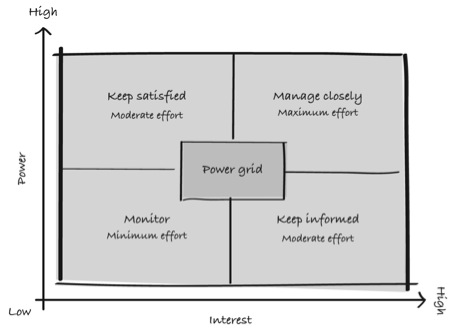
Q. You use a tool called a power grid to assess a project sponsor. How does that work? A: Well it is all about how to control your greatest asset and potentially your biggest threat. Critical to any projects success is having a good project sponsor, but, like the saying goes ‘you can pick your friends but you can’t pick your relatives’ and the same is true of project sponsors. So what makes a good project sponsor and how do you deal with the one you have just inherited for your project? The Project Sponsor is the key stakeholder representative for the project and provides the necessary support for the Project Manager with the primary responsibility of achievement of the project objectives and benefits. An inappropriate choice of Project Sponsor can seriously impact the possibility of success of the project and provide you, the project manager, with an unwanted additional overhead. Now you can’t practically ask a sponsor for their CVand put them through a formal interview process, nice as it would be sometimes to utter the phrase ‘I’m sorry but I just don’t think that this is the job for you right now’. But you should evaluate the sponsor you have and complete, in a subtle way of course, a ‘Strengths and Weaknesses ‘assessment so that you can adapt your project approach and communication methods to maximise their sponsorship support for the project that you now manage. Tip: At your first meeting with the sponsor don’t ask ‘hard’ project questions but ask ‘softer’ and more open questions: ‘What are your hopes for this project? What are your fears about this project?’ – You will learn a whole lot more. But let’s not be pessimistic, that isn’t going to happen to you, you won’t get an extreme case of project sponsor and they won’t fail the ‘interview’. So, what is your next move? Well perhaps you should consider the power base that your project sponsor has. Use the power grid to assess your project sponsor, assess their rating of interest in this project from high to low and their actual power in the organisation, also from high to low.
This will give you an indication of the way in which you should work with them. Actually this power grid is for all project stakeholders and if you end up with a project sponsor that is in the ‘low interest’ and ‘low power’ quadrant you really have a problem. It is unlikely that this sponsor is ever going to support your management endeavours.
Q. What's the single most important take away from the book? A: Well people tell me they love the stories at the end of each chapter as they show real situations where I pretty much got it completely wrong but lived to tell the tale and learn a very good lesson. But if I was to pick one thing that project managers should do it would be to work on your communication. At least 70% of a project managers time is spent in communicating so if you are going to be productively lazy anywhere do it here. That doesn’t mean communicate badly but communicate more effectively and that can often mean less effort overall. Oh and ‘be lazy’… |

Why is it SO Hard to Hire the Right People?
| Situation: You feel like there's something wrong with the way you hire. Two weeks ago, at the PMI research conference,
Dr. Joana Geraldi, Senior Research Fellow at Cranfield School of Management, International Centre for Programme Management gave a presentation entitled Finding the Right Person for the Job: Rethinking Work-Worker Fit in PPM. The presentation was based on a research paper she co-authored with Harvey Maylor, Sergio Pellegrinelli and Scot Colquhoun. We recently asked her a few questions about how we can put her findings into action. The answers to the questions below are her personal opinions, but closely tied to the research findings. Her perspectives, both here and in the research paper are pretty thought-provoking.
Q. During your presentation you discussed the problems with the way that "fit" is judged. (a worker's fit with a work profile, or work fit to a worker's profile) Could you briefly discuss how that fit is currently determined and the problems with that approach?
Q. Hiring managers and PM practitioners seem to be unaware of these issues. Why do you think that is?
A. It is difficult to say, but my guess is that the current approaches are more accessible, widely known among HR practitioners. There are plenty of people trained to assess people through these well known competence-based models. This makes life easier. We may also be tempted by the rationality and objectivity that these models promise.
Q. You talked a bit about a more holistic approach to hiring that doesn't create such a strong separation between the work and the worker. Could you describe this approach? Do you have any tips for someone who would like to put this into practice?
A. First the theory: Building on Sandberg (2001) and Partington et al (2005) we look at worker and work as inseparable. An individual's competence cannot be reduced to objective lists of activities, but is constituted by the subjective meaning that work takes on for workers in their lived experience of it. Our task is to understand what individual workers conceive of as work and, through the elicitation of examples, how they conceive of it. More specifically, Partington proposes four conceptual levels:
That is interesting, but how do you put it into practice? As a first step, Sergio Pellegrinelli and colleagues typically run assessments with project and programme managers and identify which of the four conceptual levels above they fit into. This helps the assessors identify high potential people in their firm and also make sure they are nurtured appropriately. The next question though is how to identify which projects or programs require candidates to be at the various conceptual. One way to map a project or program to a level is to judge it's complexity. One model to measure this complexity is MODeST (Maylor et al, 2008). This model looks at Mission, Organization, Stakeholders, and Team attributes to help judge complexity. There is still a need to explore the relationship between complexity and conceptual levels, these could be explored by studies, such as:
|

Project Management - Getting Better or Worse?
| Situation: You occasionally wonder whether we're moving forward as a profession.
PMI's mission, roughly speaking, is to have business leaders view project management as essential for businessresults. Obviously, the best way to do that is to show increasing success over time. That's why I found this particular PMI research report interesting. Are we getting any better? Comparing project management in the years 2000 and 2008 was a report produced by Erling S. Andersen and present two weeks ago at the PMI Research conference. Mr. Andersen was kind enough to answer a few questions for us recently about the research he conducted.
Q. Your research was conducted using the X Model, could you tell us a bit about how that works? (both at the micro and macro level)
Q. You concluded that some areas of project management have shown improvement, saying specifically that team members are more knowledgeable about project work, project objectives are more clearly expressed, project organization is more appropriate, most work processes are improved, team members experience project work as rewarding and are more motivated for future projects, and the results of the project are more balanced. Why do you think this is true? Do you credit PMI? Better Training? Stiffer performance requirements from employers?
Q. You also talk about areas for improvement, specifically, in achieving the project mission and goals or keeping to the project schedule and budget. Why do you think this is the case? Q. Do you know of other recent and important research in this area? Do you know of other studies being conducted now that might be of interest?
|

What's Interesting to You?
| Situation: You Like to Get Your Head Around the "Big Questions" in Project Management. Hey PM Thought Leaders >> Take a look at the list below and let me know if one of the topics could really help you tackle the challenges you face every day.
Earlier this week I attended PMI's Research & Education Conference 2010. The event has asubtitle - "Defining the Future of Project Management". While I'm not sure that anyone can "Define the future" of anything, I think there were some interesting presentations. I plan to interview some of the researchers, but I was hoping to get some feedback (either here as a comment or via email, whichever is easier) on what you might find interesting. During each interview I'll be attempting to identify who the research findings might be interesting to and what practical actions you can take based on their findings.
PMI presented awards for work in the following areas:
The 2010 Project Management Journal® Paper of the Year Award
Topics presented at the conference
Anything jump out as just what you were looking for? Let me know and I'll drill down deeper for you.
pplications of positive psychology to teaching project management and leadership.” J Davis Clark School of Engineering, University of Maryland, USA 2. “ Supporting interaction in the classroom – Using personal response units.” A W Gale School of Mechanical, Aerospace and Civil Engineering, The University of Manchester, UK
3. “The use of Skype and other communications technologies to deliver international project management education.
pplications of positive psychology to teaching project management and leadership.” J Davis Clark School of Engineering, University of Maryland, USA 2. “ Supporting interaction in the classroom – Using personal response units.” A W Gale School of Mechanical, Aerospace and Civil Engineering, The University of Manchester, UK
3. “The use of Skype and other communications technologies to deliver international project management education.
|

Are You a Mac?
| Situation: You're a serious Mac user with serious project work to do.
Macs are gaining traction in many business environments, yet there aren't that many choices when We recently had the opportunity to interview Dennis Bilowus, CEO and president at AEC Software. Here's what we found out...
Q. Thinking about what your software does - Do you feel that the projects that Mac users generally work on are different (or require different functionality) than PC users? A recent Macworld review offered the following Pros and Cons for your product (see below). Are these driven by the needs you see as specific to Mac users? Can you tell us a bit about your approach to development? A: We here at AEC Software have been developing project-focused software for Mac since 1986 and for Windows since 1993. Because of the close contact that we maintain with our users, we know that Mac users generally work on the same types of projects as Windows users. Sure, there is a bit more emphasis on media and graphics by Mac users, and we definitely have some Mac-specific features. The core features provided by FastTrack Schedule 10 are cross-platform, Mac and Windows. However, we take advantage of the strengths of each platform and provide some features that are unique to each system. For example: FastTrack Schedule 10 has a different User Interface on Windows than it has on our Mac version. On Windows, we provide the user with a choice of 2 interfaces, the new Ribbon interface and a traditional Menu-based interface. The user can select the interface that they are comfortable with. Interesting side note, FastTrack Schedule 10 was the first PM scheduling application to adopt the Ribbon interface (released a few weeks ahead of MS Project 2010). On Mac, FastTrack Schedule 10 provides a Mac UI complete with a context-sensitive Format Bar and parity with the UI look and feel of Apple’s iWork Suite. Every project encounters delays that affect the schedule. The ability to easily make adjustments is important on any project. Both Mac and Windows users would like to have expert-level controls over their projects, together with the means to easily make adjustments. The new features and enhancements in FastTrack Schedule 10 provide a better workflow experience for our users as they track and manage their projects. The software is easy to use for both experienced project managers as well as the PM newcomer. We did a lot of research on the needs of users and incorporated their feedback into the way default layouts are built into files, and we developed an extensive set of project templates to help them get started quickly on their projects. For example, the default file has 40 built in Layouts. For ease of use only 15 of the 40 are displayed in the menu. We simplify the interface, but provide our users with accessible pre-set functionality should they want to utilize more powerful features of the program. After all, if we can provide our users with a great template for their project we can make them more productive. Communication of the project details and team involvement are paramount in successful project management. As such, we also build-in great visual reporting features such as summary graphs, image fields, and enable graphics, logos, and pictures to be placed into project plans which adds a lot of life to a schedule. Too often project schedules are presented as drab spreadsheets – where key project messages and data are lost as they blend into the schedule background. With FastTrack Schedule 10, communication is clear and vibrant. Graphs, images, and graphics foster a sense of involvement and accountability. Schedules are organic: living, breathing, and changing. Users can create fun, visually appealing schedules that bring out the creativity in all of us (and when was the last time the words ‘fun’ and ‘creativity’ was used to describe a project management tool or technique). Our Resource information form provides a Resource Image for a picture of the resource. Resources are not just names or employee numbers they are people. They are team members, and they are accountable for their performance. If everyone on the project buys into the project schedule, if everyone is involved with the schedule creation and schedule updates, then there is more transparency and accountability by all team members. That leads to successful projects. With our Project Consolidation feature, team meetings and stakeholder updates are a snap. It allows for the easy merging of various sub-projects into a single master schedule and provides a comprehensive view of overall project health, insight into potential bottlenecks, and promotes proactive decision-making. The power of this feature is that the users of the sub-project files never need to stop working and close their file. The consolidation occurs with live files. This provides an excellent tool for a manager to accurately monitor all project activities, costs, and resources. It is really powerful, but at the same time easy to use. Improving and streamlining workflow is one of our primary objectives when developing new versions of FastTrack Schedule. One such feature we’ve had great response to in FastTrack Schedule 10 is our Automated MS Project save option. With this feature, your project schedules are automatically saved as both a FastTrack Schedule file and MS Project file. This is a great time-saver when it’s implemented as part of a company’s standard template.
Another innovative feature is our drawing layer in Print Preview. With the drawing layer in Print Preview users can place company logos, legends, or schedule titles that enhance the presentation-quality of their project plans—thus, leaving their primary workspaces (the Gantt, Resource, and Calendar views) uncluttered.
Q: Who is the ideal user of your software? Is there a project-size, industry, or other attribute that it's particularly good for? Who is it not good for? A: FastTrack Schedule is uniquely positioned as an easy to use project management solution—one that’s ideal for both the PM newcomer as well as the experienced PM who are frustrated with complex, enterprise-level PPM tools. For both these types of project managers, FastTrack Schedule is simple to learn and use, provides more flexibility for customization, and offers superior presentation and reporting capabilities. FastTrack Schedule users range from the largest of companies with deployments in the thousands, to single person companies. Projects range from multi-year space exploration plans to advertizing campaigns; residential and commercial construction to entertainment/feature film special effects productions; manufacturing to pharmaceutical clinical trials, governmental planning to defense industries, IT to higher education as well as sustainability initiatives. Well…you get the picture! FastTrack Schedule is used by all types of industries on all types of projects. That’s the great thing about the project management space – everyone can use our software, because everyone is touched by a project, some way, some how. No matter if you are a distant or hands-on stakeholder; accidental project manager or experienced PMP, everyone can make use and be productive with an easy to use and flexible project management tool. It is not appropriate if someone needs project management software that is fully integrated with customer billing or has portfolio management requirements.
Q. How does your software compare to other PM players in the Mac market, such as Merlin or MindManager? A: FastTrack Schedule 10 is a tenth generation product that was originally developed on the Mac first (before our Windows version a few years after). As it stands, FastTrack Schedule is the longest running project management application on the Mac platform. Unlike other Mac only project management tools, FastTrack Schedule offers a compatible Windows version. After all, project team members can be Mac-based or Windows-based and there should be no barriers to collaboration and achieving project objectives. We have put careful consideration into the design of this version, balancing an easy to use interface with enormous flexibility and powerful tracking tools. With each release of FastTrack Schedule, we have always included features that are firsts for any project management tool on the Mac. With features such as Image Columns, an iMedia Browser, Resource Contouring and the Format Bar (to name a few) this version is no different than its 9 previous versions in its offering of innovative features. There is the unsurpassed flexibility and style of creating a project schedule that communicates all of your project/task details – which not only makes your schedule stand out, but also provides a unique sense of ownership in the schedule. The clearest example that I can think of, is the creation and modification of your bar styles. In FastTrack Schedule, not only are you provided with an unlimited number of milestones, bars and bar points to choose from, but you can create your own! If you want to use a company logo as a project delivery milestone, then import the picture in and watch it become part of your selection of customized bar styles.
Many of our customers work with mind mapping programs to brainstorm during the project planning phase. FastTrack Schedule integrates with the leading mind-mapping program, MindManager, providing an ideal “Concept to Completion” process model. FastTrack Schedule 10 provides full integration with both the Mac and Windows versions of MindManager enabling users to open MindManager files and automatically converts the maps into a traditional Gantt chart. Once in FastTrack Schedule, project plans can be adjusted as needed and rounded out with dependencies, resources, and costing details and then effectively tracked during the execution phase. And FastTrack Schedule will also export a schedule as a MindManager file.
Q: Why would a PM use your software versus a SAAS offering? Wouldn't that be a better choice in a mixed PC/Mac environment? A: No SaaS software offers the speed, sophistication, flexibility, security or unparalleled presentation-quality of FastTrack Schedule 10. Many SaaS solutions are rigid and do not allow for much customization. When you purchase licenses for FastTrack Schedule 10, you pay one price. There are no recurring monthly fees. FastTrack Schedule 10 provides the UI appropriate for each platform. Users are not dependent on having an Internet connection to manage or update their projects – which is a large downside for project managers on the go. We have desktop speed; users are not at the mercy of their Internet connection and their confidential schedules are stored on local computers or secure corporate servers.
Q: How do you see your software evolving over the next year? A: We have some interesting concepts in the pipeline. As with most software companies, we are not at liberty to discuss specifics about future products. We’re excited by the opportunity that amazing mobile devices such as the iPad, iPhone and Android phones offer for project collaboration. Stay tuned. |



