


From "Triple Constraint" to "Success Star"?


| Situation: You want to be help define something new... I had a terrific response to my Triple Constraint posting week before last. So I thought I would take it one step further this week based on your comments. If possible, I'd like to see if it makes sense to collectively create something new. If it's a bad idea, that's fine - just let me know what you think. Fully realizing that the PMBOK Guide does not put the Triple Constraint out there as the measure for success on a project, I was trying to address the reality (and Aaron Shenhar's) position - that it's very often used that way. To me it's a problem when PMs get so FOCUSED on the Triple Constraint, that they make mistakes in the delivery of their project in the name of "technical success". I got a long string of comments back that expressed a range of opinions and it made me think that it might be productive to take a look at a couple of potential "success stars" - a quintuple constraint if you will, that we could actually use to define the success of a project. 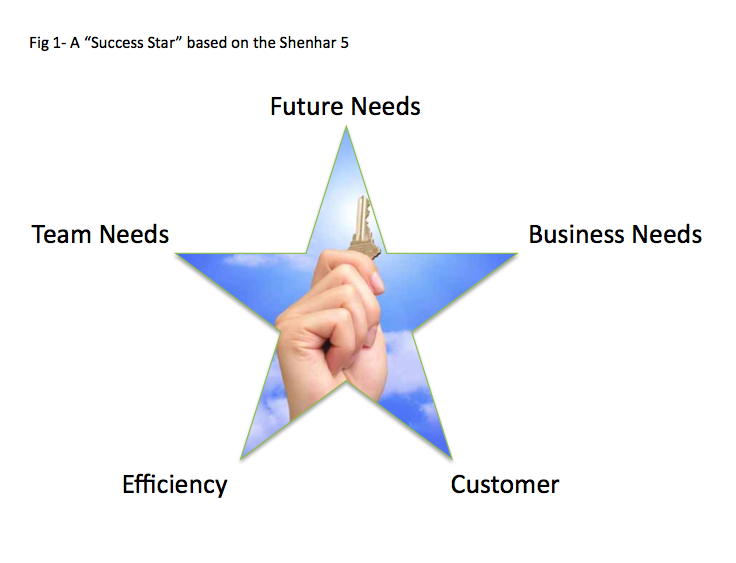 If you look at Figure 1, I've used Shenhar's five success criteria as the points on the star, meaning these are the five things that must be balanced in order to have a successful project. Remember the triple constraint elements are all captured in the "efficiency" point here. So the "technical" success of the project is just one element among five you need to be aware of.
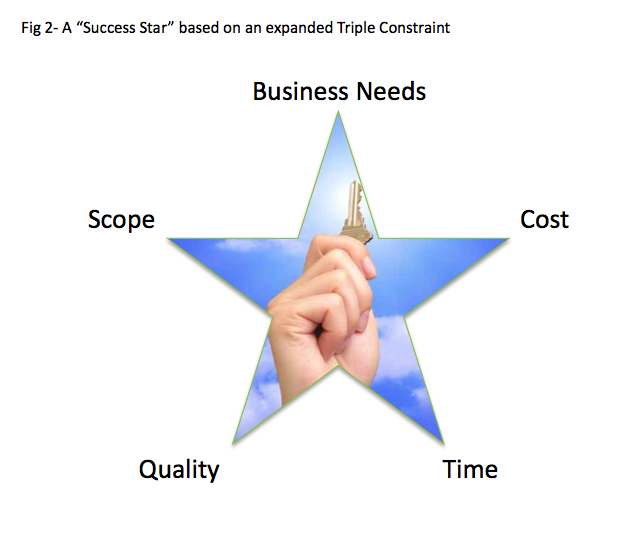 In some you comments, I felt like the was the feeling that the triple constraint was good, but it was missing a "business value" or "business needs" point. I believe some said that "quality" could be too defect focused and didn't necessarily capture all of the business impacts, the ROI, the strategic impact at a given point in time, future needs, etc. So I threw together the version in Figure 2, simply moving quality out to a point and adding business needs as another. I'm not saying this is a solution and one argument against it is obvious - since the new elements can be generally quantified in terms of cost, they are not valid as separate "constraints". They don't have the same direct "push/pull" going on that the triple constraint has. You could also argue that future needs (whatever requirements they generate) should be part of scope, but then so could requirements related to quality. In some you comments, I felt like the was the feeling that the triple constraint was good, but it was missing a "business value" or "business needs" point. I believe some said that "quality" could be too defect focused and didn't necessarily capture all of the business impacts, the ROI, the strategic impact at a given point in time, future needs, etc. So I threw together the version in Figure 2, simply moving quality out to a point and adding business needs as another. I'm not saying this is a solution and one argument against it is obvious - since the new elements can be generally quantified in terms of cost, they are not valid as separate "constraints". They don't have the same direct "push/pull" going on that the triple constraint has. You could also argue that future needs (whatever requirements they generate) should be part of scope, but then so could requirements related to quality.At any rate, my point was not to say, "here are two solutions - pick one", but rather to generate some interesting conversation. If you accept that the triple constraint is overused as success criteria - what would be better? |
Posted on: June 09, 2008 12:40 PM
| Permalink |
Comments (20)
Can You "Create Power" by Focusing on the Big PIcture?
Situation: You want to be more influential in your PM role. In my last posting, I discussed the Triple Constraint and whether its a good success standard or even a good focal point for project managers today. In this posting, I wanted to touch on a follow-on concept that Aaron Shenhar described in his PMI Chapter presentation. He said that "Project Managers have a terrific opportunity to Create Power by focusing on higher level issues versus technical project success". In my last posting, I discussed the Triple Constraint and whether its a good success standard or even a good focal point for project managers today. In this posting, I wanted to touch on a follow-on concept that Aaron Shenhar described in his PMI Chapter presentation. He said that "Project Managers have a terrific opportunity to Create Power by focusing on higher level issues versus technical project success". PM as Strategist He said that if PMs focus on creating competitive advantage by thoroughly understanding that aspect of the project and keeping the project focused on achieving that advantage - they are more likely to acheive real success. PM as Visionary He also said that "spirit" is important in that the PM must create excitement by articulating a clear view of the future - effectively a "project vision". I would say that to put this into action you need: - To be sure your project is a "competitive advantage" project. - To have your head high enough above the weeds to clearly see the big picture and completely understand the competitive advantage. (Investing a significant amount of time with upper management both in the beginning and throughout the project. - Ensure you have the right sponsor. What other things are key to making this work? |
Posted on: May 24, 2008 03:34 PM
| Permalink |
Comments (0)
Is the Triple Constraint the WRONG way to Define Success?
| Situation: You want to take a broader view of managing projects. My new favorite author spoke at our local PMI chapter meeting last night. Aaron Shenhar's book, Reinventing Project Management gives you a LOT of food for thought, but I think that one of his points is truly a breakthrough concept in our field. It cuts to the core of why there is so much controversy around PMBOK-based approaches and Agile approaches. In his presentation, given mostly to PMPs mind you, he says, "PMI has given us a great foundation. However, it's time to leave that foundation and go to the next level."  During his talk, he described a number of reasons why the standard approach to projects must change. A lot of it sounded rather "Agile" in nature. For instance, he talked about the Triple Constraint theory as being a key impediment to successfully delivering projects - because it incorrectly defines the success criteria. He said, success should not be defined just in terms of Scope, Cost, and Time - which are strictly efficiency-based. The focus should be more on business results and customer satisfaction. During his talk, he described a number of reasons why the standard approach to projects must change. A lot of it sounded rather "Agile" in nature. For instance, he talked about the Triple Constraint theory as being a key impediment to successfully delivering projects - because it incorrectly defines the success criteria. He said, success should not be defined just in terms of Scope, Cost, and Time - which are strictly efficiency-based. The focus should be more on business results and customer satisfaction.His definition of success is broken down into the following categories: - Efficiency (criteria similar to the triple constraint) - Customer (criteria = customer satisfiers) - Team (criteria = customer satisfiers) - Business Needs (criteria = things like ROI, strategic fit, and competitive advantage) - Future Needs (criteria = future value, like in the case of new technology where much of the value is yet to be defined)  His theory (he describes it as 'project manager as mini-CEO') is "If you approach projects with this broader set of success criteria, you will be a better project manager, because the results will be better." It's hard to argue with that. His theory (he describes it as 'project manager as mini-CEO') is "If you approach projects with this broader set of success criteria, you will be a better project manager, because the results will be better." It's hard to argue with that. It feels to me like he is calling for us to combine what PMI is starting to address separately as leadership skills with the PM approach in general. How do you define project success? If the Triple Constraint good the way it is or should some of these higher level issues always be considered when managing projects? |
Posted on: May 21, 2008 01:52 PM
| Permalink |
Comments (41)
Scrappy Project Management
Situation: You're tired of guiding new PMs with templates. Kim Wiefling is a scrappy project manager - no doubt about it. Whether you're listening to a voice mail from her, reading an email she sent, or browsing through her book. She's the kind of person that calls it like it is - and that's what I like about her book, Scrappy Project Management. Kim Wiefling is a scrappy project manager - no doubt about it. Whether you're listening to a voice mail from her, reading an email she sent, or browsing through her book. She's the kind of person that calls it like it is - and that's what I like about her book, Scrappy Project Management.It's not about templates or process (not that I have anything against those). Each chapter focuses on a rookie mistake that every new PM makes before they have enough experience to set them straight. Here's a list of the chapter titles:
I know, I know - but it's worth a shot... |
Posted on: May 12, 2008 05:17 PM
| Permalink |
Comments (1)
What Really Makes You a Leader?
| Situation: You're in a mood to Show off your leadership skills... There are LOTS of great discussions happening right now in the new Leadership GIG. As a part of that, I thought it would be interesting to get your opinion on what is the most important predictor of leadership potential. If you have a moment now, just click on the graphic below to tell everyone what you think. 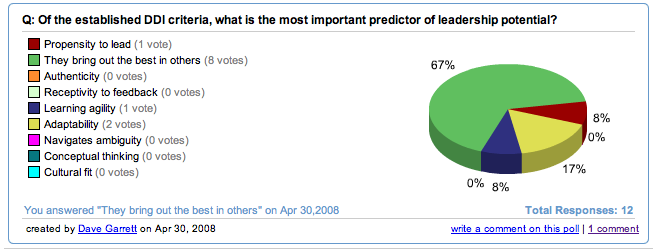 |
Posted on: May 12, 2008 11:42 AM
| Permalink |
Comments (6)


