


The Matchmaker
Categories:
Business
Categories: Business


|
How do you pick your project manager for the job? Depending on the domain knowledge and skillset that the individual has? Using some scheduling approaches like round-robin and first-come-first-serve? Or simply based on whoever is available? Regardless of what approach you use, just make sure you don’t leave it all to the computer to handle it as the matchmaking job is more of an art than a routine that can be defined scientifically. There are no fixed rules on 'how to select project manager’, but there are a few pointers below that may help you to get started with.
|
 As a manager of a project management office, I often find myself doing the matchmaker’s job. The difference is I don’t play cupid for couples, instead I match up project managers with projects. Easy job for the money you would say. Not necessary. A wrong decision made would have a good project ruined or even the reputation of a promising project manager crushed. Just like the sacred duty of the matchmaker who ties the nuptial knot and toys with the fate of two fine souls, the task of project manager selection and assignment carries a lot of weight and responsibility in itself blessed with trust, hope and expectation of the stakeholders. It is not something mundane and easy as many of us would have believed and we should not take it too casually.
Good Job, Well Done!
Categories:
Business
Categories: Business
| Boss: “Good job, well done!” Employee: “Dear Boss, don’t we deserve something better than these bland and over-clichéd compliments?”
I have to agree with my colleague. In fact, we have to be more cautious and sensitive when we are giving our compliments and feedback as our team deserves it. Don't do it for the sake of doing it. The problem with many of us is we are too busy (a bad excuse for being lazy) and tend to take whatever convenient as a quick response without giving much thought on the repercussion. We keep doing this so often that it has become a bad habit unknowingly. Fair enough, people will just become immune and don’t give a damn when they have had enough of those craps. I believe people will feel more appreciated if we are a little bit more specific and elaborative in our feedback. For example, instead of just saying “Well done!” plainly, we could try saying “You have done a marvelous job in cutting down the cost by 20% and yet, able to complete the project in time without overworking the team.” See the difference? Be more appreciative with what the team has done for you. A little retouch on the feedback like the previous example works magic. It not only shows your gratitude sincerely, but also helps the person to know exactly what he or she has done well. Another interesting pattern that I have observed is people like to be the ‘good guy’ or ‘Mr. Nice’. We enjoy being ‘accepted’ and being ‘liked’ at work. Who’s not? As a result, we tend to only talk about the good things that people have done but reluctant to point out their faults (office politics is an exception). This is not healthy. A good and balanced feedback should consist of both positive and negative elements that help to reinforce our learning. As much as we would like to praise people, we should also provide constructive advices on what they have done wrong and how they could do better. This is exactly what we should do in the project closure meeting. As Matthew Syed, the author of “Bounce”, wrote – “We need to know where we are going wrong if we are going to improve… Feedback is, in effect, the rocket fuel that propels the acquisition of knowledge, and without it no amount of practice is going to get you there.” So make it a point that you will remember to be ‘negative’ in order to be constructive when you are giving your feedback to someone next time. To those leaders and bosses out there, if you are still sending out crappy compliments, then here is the good news – “Good job, well done and you are not the only one.” |
 I am not sure about you, but I have received a lot of these craps since my first job and, to be honest, I was responsible for sending out a handful of them too. Don’t get me wrong. There is nothing wrong to praise or encourage someone after he or she has done something great. In fact, you often need to do that to keep people motivated. The objective is good. It is what being said that ruins the game. With all due respect, I think it is pure laziness or simply ignorant of the situation that causes bosses to send out such unimpressive compliments. Imagine how the employees would feel when they have already received the same “well done” the N number of times. Some would have just moved on without thinking too much on these tasteless words, while there are those who would have taken it with a pinch of salt and doubted the sincerity of the act. For the worst of it, some might have even taken it as an insult for the hard work they have put in. I have a colleague that once asked me – “If everyone keeps telling me that I have been doing a wonderful job out there, then why ain’t I getting my well-deserved promotion?”
From Guesstimate to Estimate
Categories:
Business
Categories: Business
|
During the early stage of project initiatives screening, we want to provide senior management with cost estimate that is as accurate as possible to avoid overestimation that often results in the project being dropped or underestimation that causes overblown of budget during project execution. The fact is we can’t provide accurate estimate on the cost if the information we have in hands is limited. Yet, it is not justifiable for us to invest too much time and effort into gathering information that we need for cost estimation if the project has not been approved. Isn’t this ironical? I believe many of you should have encountered this awkward Catch-22 experience before while managing your projects. Below are a few tips to help you to get along if you are caught in a similar situation again.
|
 A junior project coordinator in my team raised this question some time back –
RACI Chart Battle
Categories:
Politics
Categories: Politics
|
RACI chart, in general, describes the participation by various roles in completing tasks or deliverables for a project; nothing more, nothing less. However, most of us are pretty lousy when it comes to using the RACI chart correctly. I am not sure since when we have become so ‘RACIst’. It did not happen overnight for sure. Like it or not, we have long been abusing the use of RACI chart. We are using it more for defining political boundaries than as a tool for clarifying roles and responsibilities. A RACI chart, to us, is a power map – one that defines who are in control and who are being controlled. It defines the territories each marked in different color and alphabet. As a result, we have to struggle through the ‘RACI chart battle’ every now and then due to this aberrant ‘RACIsm’ in us. The RACI Chart Battle Most people vie for the ‘A’ in every task as it symbolizes authority and control. They want the authority to approve as many tasks as possible yet, most often than not, they have all forgotten about the accountability part of it. The fights on this piece are the most intense. Each ‘A’ won is a critical map pin that can help them to extend their political boundaries. The more map pins the merrier, nothing else matters. On the other hand, people are also trying their best to push away the ‘R’ assignments. They see the 'R' as bane that belongs to no one else but the pathetic scapegoats. It is easy to pay lip service, but when it comes to actually doing the job, nobody really likes to be held responsible for it. This is partly due to the fact that people that are responsible to get the job done are usually not given the right or sufficient authority that is required for the execution. Then there is this ‘egocentric’ group. They want to have a say and their voices to be heard in every single meeting and discussion. They aim for the ‘C’ in every task and want you to seek their advices in everything you do. Attention is what they want to get from you. As the saying goes, ‘too many cooks spoil the broth’. In fact, if you have to consult a long list of people before arriving at a decision in your project, you would probably have a hard time in getting things done efficiently. Last but not least, we have the Kiasu group. They are the nosy type who afraid of being ‘kept in the dark’. Although they have nothing to do with anything, they often demand others to keep them in the loop of everything. People in this group have huge appetites for reports. You should not be surprised to find them subscribed to hundreds of newsletters but hardly read one. To them, information is power, relevant or not is the least of their concerns. They feel insecure and get panicky if they are out of the loop. Apart from the bloodshed, the battle usually leaves us with a useless RACI chart that is full of wrong and redundant responsibility assignments. Time wasted and relationships worsened. What do we gain here? Battles like this have plagued many projects in the past. It is time for us to put things back in the right perspective by reestablishing RACI chart back to its original form and let it be what it should be. If you have not been through a RACI chart battle yet, then well, congratulations! However, if you have gone through one or participated and contributed in some of those battles, you should seriously consider pulling yourself out. Do your homework and use RACI chart correctly for the right purpose. Stop being a ‘RACIst’! |
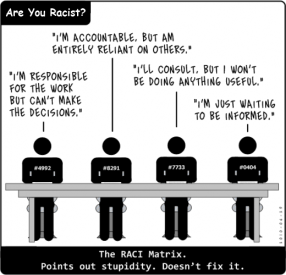 On a gloomy Monday morning in October, in a prison cell-like conference room in northern part of Singapore, a group of people gathered around a whiteboard each with a marker pen of different color in their hands. Their expressions were deadpan. Their eyes fixated on a
Customers First?
Categories:
Culture
Categories: Culture
|
“No, employees first, customers second!” heralded Vineet Nayar, Vice Chairman and CEO of HCL Technologies, as he kicked off the seminar in Singapore in February 2011. Vineet was there to talk about how value is created in the new knowledge economy and how organizations leveraging information technology across industries can be transformed through disruptive management. This, according to Vineet, builds on top of the philosophy of “Employees First, Customers Second” (EFCS), an innovative management approach that empowers employees, drives passion in them, encouraging individuality and entrepreneurship, and moves the organization forward. Watching Vineet sashaying across the stage, passionately telling stories and giving examples to explain the philosophy of EFSC while characteristically waving his hands in the air to reinforce some of his points, was a great enjoyment. However, I wonder how many people in the audience are ready to embrace such radical management practices of confronting the truth, building trust through transparency, inverting the management pyramid by empowering the employees, and shifting the responsibility of change from top to bottom. “Oh, wait a minute Vineet. Are you telling us to value someone that we are paying money to more than someone we are getting money from? This sounds crazy!” I heard a murmur in the audience. I must admit that I do have some reservations about the effectiveness of EFCS when I first heard about it. Let’s face it, the thought of ‘Customers First’ is so deeply ingrained in us that most people find it hard to shake off. It is just so common sense. What so good about giving the employees all the focus while paying less attention to the customers? How can this benefit the organization? We know that having a team of talents is half a battle won in this new knowledge economy, but placing them ahead of our valuable customers is another story altogether. Yet, the gargantuan success and growth of HCL Technologies over the past six years since the introduction of EFCS in 2005 is definitely not accidental. As I explored further into this, I started to see some light from another direction. Let’s turn the table around and ask the question ‘What could be bad about putting Customers First?’ instead. In general, it is perfectly alright to have a customer-centric culture where the focus is on serving the customers well with their needs as top priorities. Things turn bad when people start worshipping the customers and treating them like kings. In such a culture, the employees will do everything to please the customers and satisfy their needs blindly regardless of whether there is real value in doing it. They behave like seamstresses who sew according to instructions instead of couturieres who design for the haute couture. In other words, they have given up the freedom to be creative and the opportunity to lead. Eventually, they are likely to end up as one of the followings.
I have collaborated with HCL Technologies in a couple of projects over the past few years. I wouldn’t say that they are flawless in their EFCS implementation, but at least they have a lot lesser employees that behave like the three types mentioned above compare to other vendors. On the contrary, I am fortunate to have worked with a few great people in HCLT who accept responsibility and take ownership with pride and step up and lead when the situation calls for it. “Employees First, Customers Second”, to me, is no longer just an interesting catch phrase. I am witnessing it in effect. |
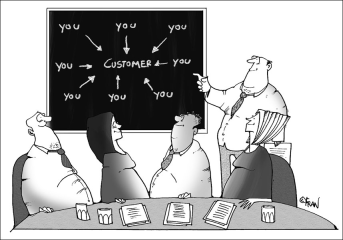 Our minds have been infested by the adage ‘Customers First’ since the day we stepped into the society. We hardly doubted its truth. It is obvious, isn’t it? A company exists to serve the customers well so as to sell services or products to them in return for some profits. In order to achieve this grandiose objective, they have to put their customers in the first place isn’t it?

