


Abracadabra!
Categories:
Culture
Categories: Culture


|
Change should be like magic. I love magic. I always marvel at the uncanny ability of magicians to pull a rabbit out of their empty hats. Do they have supernatural powers? “Abracadabra! And there you go.”, the magician has moved the coin from your pocket into his hand. The change was so swift that you didn’t even notice it had actually occurred. Isn’t this the best performing art of change? Magicians are just normal people like us, but trained to read and manipulate human minds. They are the masters of deception and illusion. Their magic is nothing more than a series of finely honed actions crafted through in-depth understanding of human psychology. They exploit the weaknesses in human brain to create the illusion of performing the impossible. These days, even neuroscientists and psychologists have shown great interest in the tricks of the mind which have provided them useful insight into how the brain works. In general, there are three critical psychological techniques commonly used by magicians in their magic, and they are – misdirection, illusion and forcing (you may read more on these techniques in this article). Are we able to exploit these techniques in change management? Below are some of my suggestions to accomplish this.
|
 If you think that the best approach to implement change is a top-down-force-it-through authoritarian approach, then you are wrong. You don’t force people to change; you help them to change and make the process more enjoyable for them. If you believe that the best way to help people to progress through change is through communication, then you are again wrong. I am not saying that we do not need communication. In fact, substantial amount of communication is good to keep people aligned with the activities going on. However, over-communicating or hard-selling may have negative impact on the change implementation itself. Imagine if I keep telling you that there is a big change coming your way and you have to prepare for this and that, no doubt, I am prepping you up for the change but at the same time, I am also instilling fear in you subconsciously. In fact, I am amplifying the fear of change and giving you extra stress unnecessarily. Some people might argue that communication is the key to keep people out of the dark in any change implementation. Yes, I agree. I just don’t like those that have gone to the extreme in propagandizing it. In reality, the opposite is true – the best form of change takes place without people even noticing it.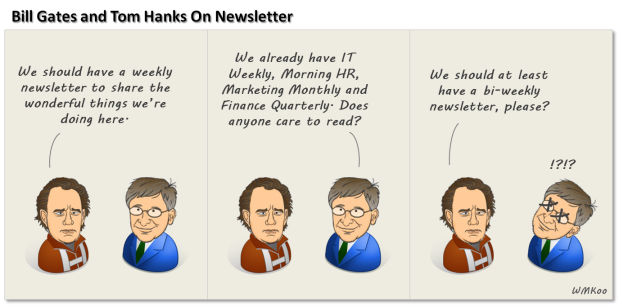
Suck it, Poke it!
Categories:
Culture
Categories: Culture
|
Yes ‘suck it, poke it’, this is exactly what we should do when we push out changes in organizations. It is very common for us to encounter resistance and push-back in change implementation. When we bump into a wall, we should take a step back and try a different approach instead of keep charging at it with brute force. Just like the way we insert a straw into a packet of drink, we may have to ‘suck up’ to the resistance force first before we ‘poke it’ to forge the changes required. What is the point of winning a battle but losing a war? There is a Chinese proverb “Yi Tui Wei Jin” that says ‘retreat in order to advance’. Sometimes, we just have to do that. It is natural for people to put up a defense wall immediately if you were to foray into their territories and try to overthrow their strongly-held beliefs and dismantle their long-practiced processes. No one likes changes. People hate to have their comfort zones disrupted. It just gets worse if there is any sentimental attachment in those things that you are taking away from them. Imagine yourself as an evangelist that embarks on a missionary trip to preach Christianity to an aboriginal tribe. If you try to force the concept of Christianity down their throats, you will probably find yourself tied to a tree the next day. You are setting yourself up for failure if you are moving in with a mindset to change people. No, you don’t change people; you help them to change instead. In order to achieve that, you must first become part of them. There is an old saying “When in Rome, do as the Romans do.” Indeed very true. Insinuate yourself into the native tribe and be one of them. Nothing works better than being on the same side of the court. Psychologically, you will be able to lower down their defense and gain their trust. I am not saying that you have to change your job or move your office in order to blend into group. But what you do need, at a minimum, is a sympathetic ear that is able to empathize with the plight of others. Build trust, influence and lead. Build trust by showing that you understand their problems and care for their well-being. Many a time, people just need a channel for them to voice out their opinions. They want to be heard. Establish that channel. People will trust you more as they share more with you. It is like a self-reinforcing addiction. Once you have gained their trust, people will start to open up to you. They will be more willing to listen and accept your opinions. This is the right moment for you to extend your influence on them. You may make use of this opportunity to explain to them what they need to know and how the change will benefit them. Start slowly. Pace yourself well so that you do not impose too much pressure initially. Remember, you are there to help them to change and not force them to change. Once people have understood your intention and trust that you can help them, you may move on to lead them through the change. Share with them your vision, roadmap, what they need to do and how to do it together with you to achieve the ultimate goal. Change, is all about the people you are dealing with… |
 I believe many of us have this experience where we tried to poke a straw into a packet of drink but no matter how careful we were, the drink just spilled out from the opening. For those who still unable to figure out the reason, this is due to the change in air pressure inside the packet of drink causes by the action of poking a straw into it. I have found out a way to minimize the amount of spill by first sucking through the straw while poking it gently into the packet which surprisingly able to keep the air pressure in balance, thereby preventing the spill.
When Failure is Good
Categories:
Business
Categories: Business
|
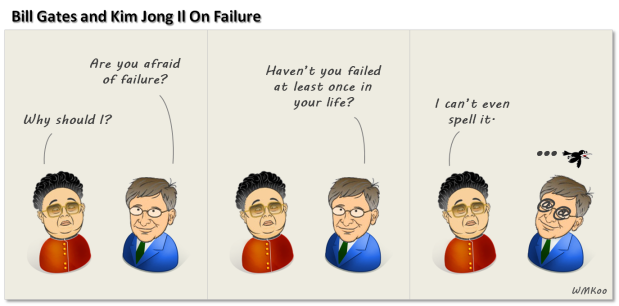
Failure? Fret not. Most people take failure as something bad. Disappointments, blames, bad reputation etc., you know? Sometimes, the fear of failure is so immense that people have stopped trying. Try talking to a perfectionist and you will realize that he has zero tolerance even for the slightest blemish in his work. As a result, people have put in a lot of time and effort trying to prevent failure from happening. On the contrary, very little attention is given to managing failure recovery which, in my opinion, is equally important. Since young, we have been taught that the best way to solve a problem is to prevent it from occurring. Trust me, I know that. But, this does not give us a reason to neglect the recovery part. In fact, in most situations, there is no way for us to ensure 100% error-free or guaranteed success. Think about managing projects. No one can guarantee right from the beginning that the project will be successful without any hiccups along the way. The same applies to software development. Realistically, it is almost impossible to find a piece of software without any bug. So why are we draining ourselves in an elusive dream? Isn’t it better if we invest more time to prepare ourselves in order to bounce back faster and stronger from a failure? This is especially crucial if you are running a service delivery operation. When a service is down, customers sulk over it while the support team scramble in panic to get it fixed. Very often, it is how fast you are able to recover from a service failure that determines if your customers are going to stick around with you for a few more years. I came across this interesting Service Recovery Paradox that states that with a highly effective service recovery, a service or product failure offers a chance to achieve higher satisfaction ratings from customers than if the failure had never happened. It got me thinking for a while and then came an epiphany. Perhaps, if we handle a negative situation positively, we may turn a service failure into an opportunity to improve customer satisfaction and build better relationships. It is not necessary that we always have to end up taking blames from the customers only. We may actually capitalize on failure. Yes, failure can be good. It gives us an opportunity to do better. It forces us out of our comfy chair to review what we have been doing so far and improve on it. We learn from each failure and become wiser and now, we may even make our customers happier. So next time when a service failure hits, remember to think about how you can swing it to your advantage. “Yes, I may trip, but I shall not fall.” I smiled to myself. |
The Boss Who Cries Wolf
Categories:
Philosophy
Categories: Philosophy
|
My ex-boss is a nice guy. He is just a bit of arrogant, impatient, hot-tempered, aggressive, and demanding. Just a little. A typical ENTJ type I would say. And he has a problem. My ex-boss likes to “cry wolf”. Well, not really crying wolf per se. Given the interesting combination of impatient and demanding in his personality, he has gone to the extreme in his requests. All his requests are urgent and top in priority. When he needs something, he wants it done yesterday. Sounds familiar? Each time my ex-boss ”cried wolf” on something urgent, I took it seriously initially, just like the villagers who have helped the shepherd boy. Sometimes, I even went all the way to burn my nights just to complete the job in order to meet his deadline. But soon after I have learned that his definition of urgent is nothing more than a meaningless adjective, I started to pay less attention to his cries and take things slowly. I believe I don’t have to go into detail to describe how bad the situation was when the real wolf visited us one fine day. I am very sure that my ex-boss is not an isolated unique example. In fact he belongs to a class of people that personify the Kiasu syndrome. You may have already spotted the shadows of your want-it-all sponsor and want-it-free customer here. It is not that they do not know what are important; they just can’t tell what are less important. This is reflected in their behavior that they want everything fast, immediate, and now! Call it kiasu, paranoid, or whatever. People in this class have lost their grip on prioritization. They feel comfortable when they are in control. This is why they want everything to be done not today, but yesterday so that they can have bigger buffer (their comfort zone) to work with. The downside? An exhausted and confused team who will never able to understand what their boss needs. The worst thing is people may start to treat all these so-called urgent requests as ‘false alarms’ and ignore them altogether eventually. In the long run, this will be a lose-lose situation for both the boss and the team. In a similar way, the anguished villagers had punished the shepherd boy by ignoring his fatal cry when the real wolf eventually paid a visit to his flock. We don’t necessary have to end up this way. The tragedy could have been prevented if someone has taken the initiative to talk to or warn the shepherd boy regarding his intolerable ‘false alarm’ behavior that has caused much distress to the villagers. Have you spoken to your boss, sponsor or customer on their intolerable kiasu behavior? If not, what is holding you back? |
 Remember this story – “
Together Everyone Achieves More
Categories:
Philosophy
Categories: Philosophy
|
Vince Lombardi once said – “The achievements of an organization are the results of the combined effort of each individual.” Sure enough, we all understand the importance of teamwork. Just like we know we can’t grab a ball with one finger, we need all our fingers to do that. However, gathering people into a group is easy; getting them to work together is another thing. Issues related to team dynamics and equity will swarm over and break the team in no time if not managed properly. The key challenge for good teamwork is therefore, well, how to make the team work as a team. No wonder it wasn’t coincidental for Henry Ford to say “Coming together is a beginning. Keeping together is progress. Working together is success.” We’ve heard enough of teamwork. So, what’s the problem? Maybe, let’s try to take a look at it from the perspective of a fable – “The Belly and the Members”. The moral of the fable is we should never overlook or undervalue the effort and contribution of any member in the team no matter how big or small the role the person plays. It may appear that the belly in the fable is doing nothing other than indulging itself in food while letting other parts of the body doing all the hard work. However, without the belly to consume the food, the body and the other parts of it will soon become too weak to function properly. Just like a linchpin may be small, but it is the only thing that keeps the wheels together. We have seen the replays of the conflict between the belly and the body parts in real life. What can we do so that Together Everyone Achieves More as a TEAM? Below are some suggestions that may help you to improve the situation.
|
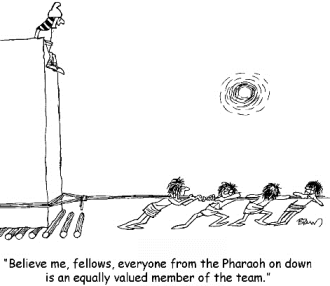 Have you ever been questioned, or even challenged, on why some members in the project team, albeit contributing less, are sharing the same glorious achievement of the team? Or do you have to deal with some smart alecks with heads so BIG that they refuse to work with the average Joes in a team? If you do, welcome to team management.

