


Authorized Accountability
Categories:
Education
Categories: Education


And so it goes on and on… The above is a series of common breaking points that may lead to unfortunate project failures. You started to ask yourself if you could possibly prevent them from happening. It is not easy, you admitted. Yet, you are still expected to sail past them in all the projects you handle. This is because when a project fails, it is always the project manager’s fault. To many people, this statement holds true regardless of whatever creative reasons you can come up with to explain for yourself. Blame it on the project manager if the project fails. You have seen how a project manager was blamed for a project disaster when the actual problem lies with an incompetent vendor. You have also witnessed how a project manager was parachuted as a scapegoat to salvage a doomed project. There is a protesting voice inside you crying “It’s unfair!” But as a project manager, your job is to listen, understand and execute effectively to ensure you deliver the project that meets the stakeholders’ expectation. No wonder your mum has been warning you that project management is the most stressful job in the world. Damn it, you regretted not taking her advice. Now back to the key question – “Should a project manager be fully accountable for the success or failure of a project?” I can spot a few raised hands. In my opinion, the answer is ‘Yes’ but it depends. You can’t simply make someone accountable for something that he or she does not have the authority to work on. Forget about the question on fairness for a moment, the lack of authority will mean that the project manager has to grope across the political minefield barefooted. You don’t need an economist to tell you the survival rate for this. In general, it is easy for us to push all the responsibilities and accountabilities to the project manager. But without the right authority, there is very little thing the project manager can do. He will not have any decision-making power, not given any budget, and probably don’t even have any control over his own team. It is like sending a general into a battle without an army backing him up. Therefore, it is imperative for project managers to be given the necessary authority to run their shows. Unfortunately, most organizations failed to realize and understand this. If I were to add on one more breaking point to the series above, it will be –
|

Ego Elephants
Categories:
Culture
Categories: Culture
| I like the way King George was introduced to Jack Sparrow in the movie Pirates of the Caribbean 4. He was introduced as ‘George Augustus, Duke of Brunswick-Luneburg, Archtreasurer and Prince-elector of the Holy Roman Empire, King of Great Britain and Ireland’. Wow, what a lengthy title and definitely one that is not easy to remember. While I was counting the number of characters in the title, I recalled a question that a colleague of mine asked some time ago – ‘Is the length of a person’s title related to the importance of the work he is doing?’ In my opinion, the straightforward answer is ‘No’. But if this is indeed the answer, then what could have possibly motivated people to create long and fanciful titles which are hard to remember? The closest explanation probably lies in a three-letter word – ‘ego’.
They vary in size. Some of them are much larger than the others. Most of the time, they are innocuous and stay dormant just like any other elephants. But the truth is, they lurk in the dark, waiting for the right moment, the provocative words or the insidious remarks, to spring into action; and when that happens, nothing can stop them, not even you. They march on, seizing over the control while leaving you paralyzed under their feet. You look so vulnerable in the stampede. And yes, this is nothing new to you. It has happened so many times in the past despite your silent protests. You bring them with you wherever you go; to the weekly project interrogation party or your favorite postmortem debate. In most of these internecine dogfights, it seems like the person with the largest ego elephant usually wins. Not that they are strong, but they are just too stubborn to admit that they are wrong. In order to reward them for their hard-fought victories, you feed them with flatteries, something that accelerates their growth. As they grow bigger and stronger, they start to obscure your vision and block your thought, which in turn makes them harder to be controlled. This is a vicious cycle. In no time, they will grow so big that you will have to take them out and hang them on your nose. How can you manage ego elephants?
You do not measure leadership by the number of medals that hang in front of your chest (that’s ego); you measure leadership by the impact you have on the people that follow behind you. |
 There is an
Taming Black Swans
Categories:
Business
Categories: Business
| I have a customer who shared with me an ‘unexpected’ and unforgettable experience that he had that almost ruined his career. A few years back, he engaged a vendor to develop a web application that was meant to be used by internal employees. Everything went fine and they had gone through the UAT smoothly. The shocking news came in on the eve of the go-live day that the key engineer working on the project had met with an accident and was unavailable to work on the migration for the application from staging to production server. Eventually, the go-live date had to be pushed back a month to allow the vendor to find a replacement and conduct essential knowledge transfer. My poor customer had to write a long report to explain this ‘unexpected’ hiccup to his management. I believe most of you have been through similar ‘unexpected’ situations that caught you totally off-guard. You might have anticipated, predicted and planned for whatever you and your team can think of and yet, you would still miss out one or two critical items that pounced back on you when you turned the corner. We deal with two types of risk in projects, the known and the unknown risks. What I have been talking about so far are the unknown ones which usually jump up and haunt us in our most unprepared circumstances.
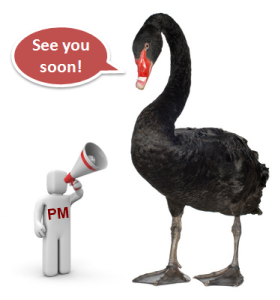
Can you imagine one of those black swans above paying you a visit in your project? You would probably dismiss this thought with a sneer as you are confident that it is highly improbable for the black swans to occur. The problem with us is we put too much emphasis on things we already know and give very little attention to things we don't know. In some cases, we even overestimated ourselves by thinking that we know something that we actually don’t, thereby creating a false sense of reality. This is obviously a key weakness in managing project risks which explains why the black swans always manage to catch us unprepared. Below are some tips that may help you to survive through the black swan events:
In short, the key to tame the black swans is not to try to predict them, but to build robustness into your projects and prepare your team to expect the unexpected. As Taleb has nicely explained – “It's like saying a bridge is fragile. I can't predict which truck is going to break it, so I have to look at it more in a structural form and reinforce its weak points.” |
 In his book “
Whore of Fame
Categories:
Philosophy
Categories: Philosophy
| Warning: The following content may sound crude and rude and contains offensive words that are not for the faint of heart. Do accept my apology if you feel offended.
“Developers are like whores. The older you get the less market value you have. In order to get out of this lowest rung in the industry, you need to study the pimp book (PMBOK) by hard and get yourself certified as a pimp (PMP) so that you can, in turn, manage the whores.” Laugh as you may, but this was the common mindset that the majority of developers had back in the early 2000s. It might not be the same in other parts of the world, but at least in the place where I belong, this was the case. I am not sure what could be the real reason, but the post Y2K impact, dot-com bubble burst and strong outsourcing and offshoring of IT jobs to India during that period could have contributed and propelled the manifestation of such sentiment in developers in those days. Whatever reason it might be, it was disheartening and discouraging for a young and aspiring developer like me at the moment when my career was just taking off. It got me wondering – Is project management the inevitable path and springboard for developers to move up the career ladder? If not, what are the alternate paths available for developers? Actually, there are quite a number of alternate roles like chief architect, IT manager, business solution manager and consultant etc. that developers may work towards. In fact, the options are plenty. The important point is not so much on what are available out there, but what you have in you that make a difference. Aristotle once said – “We are what we repeatedly do. Excellence, then, is not an act, but a habit”. As an individual, we have to keep challenging ourselves on what we can contribute and what impact we can make, which in turn justifies our value to the organization. In fact, in his top-selling book “The World Is Flat” (published around the same period), Thomas Friedman actually encouraged fellow American workers to keep upgrading their skills and focus on creating value through leadership and creativity in order to stay competitive and adapt to the challenges in the new economy. Always remember, there are many paths to fame but the choice is yours. What have you been doing to help yourself rise up to the ‘whore of fame’? |
 In the early days of my career, I once heard an elder colleague of mine jokingly lamenting about his bleak future of being a developer. This was what he said,
Unnecessary Necessities
Categories:
Business
Categories: Business
|
I was invited to a meeting to discuss a new change request process. Half way through the meeting, a colleague of mine raised a comment that the existing change request form is too complicated and takes a lot of time to fill in. When being asked if all those fields in the form are indeed necessary, the host of the meeting replied – “Yes, they are mandatory”. Why do we need so many mandatory fields in a form? After a few more rounds of investigative questioning, we found out that Microsoft Excel was the culprit. It happened that someone at the top wanted a report on the volume and status of change requests to be generated out on a monthly basis. Unfortunately, the data need to be categorized before the sleek charts and pivot tables can be plotted in MS Excel. Here we go. This was the reason why those mandatory fields were added – to provide categorization for the data. What a ‘fantastic’ reason? When grilled further on whether those mandatory fields were ever fully utilized to provide meaningful information, the host simply replied that he was not sure as those fields were added by other people many years back. Great! We felt like the children following the pied piper. Why are we wasting the bulk of our time on things that we hardly use? Should someone regularly review and weed out those unnecessary necessities from the old stale ‘best practices’? I have seen the same phenomenon occurring time and again in projects especially in requirements gathering. How many of you have come across stakeholders who keep demanding for tons of requirements that hardly add any value to the project? Are these unnecessary ‘nice to have’ requirements eroding your budgets and delaying your projects? Are you using any tools like Kano Model or Quality Function Deployment (QFD) to help you categorize and prioritize your project requirements? Do you have a change review board in your project team? If not, what do you do to ensure that the requirements raised by the stakeholders are properly evaluated and validated before investing more time and money on them? Gathering requirements is not easy, but the task of weeding out the unnecessary necessities is even more challenging. |
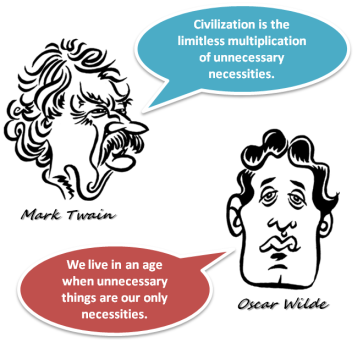 We fill up forms every now and then. We have forms for new project requests, account creation, change requests, leave applications, and even forms for purchasing toilet paper. Have you ever wondered how much time you have spent in your life filling up forms? A

