Adaptability: The Ultimate Skill for Project Leaders?


|
By Jorge Valdés Garciatorres, PMP “If opportunity doesn’t knock, build a door.” —Milton Berle
Experts say that the world will never be as we once knew it. I personally think that it will take us several years to return to some sense of normalcy. We’ll have to accept it: Adaptation is inevitable. As I prepared to write this blog, I was looking for a personal story to illustrate my resilience skills. The truth is that many came to mind. I believe that this ability, along with creativity, is something we all have as project managers. Working from home for the past 15 or 16 weeks (I’m one of the lucky ones who can work remotely during the pandemic) is perhaps the closest example of resilience. In my case, it has required less effort, but the overwhelming response we have had to our Managing Remote Teams program has helped me realize that, although the technology exists, there is still a lag in the ability of many to adapt to this new way of working. Another reflection that came to my mind was that perhaps as project managers, our shifting scope of work causes us to take life as it comes. That is to say, this professional activity that I chose and that I enjoy so much helps those of us who practice it to develop that capacity of hyper-adaptation. For example, life has led me to give courses in parking lots, and on one occasion a few years ago, I almost had to give a course while on the presidential plane for a group of Mexican government officials. I have learned to work at home, where I have a spacious and comfortable office totally adapted to my taste, and I’ve also transitioned to suddenly having to work at a 35 inch x 35 inch desk in a client's facilities. Other reflections come to my mind with regard to the technological changes that people in my generation have experienced. My kids just can’t believe that when I was young, I was my mother’s remote control, and that in my time, the “smart” were the people who used phones—and not the phones themselves. In the end, whether it is a generational skill or whether it is fostered by the career someone chooses, there is no doubt that adapting to changing situations is an important and vital skill in these times. During the "Googleographic" research I did to write this article, I came across this page in which the American Psychological Association, in addition to defining resilience, proposes some activities to help foster it. The literature available on the web around this topic has been increasing. I can also recommend two books, not to be missed, that can help you better understand how resilience can make the difference between success and failure. One story that has marked me in particular, masterfully narrated in the book Desde la Adversidad, that of Ernest Shackleton, a ship captain of about 110 years ago. He went down in history for having formed what is perhaps the most resilient team in history. Another book that I highly recommend is Bonnie St John's Micro-Resilience: Minor Shifts for Major Boosts in Focus, Drive and Energy. I had the opportunity to listen to Bonnie while attending an event a few years ago. Her story is incredible, and an inspiration for everyone. The fruit of her experience is explained very assertively in her excellent book. If you are a project manager or a consultant, chances are that you are already a resilient person. But remember that you must keep exercising your skills to keep them in shape. How do you exercise your resilience?
|

Reinvent, Reimagine, Rewrite, Reemerge—and Rise Up
|
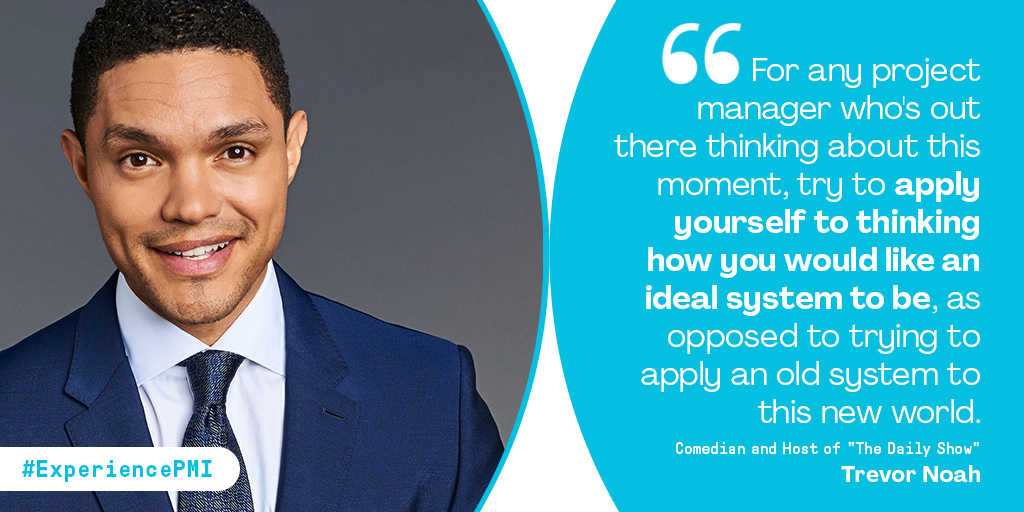
By Cyndee Miller Full disclosure: I’m a big fan of Trevor Noah. But even I was a bit surprised at his eloquence in speaking about managing projects—and what it takes to deliver them. Project skills are life skills that can be applied both professionally and personally, the comedian and author said in the second installment of PMI’s Virtual Experience Series, “Together We Rise.” And those skills are coming in handy in these strange times. Noah said he felt “inspired” by the opportunity to rethink how he does everything. “It’s not often you get an opportunity to completely revamp what you do,” he said. “We cannot ignore the situation we’re in. It would be a disservice to not emerge from this without thinking about better ways of working—of living.” That means abandoning your comfort zone. His approach? “I wake up every day saying this could be the day I get fired,” Noah said. “It makes me appreciate the fact that I’m not. It also makes me ask what else would I be doing?” There are no rules, Noah said. And that opens up new opportunities for people to reinvent ways of working, to rewrite the rules and to reemerge better than before. “For any project manager who’s out there thinking about the moment, try to apply yourself to thinking about how you would like an ideal system to be, as opposed to trying to apply an old system to this new world,” he said. And yes, that includes one of the greatest questions of our Zoom-filled times: Do you really need that meeting? Or can you handle it over a text?
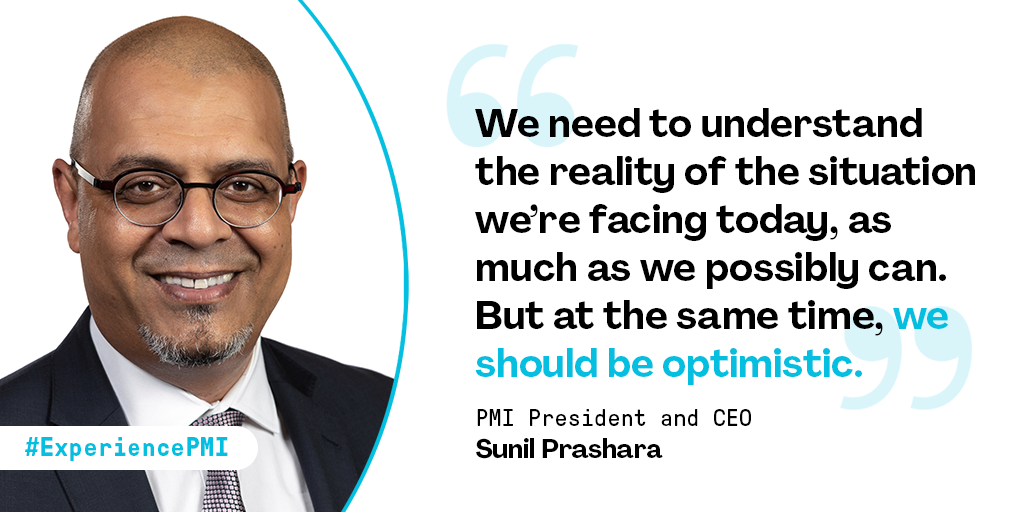
“We are in a situation where we can challenge conventional thinking,” PMI President and CEO Sunil Prashara said in talking with Noah. “Be realistic and optimistic at the same time. That allows you to innovate.” Note: This optimism isn’t the kind of unchecked, unicorn-and-kittens, pie-in-the-sky optimism. Meaningful innovation only happens when it’s based in reality. And right now that reality is intrinsically linked to COVID, which is serving as a catalyst for iteration and the exploration of new systems. The little virus is the ultimate gamechanger. “There’s nothing like a crisis to ignite innovation,” said Shobhna Raghupathy, PMP. That means ditching those old prescriptive ways of thinking and activating a new set of power skills. Adaptability, communication and collaboration are the must-haves in the age of disruption, said Erick Means of CDW. And forget failing fast. You’re still failing, said PMI’s Scott Ambler. Project leaders should instead aim to fail less often, learn faster and succeed earlier.
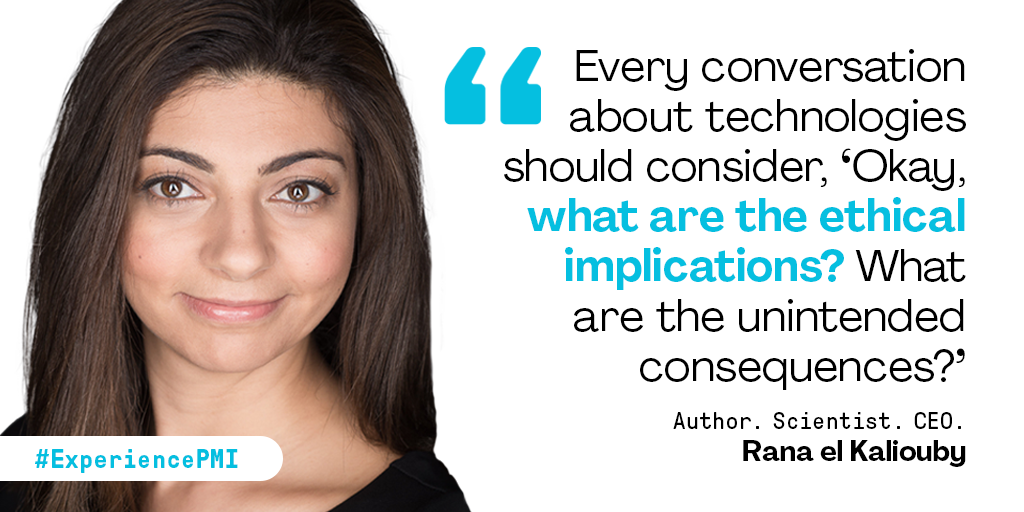
Much of innovation is tied to tech, of course, and project leaders mustn’t ignore the sometimes-sticky ethical issues that will inevitably bubble up. “Every conversation about technologies should consider, ‘Okay, what are the ethical implications? What are the unintended consequences?,’” said Rana el Kaliouby, author and CEO of healthcare Affectiva, an MIT Media Lab spin-off focused on “bringing emotional intelligence to the digital world.” The effects aren’t always what they would appear on the surface. “My biggest concern is not that robots are going to take over—it’s that we’re accidentally building in bias in unintended ways,” said el Kaliouby. The best way to combat that? Build diverse teams of people with different POVs and perspectives. Mark your calendars for the next Experience PMI event on 9 September, when Reddit’s Alexis Ohanian and Lakshyashala Edutech’s Tanya Elizabeth Ken will lead the conversation on entrepreneurship and resilience. I’ll see you there—virtually, of course. I’ll close out the same way PMI started each session throughout the day, with a simple question: What’s the one word you’d use to describe the work you’re doing today? Tell me in the comments below. |
Defining a Standard Methodology and Project Management Metrics
|
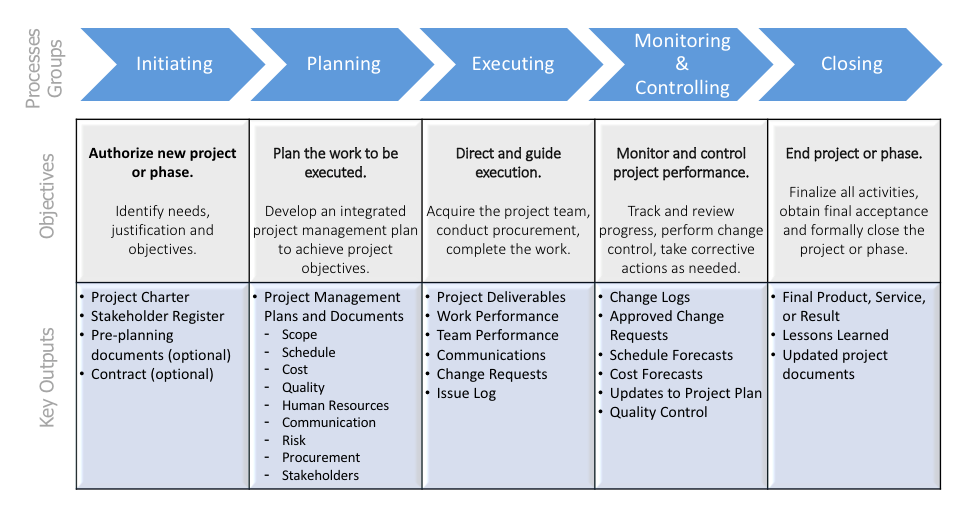
Defining standards and metrics is a key function for the Project Management Office (PMO). In many ways, a PMO is uniquely positioned to provide guidance and orientation in order to build consistency in the application of project management best practices among the projects within an organization. As you can imagine, a standard methodology provides a basis for performance, and metrics provide a basis for the measurement of that performance against the standard. To that end, project management practices can benefit from metrics to establish the depth and extent of applying standards selected by the organization. Here, I will outline the steps in developing good PM methodology for your organization and how to define metrics and key performance indicators. Developing a Project Management Methodology The first step in introducing formal project management processes and practices is the awareness of the starting point (AS IS - current situation). The PMO should scrutinize the organization’s capabilities in the project management environment as a prerequisite for designing the type, depth and comprehensiveness of project management methodology processes and tools. The PMO’s examination of current project management practices involves the following activities:
Bear in mind that project management methodology development is not a simple task. This undertaking requires:
Below you can find a simple structure to guide you in developing a detailed methodology to suit your organization’s needs.
Defining Project Management Metrics The PMO will be involved in determining which metrics are used in the project management environment. Actually, most PMOs are responsible for metrics comprising the various sets of data that represent and quantify either its prescriptive practice guidance or results from its directed measurements. A good set of metrics can be used to:
Some metrics could be:
Defining a standard project management methodology is very important for consistency, helping to improve maturity and increase project success rates. This is a collaborative endeavor and should be led by the PMO, if there is one. What are some of your biggest lessons learned from developing standard methodology or defining project metrics? |

Are You—and Your Career—Ready for a Post-COVID World?
|
By Cyndee Miller Project leaders are no strangers to change. But between a massive shift to remote work and a global recession looming, many wonder what it all means for their careers. These are unprecedented times, no doubt—but previous downturns can help point to a path forward, explains PM Network® columnist Lindsay Scott on a recent episode of Projectified™. She predicts an “extremely competitive” job market, “just as it was back then in 2008 to ’11,” following the economic meltdown known as the Great Recession. That makes networking a must, Scott says, even if it has to be adjusted to the realities of today. With happy hour mixers and conferences IRL likely not happening anytime soon, she offers up a nice hack for virtual events in a recent PM Network® digital exclusive: “Open the chat functionality on the video conferencing software to join real-time conversations during presentations. If you like what you’re reading from others, hop onto conference messaging to let them know and make more formal introductions.” The same goes for speakers: Reach out with a thank you, noting what you enjoyed most about their presentation. “It’s an easy way to warm up the introduction you’ll make later via email or LinkedIn,” Scott says. Here’s where I add a blatant plug for PMI’s Virtual Experience Series and point you to my post about the last event—and remind you there’s another one on 25 August on the theme of The Community: Together We Rise. Beyond virtual networking, now’s the time to take advantage of any extra pockets of downtime to sharpen skills. During the last downturn, Scott said, many project leaders neglected their professional development and were unpleasantly surprised by the underwhelming response they got from HR. So whether it’s checking out free learning resources from PMI or devoting an hour each day to keeping up with trends or prepping for a certification exam, putting in some work now can give you a real career edge. “When it comes to a crowded marketplace with lots of people suddenly looking for work … you want to find some way that you’re going to be able to stand out,” Scott says on Projectified™. And it’s not just about technical chops. The COVID-19 crisis is bringing communication to the fore, she says. It’s always been “a massive part of project management,” but with so many people managing dispersed virtual teams, there are new areas to learn about: “How do we keep people motivated and engaged? How do I make sure that their well-being’s all right? How do I make sure that they’re on track with their deliverables and they’re checking in and all that kind of stuff?” Given the current climate, perhaps the most valuable skill of all will simply be the ability to embrace unrelenting change. “I believe black swan incidents, like Brexit or COVID-19, might become a new normal phenomenon in the future,” says Stephen Xu, PhD, PMP, head of the project management office for business unit infrastructure at Alibaba Group, Hangzhou, China. “That will make strategic agility even more important,” the PMI Future 50 leader told PM Network®. For project leaders with the right skills and the right mindset, career prospects remain bright. “Organizations are still hiring,” Scott told Projectified™. “It’s about understanding what those organizations are and what their particular opportunities are.” How are you making adjustments to your career development during the COVID-19 crisis? Share in the comments below. |

10 Ways to Support Team Members During Trying Times
|
By Peter Tarhanidis, PhD, MBA The COVID-19 pandemic, political and racial division, unemployment and other serious issues are casting enormous shadows across the globe. On top of these stressors, many of us have isolated ourselves from each other in order to lessen the spread of the virus and combat the pandemic. As such, we’ve adopted new behaviors and virtual ways of working to rightfully ensure our health and safety. And yet, these same efforts to maintain connectivity with each other have created more virtual isolation for many of us. Especially for those working in isolation, it is critical to stay connected. While tacit interactions drive human behavior and develop relationships, what can leaders do to re-create and sustain team members’ engagement? Below is a list of ten action items that can help project leaders improve working relationships and performance during these tough times:
What actions would you add to this list to benefit our community and colleagues? |