


What Does It Take to Build a Successful Project Team?
Categories:
Teams
Categories: Teams


| By Lynda Bourne
I was recently involved in a discussion about why some projects fail and others succeed, even when they’re completed in similar circumstances. The most common determinant of project outcomes—both positive and negative—boiled down to the way the people delivering the project work together. A cooperative and committed team underpins success. This led me to think about the key requirements for creating a committed and cooperative team. And while the concepts below aren’t new, consistently creating the environment to allow them to flourish can prove challenging. In my opinion, the three most important factors are: 1) An agreed-upon objective: Defining the project objective in a way people understand is the starting point. For one person, a “great website” may mean a technical marvel with all the bells and whistles. But for someone else, it may mean a simple, easy-to-use presence. It’s up to project leaders to get the team aligned—committing to an objective that’s not going to be delivered creates disenchantment. 2) An efficient team organization. Options can range from self-organizing teams to traditional leader-follower models. What really matters is that the team works in a coordinated and organized way, and this requires good, multidirectional communication to work. 3) Trust between team members. This last element is probably the most important—and least understood. You don’t need to like someone to trust them. In fact, you don’t even need to know someone to trust them. In an emergency, for example, it’s common to see a group of strangers form into a self-organized team and work together—often in quite dangerous situations—so things are stabilized. This is often referred to as “swift trust.” More traditional trust builds on reputation and observed experiences. Either type works, but you need trust. Without that, you’re not going to rely on the other people in the group to do the right thing to help you and the rest of the group achieve your shared objective.
In the modern world, people work on projects in all sorts of ways: virtually, in agile scrums, in traditional hierarchical teams and in myriad groupings. The people may come from one organization or many. Regardless of the group structure, one thing remains true: Project success comes down to effective teamwork.
What are your tips on creating an environment that allows project teams to flourish? |

3 Backlog Pitfalls to Avoid
|
By Christian Bisson A key artifact for any successful team is a healthy backlog: a list of what’s needed to bring value to the project—written in a way the team can understand and ordered so the team is always focused on what brings the most value. Yet between all the user stories, enabler stories, technical stories, bugs, defects and so on, it can be quite challenging for a product owner to order all of this properly. Here are a few (ineffective) ways I’ve seen it done: Pitfall 1: Prioritizing what’s understoodProduct owners tend to be less technical, and not everyone can properly explain something technical in a way that conveys its value. The result is that items the product owner understands well are prioritized, leaving the other items on the side, which comes with a great long-term cost. Pitfall 2: Going with instinctI once heard the following about an item: Its value depends on how we feel that day. When people rely on pure gut feeling, the value of an item will vary depending on their emotions at the time. That means the decision of what will bring value to the product is more or less random, often resulting in leading the team to work on items that end up being pure waste. Pitfall 3: Leaning into the noiseSome people even order their backlogs based on who complains the most! This merely encourages a culture in which whoever screams the loudest gets what they want. So what works? There are many ways to take a more mathematical approach to giving value to items. What’s critical is to have an approach that allows the team to properly calculate the value of each item, regardless of what type of item it is. With clear guidelines, all three pitfalls can be avoided—and the decisions can be based on something more reliable. How do you define the value of your backlog items? |

Are You Doing Enough to Encourage Knowledge Sharing?
|
By Yasmina Khelifi, PMP, PMI-ACP, PMI-PBA Sharing knowledge has so many benefits: It’s at the heart of business continuity. It boosts team morale. It creates a culture of continued learning. It connects remote employees to crucial information. It encourages the flow of ideas and can even challenge the status quo. From my point of view, it’s part of being a project professional. As a leader, you can set the right example and get team members in the mindset of knowledge sharing. If it’s presented as a norm, the team follow your lead and carry this behavior to other projects and teams within and outside of the organization. So why isn’t it always practiced? Because it’s difficult. A few years ago, I joined a new technical team, replacing a contractor. During our handover period, we met regularly to discuss the transition, but he didn’t keep much documentation and his explanations weren’t clear to me. I had difficulties grasping the big picture. At the same time, I met the new manager regularly. But he was a true servant leader—trusting his team members—and so he didn’t have the details I needed. And the rest of the team seemed preoccupied by their headphones. (I’ve gained a reputation for asking many questions, so I thought they were afraid of investing too much time in sharing information with me.) Throughout my 20-year career, I experienced some reluctant behaviors. People don’t directly say “no,” but they demur through:
What’s crucial is to get team members to officially agree that they will contribute to sharing/explaining knowledge. But how do you secure that buy-in? I’ve found one-on-one meetings are the best strategy for reluctant colleagues. Being visual and sharing information live—away from the computer screen—also helps people focus. A few years ago, I needed an expert’s help on a new service set to launch. As I knew he balked at sharing knowledge, I organized a face-to-face meeting with him. I arrived one hour before the meeting and wrote the different topics and the questions on a big whiteboard to ensure we stayed on task and maintained clarity. Another thing to keep in mind: Subject matter experts often have scarce availability, so be sure to clarify your intention from the outset of the conversation and highlight the benefits of knowledge sharing. Your goal isn’t to step on anyone’s toes, rather to get information for a given purpose. And you have to create a safe environment to foster that type of collaboration. As a project professional, you’re responsible for devising strategies to get the information and keep it flowing across silos. There’s no silver bullet, but efforts pay off in the long term. How do you foster knowledge sharing within your project team?
|

Wanted: Innovators (And It’s Okay If They Fail Sometimes)
|
By Cyndee Miller No one could have possibly made it through this pandemic unchanged—as a person or as a professional. Existing skills have been put to the test and new ones were developed along the way. Sometimes it was something relatively simple like mastering the mute button. Other times, it was a gamechanger, like learning no-code and developing an app or two. The basic idea? To move forward, we all had to let go of business as usual. That includes letting go of the antiquated notion that somehow you can pursue breakthrough innovation without a massive flameout every now and then. It happens. It’s how you respond that matters. “Failure is the best teacher,” said Wladimir Klitschko, PhD, as he opened PMXPO, the latest in PMI’s Virtual Experience Series. An Olympian gold medalist at age 20, the heavyweight boxing champion has consistently used his losses an opportunity to learn. These days, he’s an author and business leader—and was more than ready to go a few rounds on overcoming challenges to transformation with PMI President and CEO Sunil Prashara. “I love challenges. I eat them for breakfast, lunch and dinner. That’s my food for thought, for life, for energy, for everything,” Klitschko said. He outlined four principles for transformation: focus, ability, coordination and endurance. And through his Klitschko Foundation, he’s driving that message home to young people: “The more they learn, the more secure they’ll feel,” he said. “The more knowledge they have, the better they’ll execute their plan.” Part of that knowledge base will no doubt be linked to emerging tech. But digitalization was created by people to simplify life, Klitschko said, and we shouldn’t forget the human side of technology. That means developing technology that actually delivers value. And one of the emerging ways of doing that is through citizen development, using low-code/no-code platforms to build apps without software expertise—and to do it significantly faster and at a fraction of the cost. It’s like when your boss says: Don’t bring me problems, bring me solutions. Well, citizen development “allows you to bring an actual solution,” said PMI’s Chief Strategy & Growth Officer Dave Garrett. Citizen development isn’t new, but much like agile 10-15 years ago, it’s been held back by concerns about maintaining control and transparency. That’s changing as more organizations adopt low-code/no-code strategies and establish greater governance. Let the citizen development revolution begin. “In the past we had users in spreadsheets working in an isolated fashion,” said Manpower Group’s Eric van Antwerpen. “With maturity, we’ve seen it evolve into more of a treasure box than Pandora’s box.”
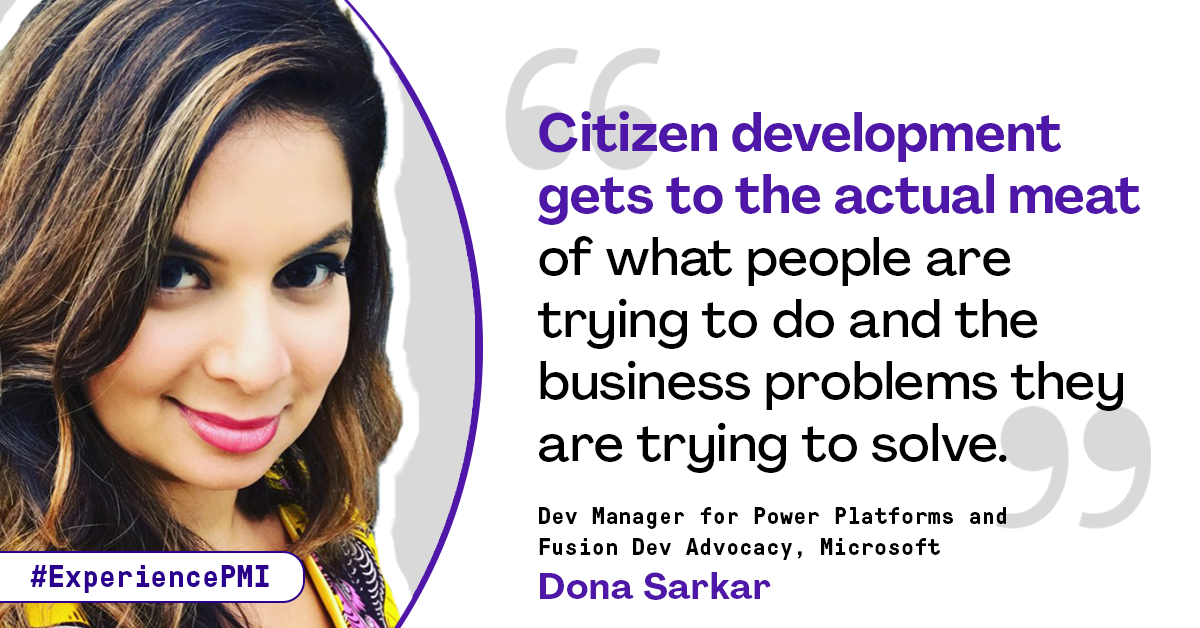
Some of this comes down to the basic rule of supply and demand: “I believe everyone needs to learn to code, but it’s not going to happen,” said Microsoft cloud advocate Dona Sarkar. Citizen development is a way to empower teams to get to the business problem—with guardrails.
It’s a future of work that will require hyper-collaboration. The next generation of citizen development “isn’t just citizen developers work over here and professional, traditional coders work over here,” said Sarkar. There will be fusion developer teams, in which citizen developers work on front-end things while traditional developers work with IT teams. The widespread adoption of low-code/no code is also helping companies uncover hidden potential in their employees, said Qrew Technologies’ Stefan Quartemont. “The future of citizen development is building strong teams and engaging in rapid problem solving.” Citizen development needs to deliver. And as with any innovation, the path to ROI is loaded with roadblocks. So what will it take for project leaders to put up a good fight when faced with inevitable challenges? A little patience and some ingenuity, said Prashara.
“There’s hope for a more united future everywhere, but we’ll need to be incredibly patient and find new ways of working to help us become better at what we do,” he said. If you missed out on the action or want to catch it all over again, PMXPO is available on demand. And don’t miss the next Virtual Experience Series on 2 June. How are you exploring innovation and new ways of working? |



2021 Jobs Outlook: Chaos, Risk—and Opportunity
|
By Cyndee Miller We’ve been mired in the COVID muck for more than a year now. The toll on our physical and mental health can’t be understated, but we’ve also seen how it’s fundamentally altered the world of work. And even as more vaccine shots make their way into more arms, some regions and sectors will continue to feel the effects well into 2021. Yet all that uncertainty doesn’t mean project leaders are lacking job opportunities, especially as companies start to see a light. When asked about their outlook on the global economy, 76 percent of CEOs said they believe it will improve during the next 12 months, according to PwC. This is big: That’s nearly 20 percentage points greater than the previous record high for optimism. The ManpowerGroup Q2 employment outlook survey echoed the sentiment, with 77 percent of companies expecting to return to pre-pandemic hiring levels by end of the year. Still, the PM Network 2021 Jobs Report reveals that prospects may vary greatly by region: Africa: After surviving its worst economic recession in half a century, Africa is projected to recover in 2021, with GDP projected to grow by 3.4 percent, according to the African Development Bank Group. But the tension between managing costs and pushing for innovation and growth can be difficult to navigate for project leaders—and their careers. “You have companies that have strategies for the new normal and related innovation investments,” says Ernesto Spruyt, founder of Tunga.io, a company in Kampala, Uganda dedicated to providing tech jobs to young Africans. “But you also have companies who try to sit it out and wait for things to go back to normal. I think the latter ones, in the end, will not prevail.” Middle East: The pandemic’s economic toll has been exacerbated by the collapse in the price of oil, wreaking financial havoc. The lingering risks from the coronavirus and low demand for oil is ratcheting up the need for the region to diversify its economy. “The pandemic raises the importance of innovation and R&D,” says Nahlah Alyamani, PMI-RMP, PMP, PgMP, planning lead for the Eastern hub, Health Holding Co., Riyadh, Saudi Arabia. Europe: Fears of a so-called third wave of COVID cases across Europe is dousing hope for a return to job market normalcy. While the economic pain varies and hiring may not have fully rebounded, look to jobs in knowledge-intensive sectors, like financial services and telecom. And there’s no denying the mass move to ecommerce. “I have noticed a huge spike for project managers in the digital space because of the pandemic,” says Luiz Andre Dias, PMP, PgMP, head of portfolio management transformation, DWP Digital, Newcastle, England. “Many digital projects have been accelerated and require a larger number of resources.” United States: It wasn’t pretty: The world’s top economy saw the worst economic contraction in its history during the second quarter of 2020. But by March of this year, the Federal Reserve was predicting GDP would increase 6.5 percent—a sharp jump from the 4.2 percent forecast made just in December. As in so many economies, the project action was driven around companies strengthening their online infrastructure and offerings to meet consumer demand, says John Challenger, CEO of outplacement firm Challenger, Gray & Christmas in Chicago. And that means they’re on the prowl for project talent with serious digital chops. Latin America: One of the last regions to be hit by the pandemic, Latin America is likely to also be one of the last to exit, according to S&P Global. While economic fates vary across the region, a proven track record with managing virtual teams, leading digital transformations or change management can all set candidates apart in an otherwise crowded talent pool, says Gustavo Pastrana, PMP, senior manager in global banking software, Diebold Nixdorf, Mexico City, Mexico. China: It was the country’s slowest expansion in decades—but it was still the only major economy to grow in 2020. “China’s job market as a whole has basically returned to normal,” said Frank Fu, founder and chairman of Shanghai Changeway Management Consulting Co., Shanghai. Project leaders looking for new opportunities should check out healthcare, insurance and online education. India: While India’s unemployment surged during the pandemic, numbers are turning around. The country’s growing digital economy is bolstering job opportunities, with online retail and last-mile delivery services seeing an ongoing spike in 2021, and insurance and healthcare maintaining an organic growth in demand. “This is a period of radical change for businesses as new definitions of work, agility and project management emerge,” says Vidhya Abhijith, PMP, a Future 50 leader and co-founder of Codewave Technologies, Bengaluru. “Organizations are embracing a future work environment that looks like a thriving social network, with smaller groups of people connected online and moving ideas into reality.” With such great flux across sectors and geographic regions, some project leaders are looking for safety and sticking with their current companies. But others are considering new opportunities in a time of massive change. Project leaders need to examine their personal appetites for risk, says Lindsay Scott, co-founder of Arras People, a U.K. recruiting firm focused on project talent. “People are seeing different pockets of opportunity that wouldn’t have been existing right now if we’d not had this year of a pandemic,” she told Projectified on a jobs outlook episode. “If you’re more inclined to take a few more risks, perhaps now really is the right time.” How are you balancing risk and opportunity as you map out your 2021 career plan? |


