Community Ambassadors Program to Launch January 2020
Categories:
community
Categories: community


|
One of many efforts to enhance programming on ProjectManagement.com, the Community Ambassadors Program will launch on January 2, 2020! The Ambassadors Program will provide community members with additional support resources who facilitate and encourage constructive conversations as well as assist members in navigating the community. The Program seeks to highlight voices in the community that are helpful, professional, passionate, and knowledgeable in order to allow community members to get the most out of the site and their interactions with each other. Ambassadors are active ProjectManagement.com members who are advocates of the community as well as leaders in the project management field. They are generously offering their time to PMI’s online community to ensure a better experience for all community members! We are excited to announce that our first Ambassadors will be Emily Luijbregts and Andrew Craig, starting in the role on January 2, 2020. More information will be posted at that time so that you may become better acquainted with Emily and Andrew. Feel free to say hello as you see them around the community! In 2020, we will be identifying additional community members to serve as Ambassadors in order to grow the program and better support community members. Below are some FAQs regarding the Ambassadors Program for your reference. Please reach out to [email protected] with any questions. Project Management.com Ambassadors Program FAQs What qualifications do I need in order to become a Community Ambassador? Community Ambassadors are PMI members who have been a part of the ProjectManagement.com online community for at least one year. Ambassadors have a complete profile (including picture) and act in accordance with the Community User Guidelines; they are active members of the community who post discussion topics, address their peers’ questions, provide substantive feedback on content items, and seek to be helpful and engaging in their interactions with others. These items inform our selection criteria for the Ambassadors Program. Do I have to be a PMI Member to be an Ambassador? Yes, we require that Ambassadors be PMI members so that they have access to all content (including premium content) on ProjectManagement.com. This allows Ambassadors to fully engage with community members across the various content areas. Do I have to hold a PMI certification, such as the PMP, to be an Ambassador? No, a PMI certification is not a requirement to be a Community Ambassador. Why was I not chosen for the Ambassadors Program? For the initial launch, the program is starting small with two Ambassadors. This will allow us to best develop and refine the Ambassadors Program while we gather feedback and evaluate what is working. There are many great candidates within the community who will be considered, as we expand the program over time. We look forward to your continued interest! What is the time commitment for being an Ambassador? Ambassadors agree to a 6 month term. Ambassadors may serve up to two consecutive terms (one year) which is followed by a six month break. After this break, individuals may once again be considered for the Ambassadors Program. How often will new Ambassadors join the program? Currently, we do anticipate that the Ambassadors Program will expand over time. This growth will be based upon the success of the program and as needs are determined going forward. I know someone who would make a great Community Ambassador. What can I do? We certainly welcome suggestions for future Community Ambassadors. Please contact [email protected] or a Product Specialist with your recommendation. We will then consider the candidate in the context of our selection criteria for the Ambassadors Program. |
PMBOK® Guide – Seventh Edition Volunteer Opportunities for Translation Validation
|
PMI is currently seeking volunteers to validate translations of the PMBOK® Guide – Seventh Edition! The PMBOK® Guide will be available in eleven languages, and volunteers are needed in order to ensure that the translations are accurate for the following languages:
Please note that the PMBOK® Guide will also be available in Hindi; however, translation is being managed via a similar process in the PMI India office. For this in person volunteer opportunity, PMI staff will lead meetings where volunteers, using a consensus-based approach, validate translated content from the PMBOK® Guide – Seventh Edition. The Chinese, Japanese and Korean translations will be validated at a meeting to be held in Tokyo from 27 February - 1 March, 2020. The French, German, Italian, Portuguese, Russian, and Spanish translations will be validated at a meeting to be held in London from 5 - 8 March, 2020. PMI will cover travel, hotel, and other reasonable travel related expenses for all volunteers. Volunteer requirements include:
If you are interested in volunteering, please apply in the Volunteer Relationship Management System (VRMS) for the respective language: Arabic Validation Volunteer Opportunity Chinese Validation Volunteer Opportunity French Validation Volunteer Opportunity German Validation Volunteer Opportunity Italian Validation Volunteer Opportunity Japanese Validation Volunteer Opportunity Korean Validation Volunteer Opportunity Portuguese Validation Volunteer Opportunity Russian Validation Volunteer Opportunity Spanish Validation Volunteer Opportunity This opportunity closes on 20 December 2019. |
What are Performance Domains, and Why Should I Care?
Categories:
standards
Categories: standards
|
By: Cynthia Dionisio, Co-leader PMBOK® Guide–Seventh Edition Development Team In past blogs, various members of the PMBOK® Guide–Seventh Edition development team and community have talked about the evolution of The Standard for Project Management and you have heard from team members about some of the thoughts around the principles that comprise the concepts for the Standard. Recently, Maria Cristina Barbero, Standards Member Advisory Group member, discussed the concept of a Body of Knowledge. One of the sections in the Guide to the Project Management Body of Knowledge is Project Management Performance Domains. This is a new approach in the PMBOK® Guide. Past editions of the PMBOK® Guide used Process Groups and Knowledge Areas as the organizing concept. In the Seventh Edition we are shifting the focus to Performance Domains. If you are a bit of a Standards geek like I am, you may have noticed that The Standard for Program Management and The Standard for Portfolio Management are comprised of performance domains, so this is not a new thing in PMI’s standards. As we communicate about this shift, I have been asked several times, what is a performance domain? I admit, the term is a bit vague. I struggled with this myself for a while. Here is what The Standard for Program Management says: Program Management Performance Domains are complementary groupings of related areas of activity or function that uniquely characterize and differentiate the activities found in one performance domain from the others within the full scope of program management work. If that doesn’t quite resonate with you, let me share how I think of domains. I think of them as broad areas of focus for project delivery. Think about when you work on a project. You spend time focusing on the outcome or deliverable that the project was undertaken to develop. You spend time focusing on the team. You spend time focusing on stakeholders. These are areas of focus that interrelate and interact with each other within your project. There are times when a situation arises with a stakeholder that you need to address immediately. That situation involves a stakeholder but it also impacts planning, delivery, navigating uncertainty, project performance measurement and other aspects of project work. So instead of thinking about engaging with the stakeholder in isolation of everything else, you think about the stakeholder, the situation and their impacts across the various project work domains. Domains run concurrently throughout the phases of a project life cycle, regardless of how you deliver value (frequently, periodically, or at the end). If we use the examples above, your focus on the deliverables has to include thoughts about your stakeholders, and your team. But the activities associated with creating those deliverables are different activities than those you undertake in working with your team members. The activities interrelate, but they are different. They are interdependent, and they overlap in different ways throughout the project. However, you can’t work on a project without focusing on deliverables, stakeholders and team members. There is another aspect of performance domains – they are outcomes focused. Notice that outcomes are different from outputs. As you are likely aware, in previous editions of the PMBOK® Guide the processes culminated in an output, such as a scope statement, risk management plan, stakeholder register, etc. Outputs are fine, but they are not the same as outcomes. Outputs enable outcomes. For example, if we have a performance domain around effective interaction with stakeholders, I would want to know the outcomes associated with that. For example, one outcome might be satisfied stakeholders. I can measure that with surveys, observing relationships and interactions, etc. Each performance domain has measurable outcomes, and the outcomes are different from an output. I might use an output, such as a stakeholder register to enable the outcome, but the stakeholder register is not the most important thing, stakeholder satisfaction is what’s important. This is a big shift in how we think about delivering projects, so let me summarize it for you:
In forthcoming blogs, you will hear from team members who will share their thoughts on possible performance domains for project management. I hope you enjoy the upcoming series. There is much more to come, so check back frequently. |

Thank You For All Your Support!
|
On this global day of giving, we are grateful for people like you who choose to support our mission to promote Project Management for Social Good®. We are focused on working together to help create a better future for people and communities around the world, especially our youth, by leveraging the power of project management. So, how would your gift make a difference? This year, support from donors has helped PMIEF:
A gift to PMIEF of just $25 by year-end will have a ripple effect on people and communities around the world. Together we’ll change the world, one project at a time! |

PMI Educational Foundation Open House - Happening Today!
|
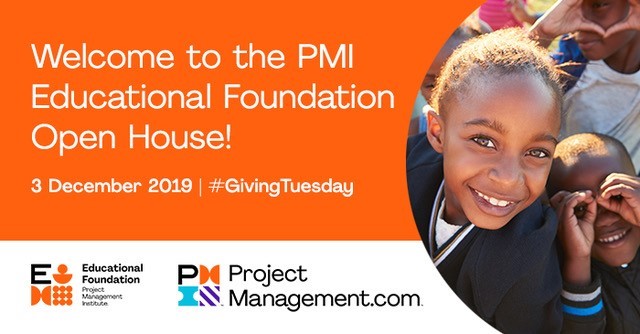
Welcome to our annual open house! All day long, in celebration of #GivingTuesday, and in collaboration with the Project Management Institute Educational Foundation (PMIEF), we are highlighting how you can use project management to give back. We are thrilled to open up our community today to all project professionals around the world to continue the conversation around making a difference through the use of project management. We have a LIVE webinar (open to all), two on-demand webinars, and plenty of other content focused on how people just like you are utilizing their project management skills to create lasting change in their communities. Find out what content we have in store for you today by downloading the PM for Social Good® 2019 Open House Program Guide! You can also find a listing of today's content below:
But wait...there's MORE! TODAY ONLY: For all of those who download the program guide on Tuesday, 03 December 2019 as part of your participation in the Open House, you will receive a special badge for your ProjectManagement.com profile!
We hope that you become inspired to give back to your community and make a difference, no matter how big or how small. In the spirit of celebration and togetherness today's content is open to anyone and everyone so invite your friends and colleagues to join in on the fun! A gift to PMIEF of just $25 by year-end will have a ripple effect on people and communities around the world. Together we’ll change the world, one project at a time! Help us celebrate #GivingTuesday with the PMIEF and enjoy the day!
|