

Is the PMO governing projects, or trying to control complexity with inadequate tools?
Categories:
PMO
Categories: PMO


| Few PMO heads openly admit this. However, there is a significant difference between controlling projects and improving the organization's ability to deliver value. Many PMOs confuse these things.
At some point, it is worth asking an uncomfortable question: Is the PMO solving the problem, or merely organizing the chaos in a visually elegant way? The book Doing the Right Project: Using a Systems Thinking Approach to Select Successful Projects raises precisely this type of question. Most PMOs still operate according to a linear logic:
Often, the attempt to increase control begins to reinforce the problem itself. Tools such as Causal Loop Diagrams help to make this behavior visible.
The system then enters a loop. The PMO begins to act as an administrative stabilizer while the organization loses its adaptive capacity. This may be one of the most uncomfortable conclusions: A PMO can increase operational maturity while simultaneously reducing organizational viability. Stafford Beer’s Viable System Model addresses precisely this imbalance between:
Yet many PMOs remain designed to preserve stability in environments that change too quickly. There is another issue. The organizational chart rarely explains how decisions are actually made. Projects may follow the formal governance structure, but influence, priority, and decision-making speed usually circulate through informal networks. Tools such as:
Almost no PMO measures this. Perhaps because it is more comfortable to measure:
Many PMOs believe that the portfolio problem is prioritisation. This is not always the case. Sometimes, the real problem is the organization's inability to stop initiatives. The system continues absorbing demand until it reaches saturation. The Stock and Flow Model helps to reveal precisely this dynamic: the invisible accumulation of work that gradually degrades capacity, collaboration, and delivery speed. This rarely appears in traditional reports. Another relevant issue is that different business areas often interpret the same problem in entirely different ways. While one area perceives “governance,” another perceives “bureaucracy”. While leadership understands “control,” teams experience “delay”. Tools such as: Cognitive Mapping; CATWOE; help reveal these differences in perception before they develop into organizational conflict. Perhaps the most difficult conclusion for many PMO heads is this: A PMO can be highly competent at governing projects and still contribute to the exhaustion of the organizational system. This type of discussion has appeared increasingly frequently in PMO assessments conducted by AIPMO recently. Often, the problem was not:
The problem was the system’s inability to:
Tier 1 assessment helps initiate this type of analysis. It is not merely an operational questionnaire. It is a diagnostic mechanism designed to identify patterns that normally remain invisible in the PMO’s day-to-day activities. Many organizations discover, for example:
The discussion becomes: “How can we increase the organization's capacity to generate value without degrading the system itself?” You can run a masterclass with your team that examines this change in perspective in greater depth. It is not intended to introduce another methodology. Instead, it discusses:
The modern PMO challenge no longer appears to be limited to project execution. The challenge lies in understanding how decisions, governance, and control structures influence organizational capacity, speed, collaboration, adaptation, and perceived value within the system itself. In some cases, this discussion naturally evolves into more extensive PMO transformation initiatives. Not necessarily because the organization wants more governance, but because it begins to recognize that some portfolio problems do not originate within projects. They originate within the organizational system that produces those projects. Nelson Rosamilha,PhD [email protected] |
From Governance to Execution Intelligence: How PMOs Navigate Complexity
| The traditional PMO toolkit is well known. Governance. Planning. Monitoring. Dependency management. Performance tracking. Decision-making support. All of these remain important. However, there are environments where these mechanisms are no longer sufficient to explain the challenges being faced. Even with more meetings, more metrics, more governance forums, and more controls, organizations continue to struggle with:
A common trap for PMOs is assuming that similar problems require similar responses. When something deviates from expectations, organizations often react in predictable ways:
So..... Are we facing an execution problem or an interpretation problem? Several signals can help answer this.
The PMO moves beyond being merely a coordination mechanism and starts acting as a layer of organizational intelligence. This means observing how different capabilities and services interact to produce outcomes. Because governance alone rarely creates impact. Integration does. Not every organizational tension falls under the PMO's direct responsibility. A useful distinction is to separate three domains:
This perspective prevents the PMO from becoming the owner of every organizational problem. Another important consideration: Having data is no longer the differentiator. The challenge now is transforming information into meaningful interpretation that supports decision-making. One simple practice is reviewing the questions asked during meetings. Instead of asking: Are we on schedule? Consider asking:
This requires triangulation. Combining operational evidence, stakeholder perceptions, and existing organizational capabilities. Complex environments rarely reveal their challenges through a single source of information. Alignment also changes in nature. It becomes a continuous process rather than a one-time event. Some practices that can strengthen the PMO include:
Waiting for complete certainty before communicating often produces:
What we know. What is still evolving. What we will do now. Five Questions for Your Next Meeting
However, some environments require an additional capability. For the PMO, this means complementing discipline with interpretation, connecting organizational capabilities, sustaining decisions under incomplete information, and transforming information into execution intelligence. In complex environments, competitive advantage does not emerge from the quantity of metrics. It emerges from the ability to understand what those metrics are actually saying, to develop the capability to interpret context, connect services, make decisions under uncertainty, and transform governance into measurable impact. This is one of the themes explored in the IPMO Practitioner program, which approaches the PMO not merely as a coordination structure, but as a capability-based system focused on value generation in increasingly complex organizational environments. Nelson Rosamilha [email protected] |
PMOs Navigating Complexity: From Coordination to Sensemaking
PMOs typically operate through a familiar set of mechanisms:
But there is a type of environment that challenges this operating model. Even with:
The challenge becomes less about controlling execution and more about interpreting context. Not every problem requires the same responseA common trap in PMO environments is assuming that problems that look similar require the same treatment. When something is not working, typical responses often emerge:
A more useful question may be: Are we dealing with an execution problem or an interpretation problem? Some signals can help.
Decisions do not always arrive completeProjects frequently receive decisions accompanied by:
Turning interpretation into certainty. One practical alternative for PMOs is to structure conversations across three levels. What is definedAvailable facts, decisions already made, and current direction.What remains under analysisImpacts, dependencies, validations, and assumptions.What happens nextImmediate actions, follow-up activities, and review points.This separation reduces noise without requiring absolute predictability. Data does not replace understandingMany PMOs already have enough information. The challenge has changed.
Are we on schedule? With questions such as:
The goal is to complement indicators with interpretation. Alignment becomes a process rather than an eventIn more dynamic environments, alignment does not happen only at formal milestones. It needs to be rebuilt continuously. Some practices that PMOs can apply:
It is to prevent different areas from operating with different versions of reality. Communication also changesAnother recurring issue is waiting for complete certainty before communicating. In practice, this often creates:
What we knowWhat is still evolvingWhat we will do nowThis approach improves alignment without creating false predictability. Five questions for PMOs to bring into the next meeting
ClosingGovernance remains necessary. But some environments require an additional capability. For PMOs, this means complementing discipline with interpretation, expanding contextual awareness, and maintaining direction while understanding continues to evolve. |
How to Measure PMO Impact Practically, Based on Evidence Rather Than Perception
Categories:
pmo
Categories: pmo
| Most PMOs do not measure impact. They measure activity. And they often treat both as if they were the same thing. The problem is not conceptual. It is structural. Impact is not something a PMO “declares.” It must be derived from organized evidence, and that evidence does not emerge from isolated indicators. It emerges from a system. The PMO-Mi Model framework addresses this explicitly: Measurement does not start with impact. It starts with the structure that allows impact to be observed. This implies three distinct layers that most PMOs tend to mix.
The first mistake is using progress as evidence. Common examples include:
These indicators demonstrate execution, not effect. They answer: “What was done?” But they do not answer: “What changed because of it?” This distinction is fundamental. Impact only exists when there is an observable change in the organizational system.
The second mistake is using maturity as a proxy for impact. More structured PMOs often assume: “We have capability, therefore we generate impact.” The data suggests otherwise. Organizations continue investing in delivery capability while still showing significant gaps in converting those investments into business outcomes. Capability measures potential. Impact measures realization. Without evidence of realization, maturity is merely infrastructure.
The PMO-MI model is explicit: Impact is not attributed to the PMO as an entity. It is attributed to the services the PMO performs. This entirely changes how measurement should be approached. The question is not: “PMO impact” The question becomes: “What is the impact of service X within domain Y?” Without this linkage, there is no traceability. And without traceability, there is no evidence.
Another recurring mistake is treating indicators as proof. Isolated indicators do not demonstrate impact. They must be integrated into a coherent interpretation logic. Within the AIPMO perspective, measurement maturity requires moving from data to decisions. This implies:
Without this, the PMO accumulates data but does not generate evidence.
Impact does not appear directly. It must be inferred through observable patterns. For example: Not: “The PMO improved decision-making.” But rather:
And most importantly: A clear connection with the service that generated the effect. Without this structured inference, the PMO remains trapped in perception. The central point If impact cannot be traced, connected to services, and observed in organizational behavior, then it is not being measured. It is being assumed. |
How to Reposition the PMO for Real Influence
Repositioning the PMO is not an organizational decision. It is a consequence of the operating model in which the PMO exists.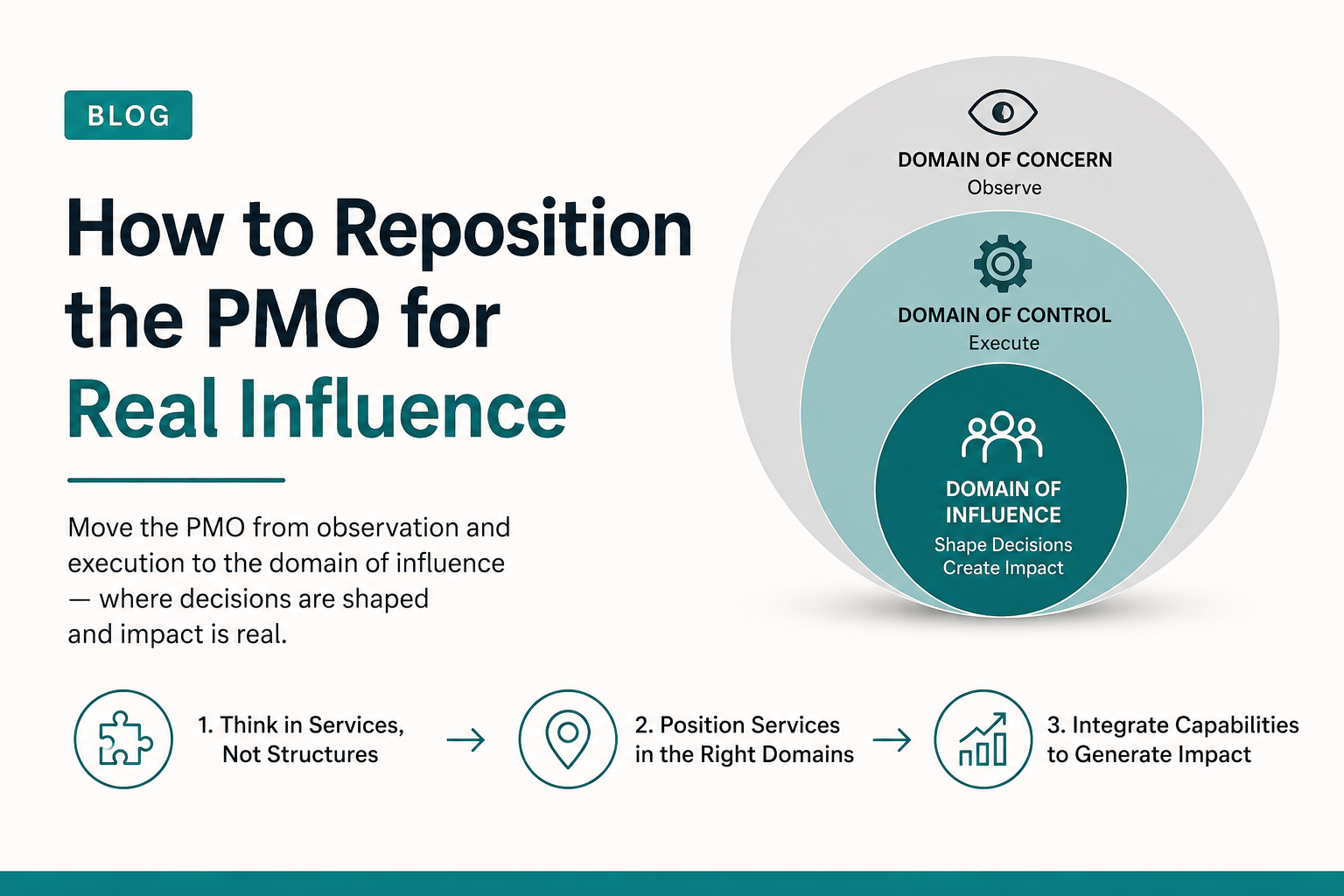 As long as the PMO remains restricted to the domain of concern, it observes. When it operates within the domain of control, it executes. Influence only emerges when the PMO consistently operates within the domain of influence. Most PMOs are not at this level, and it is not because of a lack of technical capability. It is because the operating model prevents it. The mistake begins with how the PMO is defined. It is still treated as a structure. But structures do not generate impact. What generates impact are capabilities organized into services, operating within specific domains, and connected to the real decision-making process. Without this, any attempt to reposition the PMO becomes narrative. It does not change behavior. Repositioning the PMO requires three structural changes.
Influence is not a characteristic of the PMO. It is the result of the services the PMO delivers. The PMO-MI Model model is direct: Impact is not in the existence of the PMO, but in how its services operate and connect. This changes the core question. Instead of asking: “What is the role of the PMO?” The question becomes: “Which services actually interfere with relevant decisions?” Without this shift, the PMO continues trying to gain relevance through internal structure. And that does not change outcomes.
Not every service needs to influence decisions. However, critical services must be positioned where decisions are made. The model establishes that impact occurs in the domains of control and influence, not within observation. This requires a clear distinction:
Without this distinction, the PMO increases operational activity without increasing organizational relevance.
Isolated capability does not create influence. Impact is not the result of adding practices together. It emerges from the integration between services and domains. This is the most neglected point. PMOs improve processes, tools, and controls. But they fail to integrate capabilities in ways that alter how the organizational system operates. The result is predictable:
The capability to connect information, anticipate implications, and act before decisions become fixed. Without this, the PMO reacts instead of directing.
How to measure impact practically, based on evidence rather than perception. |


