
7 Tips to Digitally Transform Your Organization
Categories:
business agility
Categories: business agility


|
What not to do when digitally transforming your organization.
|

Business Agility: Strategy - Part 2
Categories:
business agility
Categories: business agility
| Market and competition factors, innovation dynamics and technological journeys are among the agile drivers of organizations
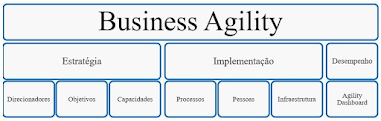
In the previous article I presented an overview of the Business Agility model according to the figure below. Formulating the Business Agility strategy is a crucial first dimension of building agility. The definition of strategy allows the organization to carry out a course of action based on a clear understanding of the performance of the “why” (logic) and the “what” to do.
When formulating the strategy, it is important to consider the agile drivers of the organization, which are: market and competition factors in the industry in which your company operates; innovation dynamics and technology journeys; network and value chain; sociopolitical norms and trends; internal organizational aspects; and change factors. These elements must be considered when directing your Business Agility strategy. Still on strategy, when efining agile objectives, it is necessary to formulate a strategic response for each one of them, reflecting on how these elements will help in this formulation. The agile objectives are: company priorities and business objectives; requirements and level of agility needed; target scenario to be achieved; critical success factors for each of these agile goals; and action strategy to achieve them. But the organization also needs to plan for its agile capabilities and gaps. Once identified, it is then necessary to plan and act on each gap. Capabilities can be: culture; leadership performance; active; resources; between others. At this time, the use of the company's internal network is indicated, which can bring good values in the search for these capabilities. The next text will deal with the implementation of Business Agility. Instagram--> digitalmodebrasil |

BUSINESS AGILITY: CRITICAL SUCCESS FACTORS - PART 1
Categories:
business agility
Categories: business agility
| Becoming flexible and agile to meet the demands of products and services in a globalized and highly competitive environment is a constant challenge for organizations.
In a volatile and uncertain business environment, where customer demands are dynamic, competitiveness, competition and technological innovations ended up creating a scenario that forces companies to consider their ability to respond quickly. And this may be possible with some measures, such as: digitalization of business processes – which provide for the creation of new access channels for customers –; integration with partners; internal efficiency gains and creation of new products or services; or the ability to automate business processes in an integrated, synchronized and continuous way, supporting agility within the organization. Given the above context, Business Agility becomes a key player in business success. This ability to relate to customers, implement the operation and use the ecosystem of partners to continuously prosper in a dynamic and unpredictable business environment occurs through this concept that is much discussed in the market, Business Agility (BA) . We can define Business Agility as the ability of an organization to perceive changes in the environment and respond to such changes effectively and efficiently. The organizational implementation of BA must be carried out taking into account three critical dimensions of success, namely: Strategy, Implementation and Performance. In this article I describe these critical success factors, so that the next articles will bring you in detail each of these dimensions, their main elements and the composition of each of these elements, exemplified in Figure 1. Formulating the BA Strategy is a crucial first dimension of building agility. Defining strategy allows the organization to undertake a course of action based on a clear understanding of why (logic) and "what" to do. When formulating the strategy, it is important to consider the organization's agile drivers , such as the market, value chain, regulatory trends and internal organizational aspects, among others. Still on strategy, when defining the Objectives , one must take into account the business objectives, the company's priorities, the scenarios to be pursued and the critical success factors for these scenarios. However, the organization also needs to plan its Capabilities and organizational resource gaps and thus devise a plan to fill these gaps. In short, your strategy to succeed must be composed of Drivers, Objectives and Capabilities. With the strategy designed, the next step is its implementation. The implementation of the BA is related to the elements associated with the practical execution of the strategy. In this step, strategic objectives become implementation practices, that is, determine the practices or initiatives needed to achieve capabilities, measure and evaluate agility performance, and make corrections based on the results. At this stage, the Processes that need to be reviewed, People skills , human resources, technology and Infrastructure . The last dimension is the verification of the agility performance , which is related to the elements to identify the adequate indicators to evaluate the efficiency and effectiveness of the initiatives for the achievement of the Strategy. Once the BA has been defined and put into action, it's time to measure the results through a dashboard of relevant success metrics such as KPI, Agile Scorecard, Agile Maturity, OKR, etc. This makes it possible to check whether the resulting performance is satisfactory or not and undertake accordingly with appropriate decisions and actions. Becoming flexible and agile to meet the demands of products and services in a globalized and highly competitive environment is a constant challenge for organizations. To deal with everyday challenges, disruptive technologies and innovation, business agility needs to be anchored in business skills and efficiency. Business Agility covers important aspects of business efficiency and provides an understanding of the effective operation of businesses where information technology plays an accelerating role. Technology, product and project management are some of the elements within this scenario, but these three isolated factors do not guarantee the effectiveness of Business Agility. In the next articles we will continue to describe the implementation of Business Agility, for that I will post here three more articles where we will detail each of the following topics: Agile Strategy, Implementation and Performance. |



