
How to Measure PMO Impact Practically, Based on Evidence Rather Than Perception
Categories:
pmo
Categories: pmo


| Most PMOs do not measure impact. They measure activity. And they often treat both as if they were the same thing. The problem is not conceptual. It is structural. Impact is not something a PMO “declares.” It must be derived from organized evidence, and that evidence does not emerge from isolated indicators. It emerges from a system. The PMO-Mi Model framework addresses this explicitly: Measurement does not start with impact. It starts with the structure that allows impact to be observed. This implies three distinct layers that most PMOs tend to mix.
The first mistake is using progress as evidence. Common examples include:
These indicators demonstrate execution, not effect. They answer: “What was done?” But they do not answer: “What changed because of it?” This distinction is fundamental. Impact only exists when there is an observable change in the organizational system.
The second mistake is using maturity as a proxy for impact. More structured PMOs often assume: “We have capability, therefore we generate impact.” The data suggests otherwise. Organizations continue investing in delivery capability while still showing significant gaps in converting those investments into business outcomes. Capability measures potential. Impact measures realization. Without evidence of realization, maturity is merely infrastructure.
The PMO-MI model is explicit: Impact is not attributed to the PMO as an entity. It is attributed to the services the PMO performs. This entirely changes how measurement should be approached. The question is not: “PMO impact” The question becomes: “What is the impact of service X within domain Y?” Without this linkage, there is no traceability. And without traceability, there is no evidence.
Another recurring mistake is treating indicators as proof. Isolated indicators do not demonstrate impact. They must be integrated into a coherent interpretation logic. Within the AIPMO perspective, measurement maturity requires moving from data to decisions. This implies:
Without this, the PMO accumulates data but does not generate evidence.
Impact does not appear directly. It must be inferred through observable patterns. For example: Not: “The PMO improved decision-making.” But rather:
And most importantly: A clear connection with the service that generated the effect. Without this structured inference, the PMO remains trapped in perception. The central point If impact cannot be traced, connected to services, and observed in organizational behavior, then it is not being measured. It is being assumed. |
How to Reposition the PMO for Real Influence
Repositioning the PMO is not an organizational decision. It is a consequence of the operating model in which the PMO exists.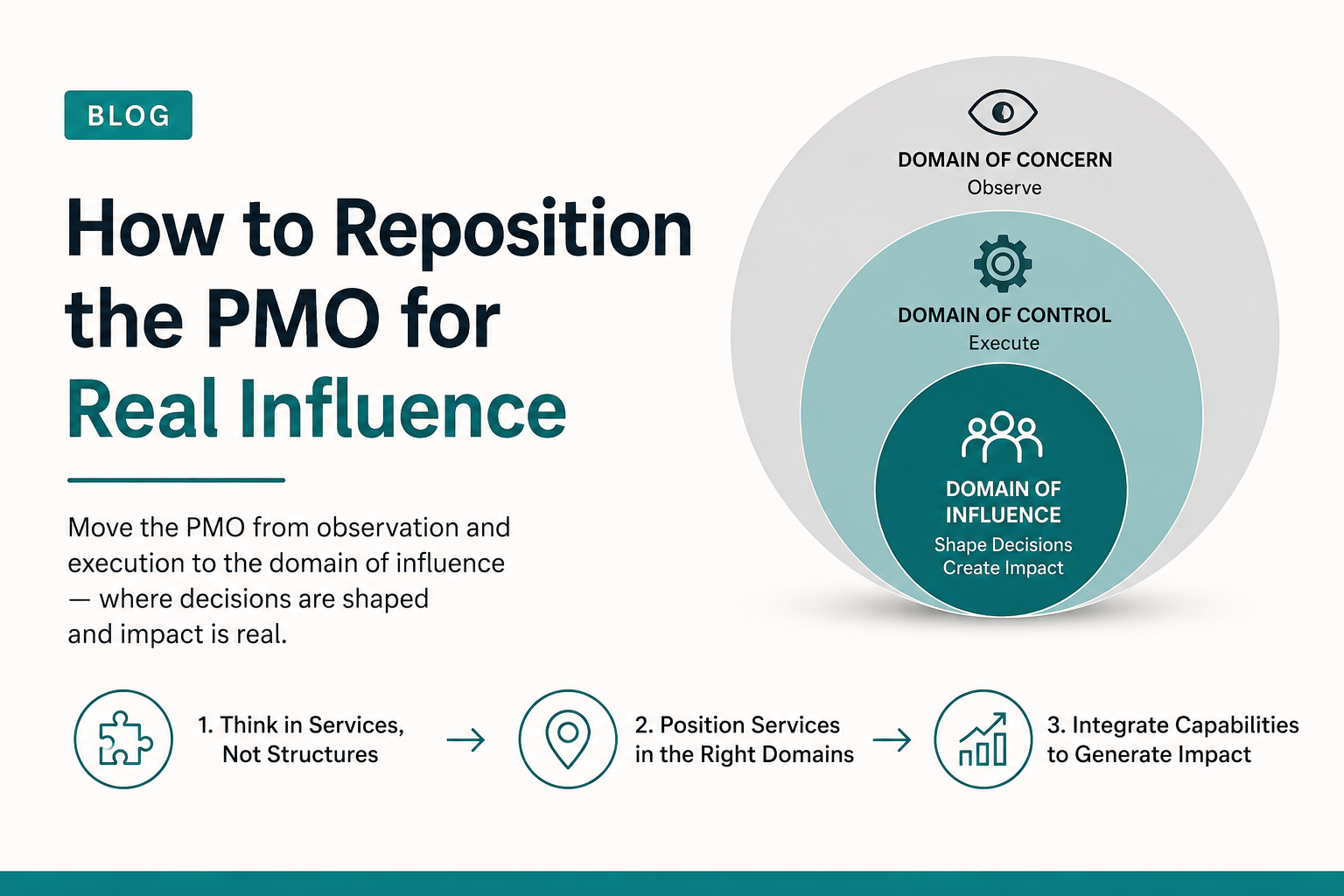 As long as the PMO remains restricted to the domain of concern, it observes. When it operates within the domain of control, it executes. Influence only emerges when the PMO consistently operates within the domain of influence. Most PMOs are not at this level, and it is not because of a lack of technical capability. It is because the operating model prevents it. The mistake begins with how the PMO is defined. It is still treated as a structure. But structures do not generate impact. What generates impact are capabilities organized into services, operating within specific domains, and connected to the real decision-making process. Without this, any attempt to reposition the PMO becomes narrative. It does not change behavior. Repositioning the PMO requires three structural changes.
Influence is not a characteristic of the PMO. It is the result of the services the PMO delivers. The PMO-MI Model model is direct: Impact is not in the existence of the PMO, but in how its services operate and connect. This changes the core question. Instead of asking: “What is the role of the PMO?” The question becomes: “Which services actually interfere with relevant decisions?” Without this shift, the PMO continues trying to gain relevance through internal structure. And that does not change outcomes.
Not every service needs to influence decisions. However, critical services must be positioned where decisions are made. The model establishes that impact occurs in the domains of control and influence, not within observation. This requires a clear distinction:
Without this distinction, the PMO increases operational activity without increasing organizational relevance.
Isolated capability does not create influence. Impact is not the result of adding practices together. It emerges from the integration between services and domains. This is the most neglected point. PMOs improve processes, tools, and controls. But they fail to integrate capabilities in ways that alter how the organizational system operates. The result is predictable:
The capability to connect information, anticipate implications, and act before decisions become fixed. Without this, the PMO reacts instead of directing.
How to measure impact practically, based on evidence rather than perception. |
The New Consciousness of the Management Office
From Process Governance to Thought GovernanceYet a persistent paradox remains. Despite better tools and more data, many organizations continue to struggle with strategic misalignment, inconsistent prioritization, and decisions that fail to translate into measurable impact. Technology has advanced. Decision quality has not evolved at the same pace. This suggests that the core challenge is no longer operational. It is cognitive. The question is no longer how to control processes more effectively. It is how to structure the thinking that governs those processes. Historically, the Management Office has been designed as the guardian of process governance: standards, compliance, reporting, structure, discipline. Its role was to ensure order and predictability. But in environments characterized by complexity, interdependence, and compressed strategic cycles, process control is no longer sufficient. Maturity today is defined not only by the existence of governance mechanisms, but by the quality of the reasoning that guides their application. The new consciousness of the Management Office represents this shift. It moves from monitoring procedures to curating organizational judgment. It asks not only, “Are we following the process?” but also, “Are we thinking with strategic clarity?” This transition requires five structural shifts: • From certainty to continuous learning • From control to transparency • From rigid stability to adaptability • From isolated efficiency to ethical responsibility • From functional silos to conscious collaboration  Artificial intelligence, in this context, is not the protagonist. It is a catalyst. AI amplifies patterns. It makes implicit criteria visible. It exposes inconsistencies. If an organization operates with clarity, AI enhances clarity. If it operates with noise, AI amplifies noise. The real transformation does not happen in the tool. It happens in the mindset that governs its use. How to Begin TomorrowThis shift may sound abstract. It is not. It starts with structured interventions. At your next portfolio review meeting, replace part of the status discussion with three questions: • What strategic assumption are we making here? • Which invisible criterion is guiding this decision? • What would prove this decision wrong six months from now? Before prioritizing initiatives, make the decision criteria explicit. Not only the scoring model, but the reasoning behind it. Implement a strategic decision log. Capture not only what was decided, but why, under which assumptions, and with which accepted risks. Once per quarter, conduct a strategic coherence review. Not a process audit. A reasoning audit. Ask whether the portfolio truly reflects declared strategic intent. These practices require no new technology. They require cognitive maturity. Structure Sustains ConsciousnessAwareness without structure dissolves into rhetoric. Developing this new consciousness demands method: disciplined prioritization logic, explicit governance criteria, integrated portfolio alignment, and systematic learning from decisions. Without structure, mindset remains aspiration. With structure, mindset becomes institutional capability. The most important question is not whether your Management Office is digital. It is whether it is conscious. AI does not create maturity. It reveals it. |


