Project Management

Operational Excellence in Project Management

by
Leadership, PMO and Project Management

About this Blog

RSS

Recent Posts

Is the PMO governing projects, or trying to control complexity with inadequate tools?

From Governance to Execution Intelligence: How PMOs Navigate Complexity

PMOs Navigating Complexity: From Coordination to Sensemaking

How to Measure PMO Impact Practically, Based on Evidence Rather Than Perception

How to Reposition the PMO for Real Influence

Categories

Agile, best practice, business agility, competence, Consulting, customer, customer succcess, Decision Making, Education, excellence, Governance, Government, Healthcare, Information Technology, Innovation, kamishibai, Leadership, leadership, lean, Organizational Project Management, PM in Academia, PMO, pmo, pmo, project leader, project manager, risk, risk management, scope, storytelling, team

Date

Is the PMO governing projects, or trying to control complexity with inadequate tools?

Categories: PMO

linkedin twitter facebook Request to reuse this  
Few PMO heads openly admit this.

However, there is a significant difference between controlling projects and improving the organization's ability to deliver value.
Many PMOs confuse these things.
  • The dashboards are up to date.
  • The executive forums take place.
  • The indicators are green.
  • The reports are submitted on time.
Even so:

  • The organization remains slow.
  • Priorities change every week.
  • Business areas are constantly overloaded.
  • Stakeholders complain about bureaucracy.
  • Projects compete with one another.
  • The portfolio grows faster than the organization's delivery capacity.

At some point, it is worth asking an uncomfortable question:

Is the PMO solving the problem, or merely organizing the chaos in a visually elegant way?

The book Doing the Right Project: Using a Systems Thinking Approach to Select Successful Projects raises precisely this type of question.

Most PMOs still operate according to a linear logic:

  • Identify the problem;
  • Create controls;
  • Measure compliance;
  • Expand governance.
The difficulty is that complex organizations do not respond linearly.
Often, the attempt to increase control begins to reinforce the problem itself.

Tools such as Causal Loop Diagrams help to make this behavior visible.
  • More approvals generate:
  • More queues;
  • More handoffs;
  • More delays;
  • More multitasking;
  • Greater executive dependency.
The natural response is usually predictable: create even more governance.
The system then enters a loop.
The PMO begins to act as an administrative stabilizer while the organization loses its adaptive capacity.

This may be one of the most uncomfortable conclusions:

A PMO can increase operational maturity while simultaneously reducing organizational viability.

Stafford Beer’s Viable System Model addresses precisely this imbalance between:
  • Operations;
  • Coordination;
  • Control;
  • Intelligence;
  • Adaptation.
Organizations survive through adaptation.

Yet many PMOs remain designed to preserve stability in environments that change too quickly.
There is another issue.

The organizational chart rarely explains how decisions are actually made.

Projects may follow the formal governance structure, but influence, priority, and decision-making speed usually circulate through informal networks.

Tools such as:
  • Social Network Analysis;
  • Actor Mapping;
show that some individuals accelerate decisions without holding executive positions, while others can obstruct entire programmes without ever appearing in the steering committee.

Almost no PMO measures this.

Perhaps because it is more comfortable to measure:
  • Schedule;
  • SPI;
  • KPI;
  • Status reports.
Then to discuss:
  • Influence;
  • Systemic behaviour;
  • Organizational overload;
  • Capacity degradation;
  • Perceived value.
There is another important challenge to conventional thinking.

Many PMOs believe that the portfolio problem is prioritisation.

This is not always the case.
Sometimes, the real problem is the organization's inability to stop initiatives.
The system continues absorbing demand until it reaches saturation.

The Stock and Flow Model helps to reveal precisely this dynamic: the invisible accumulation of work that gradually degrades capacity, collaboration, and delivery speed.
This rarely appears in traditional reports.

Another relevant issue is that different business areas often interpret the same problem in entirely different ways.
While one area perceives “governance,” another perceives “bureaucracy”.
While leadership understands “control,” teams experience “delay”.
Tools such as:
Cognitive Mapping;
CATWOE;
help reveal these differences in perception before they develop into organizational conflict.
Perhaps the most difficult conclusion for many PMO heads is this:
A PMO can be highly competent at governing projects and still contribute to the exhaustion of the organizational system.
This type of discussion has appeared increasingly frequently in PMO assessments conducted by AIPMO recently.
Often, the problem was not:
  • The absence of processes;
  • The absence of processes;
  • The lack of indicators;
Or the absence of governance.
The problem was the system’s inability to:
  • Adapt;
  • Prioritise;
  • Integrate business areas;
  • Sustain flow;
Reduce organizational friction.
Tier 1 assessment helps initiate this type of analysis.
It is not merely an operational questionnaire. It is a diagnostic mechanism designed to identify patterns that normally remain invisible in the PMO’s day-to-day activities.

Many organizations discover, for example:
  • Excessive governance without a proportional increase in value;
  • Limited strategic influence;
  • Structural portfolio overload;
  • Conflicts between control and speed;
  • Misalignment between business areas;
  • Operational maturity without adaptive capacity.
This type of reflection usually changes the PMO’s mindset.
The discussion becomes:

“How can we increase the organization's capacity to generate value without degrading the system itself?”

You can run a masterclass with your team that examines this change in perspective in greater depth.
It is not intended to introduce another methodology.
Instead, it discusses:
  • Organizational behavior;
  • System dynamics;
  • Adaptation;
  • Governance in complex environments;
  • Influence;
  • Overload;
  • Portfolio flow;
  • Operational sustainability.

The modern PMO challenge no longer appears to be limited to project execution.
The challenge lies in understanding how decisions, governance, and control structures influence organizational capacity, speed, collaboration, adaptation, and perceived value within the system itself.
In some cases, this discussion naturally evolves into more extensive PMO transformation initiatives.
Not necessarily because the organization wants more governance, but because it begins to recognize that some portfolio problems do not originate within projects.
They originate within the organizational system that produces those projects.

Nelson Rosamilha,PhD
[email protected]
Posted on: July 15, 2026 01:59 PM | Permalink | Comments (0)

Decision Intelligence: The Real Test of AI Maturity in the PMO

linkedin twitter facebook Request to reuse this  
The recent redefinition of project success has shifted the focus from execution to delivered value. Success is no longer defined solely by schedule and budget compliance, but by value creation that justifies the effort and investment involved (Project Management Institute [PMI], 2024). This shift has direct implications for the role of the PMO.

At the same time, the profession faces a structural talent deficit. Projections indicate that by 2035, demand for project professionals could reach 65 million, with a potential gap of nearly 30 million (PMI, 2025a). Complexity is growing faster than available human capacity.
In this context, decisions become the true organizational asset.

However, evidence indicates that only 18% of professionals demonstrate a high level of business acumen, the ability to interpret strategic context, integrate variables, and understand broader organizational impacts (PMI, 2025b). This suggests that many decisions may be made under bounded rationality, even when supported by data.

The arrival of artificial intelligence amplifies this tension.

Recent studies on GenAI usage indicate that advanced users achieve higher output quality, but also report increased collaboration challenges and risks of misuse (PMI, 2025c). AI does not correct structural weaknesses. It amplifies them.
If the PMO’s decision architecture is immature, AI simply accelerates poorly structured decisions.
This is where the concept of Decision Intelligence emerges within the AI-PMO context.
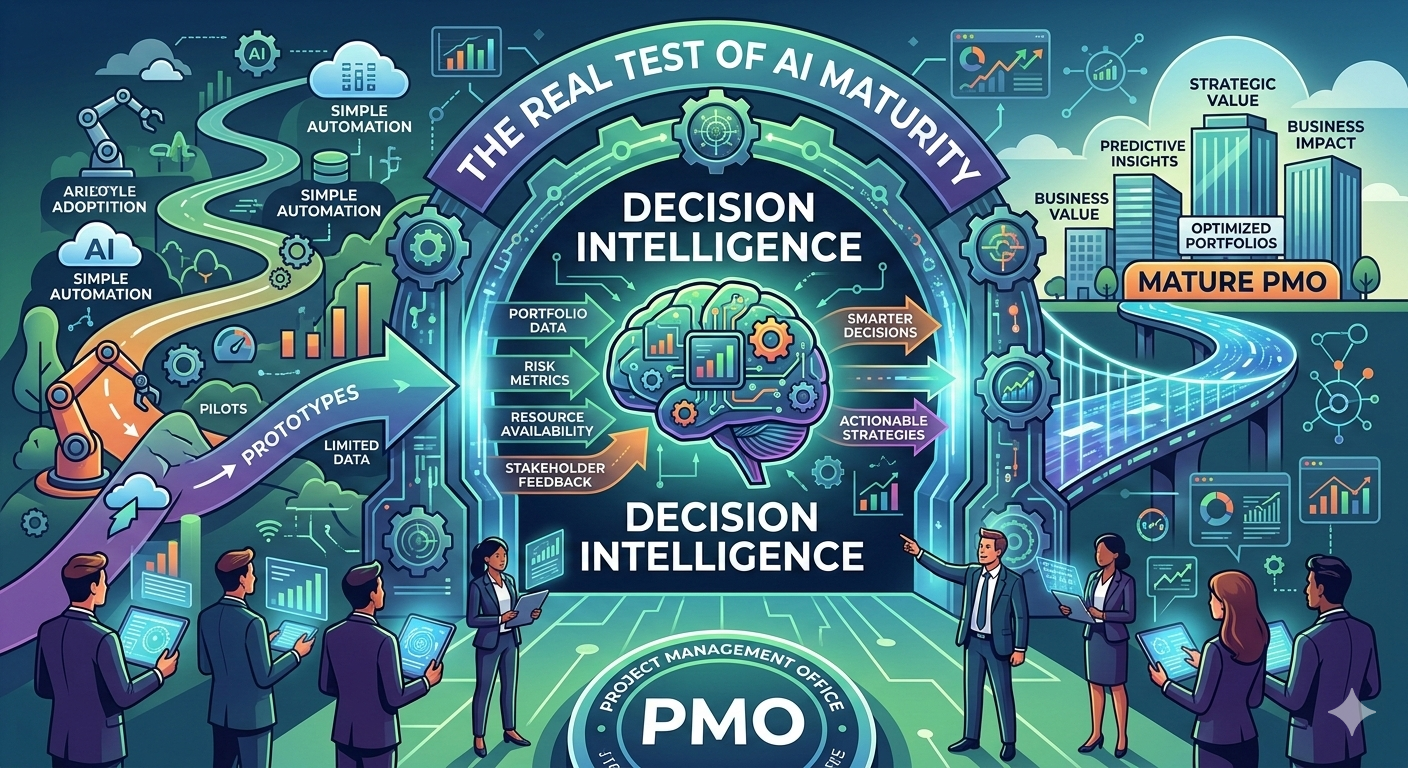


Decision intelligence goes beyond data analysis. It represents the capability to make explicit the criteria, patterns, and biases that structure organizational decisions. The AI-PMO model positions AI as strategic infrastructure and as a cognitive mirror, revealing inconsistencies, recurring patterns, and systemic impacts (AIPMO & Joslin, 2025).
Yet this transformation is sustained by clear principles.

First, final human accountability. AI-assisted decisions require explicit human validation and justification. Accountability is not transferred to the algorithm.
Second, transparency and explainability. If a PMO cannot explain the criteria behind an algorithmic recommendation, maturity does not exist. Governance requires traceability.
Third, active governance. AI must operate under structured supervision, with defined roles, continuous monitoring, and risk evaluation. Technology without governance accelerates uncertainty.
Fourth, ethics over efficiency. The fastest decision is not necessarily the right one. In the AI-PMO model, operational efficiency never overrides ethical responsibility.
Fifth, human AI integration. Maturity does not lie in pure automation, but in combining algorithmic analysis with contextual judgment. AI augments cognition; it does not replace reflection.
Sixth, reflexive learning. An intelligent PMO does not merely decide. It learns from its decisions. AI can surface invisible patterns but only if formal review and learning processes exist.

These principles fundamentally redefine maturity.

AI maturity is not measured by the number of automated dashboards or algorithm-generated reports. It is measured by the PMO’s ability to:
  • Make decision criteria explicit
  • Ensure transparency and justifiability
  • Operate under structured governance
  • Integrate ethics into decision processes
  • Combine algorithmic analysis with human judgment
  • Learn from patterns and consequences
A PMO may be technologically advanced and still operate at a low level of decision maturity.
The central question, therefore, is not whether the PMO uses AI.

The question is:

  1. Does the PMO know how to explain why it decides the way it does?
  2. Is AI being used to accelerate decisions or to improve them?
  3. Is there formal oversight over AI-assisted decisions?
  4. Are decision criteria transparent or implicit?
  5. Is the organization measuring automation or strategic impact?

The Intelligent PMO is not the one that uses AI as an operational tool.
It is the one that governs AI, understands its own decision architecture, and elevates the strategic quality of organizational choices.
And perhaps the most important question is not technological.
Perhaps it is structural.

If AI were removed tomorrow, would your PMO’s decision process remain solid, transparent, and justifiable?

Or does it depend on outputs that no one truly questions?

References

  • AIPMO, & Joslin, R. (2025). AI-PMO™ Foundations: The Intelligent Companion. Association of International Project Management Officers (AIPMO). AI-PMO Foundations
  • Project Management Institute. (2024). Maximizing project success. Project Management Institute.
  • Project Management Institute. (2025a). Global project management talent gap. Project Management Institute.
  • Project Management Institute. (2025b). Pulse of the Profession® 2025. Project Management Institute.
  • Project Management Institute. (2025c). Reclaiming Agile’s Promise: How GenAI enhances agility’s business value through human-centered collaboration. Project Management Institute.
Posted on: February 27, 2026 04:20 PM | Permalink | Comments (0)

Why PMOs Don’t Fail for Lack of Method — They Fail for Lack of Organizational Intelligence

Categories: PMO

linkedin twitter facebook Request to reuse this  

Using the Tier 1 Assessment to Distinguish Maturity, Influence, and Real Organizational Impact


For years, the default response to almost every PMO-related problem has been the same:
more methods, more processes, more frameworks, more tools.

The outcome is familiar. PMOs are increasingly structured, certified, and instrumented and paradoxically, increasingly distant from strategic decision-making.

This paradox is not caused by lack of effort.

Nor by lack of discipline.
Nor by lack of technical knowledge.
It runs deeper.

When we observe PMOs in day-to-day organizational life, a recurring pattern emerges. Reports are produced. Dashboards are updated. Processes are followed.
Yet decisions continue to be made outside the PMO.
Or worse, without the PMO.
In these cases, the problem is not execution.
It is interpretation.
Interpretation of organizational context.
Interpretation of real limits of influence.
Interpretation of tensions between strategy, portfolio, and operations.
Interpretation of what truly matters to decision-makers.

Across real PMO diagnostics conducted in different sectors, organizational sizes, and maturity levels, the same pattern appears. Many PMOs demonstrate reasonable methodological maturity. Very few demonstrate consistent impact on decisions, priorities, and outcomes.
Not because processes are missing.
But something far more difficult is missing: organizational intelligence.

Organizational intelligence is not synonymous with data.
Nor with reports.
Nor with automation.

It is the capability to transform information into judgment, judgment into decisions, and decisions into impact. And that capability cannot be achieved through methods alone.
One of the most common blind spots in modern PMOs is not lack of information but excess information without interpretation. Many PMOs confuse transparency with intelligence. They provide visibility but avoid making trade-offs explicit. They deliver data but stop short of interpretation.

The result is an informational PMO, correct,well-intentioned, and largely irrelevant to executives who must decide under pressure.
As data-driven technologies and artificial intelligence become more prevalent in management environments, this challenge intensifies.
AI amplifies capabilities.
But it also amplifies fragilities.
Without clear governance, without an explicit understanding of domains of control and influenc, and, without prioritization logic, technology does not create intelligence. It merely accelerates what already exists.

Automating a PMO without organizational intelligence does notcreate ae competitive advantage. It creates noise at scale.

That is why the future of the PMO cannot be reduced to frameworks, models, or tools. It must address harder questions:

Does the PMO understand its real role within the organizational system?
Can it distinguish between perceived maturity and actual impact?
Does it operate as an administrative structure or as a service architecture oriented toward decision-making and outcomes?
For organizations that want to move beyond reflection and understand, with evidence, how their PMO actually operates, the natural starting point is the Tier 1 Assessment.

What the Tier 1 Assessment Delivers

By completing the Tier 1 Assessment (average completion time of approximately one hour), organizations automatically receive a comprehensive analytical report of roughly 40 pages, structured according to the official model of the AIPMO.
The report provides:

  • Maturity levels by service domain
  • Objective identification of real strengths and gaps
  • Prioritized recommendations based on impact and structural coherence
  • Analysis grounded in the official maturity and impact architecture
  • Configurable views for PMOs, VMOs, and related organizational functions
  • A practical demonstration of how artificial intelligence is used within analytical dashboards

Beyond the individual report, all respondents are invited to an exclusive online panel, where participants can:

  • See their relative position within the global landscape, segmented by sector, region, and organization type
  • Identify emerging patterns of maturity and impact
  • Experience how the Tier 1 AI Agent supports interpretation of results and helps translate diagnostics into executive-level insight

The consolidated results of this assessment cycle will be presented during an official global event in the first quarter of 2026, reinforcing benchmarking, collective learning, and evidence-based governance.

Perhaps this is the moment to stop adding more methods and start reading the system in which your PMO actually operates.

Posted on: February 03, 2026 09:00 AM | Permalink | Comments (4)

What PMO Global Benchmarking Reveals and How to Assess Your Own

Categories: PMO

linkedin twitter facebook Request to reuse this  

Recent international research reveals an uncomfortable but consistent reality: the actual maturity of PMOs worldwide is far lower than most organizations believe.

1. Fewer than 1% of organizations demonstrate full maturity

The State of the Modern PMO report shows that fewer than 1% of organizations simultaneously meet solid criteria across planning, governance, benefits management, and strategic alignment.
In practical terms, most PMOs operate well below their maximum potential, regardless of country or industry.

2. Limited benefits visibility and weak execution discipline

Global data highlights recurring patterns:

  • 27% of executives lack clear visibility into project benefits
  • 24% of organizations do not measure benefits in any project
  • Only 25% measure benefits in more than 75% of projects
  • Just 22% of PMOs are perceived as highly effective

If this scenario feels familiar, it is likely that significant blind spots are currently constraining strategic decision-making in your PMO.

3. Strategy and execution remain disconnected

Recent international reports indicate that:

  • 72% of organizational resources are misaligned with strategy
  • 61% of PMOs lack sufficient data to support prioritization
  • 36% of organizations do not use strategic data to inform PMO decisions

At the same time, high-performing PMOs show:

  • Around 60% higher strategic alignment
  • Approximately 57% more projects achieving their intended objectives

The difference is not context or sector. It is the combination of structured maturity and disciplined use of data.

4. Organizations are moving toward adaptive models often without diagnosis

Research on adaptive organizations highlights clear gains in decision speed, lighter governance, and faster portfolio adjustment.
However, true adaptation is only possible when an organization clearly understands where it stands and where it needs to evolve. Without diagnosis, sustainable adaptation is not possible.
 

global invitation to PMO leaders

This is precisely the challenge addressed by the PMO-MI® Tier 1 Assessment.
We are building a global benchmarking initiative, based on an international model, to answer questions PMOs around the world are asking:

  • What is the real maturity of my PMO?
  • Where are the most critical structural gaps?
  • Which domains are strong, and which are limiting impact?
  • How does my PMO compare across countries and industries?

Every participation strengthens the global data set and improves the quality of comparisons.

What you receive when you complete the Tier 1 Assessment
1. A structured international diagnosis
A comprehensive report of approximately 44 pages covering:

  • PMO vision, mission, and purpose
  • Maturity across 24 service domains
  • Real strengths and structural gaps
  • Clear and practical recommendations

2. Evidence-based support for strategic conversations
You replace subjective opinions with comparable, structured evidence, strengthening your legitimacy with executive leadership.

3. Participation in a global benchmark
Your PMO becomes part of an international reference base, enabling real comparison and cross-learning.

4. Prioritization clarity
The diagnosis helps redirect effort toward domains that truly drive impact, reducing dispersion and rework.

5. Connection between diagnosis and solution
Results can be deepened through action-oriented workshops, connecting analysis to practical evolution.

Why participate now

Because meaningful benchmarks are built early.
The sooner you participate, the stronger the comparative insight and collective learning.
? In approximately 30 minutes, you receive a complete diagnostic report and contribute to raising the global standard of PMOs.

This is an open invitation to PMO, VMO, and project governance leaders worldwide.


Posted on: January 29, 2026 02:24 PM | Permalink | Comments (2)

Oct 10, 2024

linkedin twitter facebook Request to reuse this  

The Half Double methodology is an innovative hybrid approach to project management, designed to maximize impact and accelerate project execution in dynamic and complex environments. 

The Half Double methodology is built on three fundamental principles:

  1. Impact : Continuous focus on creating impact, ensuring that project outcomes generate real, tangible value for stakeholders. This principle emphasizes the importance of delivering measurable, high-priority benefits throughout the project lifecycle.
  2. Flow : Maximizing workflow by reducing time between steps and eliminating bottlenecks that could delay delivery. The methodology encourages rapid adaptation and minimizing work in progress to maintain a steady, efficient pace.
  3. Leadership : Strong and engaged leadership, with an emphasis on close and active management. Leadership at Half Double is geared towards empowering the team, fostering collaboration and making quick and informed decisions.

Methods and Tools of the Half Double Methodology

The implementation of the Half Double methodology involves the application of three fundamental principles using specific methods and tools:

IMPACT

     Methods

  • Early Impact : Identifying and prioritizing high-value deliverables early in the project to ensure early and visible impact.
  • Pulse Checks : Conducting regular impact checks to ensure the project is on track to deliver expected results.

     Tools:

  • Impact Case : a document that details the expected benefits of the project and how they will be measured and achieved.
  • Impact Tracking : Continuous monitoring system of project results in terms of impact, using pre-defined metrics.

FLOW

      Methods :

  • Rhythm in Key Events : Establishing a clear rhythm for key project events such as status meetings, planning sessions, and reviews.
  • Co-location and Visual Tools : Promoting team co-location and using visual tools to facilitate communication and transparency.

        Tools :


  • Kanban Boards : Visual dashboards to manage workflow, highlighting task progress and identifying bottlenecks.
  • Daily Stand-ups : Short daily meetings to sync the team, discuss progress, and quickly resolve impediments.

LEADERSHIP

        Methods :

  • Active Project Ownership : Ensuring that project leaders are actively involved and empowered to make quick decisions.
  • Engaged and Committed Leadership : Fostering an environment where leadership is constantly engaged and committed to the success of the project.

        Tools :


  • Leadership Pulse Check : Tool to regularly assess the level of engagement and effectiveness of project leadership.
  • Stakeholder Map : Mapping stakeholders to identify their needs and influences, ensuring effective communication and strategic alignment.

Local Translation: Adapting the Half Double Methodology to the Local Context

Adapting the Half Double methodology to the local context, known as "local translation", involves customizing the principles, methods and tools to meet the specific needs of the organization and the project environment. This process includes:

  • Contextual Analysis : Assessment of the unique characteristics of the project environment, including organizational culture, governance structure, and existing practices.
  • Customization of Practices : Adjustment of the methods and tools of the Half Double methodology to align with local realities, ensuring relevance and effectiveness.
  • Stakeholder Engagement : Active involvement of local stakeholders to obtain feedback and promote acceptance of adapted practices.
  • Training and Capacity Building : Development of customized training programs to train staff and leaders in the application of Half Double practices adapted to the local context.

Benefits and Challenges

Applying the Half Double methodology offers several significant benefits:

  • Increased Impact : By focusing on impact from the beginning and ensuring high-value deliverables, projects can generate significant benefits in less time.
  • Reduced Cycle Time : Emphasis on maximizing workflow helps reduce cycle times, allowing projects to be completed faster.
  • Team Engagement : Active leadership and a focus on team collaboration and empowerment foster a positive and productive work environment.
  • Flexibility and Adaptability : The Half Double methodology is adaptable to different types of projects and environments, making it a versatile choice for organizations operating in dynamic and uncertain contexts.

However, implementing the Half Double methodology can present challenges, such as the need for significant cultural transformation, resistance from stakeholders accustomed to traditional methodologies, and the need for continuous investment in training.


The Half Double hybrid project management methodology represents an innovative and effective approach to meeting the challenges of modern projects. With its focus on impact, flow and leadership, and the use of specific methods and tools, Half Double offers a practical and powerful way to maximize results and accelerate project execution.

By adopting the Half Double methodology and adapting its practices to the local context, organizations can benefit from greater flexibility, reduced cycle time, and a significant increase in project impact. Overcoming cultural challenges and investing in ongoing staff training are essential to reap the benefits of this innovative approach.

Half Double is not just a combination of traditional and agile practices; it is a project management philosophy that puts impact and leadership at the heart of every initiative, fostering a collaborative, agile and highly efficient work environment.

Posted on: October 10, 2024 02:10 PM | Permalink | Comments (3)
ADVERTISEMENTS

"A nod's as good as a wink to a blind bat"

- Eric Idle, Monty Python's Flying Circus

ADVERTISEMENT

Sponsors