
Why project leadership is becoming an essential capability in complex organizational environments.


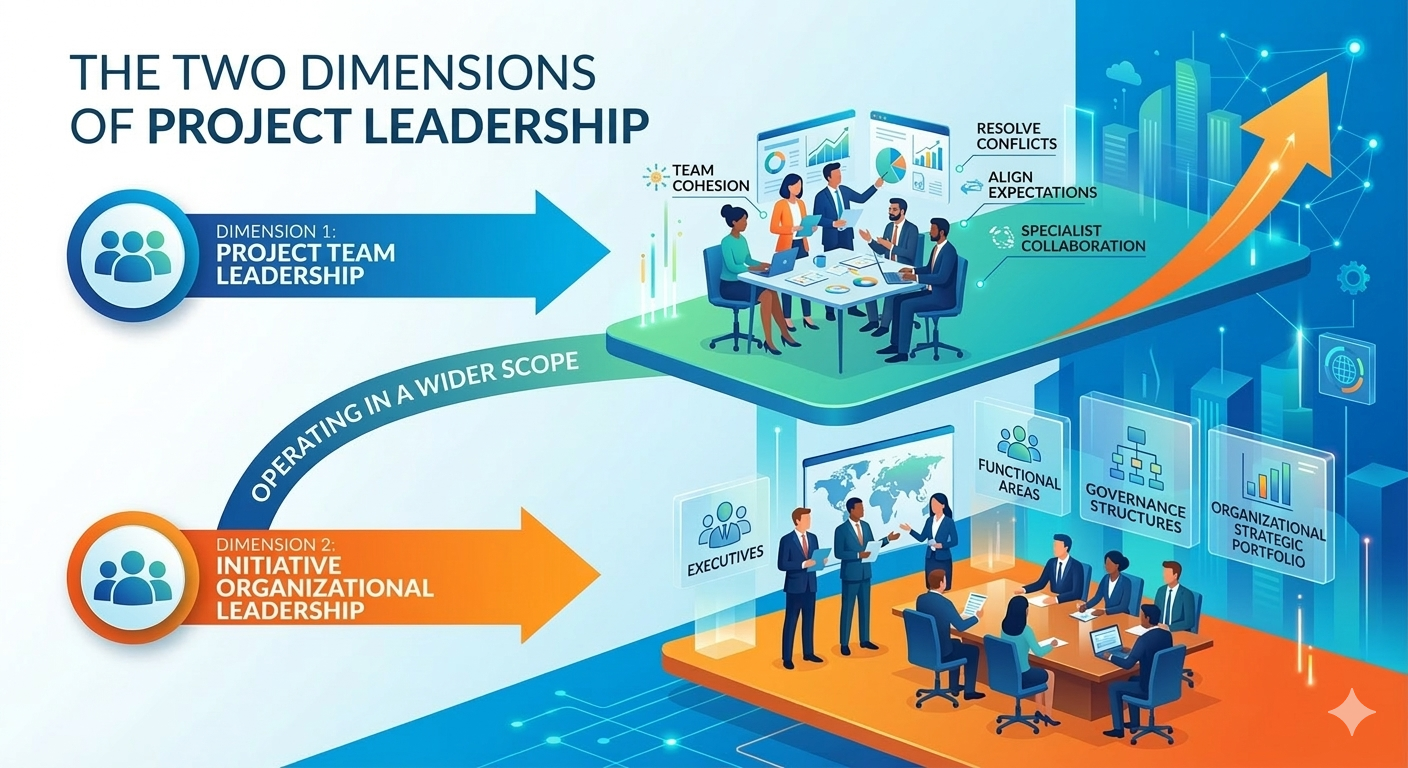
| Leadership in projects has always been considered important in the project management literature. However, the practical meaning of leadership has changed significantly as projects have come to play a more central role in organizational transformation. What was once largely understood as the ability to coordinate teams and deliver scope within time and budget has evolved into something broader: the ability to connect projects to strategy, navigate organizational complexity, and generate real business impact. To understand this evolution, it is useful to examine how three widely used references address the topic: PMI, IPMA, and more recent approaches associated with the concept of Project Leadership. For many years, the dominant literature treated leadership as a competence of the project manager. For the Project Management Institute, leadership appears primarily within the domain related to the project team. The emphasis is on skills such as motivating people, resolving conflicts, building trust, and facilitating collaboration within the project team. This model assumes that the project manager must create an environment in which the team can perform the work effectively. A similar approach can be observed in the IPMA thtat organizes professional competencies into three broad areas: Perspective, People, and Practice. Leadership appears within the People domain and is treated as a behavioral competence involving influence, integrity, communication, and the ability to mobilize people. These models have contributed enormously to the professionalization of the discipline. However, they also reflect a historical moment in which projects were often seen as relatively bounded execution mechanisms within organizations. As projects increasingly became vehicles for innovation, digital transformation, and organizational change, this understanding began to expand. Today many projects are no longer limited to delivering a product or system. They involve profound organizational change. Digital transformation projects, for example, may alter processes, power structures, business models, and even organizational culture. In such contexts, leadership in projects is no longer confined to the project team.
In other words, technically well-managed projects may still fail if they are not properly connected to the strategic priorities of the organization. A simple example helps illustrate this difference. "Imagine a project implementing a new enterprise resource planning (ERP) system in a large industrial organization. A traditional project manager might focus on building a detailed schedule, managing technical risks, coordinating the IT team, and ensuring that the system is delivered on time and within budget. From a project management perspective, this might be considered a success. However, many ERP projects fail not because of technical problems but because of organizational factors. User resistance, conflicts between departments, redefinition of processes, and disputes over information control are common challenges. If these issues are not addressed, the system may be implemented correctly yet still fail to deliver the expected benefits." In this type of situation, the role of leadership becomes much broader. The project leader must act as an organizational integrator. This involves engaging with executives, understanding strategic implications, negotiating changes across departments, and ensuring that the initiative remains aligned with business priorities. This requires competencies that go beyond traditional project management techniques. This point also appears in research analyzing the role of governance structures and PMOs. Studies indicate that these structures influence project success not only through methodologies and tools but primarily through the way they connect projects to strategic decision-making within the organization. In this context, project leadership is exercised within a broader organizational system that includes portfolios, governance mechanisms, and decision structures. This movement helps explain why, in more recent discussions about the evolution of the profession, the term Project Leadership is appearing with increasing frequency. The idea is not to replace the concept of project management but to recognize that the role of the professional has expanded. Project professionals still need to master methods, planning, and control. But they also need to understand organizational dynamics, strategy, and change. The relevant question for the project management community may therefore not be limited to how to improve project management techniques. The question may be deeper. Are we training professionals who are capable only of managing schedules, or leaders capable of guiding initiatives that truly transform organizations?
References
|
Project Management Pills – A Thousand ways to fail as a Project Manager
|
The biggest challenge is your discipline to run the project in a continuous way not your technical expertise, think about that. |
 I´ve seen and read thousands of articles, posts, books and presentations in how to fail as a Project Manager… As I am one of them I´ve decided that it is time to collect tips and tricks and share with the community, here we go:
The role of Leader in Project Management
| Managed projects and delivery it with success demands what is obvious, meaning, ability, technical skills and knows project management process, but it is more than that,, you have to understand the basic principles of leadership and you have to exercise them daily and when you do this you will understand this sentence: "Not every project manager is project leader." And during project execution will remember this phrase also: "Your team is equally important to the success of the project and it should be a high performance team." A team of this level does not fall from the sky or appears miraculously, it takes time to build a high performance team, but don´t be naive, teams needs strict discipline and rigid definition and control roles and responsibilities which has to be e followed! If you want your team to be high performance you need to create this structure otherwise you will have chaos in your project, when it is achieved you will be able to trigger innovation and creativity with the team and results will be materialized. This is your role as a leader, create this structure ! You want to be one more or want to make a difference? Remember for each project delivered with success project you get a free invitation to run another project and, increasingly complex. You decide which path you want to follow, up or down the ladder of success...If you want to climb the hill I invite you to continue reading this article because from this point I write for those who want to win.
As leader there are principles you have to consider and follow as stated above, which I will describe below:
"The reason most people do not achieve their goals is because they were not defined, or have never been seriously considered by them as attainable or reliable. Winners can tell you where they're going, what they plan to do along the way, and who will participate in this adventure with them "- Denis E. Waitley
|

Using Storytelling in Project Management
| We as project managers are facing an additional major challenge with our project team... The clash of generations (baby boomers, generation X, Y and millennium ), four generations (as far as I remember until now...) working together ... that have different behavior characteristics in relation to others. The consequence of this is the increasing complexity for us project managers is to understand and communicate effectively with the them, for example a project manager in age of 60 years old, and a team with the following ages: 20 , 35 and 45 so this becomes very complex. Imagine another situation where you request to a staff member to invest his time to delivery a set of tasks from a task list which you have previously communicated to him but he could not do the job properly. Why ? What happened is that the storytelling was not applied , that is, the lack of a "proper narrative" did not cause engagement of your colleague. In that case he had less chance to remember and probably could not get involved or repeat the appropriate behavior for the completion of that work, this happened for two factors combined: Communication noise and clash of generations When we explain what is expected to a colleague we should explain it in a narrative way (with the procedure included) and providing an example on when and what the situation that happened. Read for example the text below: "Once upon a time, a group of people who were outraged at how the failed software projects. Then they had begin to study more about the nature of the software and found that developing software is an extremely intellectual work and not manual or repetitive. Thus, the Taylor models concerning job specialization and motivation of workers which were inherited in software management would not be the most recommended best practices. In fact, it would be virtually opposite. " This is storytelling! If you succeed to create an emotional connection with your team member your colleague will be able to feel and be excited about this narrative as a consequence engagement and commitment will come together. Remember the stories you heard from your mother and grandma when you were young ? Same approach !
This concept of "storytelling" is actually already well known in the business world with the name of Storytelling, a strong tool for corporate communication both internally and externally as we begin to use in projects. Projects are communicated and messages are transmitted through stories, creating an emotional bond, facilitating the understanding and memorization. This technique is high precisely because of the new challenges in the workplace, generated by the transformation that technology has brought us (is the new trend for the coming years, for which we must prepare ourselves). The more we use social media, more will need to incorporate storytelling techniques to motivate, lead and work with the new generations. Concluding: A good project leader who can engage and explain to your project member what should be done in a certain project procedure or how to act in the face of certain situations before meet a customer or in how the conduct of project activities;instead of using a list actions that must be done, it uses an example ( a story ) in which those procedures were applied achieving greater efficiency . I hope you had enjoyed it ! Nelson Rosamilha,PMP®,BB®,Prince 2 Practitioner®
|


