Project Management

Operational Excellence in Project Management

by
Leadership, PMO and Project Management

About this Blog

RSS

Recent Posts

Is the PMO governing projects, or trying to control complexity with inadequate tools?

From Governance to Execution Intelligence: How PMOs Navigate Complexity

PMOs Navigating Complexity: From Coordination to Sensemaking

How to Measure PMO Impact Practically, Based on Evidence Rather Than Perception

How to Reposition the PMO for Real Influence

Categories

Agile, best practice, business agility, competence, Consulting, customer, customer succcess, Decision Making, Education, excellence, Governance, Government, Healthcare, Information Technology, Innovation, kamishibai, Leadership, leadership, lean, Organizational Project Management, PM in Academia, PMO, pmo, pmo, project leader, project manager, risk, risk management, scope, storytelling, team

Date

The New Consciousness of the Management Office

linkedin twitter facebook Request to reuse this  

From Process Governance to Thought Governance


Over the past few years, organizations have invested heavily in data, digital infrastructure, and artificial intelligence. In portfolio and transformation environments, AI is already supporting risk analysis, prioritization, forecasting, and reporting. The promise is compelling: greater speed, greater predictability, greater analytical depth.

Yet a persistent paradox remains.

Despite better tools and more data, many organizations continue to struggle with strategic misalignment, inconsistent prioritization, and decisions that fail to translate into measurable impact. Technology has advanced. Decision quality has not evolved at the same pace.

This suggests that the core challenge is no longer operational. It is cognitive.

The question is no longer how to control processes more effectively. It is how to structure the thinking that governs those processes.

Historically, the Management Office has been designed as the guardian of process governance: standards, compliance, reporting, structure, discipline. Its role was to ensure order and predictability.
But in environments characterized by complexity, interdependence, and compressed strategic cycles, process control is no longer sufficient.
Maturity today is defined not only by the existence of governance mechanisms, but by the quality of the reasoning that guides their application.
The new consciousness of the Management Office represents this shift.
It moves from monitoring procedures to curating organizational judgment. It asks not only,

“Are we following the process?” but also, “Are we thinking with strategic clarity?”

This transition requires five structural shifts:

• From certainty to continuous learning
• From control to transparency
• From rigid stability to adaptability
• From isolated efficiency to ethical responsibility
• From functional silos to conscious collaboration


Artificial intelligence, in this context, is not the protagonist. It is a catalyst.
AI amplifies patterns.
It makes implicit criteria visible.
It exposes inconsistencies.
If an organization operates with clarity, AI enhances clarity.
If it operates with noise, AI amplifies noise.
The real transformation does not happen in the tool.
It happens in the mindset that governs its use.

How to Begin Tomorrow


This shift may sound abstract. It is not.
It starts with structured interventions.

At your next portfolio review meeting, replace part of the status discussion with three questions:

• What strategic assumption are we making here?
• Which invisible criterion is guiding this decision?
• What would prove this decision wrong six months from now?

Before prioritizing initiatives, make the decision criteria explicit. Not only the scoring model, but the reasoning behind it.

Implement a strategic decision log. Capture not only what was decided, but why, under which assumptions, and with which accepted risks.

Once per quarter, conduct a strategic coherence review. Not a process audit. A reasoning audit. Ask whether the portfolio truly reflects declared strategic intent.
These practices require no new technology. They require cognitive maturity.

Structure Sustains Consciousness


Awareness without structure dissolves into rhetoric.

Developing this new consciousness demands method: disciplined prioritization logic, explicit governance criteria, integrated portfolio alignment, and systematic learning from decisions.

Without structure, mindset remains aspiration.
With structure, mindset becomes institutional capability.

The most important question is not whether your Management Office is digital.

It is whether it is conscious.
AI does not create maturity.
It reveals it.
Posted on: February 16, 2026 10:06 AM | Permalink | Comments (1)

Why PMOs Don’t Fail for Lack of Method — They Fail for Lack of Organizational Intelligence

Categories: PMO

linkedin twitter facebook Request to reuse this  

Using the Tier 1 Assessment to Distinguish Maturity, Influence, and Real Organizational Impact


For years, the default response to almost every PMO-related problem has been the same:
more methods, more processes, more frameworks, more tools.

The outcome is familiar. PMOs are increasingly structured, certified, and instrumented and paradoxically, increasingly distant from strategic decision-making.

This paradox is not caused by lack of effort.

Nor by lack of discipline.
Nor by lack of technical knowledge.
It runs deeper.

When we observe PMOs in day-to-day organizational life, a recurring pattern emerges. Reports are produced. Dashboards are updated. Processes are followed.
Yet decisions continue to be made outside the PMO.
Or worse, without the PMO.
In these cases, the problem is not execution.
It is interpretation.
Interpretation of organizational context.
Interpretation of real limits of influence.
Interpretation of tensions between strategy, portfolio, and operations.
Interpretation of what truly matters to decision-makers.

Across real PMO diagnostics conducted in different sectors, organizational sizes, and maturity levels, the same pattern appears. Many PMOs demonstrate reasonable methodological maturity. Very few demonstrate consistent impact on decisions, priorities, and outcomes.
Not because processes are missing.
But something far more difficult is missing: organizational intelligence.

Organizational intelligence is not synonymous with data.
Nor with reports.
Nor with automation.

It is the capability to transform information into judgment, judgment into decisions, and decisions into impact. And that capability cannot be achieved through methods alone.
One of the most common blind spots in modern PMOs is not lack of information but excess information without interpretation. Many PMOs confuse transparency with intelligence. They provide visibility but avoid making trade-offs explicit. They deliver data but stop short of interpretation.

The result is an informational PMO, correct,well-intentioned, and largely irrelevant to executives who must decide under pressure.
As data-driven technologies and artificial intelligence become more prevalent in management environments, this challenge intensifies.
AI amplifies capabilities.
But it also amplifies fragilities.
Without clear governance, without an explicit understanding of domains of control and influenc, and, without prioritization logic, technology does not create intelligence. It merely accelerates what already exists.

Automating a PMO without organizational intelligence does notcreate ae competitive advantage. It creates noise at scale.

That is why the future of the PMO cannot be reduced to frameworks, models, or tools. It must address harder questions:

Does the PMO understand its real role within the organizational system?
Can it distinguish between perceived maturity and actual impact?
Does it operate as an administrative structure or as a service architecture oriented toward decision-making and outcomes?
For organizations that want to move beyond reflection and understand, with evidence, how their PMO actually operates, the natural starting point is the Tier 1 Assessment.

What the Tier 1 Assessment Delivers

By completing the Tier 1 Assessment (average completion time of approximately one hour), organizations automatically receive a comprehensive analytical report of roughly 40 pages, structured according to the official model of the AIPMO.
The report provides:

  • Maturity levels by service domain
  • Objective identification of real strengths and gaps
  • Prioritized recommendations based on impact and structural coherence
  • Analysis grounded in the official maturity and impact architecture
  • Configurable views for PMOs, VMOs, and related organizational functions
  • A practical demonstration of how artificial intelligence is used within analytical dashboards

Beyond the individual report, all respondents are invited to an exclusive online panel, where participants can:

  • See their relative position within the global landscape, segmented by sector, region, and organization type
  • Identify emerging patterns of maturity and impact
  • Experience how the Tier 1 AI Agent supports interpretation of results and helps translate diagnostics into executive-level insight

The consolidated results of this assessment cycle will be presented during an official global event in the first quarter of 2026, reinforcing benchmarking, collective learning, and evidence-based governance.

Perhaps this is the moment to stop adding more methods and start reading the system in which your PMO actually operates.

Posted on: February 03, 2026 09:00 AM | Permalink | Comments (4)

What PMO Global Benchmarking Reveals and How to Assess Your Own

Categories: PMO

linkedin twitter facebook Request to reuse this  

Recent international research reveals an uncomfortable but consistent reality: the actual maturity of PMOs worldwide is far lower than most organizations believe.

1. Fewer than 1% of organizations demonstrate full maturity

The State of the Modern PMO report shows that fewer than 1% of organizations simultaneously meet solid criteria across planning, governance, benefits management, and strategic alignment.
In practical terms, most PMOs operate well below their maximum potential, regardless of country or industry.

2. Limited benefits visibility and weak execution discipline

Global data highlights recurring patterns:

  • 27% of executives lack clear visibility into project benefits
  • 24% of organizations do not measure benefits in any project
  • Only 25% measure benefits in more than 75% of projects
  • Just 22% of PMOs are perceived as highly effective

If this scenario feels familiar, it is likely that significant blind spots are currently constraining strategic decision-making in your PMO.

3. Strategy and execution remain disconnected

Recent international reports indicate that:

  • 72% of organizational resources are misaligned with strategy
  • 61% of PMOs lack sufficient data to support prioritization
  • 36% of organizations do not use strategic data to inform PMO decisions

At the same time, high-performing PMOs show:

  • Around 60% higher strategic alignment
  • Approximately 57% more projects achieving their intended objectives

The difference is not context or sector. It is the combination of structured maturity and disciplined use of data.

4. Organizations are moving toward adaptive models often without diagnosis

Research on adaptive organizations highlights clear gains in decision speed, lighter governance, and faster portfolio adjustment.
However, true adaptation is only possible when an organization clearly understands where it stands and where it needs to evolve. Without diagnosis, sustainable adaptation is not possible.
 

global invitation to PMO leaders

This is precisely the challenge addressed by the PMO-MI® Tier 1 Assessment.
We are building a global benchmarking initiative, based on an international model, to answer questions PMOs around the world are asking:

  • What is the real maturity of my PMO?
  • Where are the most critical structural gaps?
  • Which domains are strong, and which are limiting impact?
  • How does my PMO compare across countries and industries?

Every participation strengthens the global data set and improves the quality of comparisons.

What you receive when you complete the Tier 1 Assessment
1. A structured international diagnosis
A comprehensive report of approximately 44 pages covering:

  • PMO vision, mission, and purpose
  • Maturity across 24 service domains
  • Real strengths and structural gaps
  • Clear and practical recommendations

2. Evidence-based support for strategic conversations
You replace subjective opinions with comparable, structured evidence, strengthening your legitimacy with executive leadership.

3. Participation in a global benchmark
Your PMO becomes part of an international reference base, enabling real comparison and cross-learning.

4. Prioritization clarity
The diagnosis helps redirect effort toward domains that truly drive impact, reducing dispersion and rework.

5. Connection between diagnosis and solution
Results can be deepened through action-oriented workshops, connecting analysis to practical evolution.

Why participate now

Because meaningful benchmarks are built early.
The sooner you participate, the stronger the comparative insight and collective learning.
? In approximately 30 minutes, you receive a complete diagnostic report and contribute to raising the global standard of PMOs.

This is an open invitation to PMO, VMO, and project governance leaders worldwide.


Posted on: January 29, 2026 02:24 PM | Permalink | Comments (2)

Oct 10, 2024

linkedin twitter facebook Request to reuse this  

The Half Double methodology is an innovative hybrid approach to project management, designed to maximize impact and accelerate project execution in dynamic and complex environments. 

The Half Double methodology is built on three fundamental principles:

  1. Impact : Continuous focus on creating impact, ensuring that project outcomes generate real, tangible value for stakeholders. This principle emphasizes the importance of delivering measurable, high-priority benefits throughout the project lifecycle.
  2. Flow : Maximizing workflow by reducing time between steps and eliminating bottlenecks that could delay delivery. The methodology encourages rapid adaptation and minimizing work in progress to maintain a steady, efficient pace.
  3. Leadership : Strong and engaged leadership, with an emphasis on close and active management. Leadership at Half Double is geared towards empowering the team, fostering collaboration and making quick and informed decisions.

Methods and Tools of the Half Double Methodology

The implementation of the Half Double methodology involves the application of three fundamental principles using specific methods and tools:

IMPACT

     Methods

  • Early Impact : Identifying and prioritizing high-value deliverables early in the project to ensure early and visible impact.
  • Pulse Checks : Conducting regular impact checks to ensure the project is on track to deliver expected results.

     Tools:

  • Impact Case : a document that details the expected benefits of the project and how they will be measured and achieved.
  • Impact Tracking : Continuous monitoring system of project results in terms of impact, using pre-defined metrics.

FLOW

      Methods :

  • Rhythm in Key Events : Establishing a clear rhythm for key project events such as status meetings, planning sessions, and reviews.
  • Co-location and Visual Tools : Promoting team co-location and using visual tools to facilitate communication and transparency.

        Tools :


  • Kanban Boards : Visual dashboards to manage workflow, highlighting task progress and identifying bottlenecks.
  • Daily Stand-ups : Short daily meetings to sync the team, discuss progress, and quickly resolve impediments.

LEADERSHIP

        Methods :

  • Active Project Ownership : Ensuring that project leaders are actively involved and empowered to make quick decisions.
  • Engaged and Committed Leadership : Fostering an environment where leadership is constantly engaged and committed to the success of the project.

        Tools :


  • Leadership Pulse Check : Tool to regularly assess the level of engagement and effectiveness of project leadership.
  • Stakeholder Map : Mapping stakeholders to identify their needs and influences, ensuring effective communication and strategic alignment.

Local Translation: Adapting the Half Double Methodology to the Local Context

Adapting the Half Double methodology to the local context, known as "local translation", involves customizing the principles, methods and tools to meet the specific needs of the organization and the project environment. This process includes:

  • Contextual Analysis : Assessment of the unique characteristics of the project environment, including organizational culture, governance structure, and existing practices.
  • Customization of Practices : Adjustment of the methods and tools of the Half Double methodology to align with local realities, ensuring relevance and effectiveness.
  • Stakeholder Engagement : Active involvement of local stakeholders to obtain feedback and promote acceptance of adapted practices.
  • Training and Capacity Building : Development of customized training programs to train staff and leaders in the application of Half Double practices adapted to the local context.

Benefits and Challenges

Applying the Half Double methodology offers several significant benefits:

  • Increased Impact : By focusing on impact from the beginning and ensuring high-value deliverables, projects can generate significant benefits in less time.
  • Reduced Cycle Time : Emphasis on maximizing workflow helps reduce cycle times, allowing projects to be completed faster.
  • Team Engagement : Active leadership and a focus on team collaboration and empowerment foster a positive and productive work environment.
  • Flexibility and Adaptability : The Half Double methodology is adaptable to different types of projects and environments, making it a versatile choice for organizations operating in dynamic and uncertain contexts.

However, implementing the Half Double methodology can present challenges, such as the need for significant cultural transformation, resistance from stakeholders accustomed to traditional methodologies, and the need for continuous investment in training.


The Half Double hybrid project management methodology represents an innovative and effective approach to meeting the challenges of modern projects. With its focus on impact, flow and leadership, and the use of specific methods and tools, Half Double offers a practical and powerful way to maximize results and accelerate project execution.

By adopting the Half Double methodology and adapting its practices to the local context, organizations can benefit from greater flexibility, reduced cycle time, and a significant increase in project impact. Overcoming cultural challenges and investing in ongoing staff training are essential to reap the benefits of this innovative approach.

Half Double is not just a combination of traditional and agile practices; it is a project management philosophy that puts impact and leadership at the heart of every initiative, fostering a collaborative, agile and highly efficient work environment.

Posted on: October 10, 2024 02:10 PM | Permalink | Comments (3)

Project Management Diagnostic for ISO 21502 Compliance Guidelines on Project Management

Categories: Consulting, Governance

linkedin twitter facebook Request to reuse this  

If you are looking to optimize project management in your organization, ensuring efficiency, compliance, and success, ISO 21502 might be the key you need. This international standard not only offers a structured and effective approach to project execution but also provides valuable tools to identify gaps, mitigate risks, and align projects with your company’s strategic objectives.

In this post, you will discover how to use ISO 21502 to conduct detailed diagnostics and create action plans that elevate project management maturity, utilizing more than 270 practices and 400 tools adapted to your context. Dive into this reading and transform the way your organization conducts projects, ensuring exceptional results.

ISO 21502 is an international standard that provides guidelines for project management. Published by the International Organization for Standardization (ISO), the standard is titled "Project, Programme, and Portfolio Management — Guidance on Project Management" and offers a structured approach to executing projects efficiently and effectively.

Key Aspects of ISO 21502:2020

  • Structure and Organization: The standard provides a clear structure for project management, covering everything from the project’s initiation to its closure.

  • Project Management Principles: It defines fundamental principles that must be followed to ensure project success, including the definition of clear objectives, stakeholder engagement, and efficient resource allocation.

  • Project Management Processes: It describes recommended processes and practices for managing a project, including schedule management, budget, quality, risk, and communication.

  • Competencies and Skills: It highlights the competencies and skills necessary for project managers, emphasizing the importance of continuous development and professional training.

  • Contextual Adaptation: It recommends that processes and practices be adapted to the specific context of the project, considering factors such as project size, complexity, and organizational environment.

ISO 21502 is a valuable tool for organizations of all sizes seeking to improve the effectiveness of their project management, ensuring that projects are completed on time, within budget, and to the desired quality standards.

Reasons for Conducting a Project Diagnosis Using ISO 21502:

  • Identification of Gaps and Deficiencies: It helps to identify gaps and deficiencies in project management processes, enabling continuous improvement.

  • Improving Efficiency and Effectiveness: It assesses whether resources are being used efficiently and if project objectives are being achieved effectively.

  • Compliance with International Standards: It ensures that projects are in compliance with recognized international standards, which can enhance the organization’s credibility and reputation.

  • Risk Management: It helps identify and mitigate potential risks before they become significant problems.

  • Strategic Alignment: It ensures that projects are aligned with the organization's strategic objectives.

  • Enhancing Communication: It improves communication among stakeholders, promoting a common understanding of project objectives and methods.

  • Facilitating Audits and Evaluations: It facilitates the conduct of audits and evaluations, providing a structured basis for reviewing project performance.

  • Competency Development: It identifies areas where the team may need additional competency and skill development.

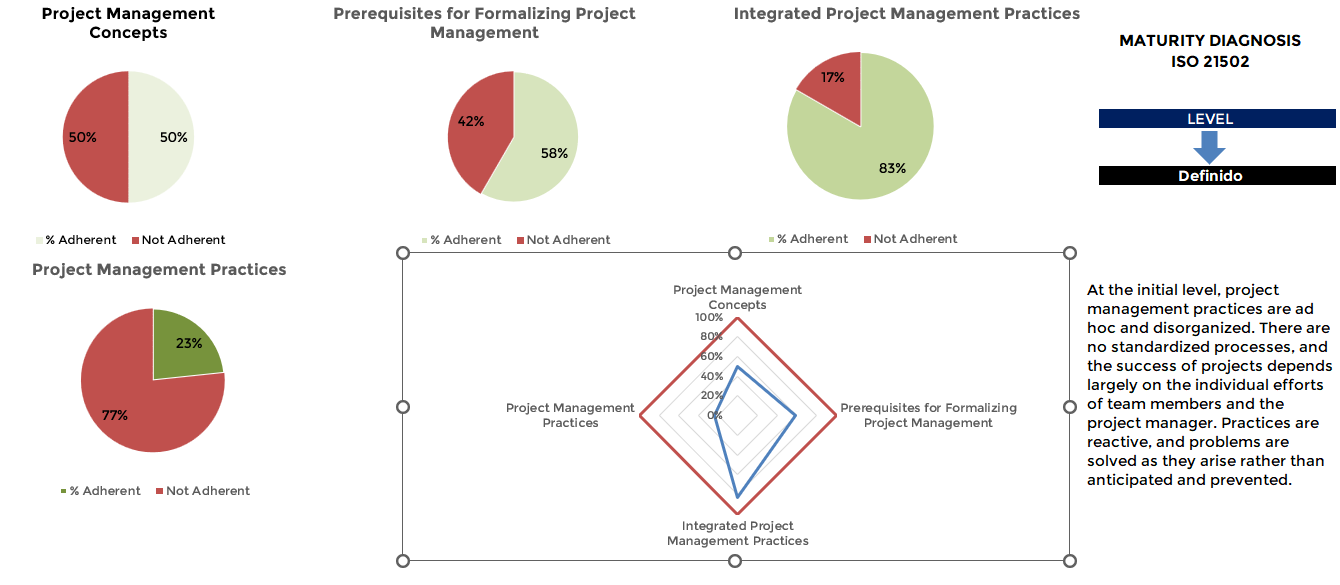
The diagnosis utilizes a set of 60 questions distributed across four different domains. The result of the diagnosis is shown in the following figure.


At the end of the diagnosis, an action plan is presented to improve project management maturity. This plan utilizes a database with over 270 practices and 400 tools suited to the project context.

Therefore, using ISO 21502 as a reference for diagnosis helps establish a solid foundation for continuous improvement in project management, promoting better results and greater success in the projects conducted by the organization.

Posted on: September 11, 2024 12:00 AM | Permalink | Comments (5)
ADVERTISEMENTS

ADVERTISEMENT

Sponsors