
Why project leadership is becoming an essential capability in complex organizational environments.


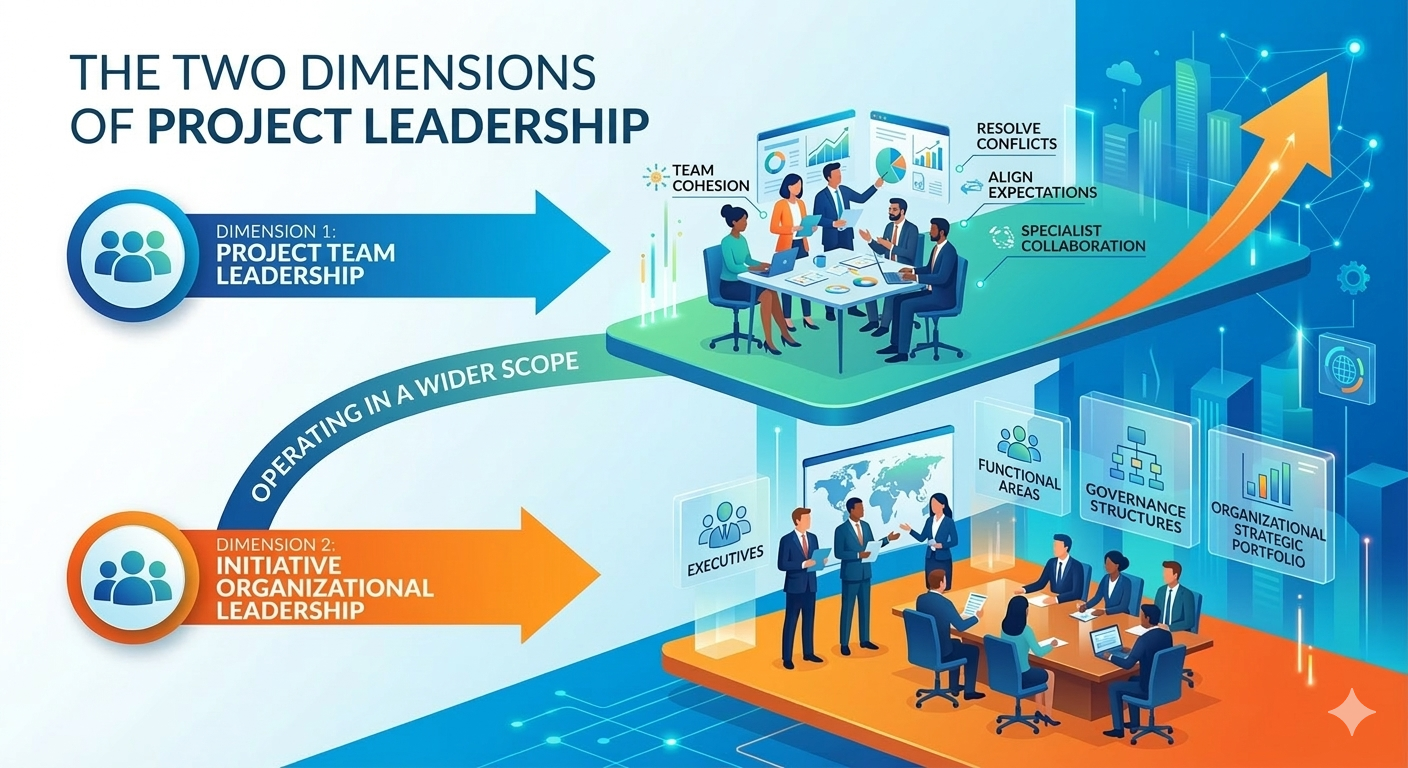
| Leadership in projects has always been considered important in the project management literature. However, the practical meaning of leadership has changed significantly as projects have come to play a more central role in organizational transformation. What was once largely understood as the ability to coordinate teams and deliver scope within time and budget has evolved into something broader: the ability to connect projects to strategy, navigate organizational complexity, and generate real business impact. To understand this evolution, it is useful to examine how three widely used references address the topic: PMI, IPMA, and more recent approaches associated with the concept of Project Leadership. For many years, the dominant literature treated leadership as a competence of the project manager. For the Project Management Institute, leadership appears primarily within the domain related to the project team. The emphasis is on skills such as motivating people, resolving conflicts, building trust, and facilitating collaboration within the project team. This model assumes that the project manager must create an environment in which the team can perform the work effectively. A similar approach can be observed in the IPMA thtat organizes professional competencies into three broad areas: Perspective, People, and Practice. Leadership appears within the People domain and is treated as a behavioral competence involving influence, integrity, communication, and the ability to mobilize people. These models have contributed enormously to the professionalization of the discipline. However, they also reflect a historical moment in which projects were often seen as relatively bounded execution mechanisms within organizations. As projects increasingly became vehicles for innovation, digital transformation, and organizational change, this understanding began to expand. Today many projects are no longer limited to delivering a product or system. They involve profound organizational change. Digital transformation projects, for example, may alter processes, power structures, business models, and even organizational culture. In such contexts, leadership in projects is no longer confined to the project team.
In other words, technically well-managed projects may still fail if they are not properly connected to the strategic priorities of the organization. A simple example helps illustrate this difference. "Imagine a project implementing a new enterprise resource planning (ERP) system in a large industrial organization. A traditional project manager might focus on building a detailed schedule, managing technical risks, coordinating the IT team, and ensuring that the system is delivered on time and within budget. From a project management perspective, this might be considered a success. However, many ERP projects fail not because of technical problems but because of organizational factors. User resistance, conflicts between departments, redefinition of processes, and disputes over information control are common challenges. If these issues are not addressed, the system may be implemented correctly yet still fail to deliver the expected benefits." In this type of situation, the role of leadership becomes much broader. The project leader must act as an organizational integrator. This involves engaging with executives, understanding strategic implications, negotiating changes across departments, and ensuring that the initiative remains aligned with business priorities. This requires competencies that go beyond traditional project management techniques. This point also appears in research analyzing the role of governance structures and PMOs. Studies indicate that these structures influence project success not only through methodologies and tools but primarily through the way they connect projects to strategic decision-making within the organization. In this context, project leadership is exercised within a broader organizational system that includes portfolios, governance mechanisms, and decision structures. This movement helps explain why, in more recent discussions about the evolution of the profession, the term Project Leadership is appearing with increasing frequency. The idea is not to replace the concept of project management but to recognize that the role of the professional has expanded. Project professionals still need to master methods, planning, and control. But they also need to understand organizational dynamics, strategy, and change. The relevant question for the project management community may therefore not be limited to how to improve project management techniques. The question may be deeper. Are we training professionals who are capable only of managing schedules, or leaders capable of guiding initiatives that truly transform organizations?
References
|
Posted on: March 11, 2026 03:56 PM
| Permalink |
Comments (1)


