The New Consciousness of the Management Office


From Process Governance to Thought GovernanceYet a persistent paradox remains. Despite better tools and more data, many organizations continue to struggle with strategic misalignment, inconsistent prioritization, and decisions that fail to translate into measurable impact. Technology has advanced. Decision quality has not evolved at the same pace. This suggests that the core challenge is no longer operational. It is cognitive. The question is no longer how to control processes more effectively. It is how to structure the thinking that governs those processes. Historically, the Management Office has been designed as the guardian of process governance: standards, compliance, reporting, structure, discipline. Its role was to ensure order and predictability. But in environments characterized by complexity, interdependence, and compressed strategic cycles, process control is no longer sufficient. Maturity today is defined not only by the existence of governance mechanisms, but by the quality of the reasoning that guides their application. The new consciousness of the Management Office represents this shift. It moves from monitoring procedures to curating organizational judgment. It asks not only, “Are we following the process?” but also, “Are we thinking with strategic clarity?” This transition requires five structural shifts: • From certainty to continuous learning • From control to transparency • From rigid stability to adaptability • From isolated efficiency to ethical responsibility • From functional silos to conscious collaboration 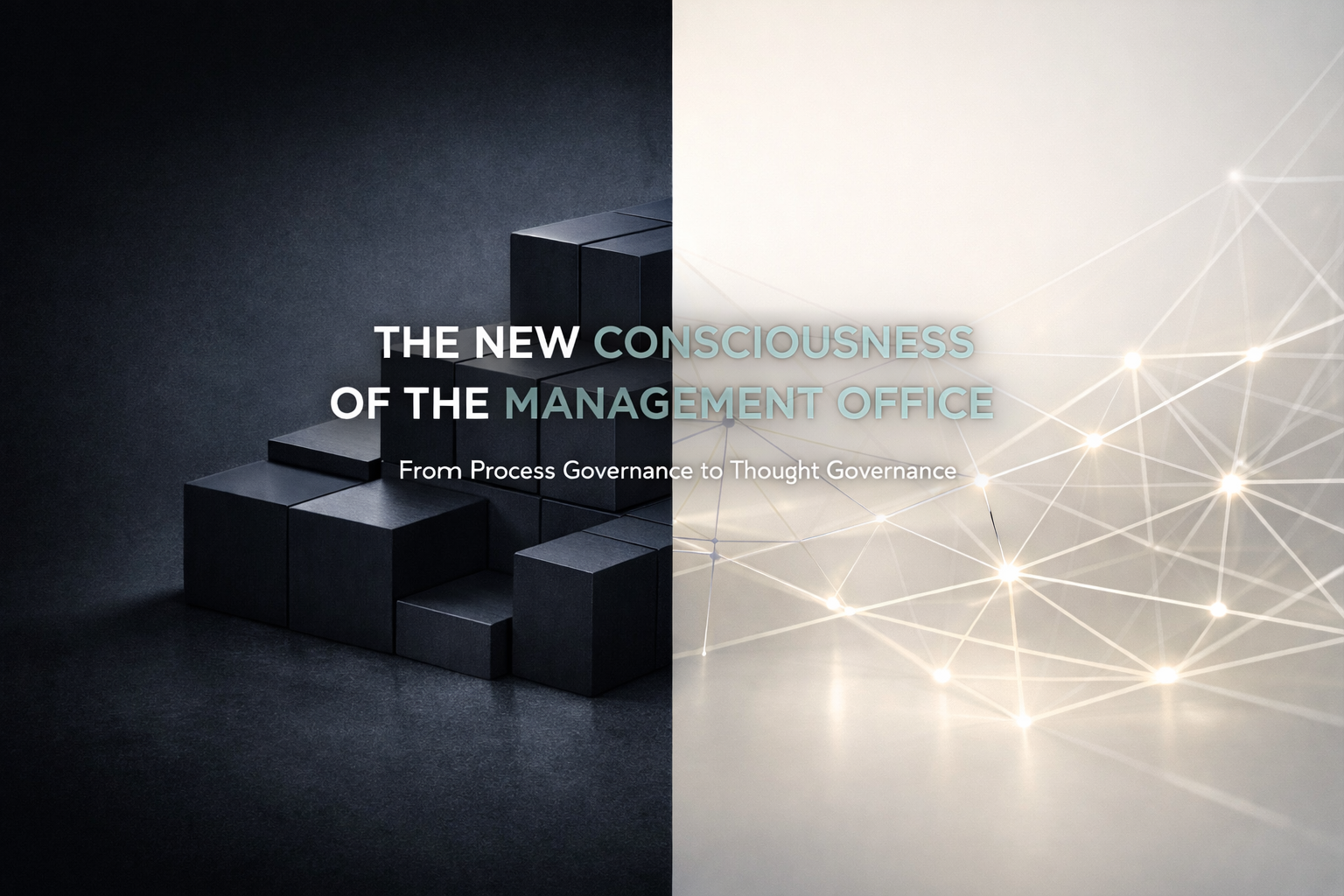 Artificial intelligence, in this context, is not the protagonist. It is a catalyst. AI amplifies patterns. It makes implicit criteria visible. It exposes inconsistencies. If an organization operates with clarity, AI enhances clarity. If it operates with noise, AI amplifies noise. The real transformation does not happen in the tool. It happens in the mindset that governs its use. How to Begin TomorrowThis shift may sound abstract. It is not. It starts with structured interventions. At your next portfolio review meeting, replace part of the status discussion with three questions: • What strategic assumption are we making here? • Which invisible criterion is guiding this decision? • What would prove this decision wrong six months from now? Before prioritizing initiatives, make the decision criteria explicit. Not only the scoring model, but the reasoning behind it. Implement a strategic decision log. Capture not only what was decided, but why, under which assumptions, and with which accepted risks. Once per quarter, conduct a strategic coherence review. Not a process audit. A reasoning audit. Ask whether the portfolio truly reflects declared strategic intent. These practices require no new technology. They require cognitive maturity. Structure Sustains ConsciousnessAwareness without structure dissolves into rhetoric. Developing this new consciousness demands method: disciplined prioritization logic, explicit governance criteria, integrated portfolio alignment, and systematic learning from decisions. Without structure, mindset remains aspiration. With structure, mindset becomes institutional capability. The most important question is not whether your Management Office is digital. It is whether it is conscious. AI does not create maturity. It reveals it. |
Project Management Diagnostic for ISO 21502 Compliance Guidelines on Project Management
| If you are looking to optimize project management in your organization, ensuring efficiency, compliance, and success, ISO 21502 might be the key you need. This international standard not only offers a structured and effective approach to project execution but also provides valuable tools to identify gaps, mitigate risks, and align projects with your company’s strategic objectives. In this post, you will discover how to use ISO 21502 to conduct detailed diagnostics and create action plans that elevate project management maturity, utilizing more than 270 practices and 400 tools adapted to your context. Dive into this reading and transform the way your organization conducts projects, ensuring exceptional results. ISO 21502 is an international standard that provides guidelines for project management. Published by the International Organization for Standardization (ISO), the standard is titled "Project, Programme, and Portfolio Management — Guidance on Project Management" and offers a structured approach to executing projects efficiently and effectively. Key Aspects of ISO 21502:2020
ISO 21502 is a valuable tool for organizations of all sizes seeking to improve the effectiveness of their project management, ensuring that projects are completed on time, within budget, and to the desired quality standards. Reasons for Conducting a Project Diagnosis Using ISO 21502:
The diagnosis utilizes a set of 60 questions distributed across four different domains. The result of the diagnosis is shown in the following figure.
At the end of the diagnosis, an action plan is presented to improve project management maturity. This plan utilizes a database with over 270 practices and 400 tools suited to the project context. Therefore, using ISO 21502 as a reference for diagnosis helps establish a solid foundation for continuous improvement in project management, promoting better results and greater success in the projects conducted by the organization. |